Week 7 HW: GENETIC circuits II
Week 7: IANNs & Fungal Materials
Part 1: Intracellular Artificial Neural Networks (IANNs)
Question 1
What advantages do IANNs have over traditional genetic circuits, whose input/output behaviors are Boolean functions?
Traditional genetic circuits typically operate on Boolean logic (AND, OR, NOT), which processes inputs as binary states (0 or 1). IANNs offer several distinct advantages:
- Analog Processing: IANNs can process continuous, fuzzy signals rather than just binary ones, allowing cells to respond to gradients of environmental stimuli (Beardall et al., 2022).
- Pattern Recognition: Unlike simple logic gates, IANNs can perform complex classification tasks, such as identifying specific combinations of biomarkers that do not follow a simple all-or-nothing rule (Moghimianavval et al., 2024).
- Robustness to Noise: Neural network architectures are inherently better at filtering molecular noise. By using weighted sums and non-linear activation functions, they can ignore minor fluctuations in input and only trigger an output when a meaningful threshold is reached (Pandi et al., 2019).
- Adaptability: While a Boolean circuit is hard-wired for one function, the weights in an IANN (represented by enzyme concentrations) can theoretically be tuned or learned over time to optimize the cell response to its environment.
Question 2
Describe a useful application for an IANN; include a detailed description of input/output behavior, as well as any limitations an IANN might face to achieve your goal.
Application: Smart Cancer Diagnostics An IANN could be engineered into a cell to detect a specific fingerprint of microRNAs (miRNAs) that characterize a tumor.
Input/Output Behavior
- Inputs ($X_1, X_2… X_n$): The concentrations of five different miRNAs associated with a specific cancer type.
- Processing: The IANN assigns weights to each miRNA. If the weighted sum of these inputs exceeds a threshold, it indicates the presence of a malignant state rather than a healthy one.
- Output ($Y$): Production of a pro-apoptotic protein to trigger cell death (the kill switch) or a fluorescent reporter for diagnostic imaging.
Limitations
- Metabolic Burden: Complex IANNs require significant cellular resources (ATP, ribosomes). This metabolic load can slow cell growth or cause the circuit to fail (Moghimianavval et al., 2024).
- Orthogonality: It is difficult to ensure that the IANN parts do not interfere with the host cell native genetic machinery.
Question 3
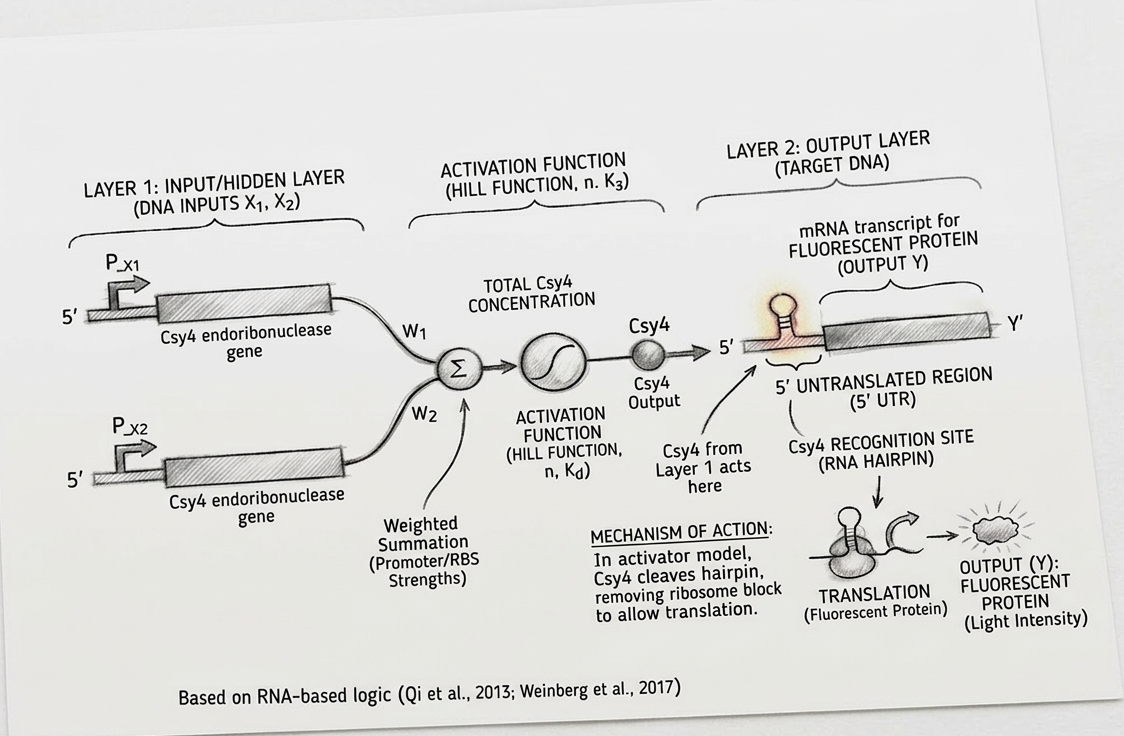
Draw a diagram for an intracellular multilayer perceptron where layer 1 outputs an endoribonuclease that regulates a fluorescent protein output in layer 2.
Part 2: Fungal Materials
Question 1
What are some examples of existing fungal materials and what are they used for? What are their advantages and disadvantages over traditional counterparts?
| Example | Use Case |
|---|---|
| Mycelium Brick/Packaging | Biodegradable alternative to Styrofoam or concrete. |
| Fungal Leather (Myco-leather) | Sustainable fashion alternative to animal leather. |
Advantages:
- Sustainability: They are carbon-negative or neutral and biodegradable.
- Low Energy: Fungi grow on agricultural waste (sawdust, straw) at room temperature, requiring far less energy than plastic or metal production.
Disadvantages:
- Water Sensitivity: Fungal materials can be hydrophilic (absorb water), leading to structural weakness in humid environments.
- Consistency: Unlike synthetic plastics, biological growth can be variable, making it harder to ensure uniform density and strength.
Question 2
What might you want to genetically engineer fungi to do and why? What are the advantages of doing synthetic biology in fungi as opposed to bacteria?
Engineering Goals: One might engineer fungi to secrete specific enzymes for breaking down complex environmental toxins (bioremediation) or to incorporate conductive nanoparticles into their mycelium to create living electronics or sensors.
Advantages over Bacteria:
- Complex Secretion: Fungi are naturally professional secretors; they can export large, complex proteins more efficiently than many bacteria (like E. coli).
- Eukaryotic Processing: As eukaryotes, fungi can perform post-translational modifications (like glycosylation) necessary for human-like proteins.
- Structural Integrity: Mycelium forms a physical, fibrous network that can span meters, allowing for the creation of large-scale physical structures which bacteria (which usually form biofilms) cannot achieve.
References
- Beardall, W. A. V., Stan, G.-B., & Dunlop, M. J. (2022). Deep learning concepts and applications for synthetic biology. GEN Biotechnology, 1(5), 360–371.
- Moghimianavval, H., et al. (2024). Engineering sequestration-based biomolecular classifiers with shared resources. BioSystems, 238, 105164.
- Pandi, A., et al. (2019). Metabolic perceptrons for neural computing in biological systems. Nature Communications, 10(1), 3854.