Week 3 HW: Lab automation
Assignment: Python Script for Opentrons Artwork
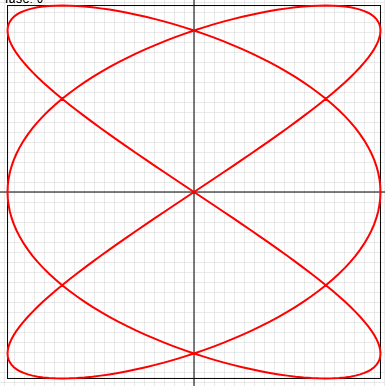
Based on the Lissajous function, the figure to be created on the agar will be the following:
Post-Lab Questions — DUE BY START OF FEB 24 LECTURE
Paper: Automation of biochemical assays using an open-sourced, inexpensive robotic liquid handler
Moukarzel et al. 2024
https://doi.org/10.1016/j.slast.2024.100205
The study aimed to evaluate the feasibility of using an open-sourced, low-cost robotic liquid handler—specifically the Opentrons OT-2—for automating biochemical assays that are traditionally run on expensive industrial liquid handling platforms. High-throughput screening is a core process in pharmaceutical development, but the cost and training requirements of conventional robotic systems can be prohibitive. The authors set out to determine whether a lightweight, Python-programmable robot could perform common assay workflows with sufficient precision and reliability to be useful in early-stage assay development and method transfer.
To test this, the team programmed the OT-2 to perform two standard biochemical assays—PicoGreen for DNA quantification and Bradford for protein concentration—using custom Python protocols that controlled pipetting and reagent transfers across microplates. These automated workflows were run repeatedly and compared to runs on a more expensive Tecan EVO liquid handler to benchmark performance. The study measured pipetting accuracy, variability, and overall assay consistency to assess how well the OT-2 handled the tasks relative to the industrial system.
The results showed that the OT-2 delivered accurate pipetting with low covariance across replicates, demonstrating performance close to that of the Tecan EVO despite its substantially lower cost and simpler hardware. Although limitations such as the absence of a crash detection system and a relatively small deck space were noted, the robot’s affordability and flexibility were highlighted as significant advantages. The authors concluded that the OT-2 represents a cost-effective, medium-throughput automation solution well suited for early-stage assay development and method transfer without requiring large capital investments.
Final Project Description – Automation of ABC Transporter Uptake and Efflux Assays in Intestinal Organoids
To develop a semi-automated workflow for ABC transporter uptake and efflux assays using intestinal spheroid and organoid cultures in a 6, 12 and 96-well plate format. The objective is to improve reproducibility, throughput, and quantitative accuracy while reducing manual variability in washing, incubation timing, and sample collection steps.

1- Automation:
A- Cell Culture:
a. Cell counter (density according to culture type). Create a script or application to count the number of cells.
b. Plate treatment. Drying and seeding. Opetrons
B- Automation of Treatments:
a. Cell culture media changes
b. Washes with buffer of cultures in pretreatments
c. Media changes and special media
C- ANT (total nucleic acids) extraction
D- Bioinformatics:
a. Census of different crop variables and of diagnostic interest. Ej.: pH, CO2, Temperature
E- Multiomics
2. Liquid Handling Automation
To design a pipetting workflow compatible with a benchtop liquid handler (e.g., Opentrons-like platform). The automated protocol will:
1- Remove culture medium
2- Wash wells with PBS (1–2 cycles, optimized).
3- Add loading medium with defined metabolite concentrations.
4- Incubate for a programmable time.
5- Remove loading medium.
6- Perform PBS washes.
7- Add HBSS efflux buffer.
8- Incubate for defined time intervals.
9- Transfer efflux supernatant to a secondary 96-well plate or tubes.
10- Add diluted Triton for cell lysis.
Timing precision will be critical, especially for efflux kinetics.
Considerations:
Automatic mapping of conditions per well (using an imported CSV file).
Differential control by column (e.g., column 1–3 control, 4–6 MK-571).
Automatic metadata recording (plate ID, date, batch).
Kinetic analysis at multiple intervals (e.g., collect at 5, 10, 15 min).
B. Example Pseudocode (Conceptual Workflow)
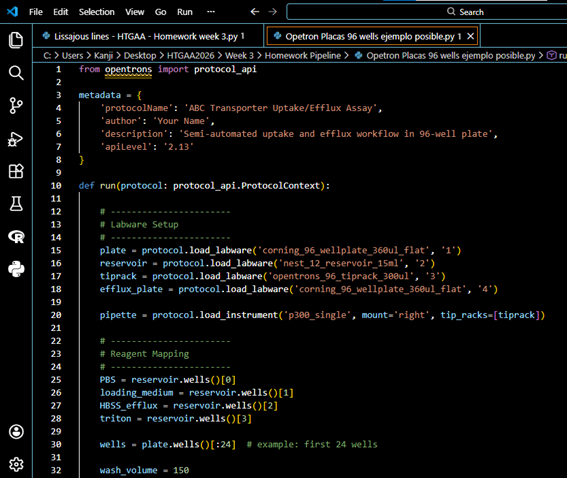
Example Opentrons Protocol – ABC Transporter Efflux Assay (96-well format)
Opetron Placas 96 wells ejemplo posible