Week 11 HW: building-genomes
Part A: The 1,536 Pixel Artwork Canvas | Collective Artwork
what about this collaborative art experiment could be made better for next year.
I didn’t have the opportunity to contribute. I think it would be useful to design a protocol with https://rcdonovan.com and then calculate the volumes per well, concentrations, or data that can be used later.
Part B: Cell-Free Protein Synthesis | Cell-Free Reagents
- Referencing the cell-free protein synthesis reaction composition (the middle box outlined in yellow on the image above, also listed below), provide a 1-2 sentence description of what each component’s role is in the cell-free reaction.
E.coli Lysate Cell extract that provides ribosomes, tRNAs, enzymes and factors necessary for transcription and translation.
- BL21 (DE3) Star Lysate (includes T7 RNA Polymerase): Optimized lysate that includes T7 RNA polymerase to efficiently transcribe genes under the T7 promoter. Salts/Buffer
- Potassium Glutamate: Maintains ionic strength and protein stability, simulating intracellular conditions.
- HEPES-KOH pH 7.5: Buffer that stabilizes the pH during the reaction.
- Magnesium Glutamate: Essential cofactor for ribosomes, RNA polymerase and enzymatic reactions.
- Potassium phosphate monobasic: Contributes to the phosphate buffer system and ionic balance.
- Potassium phosphate dibasic: It adjusts the pH together with the monobasic phosphate and stabilizes the medium.
Energy/Nucleotide System - Ribose: Carbon source for energy regeneration and nucleotide synthesis.
- glucose: Energy source for ATP production in the system.
- AMP: Monomer for RNA synthesis.
- CMP: Monomer for RNA synthesis.
- GMP: Monomer for RNA synthesis.
- UMP: Monomer for RNA synthesis.
- Guanine: Nitrogenous base that can be recycled for nucleotide synthesis.
Translation Mix (Amino Acids) - 17 Amino Acid Mix: Provides most of the amino acids necessary for protein synthesis.
- Tyrosine: Amino acid added separately for its low solubility/stability.
- Cysteine: Amino acid added separately due to its reactivity and tendency to oxidize.
Additives - Nicotinamide: Precursor of NAD⁺/NADH, key for redox reactions and energy metabolism.
Backfill - Nuclease Free Water: Adjusts the final volume without degrading RNA/DNA, maintaining nuclease-free conditions.
Describe the main differences between the 1-hour optimized PEP-NTP master mix and the 20-hour NMP-Ribose-Glucose master mix shown in the Google Slide above. (2-3 sentences)
The 1-hour optimized PEP–NTP system uses phosphoenolpyruvate as a high-energy phosphate donor and directly supplies NTPs, enabling rapid transcription–translation but with limited longevity due to fast energy depletion and byproduct accumulation. In contrast, the 20-hour NMP–ribose–glucose system relies on slower metabolic regeneration of NTPs from nucleoside monophosphates using ribose and glucose, which reduces inhibitory byproducts and sustains protein synthesis for much longer periods, albeit with slower initial rates.Bonus question: How can transcription occur if GMP is not included but Guanine is?
Transcription can still occur because guanine is salvaged into GMP inside the lysate. Enzymes such as hypoxanthine-guanine phosphoribosyltransferase (HGPRT) convert guanine + PRPP into GMP, which is then phosphorylated to GDP and GTP-the actual substrate used by RNA polymerase.
Part C: Planning the Global Experiment | Cell-Free Master Mix Design
- Given the 6 fluorescent proteins we used for our collaborative painting, identify and explain at least one biophysical or functional property of each protein that affects expression or readout in cell-free systems. (Hint: options include maturation time, acid sensitivity, folding, oxygen dependence, etc) (1-2 sentences each)
| Protein | Relevant property | Impact in cell-free systems |
|---|---|---|
| sfGFP | Highly efficient folding (superfolder variant) | Folds robustly even under suboptimal conditions, producing fast and reliable fluorescence in CFE. |
| mRFP1 | Relatively slow maturation | Delays fluorescence signal, which can underestimate expression in short experiments. |
| mKO2 | pH sensitivity (higher pKa) | Fluorescence decreases under acidic conditions, making signal dependent on buffer composition. |
| mTurquoise2 | High quantum yield (very bright) | Generates strong signal even at low expression levels, improving detectability. |
| mScarlet-I | Fast maturation and high brightness | Enables strong fluorescence in short timeframes, ideal for rapid CFE assays. |
| Electra2 | Oxygen-dependent chromophore maturation | Fluorescence can be limited in low-oxygen conditions, affecting readout in closed systems. |
Create a hypothesis for how adjusting one or more reagents in the cell-free mastermix could improve a specific biophysical or functional property you identified above, in order to maximize fluorescence over a 36-hour incubation. Clearly state the protein, the reagent(s), and the expected effect. Hypothesis: For mScarlet-I, increasing the buffering capacity (e.g., higher HEPES-KOH) and supplementing the energy system (e.g., optimizing glucose/ribose levels) will maintain stable pH and ATP availability over 36 hours, thereby supporting sustained protein synthesis and efficient chromophore maturation, resulting in higher cumulative fluorescence.
Expected effect: Improved long-term stability of the reaction environment will prevent fluorescence loss due to acidification and energy depletion, maximizing total signal output during extended incubation.The second phase of this lab will be to define the precise reagent concentrations for your cell-free experiment. You will be assigned artwork wells with specific fluorescent proteins and receive an email with instructions this week (by April 24). You can begin composing master mix compositions.
Hypothesis (tailored to mix):
- For mKO2, increasing HEPES-KOH buffer concentration (from 45 mM to ~60–70 mM) and slightly adjusting potassium phosphate balance will stabilize pH over a 36-hour incubation, reducing fluorescence loss due to acidification.
- Additionally, increasing glucose concentration (from 1.25 g/L to ~2–3 g/L) will enhance long-term ATP regeneration, sustaining protein synthesis and chromophore maturation.
Expected effect: Improved pH stability will preserve mKO2 fluorescence (which is pH-sensitive), while enhanced energy availability will maintain translation over time, resulting in higher cumulative fluorescence after 36 hours.
| Reagent | Preset | Current | Delta | Delta % |
|---|---|---|---|---|
| Cell Lysate | 6.000 uL | 6.000 uL | - | - |
| DNA Template | 2.000 uL | 2.000 uL | - | - |
| Nuclease-Free Water | 2.000 uL | 1.525 uL | -0.475 uL | -23.8% |
| Potassium Glutamate | 312.563 mM | 312.563 mM | - | - |
| Magnesium Glutamate | 6.975 mM | 6.975 mM | - | - |
| HEPES-KOH pH 7.5 | 45.000 mM | 60.000 mM | +15.000 mM | 33.3% |
| 17 Amino Acid Mix | 4.063 mM | 4.063 mM | - | - |
| Tyrosine | 4.063 mM | 4.063 mM | - | - |
| Cysteine | 4.000 mM | 4.000 mM | - | - |
| Ribose | 11.625 g/L | 11.625 g/L | - | - |
| AMP | 0.625 mM | 0.625 mM | - | - |
| CMP | 0.375 mM | 0.375 mM | - | - |
| GMP | - | - | - | - |
| UMP | 0.375 mM | 0.375 mM | - | - |
| Guanine | 0.156 mM | 0.156 mM | - | - |
| Glucose | 1.250 g/L | 3.000 g/L | +1.750 g/L | 140.0% |
| Potassium phosphate dibasic | 5.625 mM | 5.625 mM | - | - |
| Potassium phosphate monobasic | 5.625 mM | 5.625 mM | - | - |
| Nicotinamide | 3.125 mM | 3.125 mM | - | - |
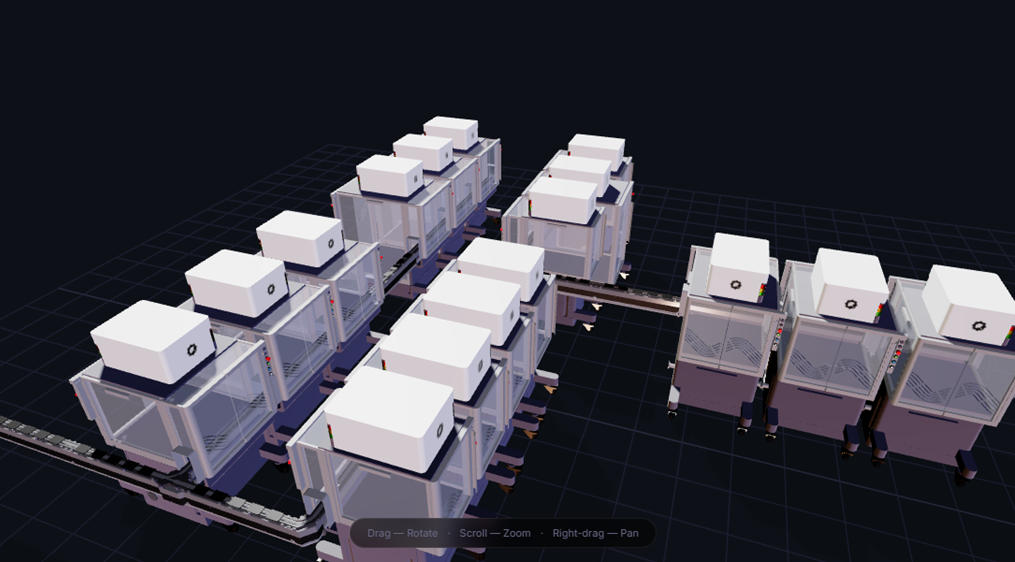
Part D: Build-A-Cloud-Lab | (optional) Bonus Assignment