Week 1 HW: Principles and Practices
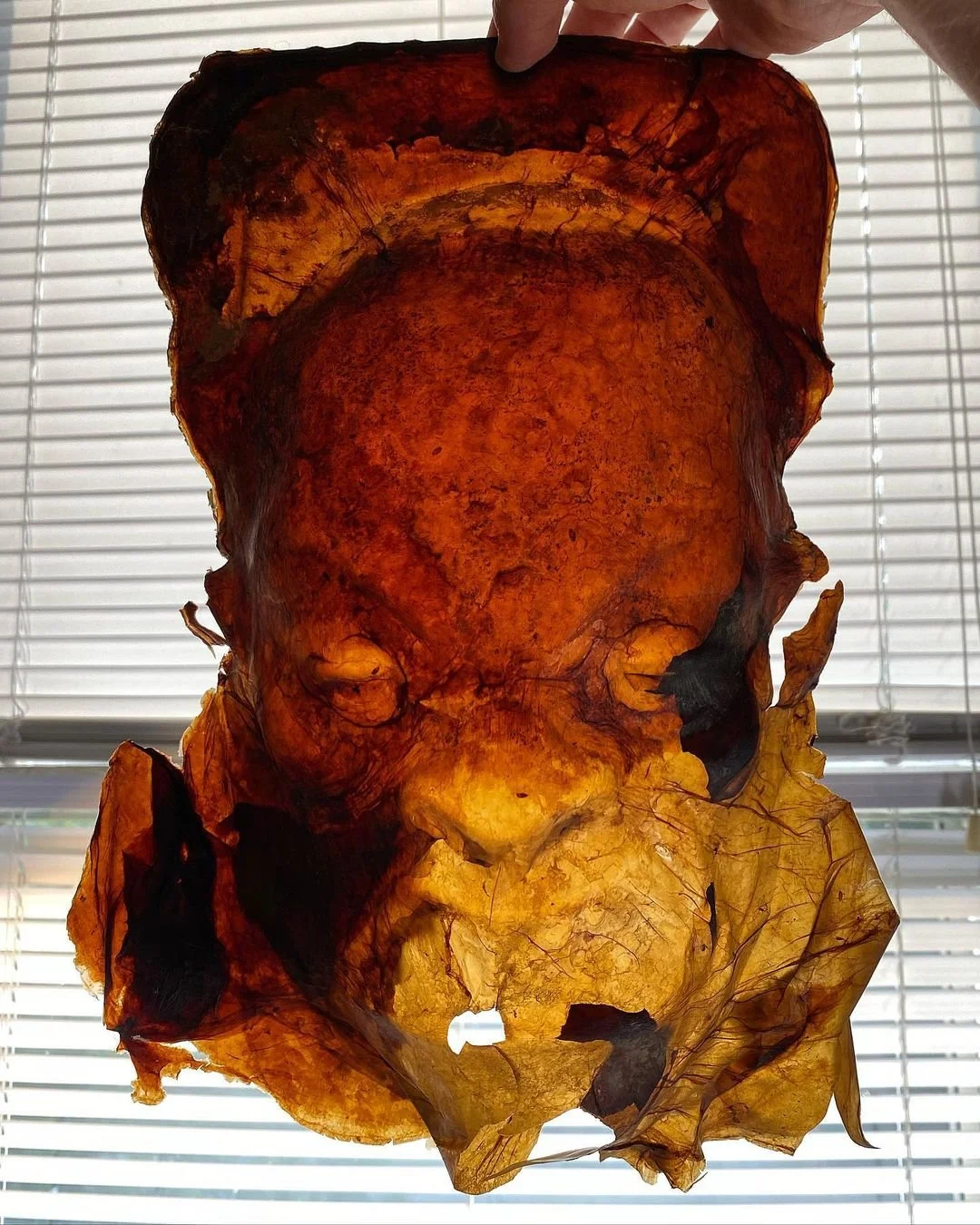
SCOBY DNA Steganography
A biological engineering application or tool that I want to develop is a system for biomaterials for artist books that contains the book contents in its DNA. Above is an example of a a previous project of mine, where I was making masks out of SCOBYs, Symbiotic Cultures Of Bacteria and Yeast. A next level project might be to use SCOBY to create pages of artist books, where the the content of the pages (illustrations, text, relief sculptures, etc.) is also written into the DNA of the yeasts and/or bacteria that makes up the SCOBY. The reasons I am interested in this, and believe others will be interested as well, is primarily twofold: 1) I am interested in this as an unusual form of artwork that “grows on you” on multiple levels (such as genetic level, personal level, cultural(!) level, etc.) and 2) I am interested in this as a form of storytelling and story distrubution that can replicate itself, where the DNA creates new copies as the yeast reproduces, then thise new copies are used to create new copies of books.
The chose the mask example above because these might be sort of like Lovecraftian grimoires, sell books with monstrous faces on them, as I am thinking of suffucuenty advanced technologies being indistinguishable from magic, computer coded and genetic codes as forms of magic, etc. This is also based on “steganography,” the practice of embedding hidden coded information within another object. The term “steganography” dates back to the “Steganographia” from 1499, whcih is a book of cryptography disguised as a book of magic.
I could also possibly drink the brewed kombucha to let the DNA into my own body’s systems, and possibly sell the drink to others during art events, where people coul ddrink the kombucha that makes the SCOBYs that make the pages of the books …
Governance goals and actions
My main governance/policy goals are to make sure that this biomaterial system is safe for artists like myself when they are creating the materials, and also to make sure they are safe for viewers and collectors of the artist books. I will name these goals as the standard goals provided in class, 1) Enhance Biosecurity, 2) Foster Lab Safety, 3) Protect the environment, and 4) Other considerations.
My three different potential governance “actions” are 1) Develop guide for safe SCOBY DNA Steganography creation for artists, 2) Provide screening and training of potential collecting institutions so they can safely handle and preserve the books, and 3) Register any kombucha drink manufacturing facility with the FDA, and adhere to FDA regulations related to creating and selling drinks.
Scoring from 1-3 with 1 as the best, 3 as the worst:
| Does the option: | Develop guide for safe SCOBY DNA Steganography creation for artists | Provide screening and training of potential collecting institutions so they can safely handle and preserve the books | Register any kombucha drink manufacturing facility with FDA, adhere to FDA regulations |
|---|---|---|---|
| Enhance Biosecurity | |||
| • By preventing incidents | 1 | 2 | 1 |
| • By helping respond | 2 | 2 | 1 |
| Foster Lab Safety | |||
| • By preventing incident | 1 | 3 | 1 |
| • By helping respond | 2 | 3 | 1 |
| Protect the environment | |||
| • By preventing incidents | 1 | 1 | 1 |
| • By helping respond | 2 | 2 | 1 |
| Other considerations | |||
| • Minimizing costs and burdens to stakeholders | 3 | 1 | 2 |
| • Feasibility? | 1 | 3 | 2 |
| • Not impede research | 1 | 2 | 2 |
| • Promote constructive applications | 1 | 3 | 2 |
Based upon this scoring, I think the governance option I would prioritize is “Develop guide for safe SCOBY DNA Steganography creation for artists.” This is not only an effective option for creating lab safety for artists, and protecting the environment and others in it, it is also a governance option that I know would be highly feasible as I would be th eprimary artist to use it. If this project scales up and includes othwrs drinking the kombucha used to make the SCOBYS, then FDA registration and following FDA regualtiosn woudl be required and highly beneficial.
Refelctning on this project proposal and new ethical concerns that I am thinking about, I would say that the combination of this as a lab safety project, an art preservation project, and a potential food safety project. I would say that those are areas that I have previously thought of individually, and am now thinking of them all together on the same project for the first time. I am also now thinking about whether this also introduces other governance/policy, perhaps related to shipping, storage, etc.
Week 2 Lecture Prep
Homework Questions from Professor Jacobson https://2026a.htgaa.org/2026a/course-pages/weeks/week-02/slides-lecture-2-jacobson.pdf :
- Nature’s machinery for copying DNA is called polymerase. What is the error rate of polymerase? How does this compare to the length of the human genome? How does biology deal with that discrepancy?
The error rate of polymerase is 1:106. The human genome length is roughly 3 x 10⁹ base pairs. The error rate is lower because of MutS Repair System in Error Correcting Gene Synthesis (slides 14 and 15).
- How many different ways are there to code (DNA nucleotide code) for an average human protein? In practice what are some of the reasons that all of these different codes don’t work to code for the protein of interest?
Google AI Overview says: “An average human protein (~500 amino acids) can be encoded by a practically astronomical number of different DNA sequences, potentially exceeding (10^{100}) combinations, due to codon redundancy where 61 triplets encode 20 amino acids. However, only a few of these codes are functionally efficient or viable in vivo due to factors like codon usage bias, mRNA stability, and proper folding.”
Homework Questions from Dr. LeProust https://2026a.htgaa.org/2026a/course-pages/weeks/week-02/slides-lecture-2-leproust.pdf :
- What’s the most commonly used method for oligo synthesis currently?
Solid phase synthesis
- Why is it difficult to make oligos longer than 200nt via direct synthesis?
Google AI Overview says: “Making oligonucleotides (oligos) longer than 200 nucleotides (nt) via direct chemical synthesis is difficult primarily because of exponentially decreasing yields caused by imperfect coupling efficiency and the accumulation of errors. "
- Why can’t you make a 2000bp gene via direct oligo synthesis?
Google AI Overview says: “A 2000bp gene cannot be produced via direct (single-pass) chemical oligonucleotide synthesis because the efficiency of the coupling reaction drops significantly, leading to low yields of full-length product and high rates of sequence errors (insertions/deletions). "
Homework Question from George Church https://2026a.htgaa.org/2026a/course-pages/weeks/week-02/slides-lecture-2-church.pdf
- Using Google & Prof. Church’s slide #4 What are the 10 essential amino acids in all animals and how does this affect your view of the “Lysine Contingency”?
Google AI Overview says: “The 10 essential amino acids that all animals must obtain from their diet (as they cannot synthesize them in sufficient quantities) are phenylalanine, valine, threonine, tryptophan, isoleucine, methionine, histidine, arginine, leucine, and lysine. This reality makes the “Lysine Contingency” from Jurassic Park scientifically flawed, as all vertebrates, including engineered dinosaurs, would already be unable to synthesize lysine, rendering the engineered deficiency redundant.”