Week 7 HW: Genetic Circuits Part II: Neuromorphic Circuits
Assignment Part 1: Intracellular Artificial Neural Networks (IANNs)
What advantages do IANNs have over traditional genetic circuits, whose input/output behaviors are Boolean functions?
Traditional genetic circuits are binary digital on/off. IANNs can be more analog, with greater ranges, which is shown in the blue gradient diagrams in the neuromorphic wizard.
Describe a useful application for an IANN; include a detailed description of input/output behavior, as well as any limitations an IANN might face to achieve your goal.
My memory of examples described in class involved cancer fighting Intracellular Artificial Neural Networks, which could take multiple inputs of different biological signs of cancer, give them different weights, and then could output either just a biosignal that suspected cancer has been detected, or maybe as outpur release a biological chemotherapy. Current limitations include that these are currently fairly difficult to design and test, which is why systes like the neuromorphic wizard are being developed to model them in simulation and predict their behavior.
Below is a diagram depicting an intracellular single-layer perceptron where the X1 input is DNA encoding for the Csy4 endoribonuclease and the X2 input is DNA encoding for a fluorescent protein output whose mRNA is regulated by Csy4. Tx: transcription; Tl: translation. Draw a diagram for an intracellular multilayer perceptron where layer 1 outputs an endoribonuclease that regulates a fluorescent protein output in layer 2.
Assignment Part 2: Fungal Materials
What are some examples of existing fungal materials and what are they used for? What are their advantages and disadvantages over traditional counterparts?
One example of fungal materials is objects made from mycelium, which can be grown into pretty much any shape you can make a form for, much like tradiitional casting. We saw several examples of mycelium projects including acoustic tile, packing material, insulation, and bricks. Yeast is also a fungus, so materials made from SCOBY (Symbiotic Culture Of Bacteria and Yeast) are also in part fungal materials. We saw images of several SCOBY fashion projects in recitation.
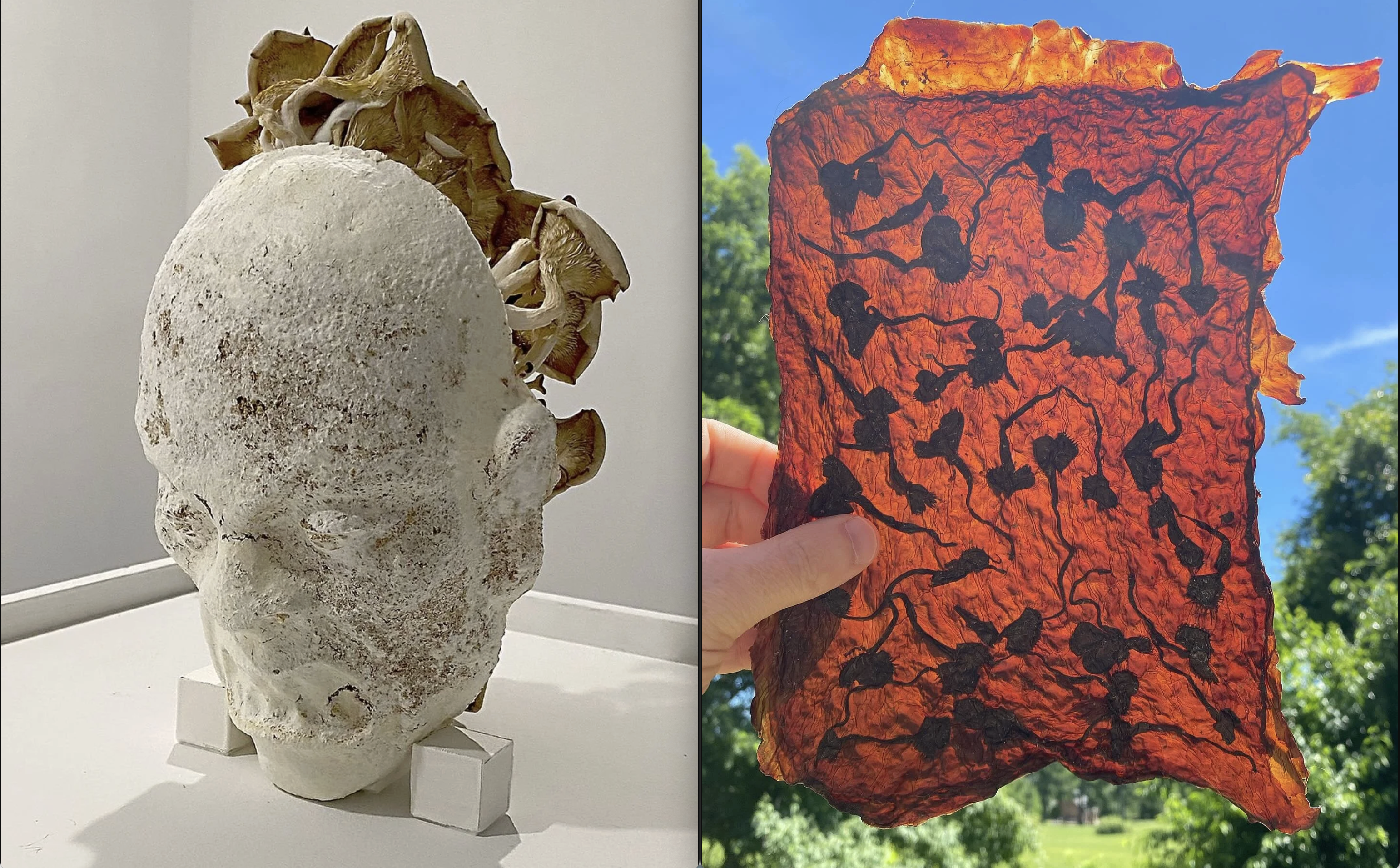
I have used fungal mycelium and SCOBYs in previous projects. Below is an image showing, on the left, a sculptural mask made of mycelium and mushrooms, and on the right is a sheet of SCOBY leather with embedded venus flytrap leaves.
What might you want to genetically engineer fungi to do and why? What are the advantages of doing synthetic biology in fungi as opposed to bacteria?
For biomaterials, genetically engineered fungi could maybe grow mycelium faster, or maybe spend less energy on fruiting and spore production and more energy on creating mycelium. A natural or agricultural fungus that has been bred and selected for creating large fruit and for reproducing well might actually be less useful for biomaterials than a fungus that has been genetically engineered for faster and stronger mycelium.
Assignment Part 3: First DNA Twist Order
Thinking about this …