Week 11 HW: Bioproduction & Cloud Labs
Part A: The 1,536 Pixel Artwork Canvas | Collective Artwork
I contributed a few early pixels to the HTGAA global artwork experiment at https://rcdonovan.com/1536
I will say that they were largely decorative, incremental changes because I was working when the wait time between each person’s changes was one minute, so I wasn’t able to make any really drastic changes. I was mostly just trying to add some additional variety and visual interest to what other collaborators had already drawn.
The final artwork has changed so much since my early contributions, which is of course fine and cool, but maybe a future experimental version of this project could make it so there was always at least one or more pixels from each participant.
Part B: Cell-Free Protein Synthesis | Cell-Free Reagents
Looking at each omponent’s role is in the cell-free reaction:
E. coli Lysate
BL21 (DE3) Star Lysate (includes T7 RNA Polymerase): has a T7 RNA polymerase gene, which means that it can express proteins with the T7 promoter upstream in its genes
Salts/Buffer
- Potassium Glutamate: helps recreate the cell’s native ionic environment by supplying potassium ions that stabilize ribosomes and enhance efficient protein synthesis
- HEPES-KOH pH 7.5: maintains a stable pH, ensuring optimal activity of enzymes involved in transcription and translation in the cell-free reaction. Magnesium Glutamate: Supplies Mg²⁺ ions, which are essential cofactors for ribosomes, RNA polymerase, and other enzymes, directly enabling transcription and translation. Potassium phosphate monobasic: Acts as part of a phosphate buffer system and contributes to maintaining pH and ionic strength in the reaction. Potassium phosphate dibasic: Pairs with the monobasic form to establish the buffering equilibrium that stabilizes the reaction pH.
Energy / Nucleotide System
- Ribose: Serves as a precursor for nucleotide regeneration pathways, supporting sustained synthesis of ATP and other nucleotides in the reaction.
- Glucose: Acts as an energy source that can be metabolized (in extract-based systems) to regenerate ATP and maintain reaction longevity.
- AMP: Functions as a nucleotide precursor that can be phosphorylated to regenerate ATP, helping sustain the reaction’s energy supply.
- CMP: Serves as a precursor for CTP synthesis, supporting continued RNA transcription.
- GMP: Acts as a precursor for GTP, which is required for both RNA synthesis and translation processes.
- UMP: Serves as a precursor for UTP, enabling ongoing RNA transcription.
- Guanine: Functions as a nucleobase precursor that can be converted into GMP and subsequently GTP for transcription and translation.
Translation Mix (Amino Acids)
- 17 Amino Acid Mix: Provides the bulk of the amino acids required for protein synthesis during translation, excluding those supplied separately for stability or solubility reasons.
- Tyrosine: Supplies tyrosine as a protein building block, often added separately due to its limited solubility in concentrated amino acid mixes.
- Cysteine: Provides cysteine for protein synthesis and proper folding, typically added separately because of its reactivity and instability in solution.
Additives
- Nicotinamide: Acts as a precursor to NAD⁺/NADH, supporting metabolic and redox reactions that help sustain energy regeneration in extract-based systems.
Backfill
- Nuclease Free Water: Serves as a solvent to dissolve components and maintain reaction volume while preventing degradation of nucleic acids.
Part C: Planning the Global Experiment | Cell-Free Master Mix Design
- For the 6 fluorescent proteins we used for our collaborative painting, here are biophysical or functional property of each protein that affects expression or readout in cell-free systems. (Such as maturation time, acid sensitivity, folding, oxygen dependence, etc)
- sfGFP: Superfolder GFP is engineered for robust folding, allowing efficient fluorescence even under suboptimal conditions in cell-free systems.
- mRFP1: This red fluorescent protein has relatively slow maturation, which can delay the appearance of fluorescence after protein synthesis.
- mKO2: mKO2 has fast maturation but is somewhat sensitive to acidic conditions, which can reduce fluorescence intensity if pH is not well controlled.
- mTurquoise2: This cyan fluorescent protein has high quantum yield and brightness but requires proper folding to achieve full fluorescence efficiency.
- mScarlet-I: mScarlet-I combines high brightness with rapid maturation, improving signal output in cell-free systems compared to older red fluorescent proteins.
- Electra2: Electra2 is a flavin-binding fluorescent protein that depends on oxygen-independent chromophore formation but requires flavin cofactors, which can influence fluorescence based on cofactor availability.
- My hypothesis for how adjusting one or more reagents in the cell-free mastermix could improve a specific biophysical or functional property you identified above, in order to maximize fluorescence over a 36-hour incubation is:
For mScarlet-I, I think increasing potassium glutamate and magnesium glutamate will enhance fluorescence by improving folding and translation. This might allow for better/faster maturation of the fluorescent protein. And maybe more Ribose or Glucose just for more energy.
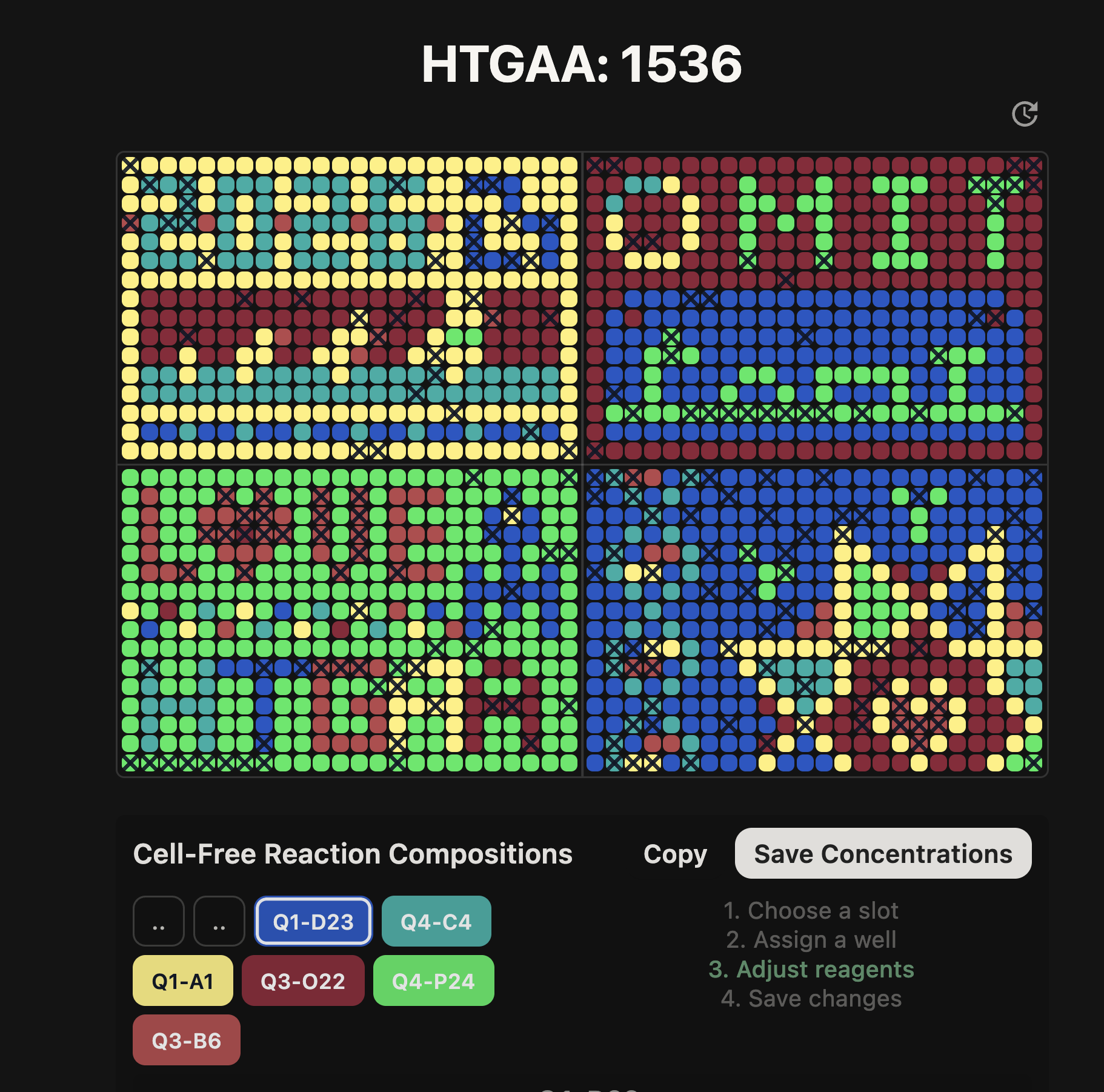
- On the 1536 artwork at https://rcdonovan.com/1536 I was able to “customize the cell-free reagent composition of wells of your choosing … up to 8 wells”
OK, I wanted to do one of each color. And only change two reagents for each one, so as not to be adjusting too many variables at once. So this si what I did:
- sfGFP: I raised Magnesium Glutamate for same reasons above. And, I raised Glucose for more energy. This was in Q4-P24, lower right, last pixel of the whole thimg!
- mRFP1: I raised Magnesium Glutamate for same reasons above. And, I raised Glucose for more energy. This was in Q3-O22, end of the A in HTGAA
- mKO2: I raised Magnesium Glutamate for same reasons above. And, I raised Glucose for more energy. This was in Q1-A1, upper left, first pixel of the whole thing!
- mTurquoise2: I raised Magnesium Glutamate for same reasons above. And, I raised Glucose for more energy. This was in Q4-C4, the first crossing of the DNA double helix.
- mScarlet-I: I raised Magnesium Glutamate for reasons above. And, I raised Glucose for more energy. This was in Q3-B6, in the heart in “LOVE”
- Electra2: I raised Magnesium Glutamate for reasons above. Let’s mix things up: I raised Nicotinamide to hopefully help with flavin metabolism. This was in Q1-D23, the second peak of the M in the Meida Lab logo.
Part D: Build-A-Cloud-Lab | (optional) Bonus Assignment
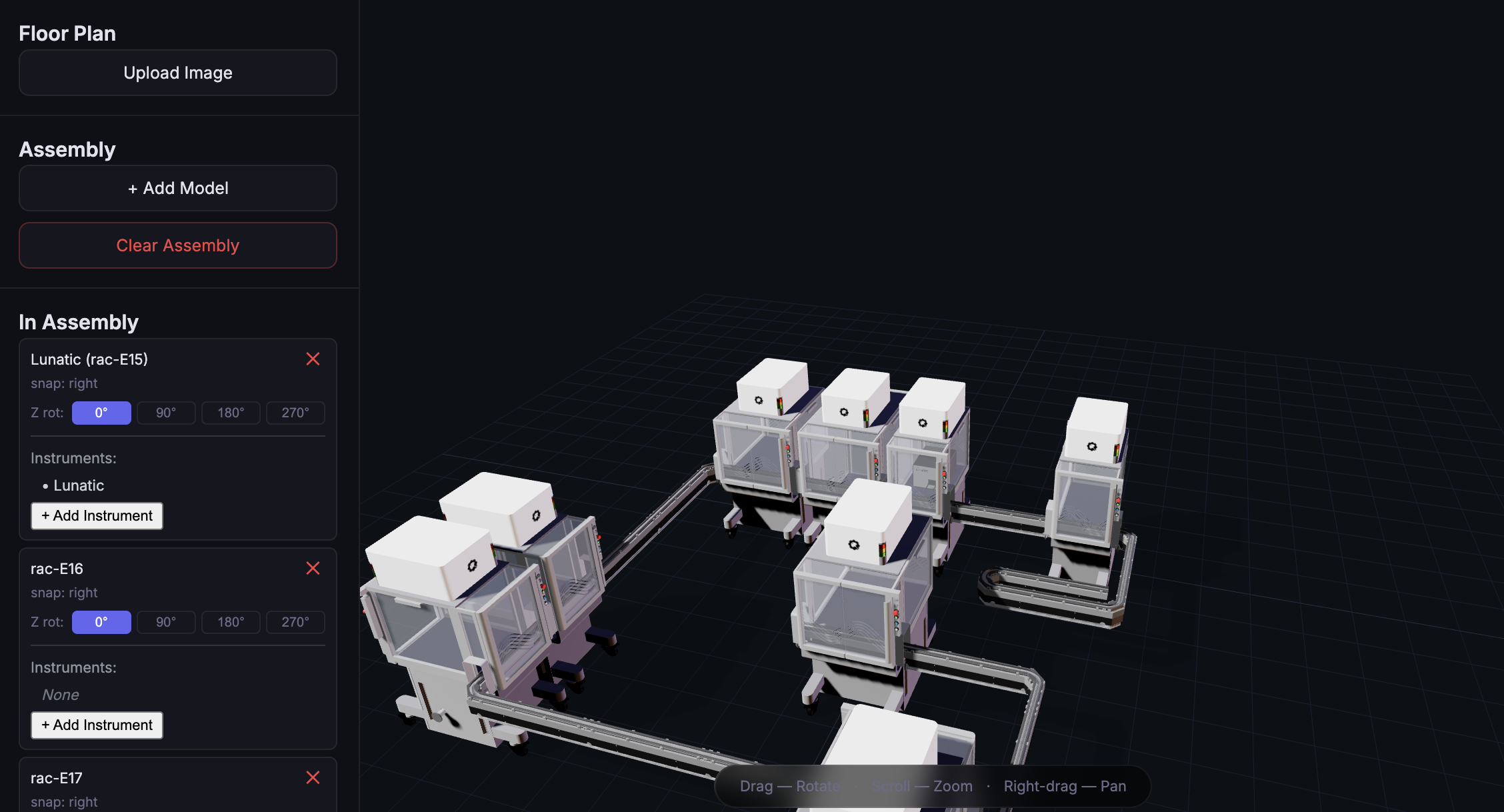
I used the simulation tool at https://racs.rcdonovan.com/ to create the cloud lab pictured below out of the Ginkgo Reconfigurable Automation Carts. It is pretty rough! Just testing things out.