Individual Final Project: SALEM II: Synthetic Animated Luminescent Engineered Microbes
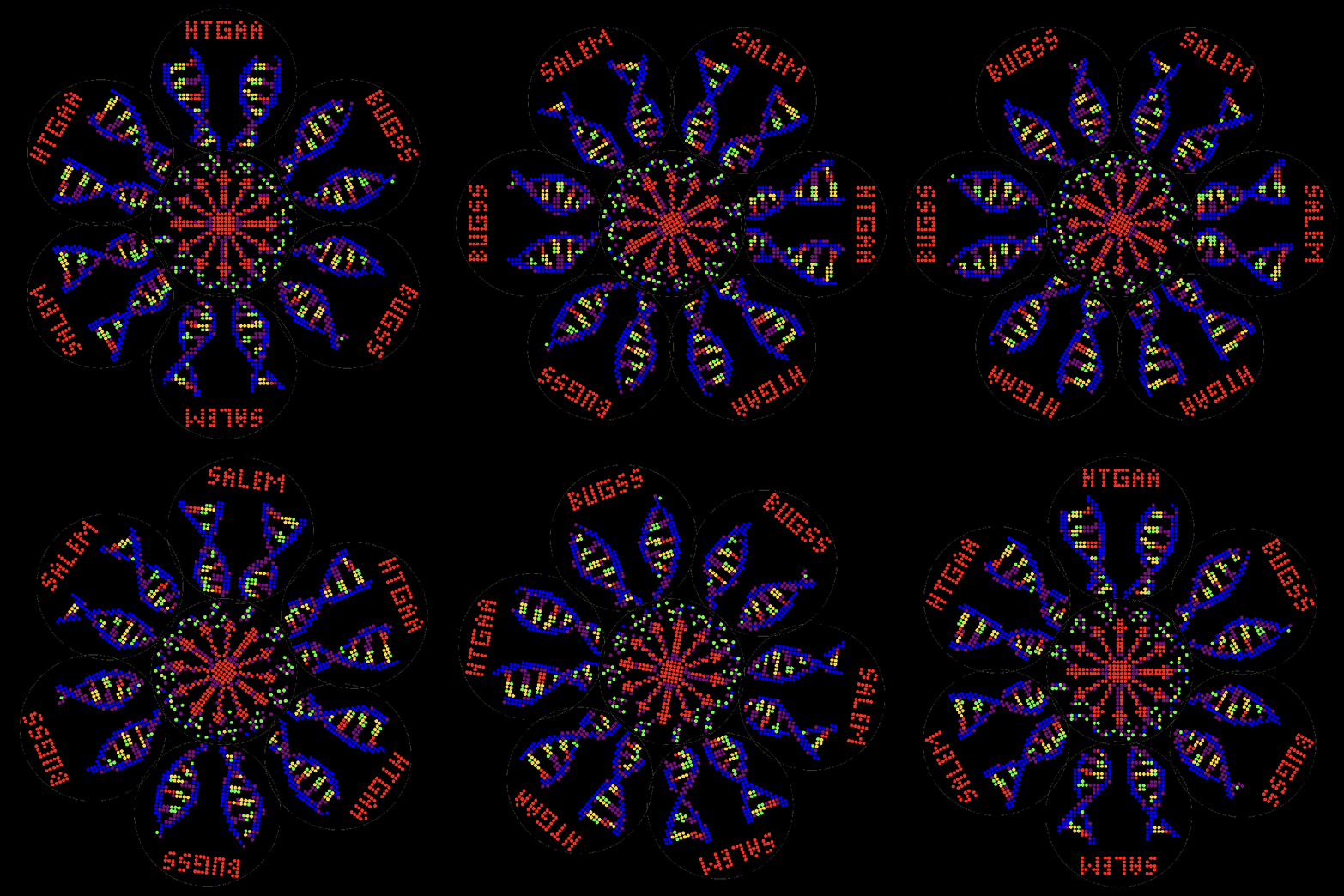
Eric Millikin, May 2026
SECTION 1: ABSTRACT:
Large-format Animated Opentrons Art
The idea here is to create large-format and animated Opentrons art mosaics, by developing my lab automation and fluorescent bacteria skills to the point where I can create larger format artwork from multiple petri dishes. Shown above is my design featuring rotating DNA strands in seven petri dishes of Opentrons agar art. My art/design here emphasizes the colors that show up best in fluorescent bacteria art; for example, green, red, and blue. My main synthetic biology challenges are 1) Can I create new custom colors biodesigned by me, based on existing mScarlet? and 2) Can I design fluorescent proteins with hidden DNA messages from my ancestors?
I am descended from women who were executed during the Salem Witch Trials, so I carry part of their DNA with me. I am calling this project “SALEM: Synthetic Animated Luminescent Engineered Microbes.” (My original working title was “Something Something Sacred Sigil System.”)
I aim to engineer fluorescent protein variant(s) based on my ancestor Mary Eastey who was executed at the Salem Witch Trials. These will be mutants based on mScarlet, will include a quote from Mary Eastey encoded into their DNA, may be spectrally shifted toward or into invisible-to-humans infrared, and may be fused with NanoLuciferase for bioluminescence. (This represents several aims of this project.)
The quote I will embed into the DNA is from Mary Eastey’s final petition to the court, “I petition to your honours not for my own life for I know I must die and my appointed time is set … if it be possible no more Innocent blood may be shed.” From the University of Virginia’s Salem Witch Trials Documentary Archive https://salem.lib.virginia.edu/n45.html#n45.22
I will create custom designs for fluorescent bacteria colors and Opentrons python code based on the “Fluorescent Pixel Art” tools created by HTGAA TA Ronan Donavan. See https://opentrons-art.rcdonovan.com/ I am building upon these by creating a series of UNIX shell scripts that I run in Mac Terminal, that largely duplicate Ronan Donavan’s system of converting pixel color positions into Opentrons coordinates. My scripts add a few other features helpful to my project, such as the ability to process all seven images at once.
As shown below, the design of the petri dish setup – six circles around a single center circle – is based on what is described as the “Egg of Life” of sacred geometry. The original chart on the left below is from https://pardesco.com/blogs/news/sacred-geometry-art-symbols-meanings
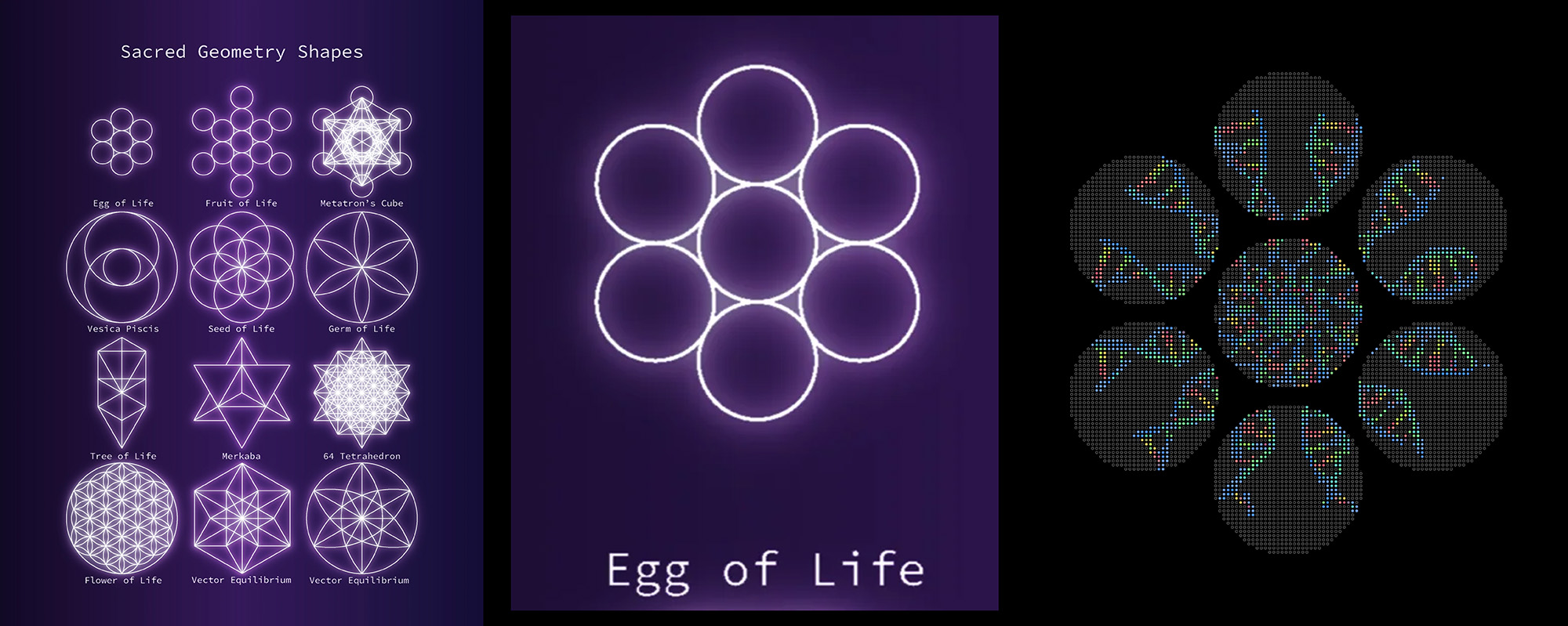
The animation system where a still image becomes animated when it is rotated is based on the “phenakistoscope,” an early pre-film motion picture device created in the 1830s. The phenakistoscope is sort of like a flip book, but instead of flipping through pages to create the illusion of motion, you spin a disc with images. You can see more info at https://publicdomainreview.org/collection/phenakistoscopes-1833/
And below is a historical drawing from the History of Science Museum in the UK https://www.mhs.ox.ac.uk/exhibits/fancy-names-and-fun-toys/phenakistiscopes/index.html, showing how a phenakistoscope was viewed, through slots on the disc with the image reflected in a mirror.
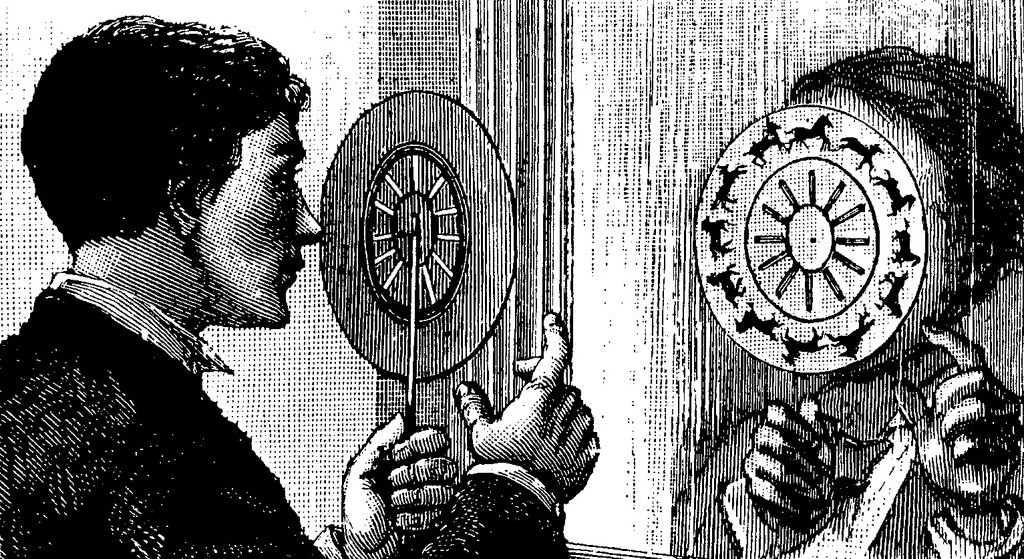
The phenakistoscope is a precursor to the more well-known “zoetrope,” where the motion picture frames are arranged on the inside of a cylinder rather than on a disc. “Zoetrope” is based on the Greek words for “wheel of life.”
So, the basic idea here is to create a sacred geometry “egg of life,” that animates like a zoetropic “wheel of life,” based on DNA, the “blueprint of life,” containing convicted “witch” Mary Eastey’s quote “I petition to your honours not for my own life …”
Significance … Broad Objective … Hypothesis … Specific Aims … Methods …
SECTION 2: PROJECT AIMS:
Aim 1: Experimental Aim:
Engineer and test fluorescent protein variant(s) based on my ancestor Mary Eastey who was executed at the Salem Witch trials. My initial “aim one” is to create DNA containing a quote from Mary Eastey inside a genetic construct, which will also contain a red fluorescent protein based on mScarlet.
I will design these synthetic biological experimental colors in Asimov Kernel and Benchling, and I will order them from Twist Bioscience. I will initially test the color(s) by hand by streaking on an agar plate with an inoculating loop in the BUGSS Lab. I can also measure the fluorescent proteins with fluorometry and ImageJ.
Aim 2: Development Aim:
Possible further development aims include:
- Create the ultimate design itself
- Create the Opentrons liquid handling robot code
- Design and create devices for live rotating display, with correct speed and lighting, rather than digital rotation
- Design possible systems for time lapse animation, during the printing process and/or growing process.
- Maybe phosphorescent bacteria that eat other phosphorescent bacteria over time.
- Longer form animation, with multiple sets of petri dishes that form longer video(s).
- New mutant colors spectrally shifted toward or into invisible-to-humans infrared
- New mutant colors fused with NanoLuciferase for bioluminescence.
Thanks to HTGAA BUGSS crew Amanda, Joel, Juhi, Mantis, Violeta, and Marian with whom I discussed these aims (some of these are their ideas!)
Aim 3: Visionary Aim:
Ultimately this project is headed towards live performances featuring Opentrons art. Below should be an embedded video clip from a previous performance with live-coded video and sound art, with my friend, mentor and collaborator Wes Taylor, professor at Wayne State University, on the right and myself on the left. A next-level aim for this project would be for somewhat similar live-coded phenakistoscope performances, featuring large-format animated video projection Opentrons art.
SECTION 3: BACKGROUND:
Briefly summarize two peer-reviewed research citations relevant to your research.
- Gadella, T.W.J., van Weeren, L., Stouthamer, J. et al. “mScarlet3: a brilliant and fast-maturing red fluorescent protein.” Nature Methods 20, 541–545 (2023). https://doi.org/10.1038/s41592-023-01809-y
From the abstract: “We report the evolution of mScarlet3, a cysteine-free monomeric red fluorescent protein with fast and complete maturation, as well as record brightness, quantum yield (75%) and fluorescence lifetime (4.0 ns).” This paper describes the process of creating multiple mutations of mScarlet to maximize growth rate as well as fluorescence. mScarlet-I3-NCwt, the protein I am using in this project, is one of the mutants they created.
- Ryan, John Charles. “Biological Processes as Writerly?: An Ecological Critique of DNA-based Poetry.” Environmental Humanities 9 (1), 129–148 (2017). https://doi.org/10.1215/22011919-3829163
From the abstract: “This article examines the DNA-based biopoetry of Christian Bök in relation to its antecedents in the art-science experiments of Joe Davis, Pak Chung Wong, and Eduardo Kac. In particular, I develop an ecocritical analysis of the process of encipherment at the center of their works.” This paper is of interest to me because it is looking at other artists use of text encoded within DNA, and it is looking at it from a humanities perspective.
Explain how your project is novel or innovative.
- My project uses Opentrons liquid handling robots to create agar art in new and unusual ways. I have successfully explored larger format (multiple petri dish) designs. I have also successfully explored animated agar art using early pre-film motion picture phenakistoscope techniques. Also, my DNA design with text encoded adds another innovative layer to agar art.
Explain why your project matters and what impact it could have. (Minimum 5 sentences.)
- One of the things that matters most about this project is that it provides a system for unique visual art to help lead conversations about synthetic biology concepts among audiences that do not typically work with it or discuss it. This could provide an accessible way to expand public engagement with synthetic biology. My goal is to ultimately create a series of animations that can be combined into a short film. Screening this film at film festivals and art galleries should provide new venues for experiencing and considering synthetic biology. The project also demonstrates new ways of using laboratory equipment and laboratory automation for visual, literary, and ultimately performance, art.
Describe the ethical implications associated with your project and identify relevant ethical principles (e.g., non-maleficence, beneficence, justice, or responsibility).
While the strains of E. coli used in agar art are nonpathogenic, I still have a responsibility to follow biosafety standards, regulations, containment, sterilization, etc. Also, since this is intended as part of an art series meant for viewing by the general public, communication about safety issues is also important. This also ties into beneficence, as exhibiting this work can contribute positively to society by helping people engage more thoughtfully with synthetic biology.
SECTION 4: EXPERIMENTAL DESIGN, TECHNIQUES, TOOLS, AND TECHNOLOGY
Create a detailed experimental plan for your final project. Include a timeline for each part of your experimental plan (i.e., how long you would expect each step in your final project to take).
- I need to convert the quote from Mary Eastey into a DNA sequence.
One way would be to first convert the sentence into letters available as IUPAC amino acid codes – https://www.bioinformatics.org/sms/iupac.html – which only has 20 letters, so I changed every B to a P, every O to a Q, every U to a V, and removed spaces:
IPETITIQNTQYQVRHQNQVRSNQTFQRMYQWNLIFEFQRIKNQWIMVSTDIEANDMYAPPQINTEDTIMEISSETIFITPEPQSSIPLENQMQREINNQCENTPLQQDMAYPESHED
Then using a reverse translate – https://www.bioinformatics.org/sms2/rev_trans.html – I converted that to a sequence of most likely codons:
attccggaaaccattaccattcagaacacccagtatcaggtgcgccatcagaaccaggtg cgcagcaaccagacctttcagcgcatgtatcagtggaacctgatttttgaatttcagcgc attaaaaaccagtggattatggtgagcaccgatattgaagcgaacgatatgtatgcgccg ccgcagattaacaccgaagataccattatggaaattagcagcgaaaccatttttattacc ccggaaccgcagagcagcattccgctggaaaaccagatgcagcgcgaaattaacaaccag tgcgaaaacaccccgctgcagcaggatatggcgtatccggaaagccatgaagat
I then double checked that with a Translate tool https://www.bioinformatics.org/sms2/translate.html to confirm it translates back into:
IPETITIQNTQYQVRHQNQVRSNQTFQRMYQWNLIFEFQRIKNQWIMVSTDIEANDMYAP PQINTEDTIMEISSETIFITPEPQSSIPLENQMQREINNQCENTPLQQDMAYPESHED
Note that there are a number of other ways to encode messages in DNA – https://earthsciweb.org/js/bio/dna-writer/ – https://www.cachesleuth.com/dnacode.html – https://dnacode.bc.cas.cz/index.php?ln=en – but I think I prefer spelling with the IUPAC amino acid codes rather than an arbitrary code system. This way, any synthetic biologist who can read the protein sequence can decode it.
- I need to get the fluorescent protein to combine this with
I am thinking mScarlet-I3-NCwt – https://www.fpbase.org/protein/1VSM7/ – since it is 1) Scarlet and there are many occult scarlet references, 2) I3 is almost the number 13, which is the typical number of witches in a coven, etc.; and 3) NCwt is almost “newt” as in “eye of newt” from the witches’ potion chant of Shakespeare’s “Macbeth. “In the caldron boil and bake; Eye of newt and toe of frog, Wool of bat and tongue of dog … For a charm of powerful trouble, Like a hell-broth boil and bubble.”
The sequence of mScarlet-I3-NCwt is:
MVSKGEAVIK EFMRFKVHME GSMNGHEFEI EGEGEGRPYE GTQTAKLKVT KGGPLPFSWD ILSPQFMYGS RAFIKHPADI PDYWKQSFPE GFKWERVMIF EDGGTVSVTQ DTSLEDGTLI YKVKLRGGNF PPDGPVMQKR TMGWEASTER LYPEDVVLKG DIKMALRLKD GGRYLADFKT TYKAKKPVQM PGAFNIDRKL DITSHNEDYT VVEQYERSVA RHSTGGMDEL YK
- I need to design this, preferably in Asimov Kernel …
Here was my construct design in Asimov Kernel as of April 15, 2026, this is now out of date! I am keeping it here for documentation and explanation purposes:
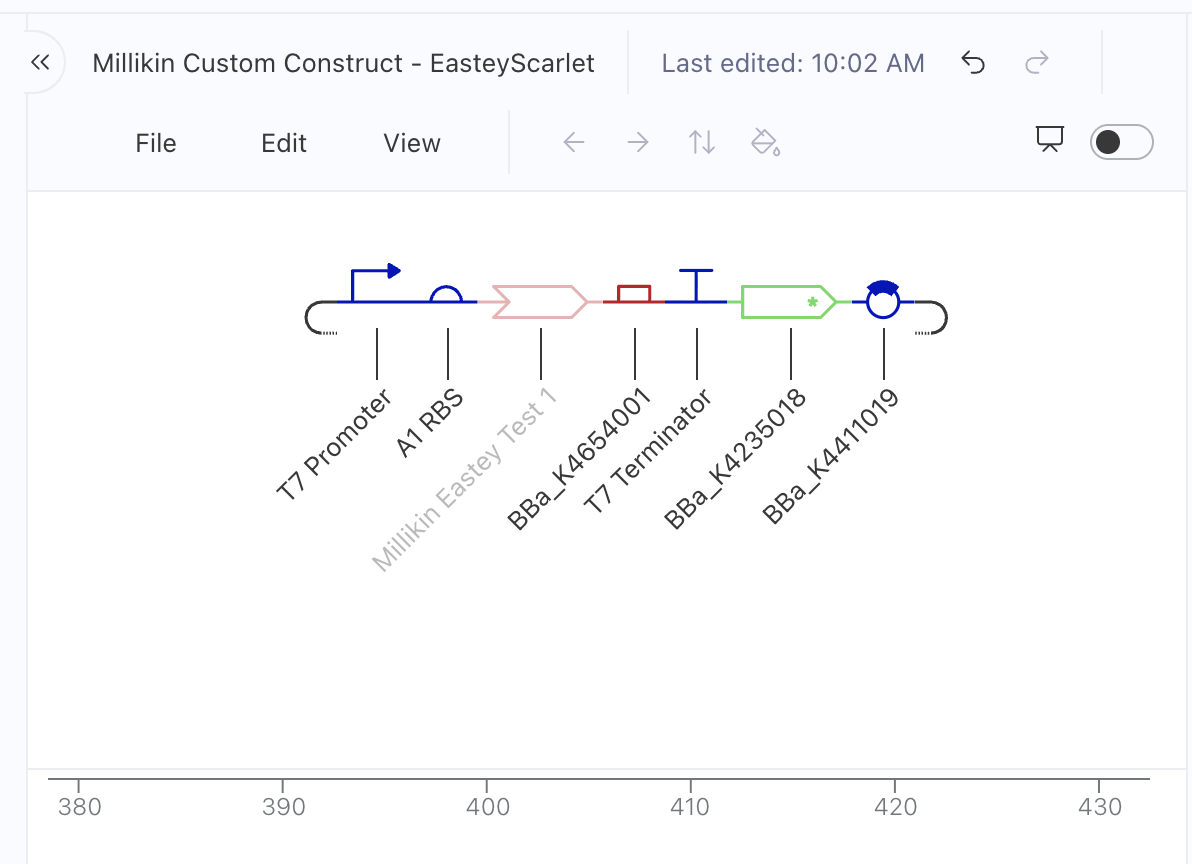
From left to right, this early version had:
- T7 promoter
- A1 RBS
- Millikin Eastey Test 1 (my code insert)
- BBa_K4654001 (mScarlet-I3 red fluorescent reporter; I can switch this to mScarlet-I3-NCwt)
- T7 Terminator
- BBa_K4235018 (Ampicillin Resistance Gene)
- BBa_K4411019 (pET28a-backbone)
I checked this out with our BUGSS lab crew and asked if everything seemed good. Our awesome TA Amanda said maybe Kanamycin resistance was what we used before. So, I was thinking about switching Ampicillin Resistance Gene for Kanamycin Resistance Gene, and then I looked up the pET28a-backbone and according to the IGEM Registry of Standard Biological Parts at https://parts.igem.org/Part:BBa_K3521004 “pET28a-Backbone … contains anti-kanamycin genes.” So, I am likely getting rid of any resistance genes in my construct since they seem redundant with what the pET28a-backbone already has.
Updated construct plan April 17, 2026:
This is now out of date! I am keeping it here for documentation and explanation purposes
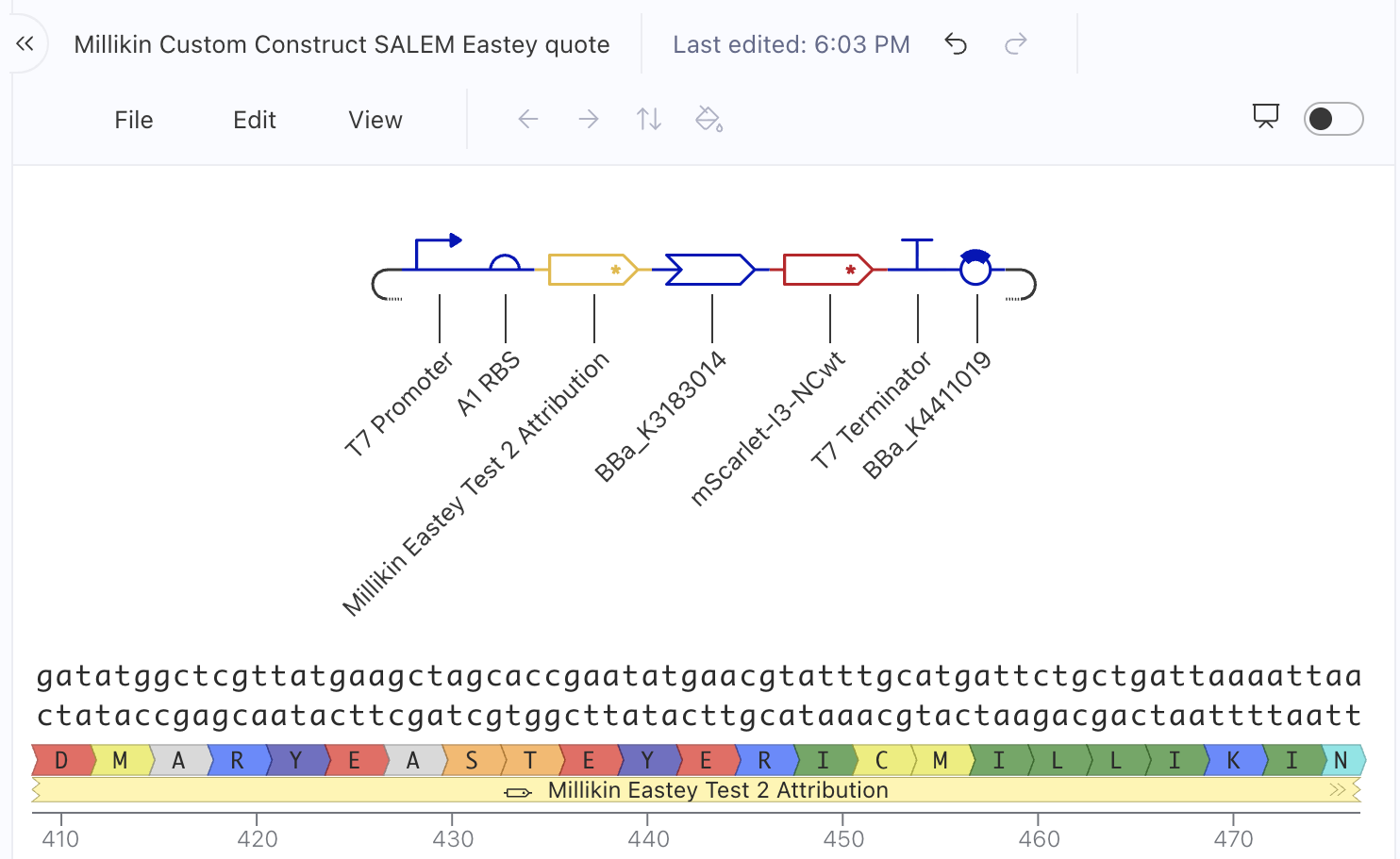
From left to right, this version had:
- T7 promoter
- A1 RBS
- Millikin Eastey Test 2 Attribution (my code insert, now with MARYEASTEYERICMILLIKIN attribution after the quote, which you can see at the bottom of the screenshot above)
- BBa_K3183014 (Gly-Ser-Gly Protein Domain Linker for E. coli)
- mScarlet-I3-NCwt (red fluorescent protein from https://www.fpbase.org/protein/1VSM7/)
- T7 Terminator
- BBa_K4411019 (pET28a-backbone)
And I exported from Asimov Kernel using “Construct as GenBank” and that file should be available at Millikin-SALEM-Construct-Eastey-Quote.gb
UPDATE construct plan April 22, 2026:
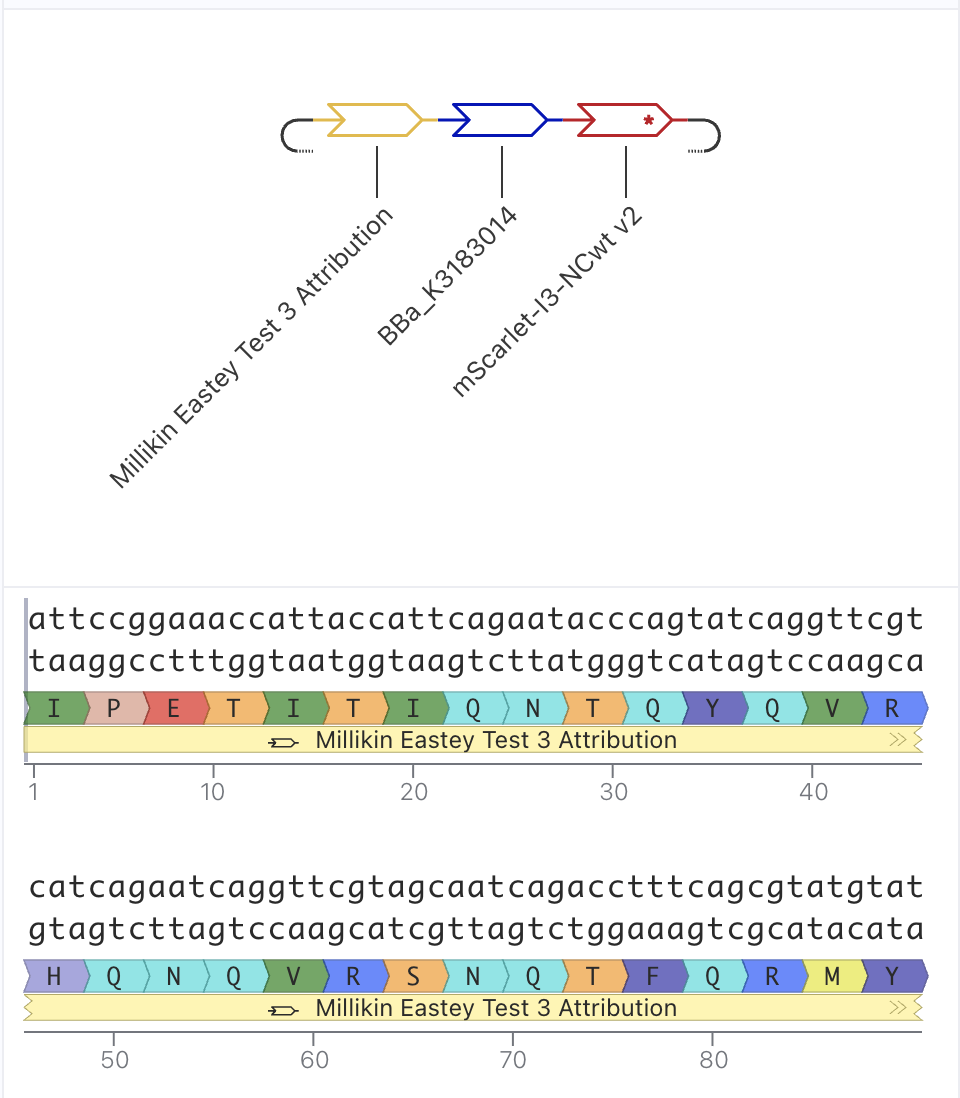
This is my latest/final version! I met with our awesome Lisa Scheifele, BUGSS Lab Executive Director, who helped me improve this! Basically, I still had some redundancies between my Asimov Kernel construct and the pET28a-backbone/
This is my updated Mary Eastey code, CDS (-start -stop) for Asimov Kernel:
    1 attccggaaa ccattaccat tcagaatacc cagtatcagg ttcgtcatca gaatcaggtt
   61 cgtagcaatc agacctttca gcgtatgtat cagtggaatc tgatttttga atttcagcgt
  121 attaaaaatc agtggattat ggttagcacc gatattgaag ctaatgatat gtatgctccg
  181 ccgcagatta ataccgaaga taccattatg gaaattagca gcgaaaccat ttttattacc
  241 ccggaaccgc agagcagcat tccgctggaa aatcagatgc agcgtgaaat taataatcag
  301 tgcgaaaata ccccgctgca gcaggatatg gcttatccgg aaagccatga agatatggct
  361 cgttatgaag ctagcaccga atatgaacgt atttgcatga ttctgctgat taaaattaat
And this is my mScarlet-I3-NCwt CDS (-start +stop) for Asimov Kernel:
    1 atggttagca aaggtgaagc tgttattaaa gaatttatgc gttttaaagt tcatatggaa
   61 ggtagcatga atggtcatga atttgaaatt gaaggtgaag gtgaaggtcg tccgtatgaa
  121 ggtacccaga ccgctaaact gaaagttacc aaaggtggtc cgctgccgtt tagctgggat
  181 attctgagcc cgcagtttat gtatggtagc cgtgctttta ttaaacatcc ggctgatatt
  241 ccggattatt ggaaacagag ctttccggaa ggttttaaat gggaacgtgt tatgattttt
  301 gaagatggtg gtaccgttag cgttacccag gataccagcc tggaagatgg taccctgatt
  361 tataaagtta aactgcgtgg tggtaatttt ccgccggatg gtccggttat gcagaaacgt
  421 accatgggtt gggaagctag caccgaacgt ctgtatccgg aagatgttgt tctgaaaggt
  481 gatattaaaa tggctctgcg tctgaaagat ggtggtcgtt atctggctga ttttaaaacc
  541 acctataaag ctaaaaaacc ggttcagatg ccgggtgctt ttaatattga tcgtaaactg
  601 gatattacca gccataatga agattatacc gttgttgaac agtatgaacg tagcgttgct
  661 cgtcatagca ccggtggtat ggatgaactg tataaataa
And this is my construct design from Asimov Kernel, much simpler than before, as before I was including several parts that were redundant with the PET-28a(+) backbone.
- Place Twist Bioscience order.
I put it into the “2026 HTGAA Ordering: DNA, Reagents, Consumables” spreadsheet on April 23 and my awesome node lead Amanda submitted the forms on April 25. I then got the Twist Bioscience quote on May 7. Things are progressing smoothly.
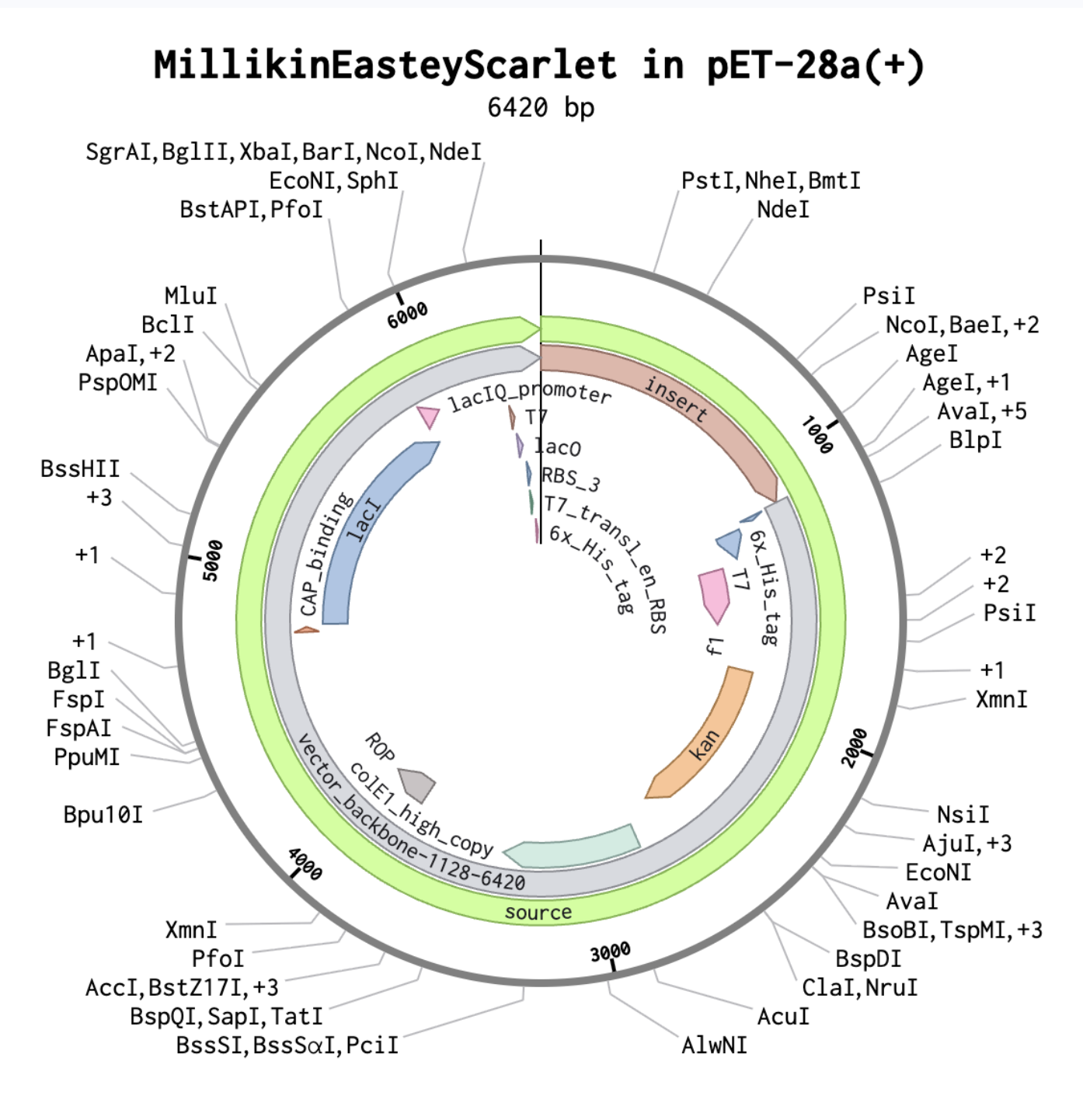
Below is an image from Benchling showing a plasmid map of the Asimov Kernel construct inserted into the pET-28a(+) as ordered from Twist Bioscience:
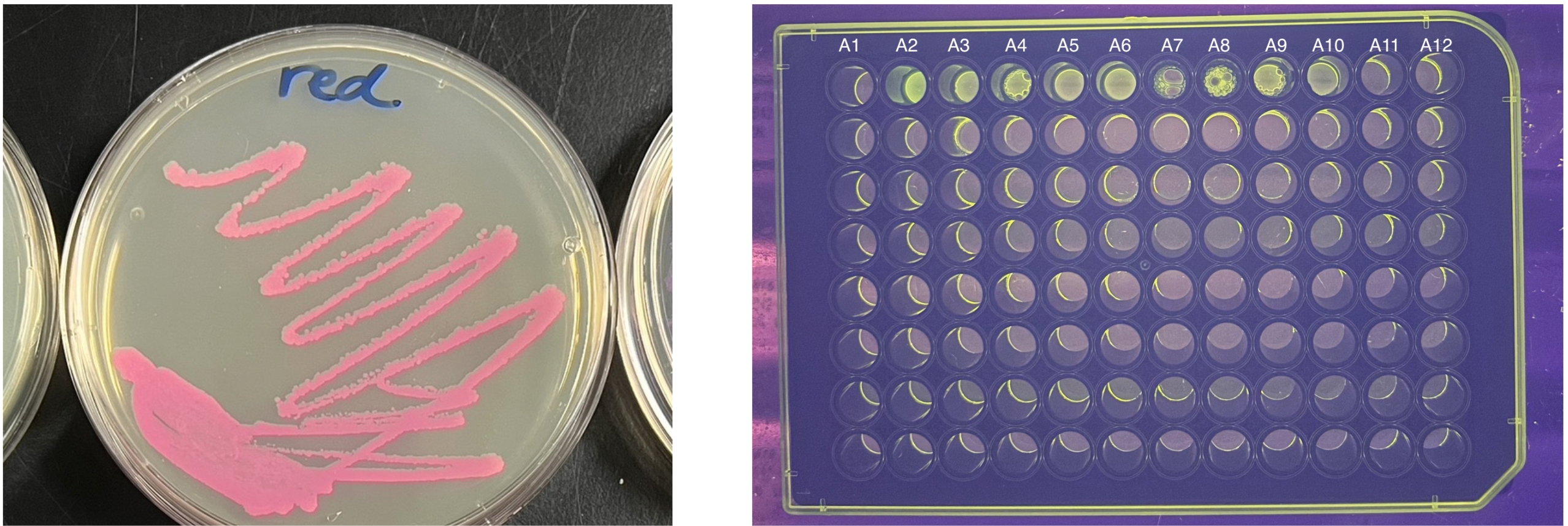
- Test the color(s) by hand by streaking on agar with inoculating loop
I will initially test the color(s) by hand by streaking on an agar plate with an inoculating loop in the BUGSS Lab. I can also measure the fluorescent proteins with fluorometry and ImageJ, as we did previously at BUGSS Lab. These are shown below.
- Finalize a design for 7 petri dishes
I have been making regular updates to my agar art design, to improve its look, to strengthen its concept, and to display my latest Opentrons coding techniques. My most recent design for the center petri dish has a star made of arrows; this is both based on the SBOL visual glyph for promoter – https://sbolstandard.org/docs/SBOL-Visual-2.2.pdf – as well as the chaos star of Michael Moorcock fantasy novels and the later used in chaos magick by Peter J. Carroll (1953 – 22 April 2026) who recently passed away. A large animated GIF of a recent version of that central star is in section 10 below.
- Convert design into Opentrons code
I had been planning on using the Fluorescent Pixel Art tool at https://opentrons-art.rcdonovan.com/
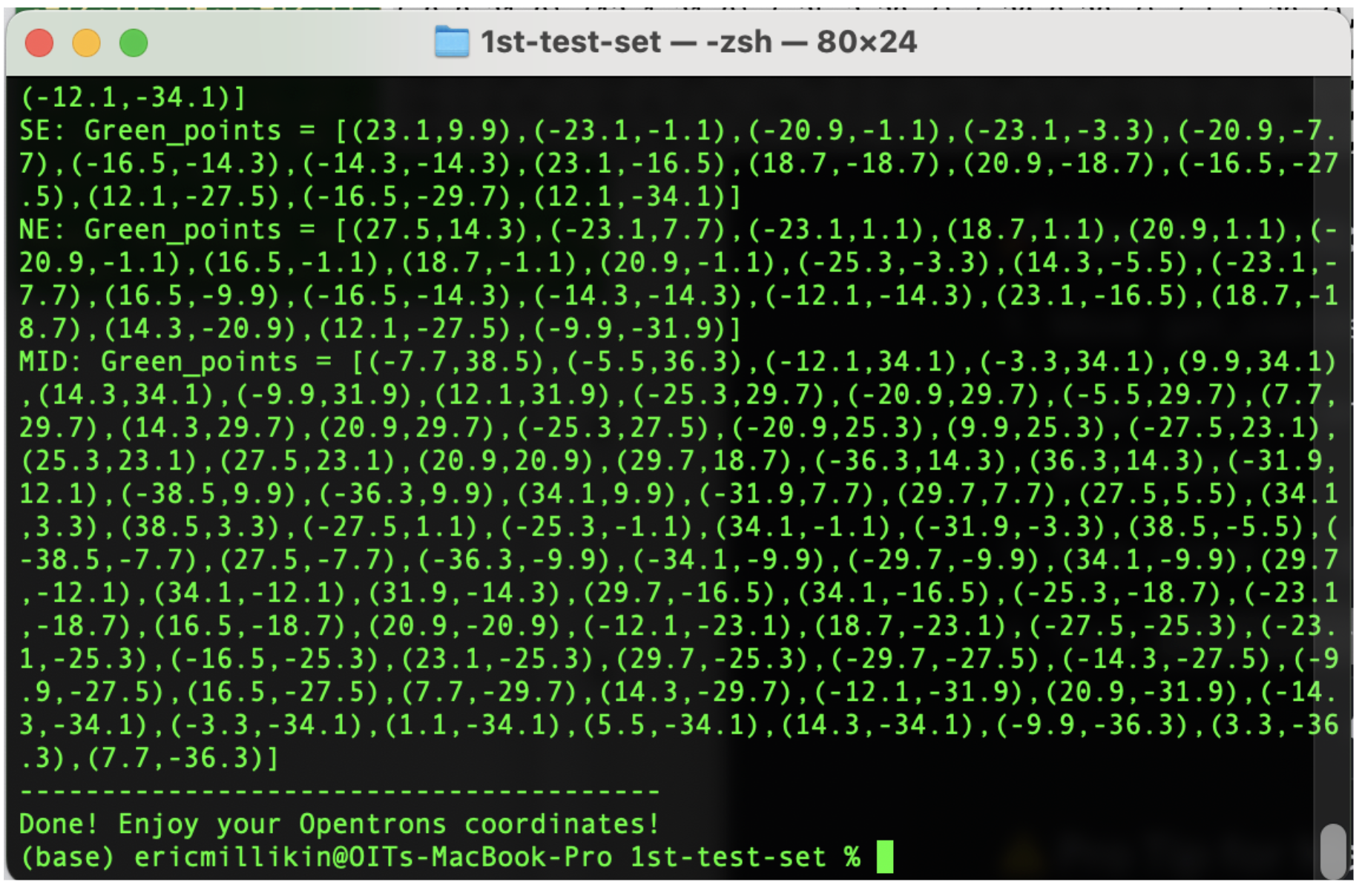
It has been updated for Ginkgo cloud lab use, so I am developing my own system to convert images into color coordinates. I have been writing some Unix shell scripts to run in terminal that use ImageMagick to crop and scale images, convert them into colors that we have at BUGSS Lab for Opentrons art, and then extract the color information and coordinates for use in Python scripting for Opentrons.
Below is a screenshot of one of my scripts running in Mac Terminal, showing extracted color coordinates for green fluorescent protein.
- Use Opentrons liquid handling robot to create the artwork
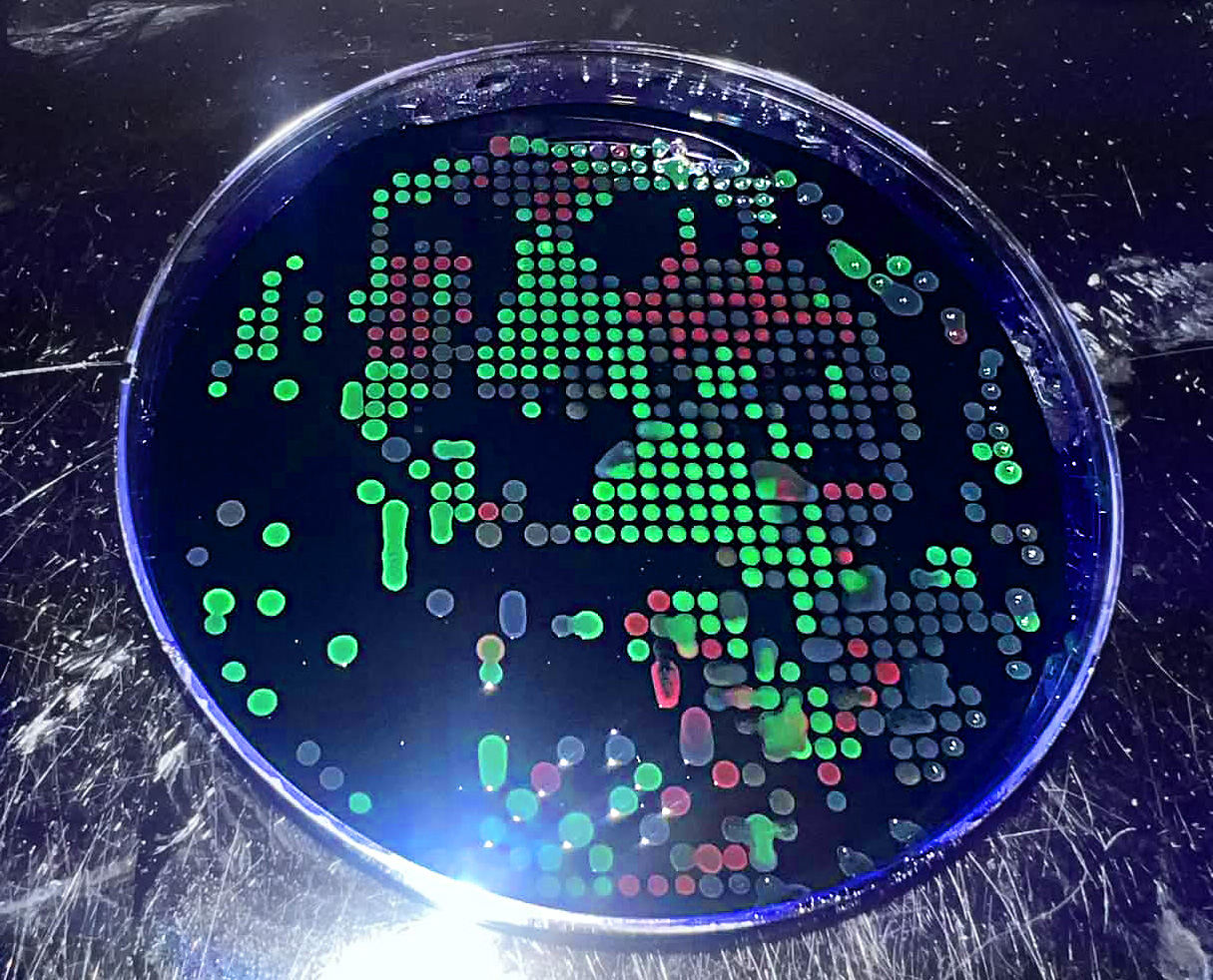
For this I will largely use the previous system we used at BUGSS Lab for Opentrons agar art, with the primary Opentrons system modification being that I will be using my new scripts for creating color coordinates for use within Python code for Opentrons.
Below is a previous Opentrons self-portrait, in a photo by Joel Tyson, showing some of the work I will be building on:
- Rotate in digital video editing to test the animation effect
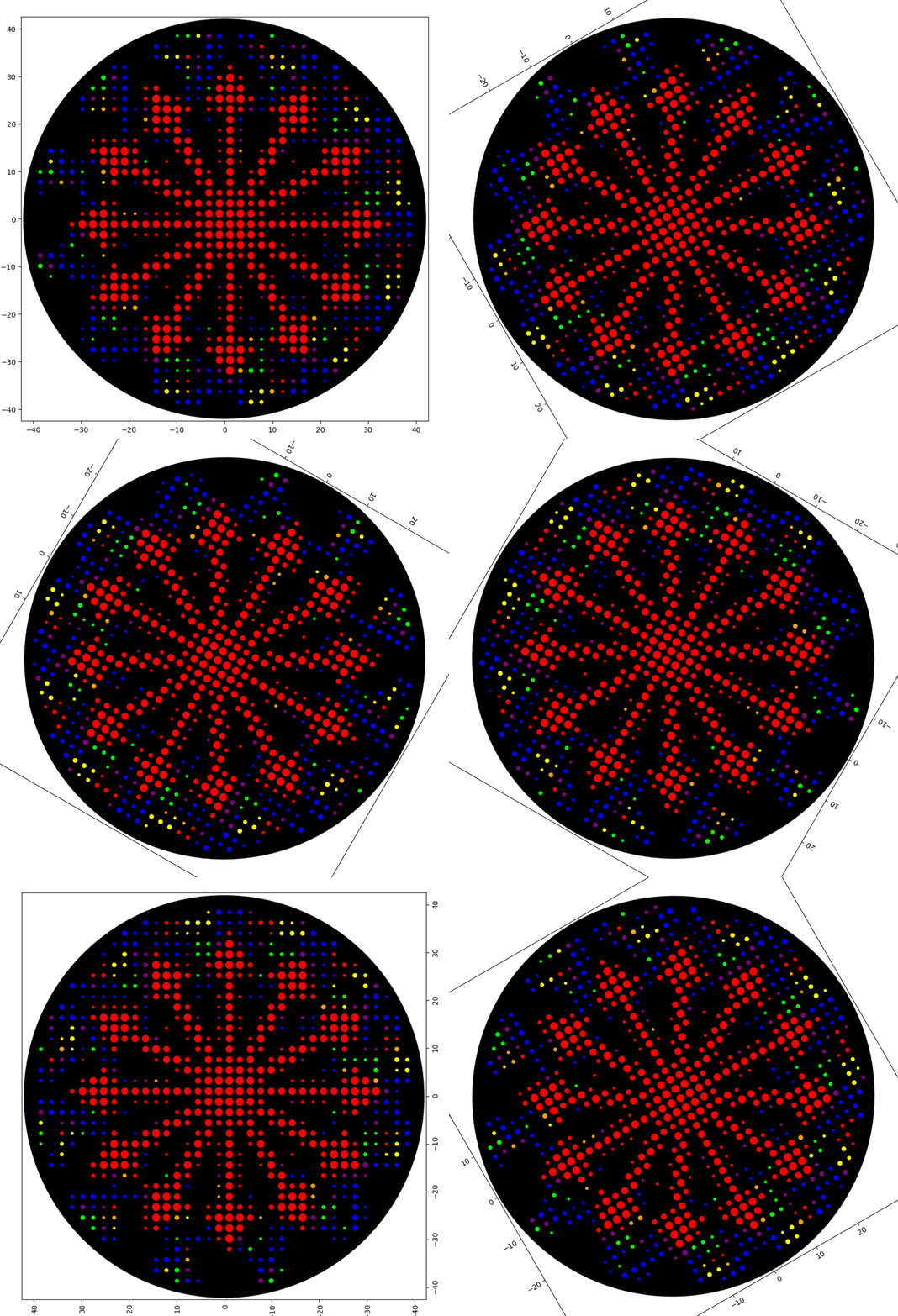
I have had success with my early-aim system for digital rotation of agar art photography to create animated videos. Below is a recent example from late May showing some of my new Opentrons code, featuring variable size dots, here going from 0.1 to 0.25 microliters:
Some of the synthetic biology techniques most relevant to my project
- Bioethical Considerations
- DNA Gel Art: DNA Editing
- DNA Gel Art: DNA Construct Design
- DNA Gel Art: Databases
- Lab Automation: Creating Code for Laboratory Automation
- Lab Automation: Using Liquid Handling Robots (e.g., Opentrons)
- Lab Automation: Designing a Twist Order
- Protein Design: Use of Asimov Kernel
- Protein Design: Use of Benchling
- Protein Design: Databases
Expand upon two techniques you checked in the previous question by describing how you would utilize those techniques in your final project. (min. 4 sentences)
I am using protein databases and Asimov Kernel for DNA Construct Design for purchasing through a Twist Order. I particularly enjoyed working with Asimov Kernel for construct design because I found its graphical interface, where I was able to build a construct out of glyphs, seemed sort of like an occult process where one might use a series of magical symbols to construct a golem or other synthetic being.
I am also Creating Code for Laboratory Automation for Using Liquid Handling Robots (Opentrons). I have particularly enjoyed writing my own Unix shell scripts and ImageMagick programs for converting my digital image files into color coordinates for Opentrons code. These new scripts I have written have allowed me to more quickly prototype new designs. I expect to keep building on these in the future. I have used ImageMagick in the past; I was pleased that I was able to use it for this project to carry on my magical themes.
Identify any How To Grow (Almost) Anything Industry Council companies which are associated with your final project (optional)
Associated with Aim 1 of my final project would probably be:
- Asimov Kernel https://www.asimov.com/kernel is likely where I design much of my new fluorescent proteins
- Opentrons https://opentrons.com/ is what I will use for automated pipetting of the designs
- Twist Bioscience https://www.twistbioscience.com/ is where I will order the DNA
Associated with possible Aim 2 and Aim 3 would be those related to biomaterials like maybe:
- Biofabricate https://www.biofabricate.co/ “sustainable biomaterial innovation for all sectors”
- BIOME Consortia https://www.biomeconsortia.org/ “cutting-edge technology to unlock and apply the near-infinite potential of microorganisms”
- Bolt https://boltthreads.com/ “B-silkTM is inspired by a special silk produced by spiders”
- Epibone https://www.epibone.com/ “facial bone product … customized for patients via a CT scan … with stem cells extracted from patients’ abdominal fat”
- Mycoworks https://www.mycoworks.com/ “create a platform for the highest quality materials using Fine Mycelium”
- Upside Foods https://upsidefoods.com/ “Cultivated meat is meat grown directly from animal cells”
SECTION 5: Results & Quantitative Expectations
What aspect of your final project did you choose to validate?
- I have designed a DNA construct to express the fluorescent protein mScarlet-I3-NCwt, ordered it via Twist Bioscience, and will ultimately test its fluorescence by using it in agar art created with an Opentrons liquid handling robot. Prior to testing it with the Opentrons robot, I will perform other tests such as streaking it on an agar plate.
Write down a detailed protocol of how you validated this aspect of your final project.
- I have validated the design of my construct within Asimov Kernel by running simulations such as checking for protein concentrations over time as well as running a biosecurity sequence scanner.
- I have validated my custom Unix shell scripts and my resulting Opentrons Python code by running Opentrons simulations within Google Colab notebooks.
- I will validate the fluorescence of my construct by streaking on an agar plate before using it in the Opentrons robot.
- I can also compare its fluorescence to other fluorescent proteins by using fluorometry and ImageJ, as we previously did in our lab. This will be most useful in later aims of this ongoing project, as I create more fluorescent proteins.
What synthetic biology techniques did you utilize in validating this aspect of your final project?
From my list of techniques above:
- I used Asimov Kernel for my construct design, running simulations, and biosecurity scanning.
- I created code for laboratory automation and for Opentrons Liquid Handling Robots and used Google Colab notebooks to run simulations to validate my code.
You must present data as part of your final project and include some analysis of that data. The data may be collected experimentally in the lab or generated as simulated data.
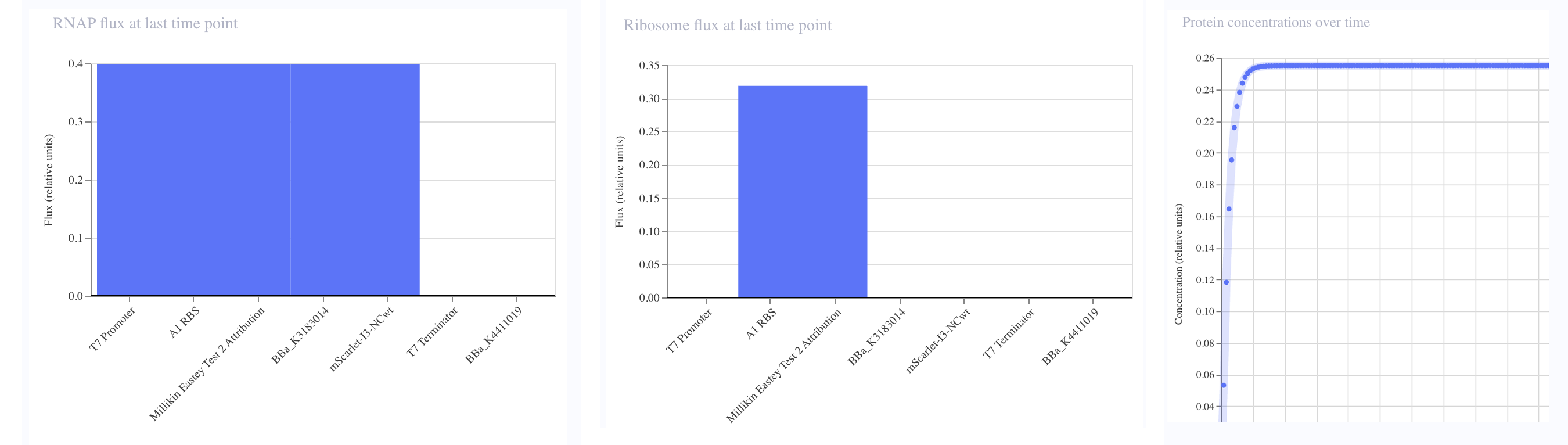
I ran several construct simulations in Asimov Kernel. For example, in my simulation of one of my constructs with the coded Eastey quote and mScarlet-I3-NCwt fluorescent protein, the screenshots below from Asimov Kernel show RNAP Flux and Ribosome Flux seemingly pretty well-balanced, and the protein concentration over time seems fast enough that experiment results are pretty quick, but not so fast that there would be worries that something toxic might grow too quickly.
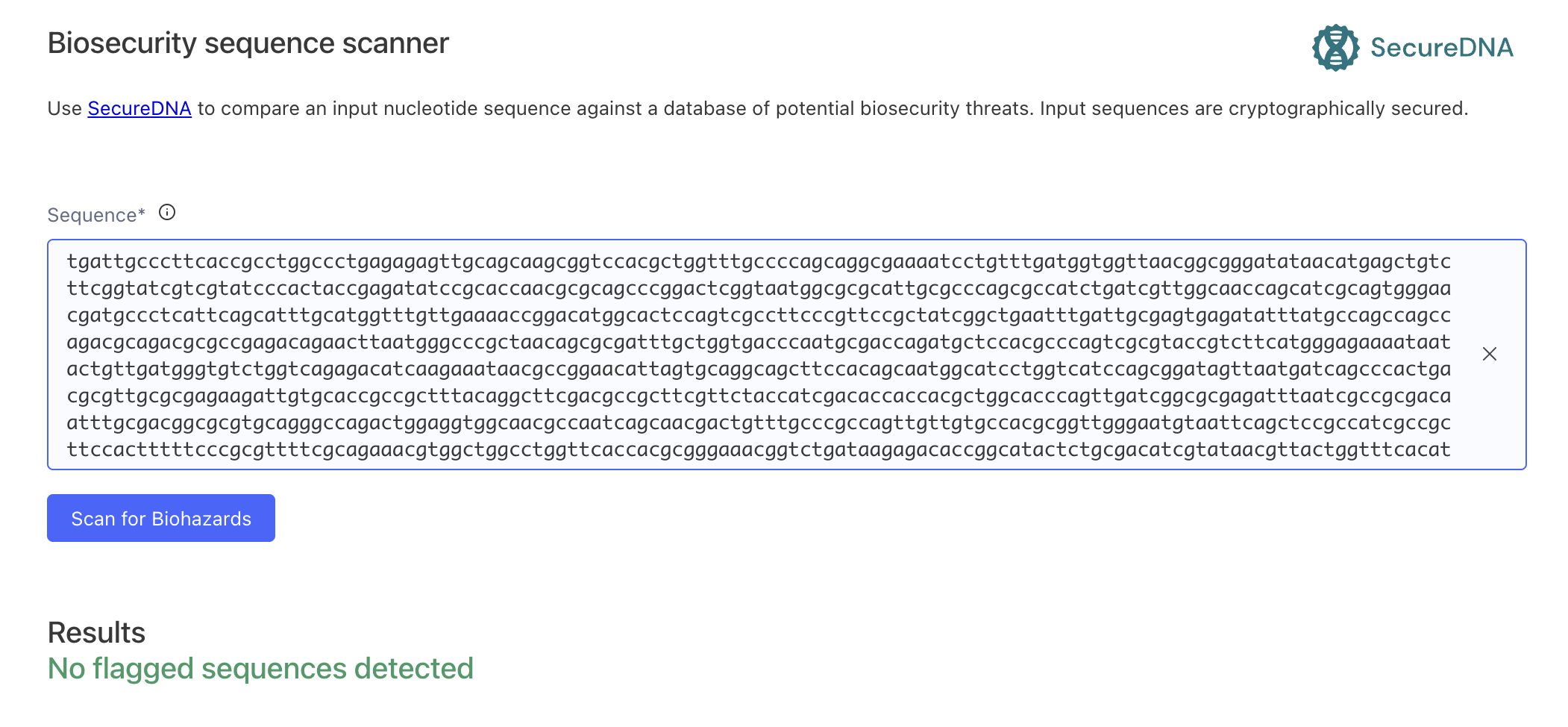
I also ran Asimov Kernel’s Biosecurity sequence scanner using SecureDNA. Below is a screenshot showing “No flagged sequences detected.”
I also performed countless validations of my Opentrons code using simulations within Google Colab notebooks, as I added new features to my series of custom scripts for converting my digital artwork into Opentrons robot coordinates.
Did you encounter any unexpected challenge(s) when performing your validation?
The major challenge for me with Asimov Kernel was probably just my learning curve with it as a new tool for me. I also had learning curve challenges with the Opentrons simulations when they were new to me. At this point toward the end of this project, the challenges with my Opentrons simulations have been the sorts of challenges that are typical of problem solving with an iterative project as I have added new features to my scripts, such as variable volume dot sizes.
SECTION 6: ADDITIONAL INFORMATION
List all references cited in this assignment (bullet-point list)
- Frazer, Jennifer. “Predatory Bacteria Are Fierce, Ballistic and Full of Potential.” (2024). Scientific American. https://www.scientificamerican.com/article/predatory-bacteria-are-fierce-ballistic-and-full-of-potential/
- Hamidi, F., Dusman, L., Booy, L. “Infinite Transformations in a Suitcase: Encountering Human-DNA Interaction through Poetry-infused Wine.” (2024). In Proceedings of the ACM Conference on Creativity and Cognition. https://doi.org/10.1145/3689050.3707674
- Ryan, J. C. (2017). Biological processes as writerly?: An ecological critique of DNA-based poetry. Environmental Humanities, 9(1), 129–148. https://doi.org/10.1215/22011919-3829163
- Su, Y., Walker, J. R., Park, Y., et al. (2022). Engineered amber-emitting NanoLuc luciferase and its use for immunobioluminescence imaging in vivo. Journal of the American Chemical Society, 144(17), 7875–7882. https://doi.org/10.1021/jacs.2c02320
- Kac, E. (2009). Cypher. Retrieved from https://www.ekac.org/cypher.text-info.html
- University of Virginia. Salem Witch Trials Documentary Archive and Transcription Project: Mary Eastey Petition. Retrieved from https://salem.lib.virginia.edu/n45.html#n45.22
- Donovan, R. Fluorescent Pixel Art Tools. Retrieved from https://opentrons-art.rcdonovan.com/
- Phenakistoscopes (1833). Public Domain Review. Retrieved from https://publicdomainreview.org/collection/phenakistoscopes-1833/
- History of Science Museum, University of Oxford. Phenakistiscopes. Retrieved from https://www.mhs.ox.ac.uk/exhibits/fancy-names-and-fun-toys/phenakistiscopes/index.html
- Sacred Geometry Art Symbols & Meanings. Retrieved from https://pardesco.com/blogs/news/sacred-geometry-art-symbols-meanings
- While making my constructs, I referenced Asimov Kernel’s bacterial demos at https://kernel.asimov.com/htgaa-2026/repositories/repository/692aad68-86f9-47e5-9655-d35dc4122b26 as well as examples of other fluorescent protein plasmids like https://www.addgene.org/189757/
Create a supply list and budget for your project (bullet-point list)
Main budget areas are:
BUGSS Lab membership (to cover lab space, time, and supplies): $100 a month or $1,000 a year
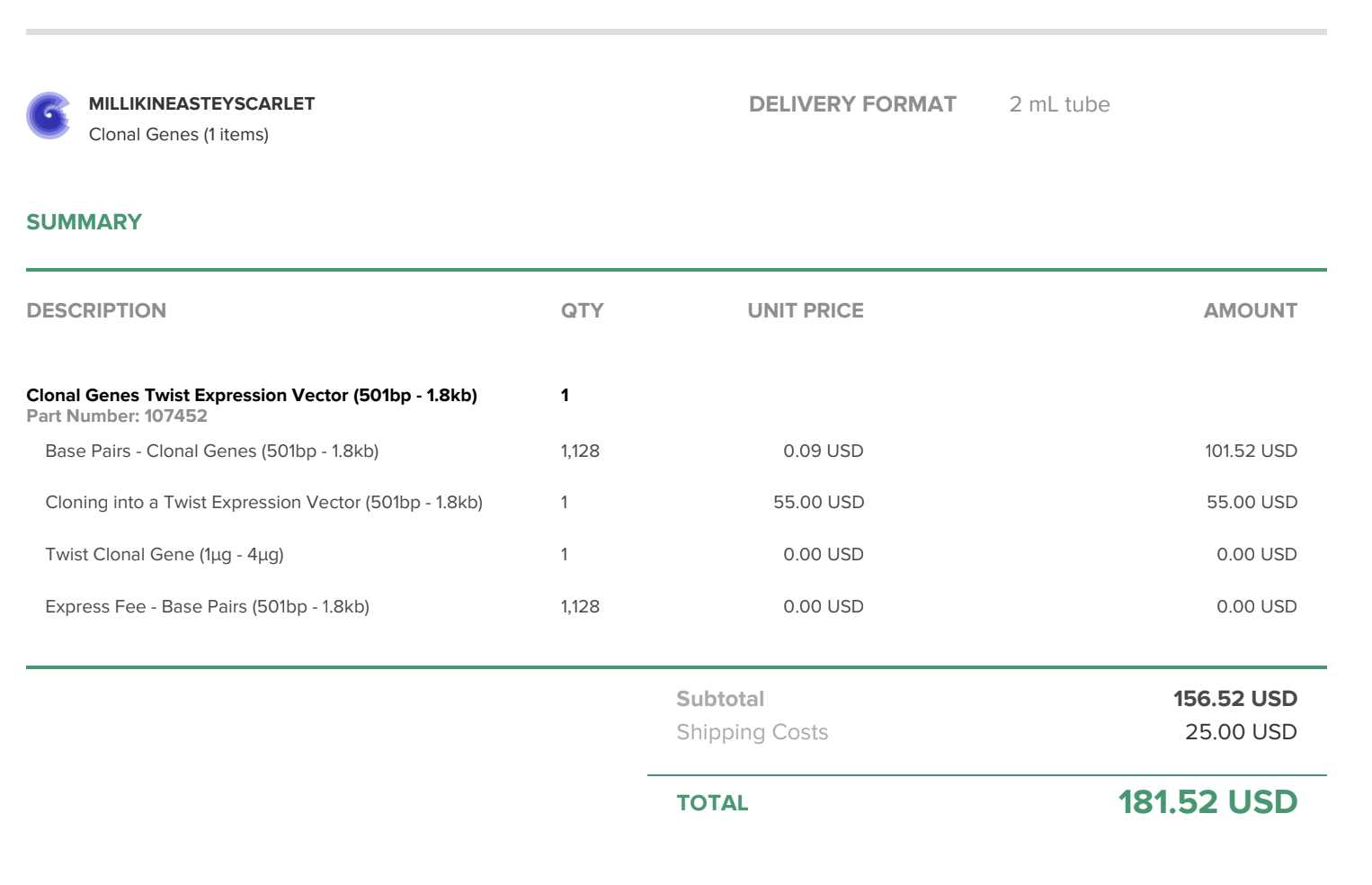
Twist order (for my custom DNA constructs): $181.52
Below is a screenshot of my first DNA order from Twist Bioscience:
Thank you! Big thanks on this project go to:
- Director Dr. David Sun Kong, Head TA Ronan Donovan, Prof. George Church, Prof. Joseph Jacobson, and everyone else at HTGAA (How to Grow (Almost) Anything)
- Amanda Mainello-Land, Joel Tyson, and Lisa Scheifele at BUGSS (Baltimore Underground Science Space)
- Juhi Dhanesha, Mantis Harper-Blanco, Marian Valdivia, and Violeta Vilcapoma, lab partners and collaborators working with BUGSS as part of HTGAA
- Ingrid Stump, Prospect Research Analyst at Virginia Museum of Fine Arts
- Everybody who joined the 12-hour global HTGAA presentations!
(Note: I based this document format on https://2026a.htgaa.org/2026a/course-pages/final-projects/individual/index.html )