Week 9 HW: Cell-free Systems
This week introduces synthesis of proteins using cellular machinery outside of a cell.
Section 1: General Homework Questions
Question 1
Explain the main advantages of cell-free protein synthesis over traditional in vivo methods, specifically in terms of flexibility and control over experimental variables. Name at least two cases where cell-free expression is more beneficial than cell production.
The primary advantage is that the cell-free method can be lyophilized (freeze-dried) and stored indefinitely outside of a lab freezer, leading to more rapid experimentation in a wide range of environments. The ability to add purified water to reconstitute and deploy means that delivery systems and analysis can be conducted in the field. A good example is a COVID test, which includes a control strip and a result readout.
Another key benefit is that the cell-free process can include well-defined parts, each with specific functions and building blocks that are not dependent upon a living host cell. This means experiments will not fail due to toxicity or competing metabolic pathways, enabling an accelerated test cycle without having to clone or transform. The ability to fine-tune concentrations, DNA templates, and protein components is a core strength of cell-free systems — something not possible in the presence of living cells.
Question 2
Describe the main components of a cell-free expression system and explain the role of each component.
The main components of a cell-free system are lyophilized reagents, freeze-dried and pelletized, which are reconstituted by adding purified water to restart the transcription and translation machinery. Components include:
- Cell extract — containing ribosomes, tRNA, and enzymes that carry out protein synthesis
- DNA template — circular or linear plasmid providing the genetic instructions
- RNA polymerase — responsible for transcription, converting the DNA template into mRNA
- Ribosomes — carry out translation, reading the mRNA to assemble the protein from amino acids
- Amino acids — the raw building blocks assembled into the target protein
- Energy system — ATP and a regeneration source such as creatine phosphate to sustain the reaction
- Salts and cofactors — such as Mg²⁺ and K⁺ to optimize ribosome function
Question 3
Why is energy provision regeneration critical in cell-free systems? Describe a method you could use to ensure continuous ATP supply in your cell-free experiment.
Energy provision is critical because without a living host cell, a substitute is required for synthesis to occur. ATP is consumed rapidly during transcription, translation, and tRNA charging, so continuous regeneration is essential. A phosphate donor such as creatine phosphate or PEP (phosphoenolpyruvate) provides the phosphate group that converts ADP back into ATP, sustaining the reaction throughout the experiment.
Question 4
Compare prokaryotic versus eukaryotic cell-free expression systems. Choose a protein to produce in each system and explain why.
Prokaryotic and eukaryotic cell-free expression systems have many differences when compared to the production of GFP, which relates to my core BioLight project. In prokaryotic cell-free, the cost would be less since the amount of expression needed for flood plates would be high. An exact level of brightness and contrast based on the presence of complex biosensors and promoters/repressors can be designed with DNA.
In contrast, the eukaryotic cell-free method is more complex and expensive, with slower and lower yield. However, this method is better suited for human therapeutics such as IL-27, an anti-inflammatory cytokine. With this approach, GFP could be fused to IL-10 to visually validate areas of inflammation being treated. IL-27 requires glycosylation — a post-translational modification not viable in prokaryotic cell-free systems — making eukaryotic cell-free the only viable option for this dual-output therapeutic application.
Question 5
How would you design a cell-free experiment to optimize the expression of a membrane protein? Discuss the challenges and how you would address them in your setup.
I would design a cell-free eukaryotic experiment that expresses IL-27R (the IL-27 membrane receptor) fused with a GFP reporter, expressed when exposed to specific light frequencies in targeted therapeutic areas. Being able to localize the mechanism of action and have it fluoresce to validate expression would be a compelling use case for membrane protein work.
The key challenge is overcoming the hydrophobic nature of membrane proteins, which aggregate and misfold without a lipid environment. This can be addressed by supplying artificial liposomes or nanodiscs — small lipid bilayer structures that the protein can correctly insert into during expression. Glycosylation of IL-27R also requires eukaryotic machinery, which is not possible in prokaryotic cell-free systems.
Question 6
Imagine you observe a low yield of your target protein in a cell-free system. Describe three possible reasons for this and suggest a troubleshooting strategy for each.
Energy depletion — A low yield may indicate exhaustion of the ATP supply needed to sustain transcription and translation. I would troubleshoot by increasing the concentration of creatine phosphate or PEP to ensure continuous ATP regeneration throughout the reaction.
Contamination or incorrect buffer composition — If the water used to reconstitute is not purified, or if salt concentrations such as Mg²⁺ and K⁺ are incorrect, this can disrupt ribosome function and lead to low or no protein output. I would ensure purified water is used at the correct volume, and verify buffer composition before reconstitution.
Membrane protein misfolding — In a eukaryotic cell-free system expressing a membrane protein, the hydrophobic nature of the target protein may lead to aggregation and misfolding without a lipid environment. I would address this by supplying nanodiscs or liposomes to provide a membrane scaffold for correct insertion and folding.
Section 2: Homework question from Kate Adamala
2a. What would the membrane be made of?
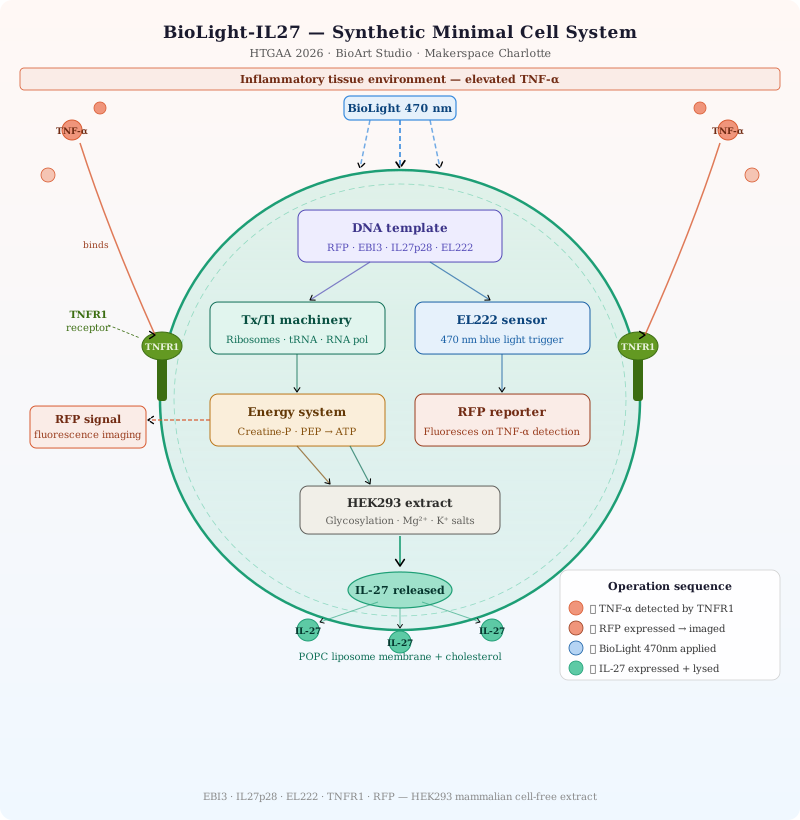
The membrane would be a liposome composed of POPC (palmitoyloleoylphosphatidylcholine) with cholesterol added to stabilize the bilayer within the cell-free system. POPC is highly biocompatible and provides a stable enough structure to support insertion of the TNF-α receptor on the membrane surface, enabling the synthetic cell to sense its inflammatory environment.
2b. What would you encapsulate inside?
The cell-free system encapsulated inside would include the DNA sequences to produce RFP and IL-27. The energy system consists of creatine phosphate and PEP, which donate phosphate groups to regenerate ATP from ADP. Required salts Mg²⁺ and K⁺ are included to stabilize the system and optimize ribosome function. The transcription and translation machinery — including ribosomes, tRNA, and RNA polymerase — provides the core expression engine. Finally, the EL222 light-sensing transcription factor is encapsulated to detect incoming 470nm blue light and trigger localized IL-27 expression in response.
2c. Which organism will your Tx/Tl system come from?
A prokaryotic cell-free system alone will not work for this design. While RFP and EL222 could be expressed using a prokaryotic E. coli extract, IL-27 requires glycosylation — a post-translational modification only available in mammalian systems. Therefore a mammalian cell-free extract, specifically HEK293, is required to correctly fold and modify IL-27. The eukaryotic machinery also better supports the overall complexity of the dual-output biocircuit. The POPC liposome membrane is constructed separately and is not dependent on the Tx/Tl system.
2d. How will your synthetic cell communicate with the environment?
The synthetic cell communicates with its environment through TNFR1 (Tumor Necrosis Factor Receptor 1) expressed on the outer membrane surface, which binds extracellular TNF-α at the inflammation site and triggers internal RFP expression as a fluorescent readout. EL222 resides inside the synthetic cell and responds to externally applied 470nm blue light, which penetrates the lipid membrane. Upon light activation, EL222 triggers IL-27 expression and the synthetic cell lyses, releasing the encapsulated IL-27 directly at the targeted inflammation site in a controlled, single-use therapeutic delivery event.
Section 3: Experimental Details
3a. List all lipids and genes
Lipids:
- POPC (palmitoyloleoylphosphatidylcholine) — primary membrane lipid
- Cholesterol — membrane stabilizer
Genes:
- RFP (Red Fluorescent Protein) — inflammation zone reporter, visible via fluorescence imaging
- EL222 — 470nm blue light sensitive transcription factor, triggers IL-27 expression
- IL-27 — heterodimeric immunoregulatory cytokine, composed of two subunits:
- EBI3 (Epstein-Barr virus induced gene 3)
- IL27p28 (also called IL-30) — the p28 subunit
- TNFR1 (Tumor Necrosis Factor Receptor 1) — membrane surface receptor that binds extracellular TNF-α
Supporting components:
- Creatine phosphate + PEP — ATP regeneration system
- Mg²⁺ and K⁺ salts — ribosome optimization
- HEK293 mammalian cell-free extract — Tx/Tl machinery
3b. How will you measure the function of your system?
The function of this system will be measured through an FDA-approved clinical trial. Subjects will be randomized into three groups: a control group receiving unmodified IL-27, a placebo group, and a treatment group receiving BioLight-IL-27. All subjects will undergo whole-body fluorescence imaging to capture a baseline inflammation heat map. The BioLight wand will then be applied to activate high-concentration inflammation sites in treatment subjects, triggering localized IL-27 release. After 24 hours, a second intravenous infusion of BioLight-IL-27 is administered and a follow-up fluorescence image captured. The delta between round 1 and round 2 imaging, alongside TNF-α blood panel measurements, will indicate therapeutic efficacy against both control and placebo groups.
BioLight-IL27: Freeze-Dried Biosensors for Robotic Home Healthcare Delivery
Pitch Summary
BioLight uses automated robotic manufacturing systems to produce freeze-dried, light-activated cell-free biosensors that detect inflammation markers and deliver localized IL-27 immunotherapy to healthcare patients at scale.
How It Works
Freeze-dried BioLight-IL27 biosensors are manufactured at scale using automated robotic systems in localized facilities, reducing the need for long-distance transportation and cold-chain refrigeration. Community healthcare providers leverage remote-operated robotic infusion systems to reconstitute and administer the biosensors intravenously, delivering them directly to patients at home for comfort and recovery. Once inside the body, the synthetic cell-free biosensors circulate to sites of elevated TNF-α, where TNFR1 membrane receptors detect inflammation and trigger RFP fluorescence as a visual readout. A mobile app connects to a fluorescence imaging sensor, and the BioLight wand delivers localized 470nm blue light to activate EL222, triggering IL-27 release precisely at the inflammation site — providing therapeutic relief instantly, anywhere, anytime.
Societal Challenge and Market Need
This represents the change needed to extend infusion-based therapies to home healthcare settings. As our population ages, debilitating chronic inflammatory conditions such as psoriatic arthritis are on the rise, and travel to approved infusion sites becomes increasingly challenging for patients. A targeted anti-inflammatory biosensor that can be self-administered at home opens the door for advanced robotically assisted, virtually supervised healthcare — representing the emergence of personalized synthetic bio-healthcare. With over 54 million Americans living with arthritis alone, the time and money saved by the medical profession will allow this market to expand exponentially, reaching more patients and delivering an extended quality of life for all.
Addressing Cell-Free System Limitations
The freeze-dried lyophilized format directly addresses stability — eliminating cold-chain dependency, extending shelf life, and enabling storage at room temperature in the home. Reconstitution with purified water is handled automatically by the robotic infusion system, removing the risk of user error during activation. While each biosensor is single-use by design, the BioLight wand and delivery hardware are fully reusable, creating a viable and cost-effective treatment model. A home healthcare platform with remote monitoring, replenishment alerts, expiration reminders, and 24/7 virtual assistance ensures consistent and safe utilization. As the market adapts and scales, automated handling of materials will make storage, transportation, and manufacturing a highly predictable, monitored, and continuously improving outcome.
Genes in Space
Question 1 — Background
(Maximum 100 words)
Cell-free protein expression systems offer a powerful platform for space biology research, diagnostics, and on-demand biomanufacturing. The BioBits® system makes this technology accessible from classrooms to the ISS. However, we do not yet know how microgravity affects the fundamental kinetics of transcription and translation outside a living cell. On Earth, gravity influences molecular sedimentation, crowding, and reaction dynamics. Removing these forces in spaceflight may fundamentally alter how efficiently cell-free systems perform. Understanding this has direct implications for long-duration missions and opens a new class of accessible, iterative experiments connecting student scientists on Earth with research aboard the ISS.
98 words
Question 2 — Molecular Target
(Maximum 30 words)
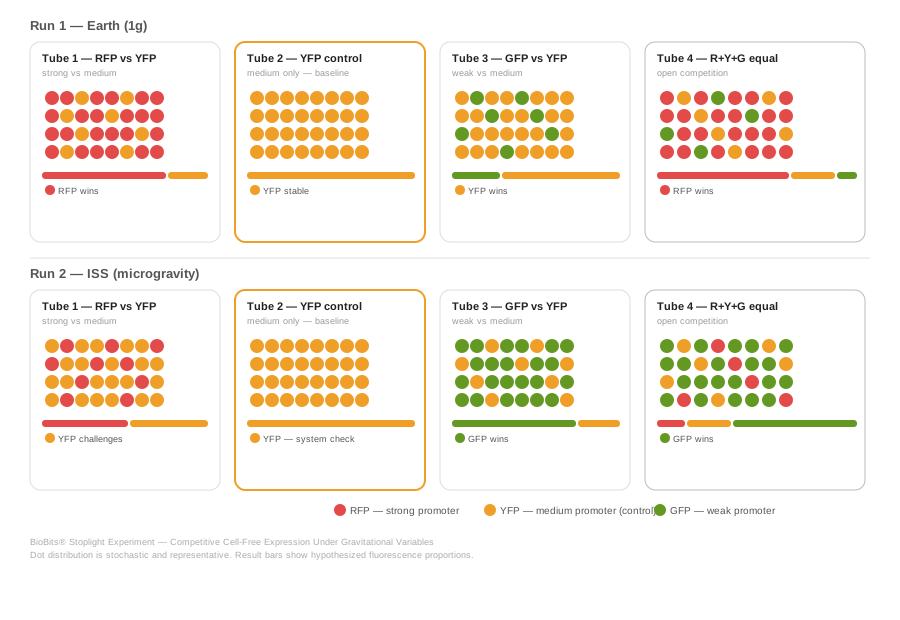
Competitive cell-free transcription and translation kinetics measured through RFP, YFP, and GFP across strong, medium, and weak promoters in four replicate BioBits® reaction wells on Earth and the ISS.
Question 3 — Target Relevance
(Maximum 100 words)
Three fluorescent reporters — red, yellow, and green — are coupled to strong, medium, and weak promoters respectively, and combined into BioBits® reaction wells where they compete for the same transcriptional and translational machinery. On Earth, gravitational effects including molecular sedimentation and crowding are expected to favor higher-strength promoters, with yellow dominant as a stable middle control. In microgravity, reduced physical barriers may shift the competitive balance toward weaker promoters, causing green to emerge more frequently. This traffic-light readout transforms subtle kinetic differences into a visually unambiguous, measurable signal directly observable through the P51 Molecular Fluorescence Viewer.
Question 4 — Hypothesis
(Maximum 150 words)
I hypothesize that microgravity will increase the efficiency of cell-free protein expression kinetics compared to Earth-based controls. In a gravitational environment, molecular sedimentation and crowding effects create physical barriers to optimal ribosome-mRNA interaction and protein folding. Removing gravity may reduce these barriers, allowing cell-free components to distribute more uniformly and interact more freely, resulting in faster or higher-yield expression. To test and predict this, we developed a three-layer platform: an in-silico simulator that models cell-free reaction dynamics computationally; a physical 3D printed magnetic kit that serves as an educational model on Earth — allowing students to hand-assemble cell-free components — and as an experimental observation tool aboard the ISS, where components are released in zero-g to document free-floating self-assembly behavior; and BioBits® four-well replicate reactions that generate real fluorescence data on Earth and the ISS. Each run retrains the simulator, improving predictive accuracy over time.
Question 5 — Experimental Plan
(Maximum 100 words)
BioBits® reaction tubes are prepared as four replicate wells on Earth and single-tube runs aboard the ISS: Tube 1 (RFP vs YFP — strong vs medium promoter), Tube 2 (YFP only — baseline control), Tube 3 (GFP vs YFP — weak vs medium promoter), Tube 4 (equal R+Y+G — open competition). Reactions are incubated using the miniPCR® thermal cycler; fluorescence outcomes are observed through the P51 Molecular Fluorescence Viewer and documented by Raspberry Pi camera. Aboard the ISS, a 3D printed magnetic molecular kit is released in zero-g; Raspberry Pi machine vision captures free-floating motion and self-assembly events. All fluorescence and motion data feed an in-silico simulator that predicts outcomes and retrains with each run.
Genes in Space 2026 — genesinspace.org