Week 11 HW: Bioproduction and Cloud Labs
HTGAA 2026 — Week 11: Bioproduction & Cloud Labs
Hypothesis — Version 2.1
This is a hypothesis on the design of a variable luminosity construct based on cell-free protein synthesis. By adding independent reagent modifications to a fixed cell-free DNA and master mix, we hypothesize a measurable delta in sfGFP luminosity relative to the unmodified control, operating on a single mechanistic axis — free Mg2+ availability:
Potassium Phosphate Dibasic added above the baseline 5.625mM sequesters free Mg2+ through phosphate chelation, reducing ribosome assembly efficiency and T7 RNAP cofactor availability — driving sfGFP expression below the control baseline.
Magnesium Glutamate added above the baseline 6.975mM directly increases free Mg2+ in solution, stabilizing ribosome subunit assembly and activating Mg-NTP complexes for both transcription and translation — driving sfGFP expression above the control baseline.
Both reagents operate on the same Mg2+ ion target from opposite directions — phosphate as a Mg2+ sink and magnesium glutamate as a Mg2+ source. The relative magnitude of the positive and negative deltas from control, measured by spectrophotometry at excitation 485nm / emission 510nm, will reveal whether the master mix is operating below, at, or above its Mg2+ optimum — directly informing the optimized reaction conditions for eLightOn CFPS deployment in BioLightX5 Aim 2.
The reagent producing the largest delta will be selected as the candidate for multi-level dose titration in a subsequent round.
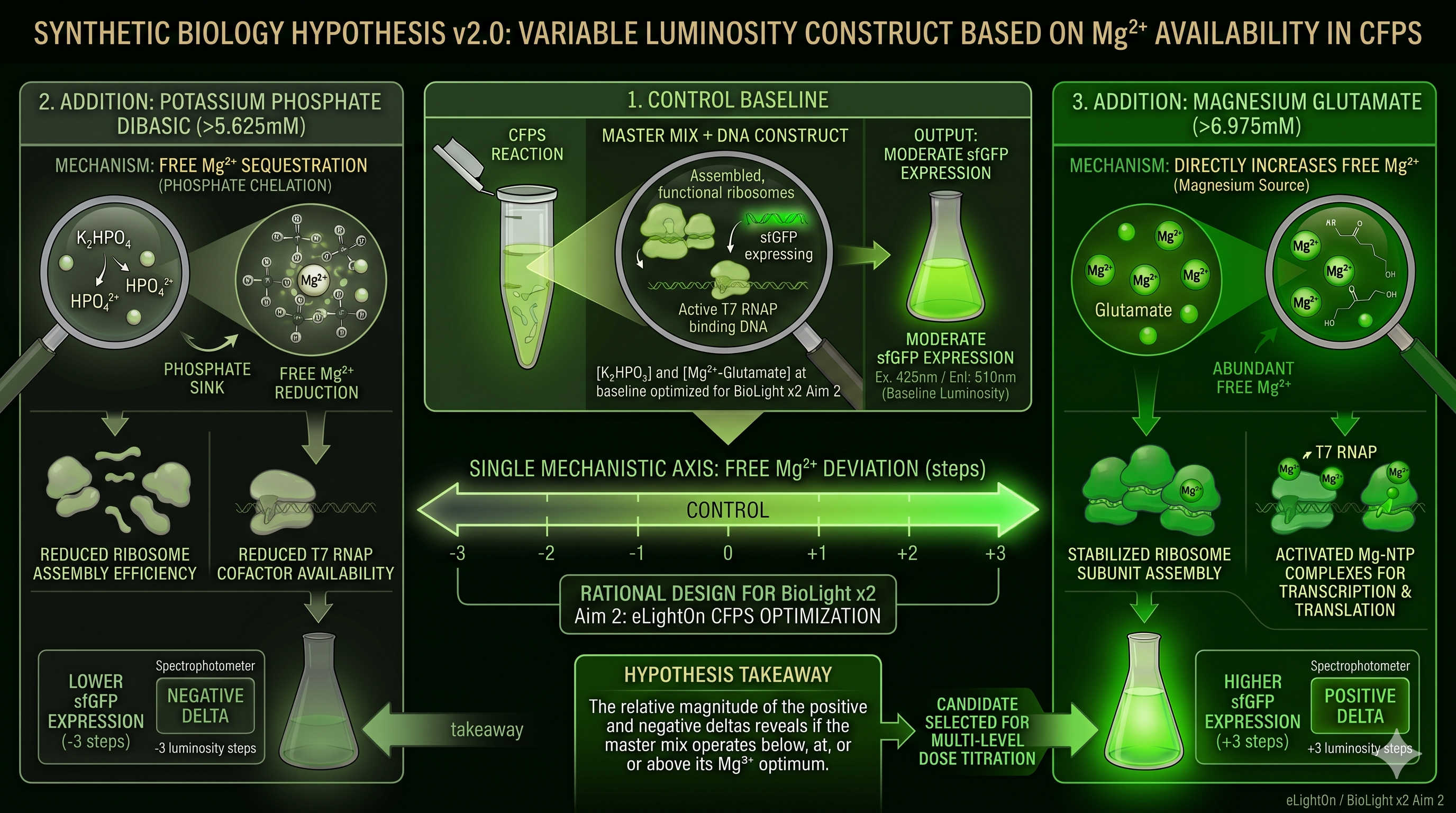
Figure 1. Mechanistic overview of the single-axis Mg2+ deviation hypothesis. Left: KPO4 dibasic as phosphate sink drives negative delta. Center: control baseline. Right: MgGlu as Mg2+ source drives positive delta.
Assignment Overview
This week’s homework is a collaborative cloud lab CFPS experiment — HTGAA 1536 — a real-time global sfGFP artwork canvas where each student contributes reagent modification wells to a shared 384-well plate, feeding into a class-wide CFPS optimization dataset.
Class project: https://rcdonovan.com/1536?id=0m7255ryvn7ttvw
Experimental Design
DNA template, master mix composition, temperature, and reaction time are fixed by the class protocol and identical across all wells. No DNA modifications are introduced. The sole experimental variable is additive supplementation — reagents added on top of the fixed master mix to modulate sfGFP expression above or below the class baseline. Water volume is adjusted automatically by the platform to maintain total reaction volume of 2000nL per additive slot. All modifications operate on the free Mg2+ axis via two independent reagents from the approved list.
Final Well Assignments — JSON Verified
All volumes verified from submitted JSON. Stock concentrations: KPO4 dibasic 0.5M, MgGlu 0.5M. Total additive volume per well: 2000nL. Total reaction volume: 12,000nL.
| Well | Label | Reagent | Stock nL | Water nL | Added (mM) | Total Final | Status |
|---|---|---|---|---|---|---|---|
| W1 | P1 | KPO4 dibasic | 150nL | 1850nL | +6.250mM | 11.875mM | Above ceiling |
| W2 | P2 | KPO4 dibasic | 100nL | 1900nL | +4.167mM | 9.792mM | Safe |
| W3 | P3 | KPO4 dibasic | 50nL | 1950nL | +2.083mM | 7.708mM | Safe |
| W4 | P4 | None | 0nL | 2000nL | — | Baseline | Control |
| W5 | P5 | MgGlu | 50nL | 1950nL | +2.083mM | 9.058mM | Safe |
| W6 | P6 | MgGlu | 100nL | 1900nL | +4.167mM | 11.142mM | Safe |
| W7 | P7 | MgGlu | 150nL | 1850nL | +6.250mM | 13.225mM | Above ceiling |
| W8 | P8 | MgGlu | 200nL | 1800nL | +8.333mM | 15.308mM | Above ceiling |
Wells P1 and P8 are designated Above ceiling — intentionally exceeding the published tolerable ionic range to map the suppression floor and inhibitory slope of the Mg2+ dose-response curve respectively. Results from these wells are expected to show reduced output relative to the safe-zone wells and will be interpreted as boundary conditions rather than optimal expression targets.
Reagent Titration — Additive Stacked Concentrations
Figure 2. JSON-verified additive stacked concentrations. Faint lower segment = master mix baseline. Solid upper segment = additive delta. Dashed lines show tolerable ionic ceilings. P1 and P8 exceed their respective ceilings as intentional Above ceiling conditions.
Mechanism of Action — Free Mg2+ as the Central Target
Both reagents operate on free Mg2+ availability — the single most sensitive variable in E. coli CFPS — from opposite directions.
Potassium Phosphate Dibasic — Under-expression
Magnesium Glutamate — Over-expression
Measurements — Delta from Control
Primary — Spectrophotometric fluorescence
Plate reader excitation 485nm / emission 510nm, RFU at class-defined endpoint:
The well with the largest magnitude delta within the safe zone becomes the candidate for multi-level dose titration in a subsequent round. Above ceiling wells P1 and P8 are evaluated separately as boundary condition data.
Predicted Spectrophotometry — sfGFP Green Gradation
Figure 3. Predicted sfGFP fluorescence across 8 wells. Bar color maps to expected visual fluorescence under UV illumination. P1 and P8 above wells predicted to show reduced output despite higher reagent concentration — inhibitory zone behavior.
Footnote 1 — Baseline RFU uncertainty: The control baseline of ~3,500 RFU used in these predictions is a conservative mid-range estimate derived from published CFPS sfGFP benchmarks. Actual baseline fluorescence for this specific extract batch at 50nM DNA template may range from 5,000–20,000 RFU depending on lysate activity, plate reader gain settings, and chromophore maturation completeness within the class-defined reaction window. All predicted RFU values and delta calculations should be interpreted as relative proportions rather than absolute measurements. The class-wide control wells across all student plates will establish the true baseline. All downstream BioLightX5 Aim 2 calibration will reference actual measured RFU from this experiment rather than these predicted values.
Footnote 2 — Above ceiling conditions P1 and P8: Wells P1 (KPO4 dibasic 11.875mM, 150nL stock) and P8 (MgGlu 15.308mM, 200nL stock) intentionally exceed their respective published tolerable ionic ceilings of 10mM and 12mM. These Above ceiling conditions are designed to map the suppression floor and inhibitory slope of the Mg2+ dose-response curve. P1 is expected to show near-complete sfGFP suppression as phosphate chelation exhausts available free Mg2+. P8 is expected to show reduced expression relative to P6 and P7 as excess Mg2+ destabilizes ribosome conformation and competes with Mg-NTP complexes. Neither Above ceiling well will be used as a target for BioLightX5 Aim 2 optimization — they serve as boundary condition markers that define the outer limits of the Mg2+ operating window for this specific extract and master mix formulation.
Connection to BioLightX5 Final Project
This week’s lab activity may be considered Aim Zero of BioLightX5, as a quantitative CFPS calibration step. The results will provide an excellent starting point for Aim 2 — the cell-free version of BioLightX5 — as a predictive model for tunable sfGFP expression using additive-only Mg2+ axis control.
| Aim | Title | Dependency on Aim Zero |
|---|---|---|
| Aim Zero | CFPS calibration | This experiment |
| Aim 1 | Wetlab validation | Independent — running in parallel |
| Aim 2 | Cell-free + imaging platform | Inherits Aim Zero predictive model |
| Aim 3 | Makerspace deployment | Inherits Aim 2 validated protocol |
Broader Significance
Additive-only expression control — without modifying DNA, master mix, temperature, or reaction time — establishes a portable, reproducible TXTL tuning framework applicable across automated and community lab settings.
- Cost efficiency: Tuning TXTL output to only the required expression level eliminates over-expression waste and reduces reagent consumption proportionally.
- Portability: A fixed master mix with additive-only modifications requires no reformulation across sites — directly deployable at Makerspace Charlotte and beyond.
- Scalability: Decoupling expression tuning from master mix preparation enables batch-consistent results across distributed platforms including the OT-2.
- Accessibility: Directly supports BioArt Studio’s mission and the iGEM 2026 distributed biomanufacturing framework.
References
sfGFP: Pédelacq et al. (2006). Nature Biotechnology 24(1):79-88. doi:10.1038/nbt1172
sfGFP FPbase: https://www.fpbase.org/protein/sfgfp
Mg2+ optimization in CFPS: Jewett & Swartz (2004). Biotechnology and Bioengineering 86(1):19-26. doi:10.1002/bit.20026
Phosphate chelation of Mg2+ in CFPS: Kim & Swartz (2001). Biotechnology and Bioengineering 74(4):309-316. doi:10.1002/bit.1121
myTXTL: Garamella et al. (2016). ACS Synthetic Biology 5(4):344-355. doi:10.1021/acssynbio.5b00296
Class project — HTGAA 1536: Donovan R. (2026). https://rcdonovan.com/1536?id=0m7255ryvn7ttvw
Cloud Lab Recitation: https://docs.google.com/presentation/d/1bz0xRXS7tOcje75Xs0dpeOOQpOwgRL1ld1DvPv3yrfU
Hypothesis- Version 1.0 (retired-no Spermidine in reagent options. See Version 2.0 above)
This is a hypothesis on the design of a variable luminosity construct based on cell-free protein synthesis. By adding independent reagent modifications to a fixed cell-free DNA and master mix, we hypothesize a measurable delta in sfGFP luminosity relative to the unmodified control:
- Spermidine at 3mM drives expression below baseline due to limiting promoter access caused by DNA over-compaction at the transcription initiation site.
- Creatine phosphate at 15mM drives expression above baseline by replenishing ATP availability and extending the active translation window beyond the point of energy depletion.
The reagent producing the largest delta will be selected as the Round 2 candidate, where it will be tested at multiple dose levels — low, medium, and high — establishing a multi-point luminosity gradient. Mg²⁺ will be introduced in Round 2 as a co-variable to determine whether ionic modulation of ribosome activity compounds or independently shifts the Round 1 delta.
Experimental Design
DNA template, master mix composition, temperature, and reaction time are fixed by the class protocol and identical across all wells. No DNA modifications are introduced. The sole experimental variable is additive supplementation — small-molecule reagents added on top of the fixed master mix to modulate sfGFP expression above or below the class baseline.
My Well Assignments
| Well | Additive | Mg²⁺ | Target | Purpose |
|---|---|---|---|---|
| Control | None | Unchanged | Baseline | Class standard — shared delta reference |
| Under | Spermidine 3mM | Unchanged | Low expression | Limits promoter access via DNA over-compaction |
| Over | Creatine phosphate +15mM | Unchanged | High expression | Extends ATP window — longer active translation |
Mg²⁺ is held constant in Round 1 and introduced only in Round 2 as a co-variable with the winning reagent.
Rationale
Spermidine and creatine phosphate were selected because they act at independent nodes in the expression pathway — transcription and energy respectively — ensuring Round 2 Mg²⁺ co-variable testing can be interpreted without confounding either mechanism.
Spermidine over-compacts DNA above its optimal concentration, limiting promoter access at the transcription initiation site and reducing mRNA output independently of ribosome activity or energy supply.
Creatine phosphate replenishes ATP availability, extending the active translation window beyond baseline energy depletion independently of transcription rate or DNA accessibility.
Measurements
Primary — Spectrophotometric fluorescence
Plate reader excitation 485nm / emission 510nm, RFU at class-defined endpoint. Delta from control is the decision metric:
The well with the largest magnitude delta becomes the Round 2 candidate.
Secondary — Mass spectrometry
Where available, mass spectrometry quantifies total sfGFP yield independent of fluorescence — including misfolded protein that fails to mature the chromophore. Correlating mass spec yield against RFU across the three wells determines whether the delta reflects translation output, folding efficiency, or both.
Round 2 Design — Pending Round 1 Results
| Well | Additive | Mg²⁺ | Purpose |
|---|---|---|---|
| Control | None | Unchanged | Baseline reference |
| Low | Winner low dose | + Mg²⁺ | Combined effect — low |
| Medium | Winner mid dose | + Mg²⁺ | Combined effect — medium |
| High | Winner high dose | + Mg²⁺ | Combined effect — high |
Connection to Final Project
This week’s lab activity may be considered Aim Zero of BioLight x2, as a quantitative CFPS calibration step. The results of Round 1, Round 2, and spectrophotometric readings will provide an excellent starting point for Aim 2 — the cell-free version of BioLight x2 — as a predictive model for tunable sfGFP expression using additive-only master mix control.
| Aim | Title | Dependency on Aim Zero |
|---|---|---|
| Aim Zero | CFPS calibration | This experiment |
| Aim 1 | Wetlab validation | Independent — running in parallel |
| Aim 2 | Cell-free + imaging platform | Inherits Aim Zero predictive model |
| Aim 3 | Makerspace deployment | Inherits Aim 2 validated protocol |
References
sfGFP: Pédelacq et al. (2006). Nature Biotechnology 24(1):79–88. doi:10.1038/nbt1172
sfGFP FPbase: https://www.fpbase.org/protein/sfgfp
Spermidine in CFPS: Jewett & Swartz (2004). Biotechnology and Bioengineering 86(1):19–26. doi:10.1002/bit.20026
Creatine phosphate: Kim & Swartz (2001). Biotechnology and Bioengineering 74(4):309–316. doi:10.1002/bit.1121
myTXTL: Garamella et al. (2016). ACS Synthetic Biology 5(4):344–355. doi:10.1021/acssynbio.5b00296
Class project — HTGAA 1536: Donovan R. (2026). https://rcdonovan.com/1536?id=0m7255ryvn7ttvw
Cloud Lab Recitation: https://docs.google.com/presentation/d/1bz0xRXS7tOcje75Xs0dpeOOQpOwgRL1ld1DvPv3yrfU