Individual Final Project
BioLight — Final Project Update
April 14, 2026 | HTGAA 2026 Individual Final Project

Short Final Project Description
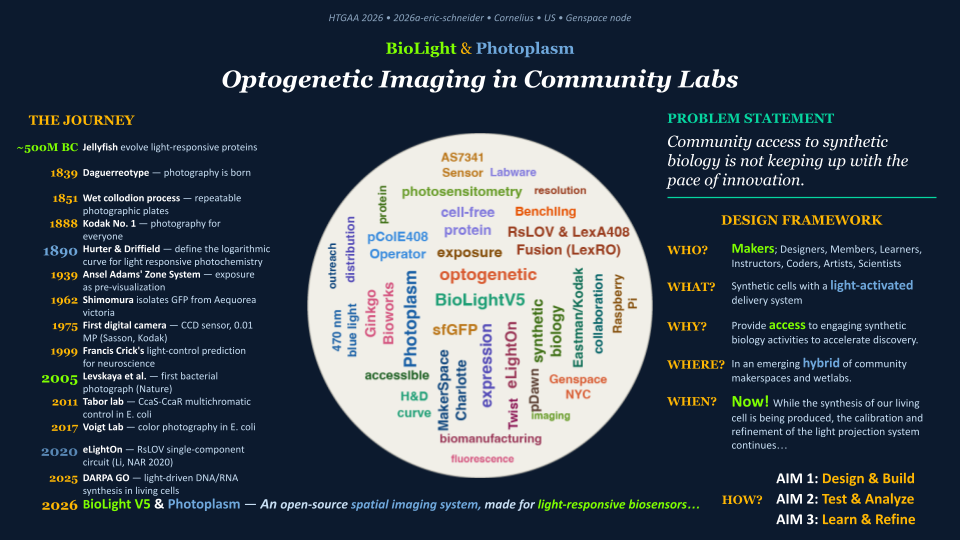
My final project develops a light-responsive genetic circuit in E. coli that expresses fluorescent protein, using LED light to map projected photographic images to a biological substrate on agar plates.
Custom-built LED exposure hardware controls light exposure, activating the engineered biosensor to achieve high-resolution, wide-gamut images appearing through protein expression in transformed bacteria.
The resulting workflow will serve as a framework for community makerspace activities and a platform for ongoing optogenetic imaging research.
Project Aims
Aim 1 — Experimental
- Engineer and validate a light-responsive fluorescent protein expression system in E. coli
- Success measured by fidelity and tonal resolution of the expressed fluorescent image relative to the projected visual image
Aim 2 — Development
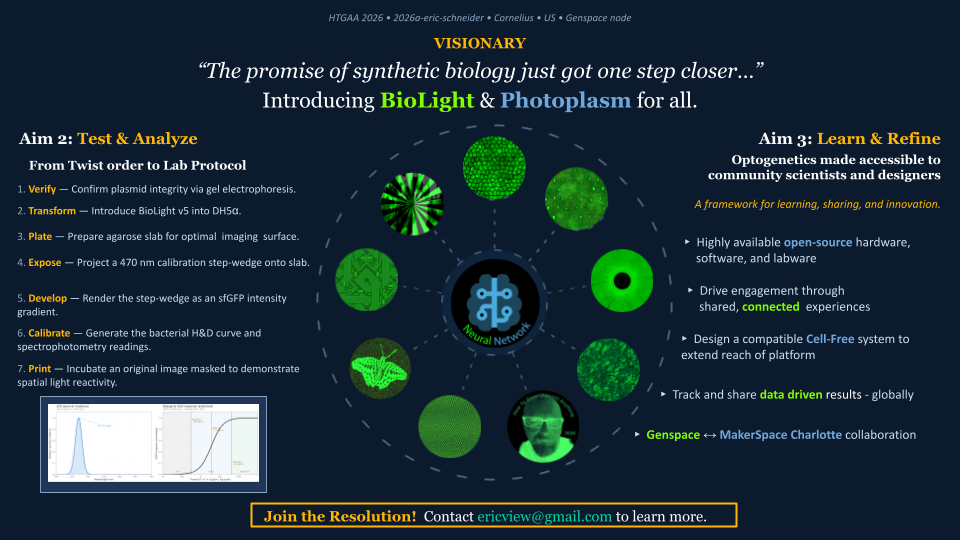
- Translate the validated bio-circuit into an integrated imaging platform
- Custom LED exposure hardware, 3D printed components, and software protocols
- Connect analog light to digital tools, back to biological output
- Explore how a cell-free system and automated lab production could increase productivity
- Custom-design and build of light projection system including:
- Raspberry Pi 5 as the primary controller
- LED light array for controlled blue light exposure
- Wavelength sensor for real-time spectral verification
- OpenCV machine vision algorithms for luminosity measurement
- Environmental sensors including temperature monitoring
- Cycle timer to regulate and automate exposure sequences
Aim 3 — Visionary
- Establish a framework for experiential learning in synthetic biology within community makerspaces
- Long-term extension into machine vision interpretation of biosensor expression patterns
- LLM and neural network integration for image recognition and biosensor pattern analysis
Aim 1
Aim 1a — pBioLight x2 (primary)
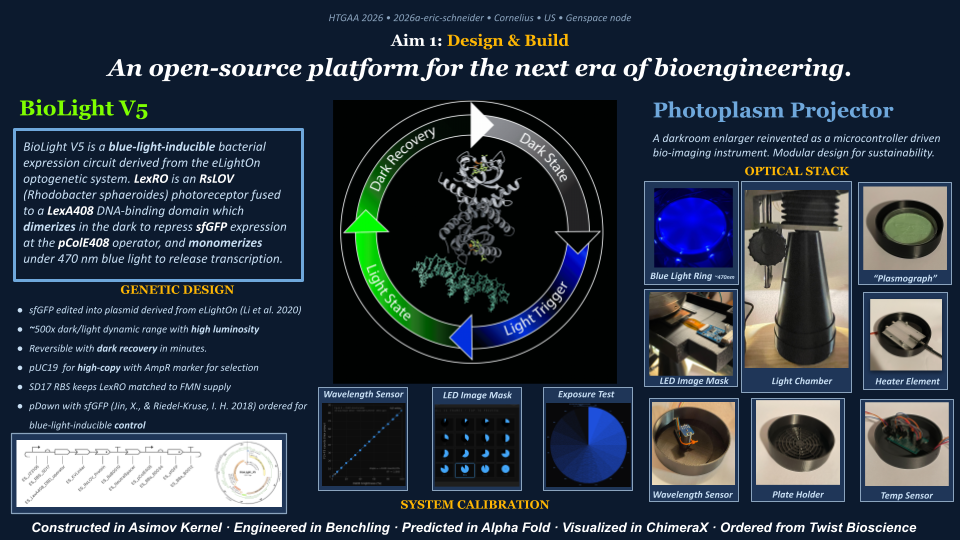
pBioLight-1B-eLightOn-v1, designated pBioLight x2, is the primary construct for Aim 1a and the fastest path to first image. It is a 2,201 bp circular single-plasmid system designed in Benchling and ordered via Twist Bioscience clonal gene synthesis in a pUC19 backbone with AmpR selection. The eLightOn system uses a LexA408 DNA binding domain fused to RsLOV, a light-oxygen-voltage domain that undergoes a conformational change upon 450nm blue light activation, releasing repression of the pColE408 promoter and driving sfGFP expression.
Circuit architecture
J23106 constitutive promoter → LexA408 DBD (P40A/N41S/A42S, codon-optimized) → RsLOV 176aa (528bp, codon-optimized) → KV linker → pColE408 promoter → BBa_B0034 RBS → sfGFP → rrnB T1/T2 terminators
Key properties
- GC content: 48.98%
- 2 ORFs confirmed, no direct repeats
- Light activation: 450nm blue light
- Dynamic range: ~10,000×
- No external reagents required — the system uses FMN, a molecule E. coli naturally produces, as its light-sensing cofactor. This simplifies the workflow compared to systems like CcaS/CcaR that require externally supplied chromophores.
- Restriction cut sites flanking sfGFP enable future color swapping without redesigning the full circuit, supporting expansion toward wide-gamut multi-color biological imaging through Aim 2 and beyond
Appendix — Optogenetic Systems Evaluated
All systems below were evaluated for use in the BioLight platform. eLightOn was selected as the primary system for pBioLight x2. Systems marked with ★ remain viable parallel tracks.
| System | Light (nm) | Plasmids | Chromophore | Dynamic Range | Complexity | Status |
|---|---|---|---|---|---|---|
| eLightOn | 450 blue | 1 | None (FMN) | ~10,000× | ★★ | Selected — pBioLight x2 |
| LEVI | 450 blue | 1 | None (FMN) | ~10,000× | ★★ | Deselected — equivalent dynamic range, less documented |
| pDawn | 450 blue | 1 | None | up to 460× | ★★ | Deselected — lower dynamic range |
| BLADE | 450 blue | 1 | None | ~100× | ★★ | Deselected — lower dynamic range |
| EL222 | 450 blue | 1 | None (FMN) | >100× | ★ | Deselected — lower dynamic range |
| CcaS/CcaR ★ | 535/672 | 2 | PCB required | ~100× | ★★★ | Viable — Aim 1b parallel track |
| EL222→Bxb1→GFP ★ | 450 blue | 2 | None (FMN) | >100× | ★★★ | Viable — Aim 1c parallel track |
| pREDawn | 640/780 red | 2 | None (BV) | 100–200× | ★★★ | Deselected — red light spectral overlap risk |
| Cph8-OmpR | 650/740 red | 3 | PCB required | ~10× | ★★★★ | Deselected — high complexity, low dynamic range |
Images
Light Responsive Plasmid Desgin (Asimov Schematic + Adobe Firefly + Gemini)
Light Projection Labware - Gemini
References
- Li et al. 2020, Nucleic Acids Research 48(6):e33, doi:10.1093/nar/gkaa044 — eLightOn system
- Levskaya et al. 2005, Nature 438, 441–442, doi:10.1038/nature04405
- Jayaraman 2016, PMC5001607
- Tabor Lab, Rice University — jtabor@rice.edu — pJT119b, pSR43.6r, pSR58.6 CcaS/CcaR optogenetic system
- Addgene pJT119b #50551, pSR43.6r #63197, pSR58.6 #63176