Section Five - Results & Validation
Author: Eric Schneider · 2026a-eric-schneider Node: Genspace NYC Affiliation: BioArt Studio, MakerSpace Charlotte
Form Prompt
Describe the results of your project. What were the results of your experiments? What data did you collect? What did you learn? If you have not yet completed your experiments, describe what results you expect to see and why. Include figures, images, graphs, or other visual representations of your data where possible. Describe any challenges you encountered and how you addressed them (or plan to address them).
Opening
BioLight & Photoplasm is a project in motion — part completed (Aim 1), part deliberately designed to begin at Genspace on May 28, 2026 (Aim 2) and part saved for an ongoing shared collaborative experience (Aim 3). The results presented here reflect that reality: some are in hand, verified, and documented; others are expected outcomes grounded in calibration data, construct design, and a carefully staged protocol. Together they tell the story of a project that has moved from a photographer’s question — what is the resolution? — through fourteen weeks of literature review, construct design, hardware build, calibration, and community formation, to the threshold of its first wet-lab exposure.
What you will find in this section:
- Results Block 1 — Aim 1: Design & Build (Experimental) · BioLightV5 Plasmid Construct — completed design, simulation, and structural analysis results; expected outcomes from Twist delivery and MVFP validation at Genspace
- Results Block 2 — Aim 1: Design & Build (Experimental) · Photoplasm Device — completed hardware build and calibration findings including the Bayer dither H&D curve and OLED 470 nm emission discovery; detailed cal02 three-state analysis quantifying the OLED additive limitation; direct comparisons of the baseline vs. Aim 2 light source and image-mask configurations against the BioLightV5 minimum effective dose (MED) reference; and a gain-selection diagnostic for Aim 2 Cree raw characterization
- Results Block 3 — Aim 2: Test & Analyze (Development) — expected results across three rounds of wet-lab work at Genspace, from MVFP baseline through first bacteriograph to Aim 3 handoff
- Figures — confirmed figure list with status, pending figures noted for v1.0 final pass
- Challenges — personal statement on the challenge of learning a new domain, followed by nine specific challenges encountered and how each was addressed
Results Block 1 — Aim 1: Design & Build (Experimental) · BioLightV5 Plasmid Construct
Completed Results
The BioLightV5 plasmid construct — BioLight V5— was designed, verified, and submitted to Twist Biosciences for clonal gene synthesis. The final v5 construct is 2,201 bp on a pUC19 backbone with AmpR selection, confirmed at 48.98% GC content with exactly two functional ORFs: LexRO-Fusion (1,143 bp) and sfGFP (717 bp). Three sequence issues identified during the design review were resolved prior to submission: an SD17 RBS spacing correction (AAA insert), removal of internal EcoRI/XhoI restriction sites, and replacement of the neutral spacer with a 50 bp AT-rich synthetic sequence. All four Benchling quality checks passed before Twist submission.
Key completed findings — construct design:
- Asimov Kernel circuit simulation confirmed sfGFP expression output; dark-state repression gap documented as known artifact of mammalian-derived simulation model — not a construct flaw (Figure 4.2)
- AlphaFold structural prediction of LexRO-Fusion confirmed stable dimer fold; FMN chromophore energy transfer gap noted as known prediction model limitation
- ChimeraX exploration of dark-state crystal structure (PDB 4HJ4) confirmed Cys55–FMN distance at 4.324 Å; LexRO dimer geometry mapped against pColE408 operator; dark-state dimerization confirmed to physically occlude promoter; monomerization under 470 nm confirmed geometrically sufficient to permit sfGFP transcription (Figures 3.1, 3.2)
- BioLightV5 non-linear design network — six-step pipeline from candidate selection through ChimeraX MOA confirmation documented with dashed feedback loops at two key iteration points (Figure 4.3)
- pDawn-sfGFP (Addgene #107741) ordered in parallel as validated single-plasmid control construct
Expected Results
A successful Twist delivery of both the engineered BioLightV5 plasmid and the Addgene pDawn-sfGFP control sets up a substantial and purposeful Aim 2 — Test & Analyze (Development) to be conducted in person at Genspace. As noted in the timeline, orientation at Genspace is scheduled for May 28 as a new community member — a fixed date independent of Twist delivery. In preparation for this work, a new working group has formed around the project: TA and mentor Yehuda Binik and HTGAA 2025 cohort participant David Chau have been meeting weekly — two-plus hours each Sunday session — focused on the project design, the protocol roadmap, and the longer-term Aim 3 — Learn & Refine (Visionary) vision of a shared collaborative biosensor experience paired with the Photoplasm light exposure unit. The protocol in the appendix is directly tied to the timeline and dependent on receipt of the first clonal DNA as its primary trigger.
A key consideration is that successful delivery of the construct is the starting point, not the finish line: there are multiple days and sequential steps of early validation required before the light projection system is engaged at all. The Minimum Viable Functional Prototype (MVFP) — a simple bench-top 470 nm blue light induction test on two culture tubes, one illuminated and one dark — must be completed and pass before any Photoplasm device work begins. This deliberate separation of construct validation from device operation ensures that if BioLightV5 does not fluoresce as expected, the fallback pDawn-sfGFP protocol can be activated without having committed time and resources to the full Photoplasm exposure workflow.
A second in-person visit to Genspace is planned following the initial round of experimental lab work, once the baseline MVFP has been established and a verified, transformed bacterial source is ready for exposure. At that point, I will travel to Genspace with the Photoplasm hardware and software — bringing the light projection system to the certified wetlab environment for the first time and beginning integrated image exposure work under institutional BSL-1 oversight. This visit is one node in a deliberately parallel model: while wet-lab milestones advance at Genspace, the MakerSpace Charlotte BioArt Lab continues building, testing, and refining the Photoplasm hardware and software in parallel — learning together across two sites simultaneously. This distributed, connected approach is not incidental to the project — it is the proof-of-concept for Aim 3 — Learn & Refine (Visionary). The Genspace ↔ MakerSpace Charlotte working collaboration, anchored by weekly sessions with Yehuda Binik, David Chau, and the broader Genspace community, is the first instance of the shared, multi-node biosensor experience that Aim 3 proposes to scale. When the first creative light mask is exposed onto a living bacterial substrate at Genspace, the MakerSpace Charlotte BioArt Lab will be ready to replicate that experience — and the distributed, connected model will have its first proof point.
This collaboration also reflects MakerSpace Charlotte BioArt Lab’s longer-term aspiration to become a recognized HTGAA Node — supported by Eric Schneider (HTGAA 2026) in a future Teaching Assistant role if deemed applicable by the program — and ultimately to achieve MTA-certified wetlab status with a direct pathway to cell-free protein synthesis via Ginkgo Bioworks, positioning the lab as a fully credentialed community node in the distributed BioLight network.
Results Block 2 — Aim 1: Design & Build (Experimental) · Photoplasm Device — Light and Image Mask Projector
Completed Results
The Photoplasm device represents the novel hardware contribution of this project to the broader synthetic biology community — a purpose-built bio-imaging instrument that reimagines the photographic darkroom enlarger as an open-source, community-deployable optogenetic exposure platform. All physical components were designed in Fusion 360 and fabricated in PETG on a Bambu X1 Carbon at my design studio and MakerSpace Charlotte.
Hardware build — completed components:
- Dark chamber frustum cone (256 mm height, 51 mm ID top, 152 mm OD base)
- Stackable spacer rings — adjustable throw distance 6–12 inches
- Bacterial plate holder
- Plate heater / incubation controller — PTCYIDU PTC element, DS18B20 temperature probe, IRLZ44N MOSFET on GPIO13, 37°C setpoint, variable and tunable — maintains bacterial culture temperature throughout the exposure window without removing the plate from the dark chamber
- Raspberry Pi 5 — all pin assignments locked (PWM GPIO18, OLED SPI, AS7341 I2C, shutdown GPIO21)
- 470 nm LED ring — EBOOT array (current); Cree XP-E2 upgrade in queue as prerequisite for Aim 2
- PWM/MOSFET driver (IRLZ44N, GPIO18) — verified working on breadboard
- Light collimator and focusing lens — sharp image projection confirmed at f/8, ~10 inches from nodal point
- OLED SSD1309 digital image mask — operational, projection confirmed sharp at plate height
- AS7341 11-channel spectral sensor — I2C verified, 256X gain stable, CSV logging clean
- (Raspberry Pi Camera Module — in queue, to be installed during Aim 2)
Calibration findings — completed:
- EBOOT LED ring measured 2.0 µW/cm² at substrate plane — 50× below eLightOn activation threshold; quantitative basis for Cree XP-E2 upgrade decision
- Three-state OLED transmission test — initially showed 99.9% optically neutral; identified as measurement artifact (LED + OLED emission not separated in original test); resolved by the corrected cal02 three-state protocol described below
- Pie-wedge step-wedge — AS7341 sensitivity sufficient to register mask spatial variation as irradiance change; retired for calibration; preserved for biological plate exposure work
- PWM sweep — 100 levels downsampled to 16 standardized steps; clean dose curve established across full operating range
- Bayer dither densitometer — 16-step sweep confirmed logarithmic H&D response: steep toe (0–25%), linear zone (25–75%), shoulder plateau (75–100%); log fit F2+F3 ≈ 138 + 22.5 × ln(density + 1), R²=0.968 (Figure 5.1)
- OLED 470 nm emission discovery — OLED emits 470 nm light proportional to pixel density, +58.7% contribution across full density range — additive light source, not neutral mask; motivates ILI9341 transmissive LCD upgrade (Figure 5.2)
- Sharp image projection confirmed at f/8 — optimal balance of depth of field and irradiance for variable agarose slab surface topology
Detailed cal02 three-state analysis — quantifying the OLED additive limitation
The OLED 470 nm emission finding referenced in Figure 5.2 was characterized in detail through a corrected three-state protocol (photoplasm_cal02.py), which addressed the measurement artifact in the original three-state OLED transmission test. The cal02 protocol records the AS7341 response under three sequential optical configurations: LED ring alone with no OLED in the optical path (S1), OLED present with all pixels driven white (S2), and OLED present with all pixels off (S3). From these three readings, three transmission/attenuation quantities are derived.
Spatial Light Modulator (SLM): the addressable optical component that controls where light passes through to the sample plane. The SLM sits between the light source and the sample, acting as a digital image mask — each pixel either passes light through, blocks it, or attenuates it by some intermediate amount. This is what enables Photoplasm to project patterns onto a bacterial lawn rather than illuminate it uniformly, and is the conceptual analog of a photographic negative in darkroom enlargement. Common SLM technologies include transmissive LCDs (the planned Aim 2 component), reflective LCoS panels, digital micromirror devices (DMDs, as in DLP projectors), and — in Photoplasm Alpha — a transparent OLED. SLMs may operate subtractively (blocking incident light, the photographic norm) or additively (emitting their own light, the OLED case); this distinction is central to the Aim 2 component swap.
| Quantity | Measured value | Interpretation |
|---|---|---|
s1_no_oled_f2f3 | 390 counts | LED ring direct, no SLM |
s2_oled_white_f2f3 | 240 counts | LED + OLED pixels on |
s3_oled_off_f2f3 | 350 counts | LED + OLED pixels off |
oled_transmission_pct | 61.5% | S2/S1 |
glass_transmission_pct | 89.7% | S3/S1 (substrate only) |
pixel_attenuation_pct | 145.8% | (S3 - S2) inverted ratio metric |
The OLED’s glass substrate is acceptably transparent (~90% transmission, consistent with optical-grade glass plus a thin organic stack). The pixel layer, however, adds light to the optical path when driven white rather than attenuating it. The 145.8% pixel attenuation value — over 100% — is the quantitative signature of this additive behavior: white pixels emit their own 470 nm photons that sum with transmitted LED light at the sensor. This is the cal02-derived counterpart to the +58.7% densitometer finding (Figure 5.2); both metrics quantify the same physics from different measurement geometries.
The contrast ratio implication is severe. With S3 = 350 counts (pixels off, “maximum exposure”) and S2 = 240 counts (pixels on, “minimum exposure”), the OLED’s effective contrast ratio is 350:240 ≈ 1.46:1, or 0.69:1 if measured in the conventional direction (closed/open). In log-exposure units, the available modulation range is log₁₀(1.46) ≈ 0.16 log units — roughly an eighth of the 1.3 log units typically required to capture a complete photographic H&D curve (toe + linear + shoulder). This is not a calibration artifact: it reproduces the established physics of OLED displays (each pixel is an electroluminescent emitter) and confirms that the SSD1309, however convenient for prototyping, is architecturally unsuited to act as a subtractive density mask in a photographic-sensitometric exposure unit.
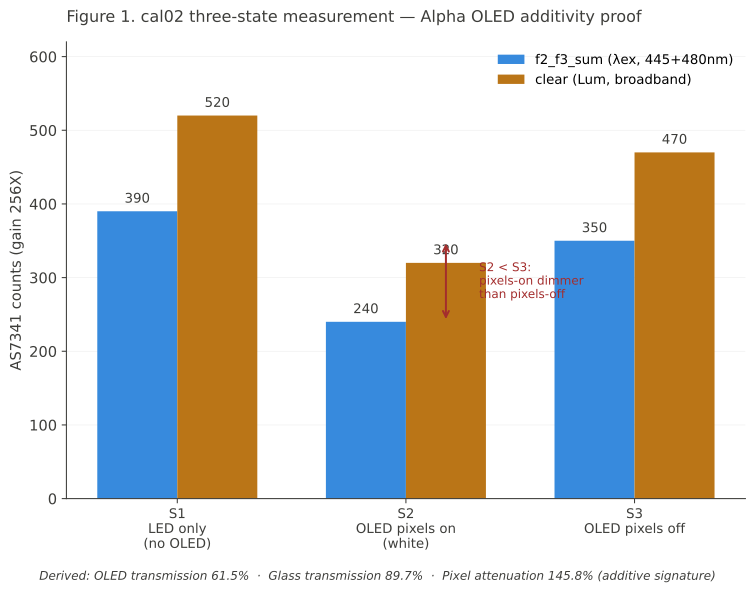
Figure 5.7. cal02 three-state measurement, April 28 2026. The S2 < S3 relationship is the quantitative signature of OLED additive emission: white pixels add 470 nm photons but block more LED light than they emit, producing net attenuation; pixels-off blocks less and produces higher net throughput. This inversion is what motivates the LCD substitution in Aim 2 and is the cal02-derived counterpart to the densitometer finding in Figure 5.2.
Baseline vs. Aim 2 light source — paired comparison against the BioLight V5 MED
The Alpha LED ring delivers 240 counts net through the OLED at the sample plane (cal02 S2 measurement). Mapped to irradiance via the placeholder coefficient Kc = 1.0, this is consistent with the calibration result of 2.0 µW/cm² noted above. The BioLight V5 minimum effective dose (MED) for construct activation — anchored on the upstream eLightOn precedent (Jayaraman et al. 2016) and the project’s stated ≥100 µW/cm² irradiance gate — corresponds to approximately 300 counts in the current AS7341 256X-gain scale. The BioLight V5 MED is anchored on the upstream eLightOn value pending in-house characterization at Genspace.
The Alpha LED+OLED system, in its working configuration, falls below MED. Even at maximum drive (PWM 100%), the combined optical losses prevent reliable construct activation. The Cree XP-E2 3-up star array is specified for 10–20× higher radiant flux than the EBOOT 5mm array at the substrate plane, tighter spectral binning around 470 nm, and more directional emission. Projected raw output at the sensor is on the order of ~2,300 counts before SLM losses, providing substantial headroom above MED even after the LCD transmission penalty.
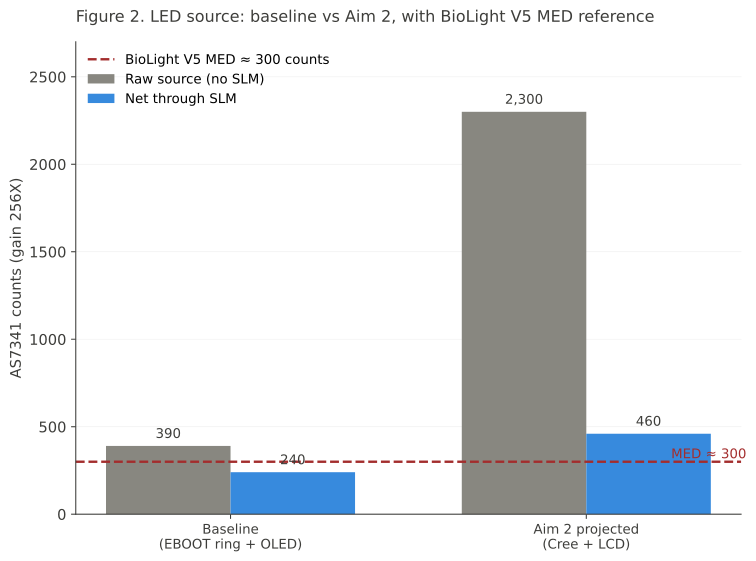
Figure 5.8. Light source comparison with BioLight V5 MED reference. The Cree+LCD net output (~460 counts) provides ~50% headroom above the MED threshold, whereas the EBOOT+OLED baseline (240 counts) falls below it — meaning the Alpha system cannot reliably engage the construct even at maximum drive.
Light source diagnostic — raw vs. net output ranges
Figure 5.8’s grouped bars convey the four data points but compress the relationship between raw source output and net delivery through the SLM. Re-plotting each system as a paired range (raw, then net) makes the magnitude of SLM transmission loss visible at a glance while preserving the MED reference for direct comparison. This view also surfaces a measurement protocol implication: the Cree raw output (~2,300 counts) substantially exceeds the AS7341’s saturation point at 256X gain (~726 counts), meaning Aim 2 raw characterization must use a lower gain setting and normalize the result back to 256X-equivalent counts for valid comparison against the Alpha baseline.
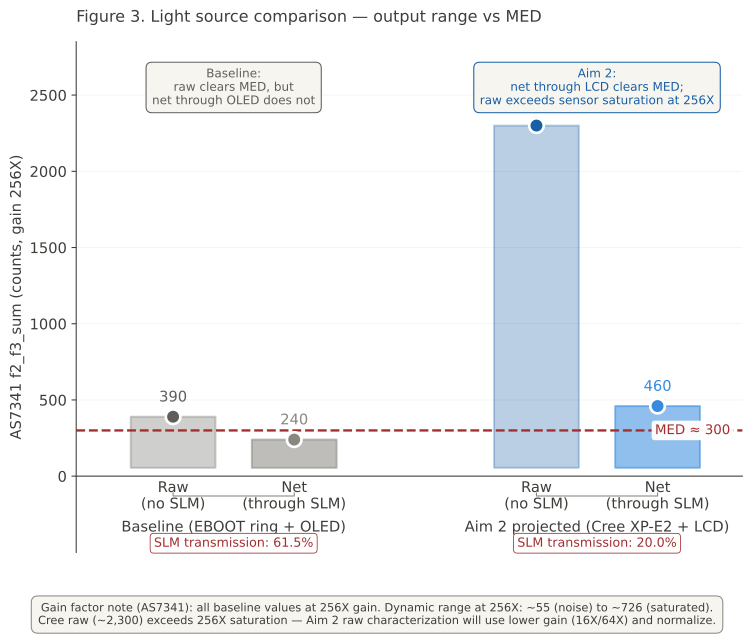
Figure 5.9. Direct light source comparison expressed as raw-vs-net output ranges at fixed gain. The SLM transmission percentages (61.5% for the baseline OLED, 20.0% for the Aim 2 LCD) quantify the photon loss between each light source’s raw output and what actually reaches the sample plane. Despite the LCD losing ~3× more photons than the OLED, the Cree’s much higher raw output more than compensates: the Aim 2 net (~460) lands above MED while the Baseline net (240) lands below.
Baseline vs. Aim 2 image mask — paired comparison against the BioLight V5 MED
The OLED’s additive emission produces three coupled failures: inverted modulation direction (increasing pixel density increases sensor reading rather than decreasing it — the opposite of photographic density behavior); compressed modulation range (only 0.16 log units of D-log E swing, against a requirement of roughly 1.0+ log units for sensitometric characterization); and MED-bracketing ambiguity (the OLED’s modulation range of 240–350 counts brackets the BioLight V5 MED rather than straddling it, so every density step produces ambiguous biology — neither a clean dark control nor a strong activation).
The ILI9341 LCD with backlight removed operates as a true subtractive shutter array. Blue-subpixel “on” passes light through the polarizer stack at panel transmission efficiency (~20% projected for blue channel through full polarizer + color filter stack); blue-subpixel “off” blocks light to the panel’s contrast floor (typically ~10:1 ratio for this class of LCD). Modulation runs in the correct direction (more pixels on = more light transmitted), with sufficient range to straddle MED with toe-region headroom on both sides. The resolution change from 128×64 monochrome (8,192 pixels) to 320×240 RGB (76,800 pixels, ~25,600 addressable blue subpixels) further enables an 8×8 Bayer dither protocol with 64 distinct density levels, against the Alpha’s 16-level 4×4 dither. This provides 4× more density steps per H&D characterization sweep, sufficient to resolve toe and shoulder curvature rather than jumping past them.
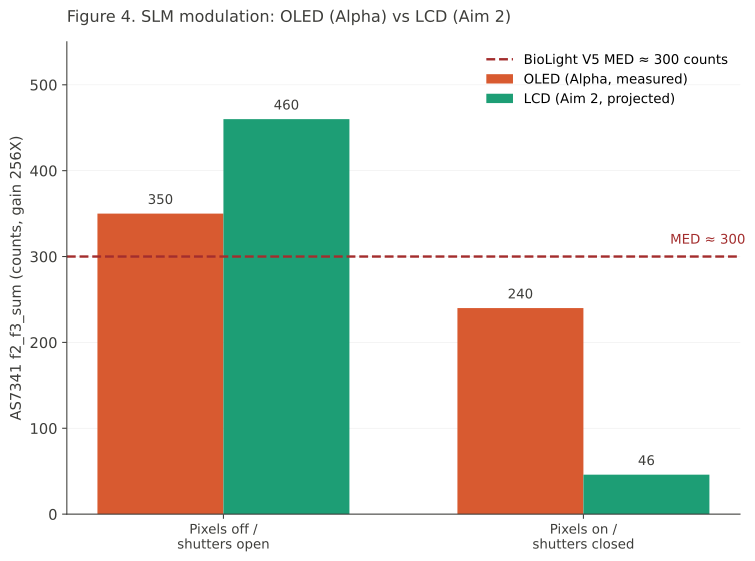
Figure 5.10. SLM modulation comparison. The OLED’s range (240–350) brackets the MED rather than straddling it, producing biology that is neither reliably dark nor reliably activated. The LCD’s projected range (46–460) clears MED in the open state and falls well below it in the closed state, enabling true toe-to-shoulder H&D characterization.
Image mask diagnostic — modulation range against the MED reference
The contrast between the two SLM options is clearest when each is plotted as a single vertical range — endpoints, midpoint, and span all visible against the MED reference. Unlike the light source case in Figure 5.9, the SLM measurements all sit comfortably within the AS7341 working range at 256X gain (noise floor ~55, saturation ~726), so no gain normalization is required for SLM characterization. The 512X gain setting remains available as a 2× amplification lever if measured LCD output falls short of projection.
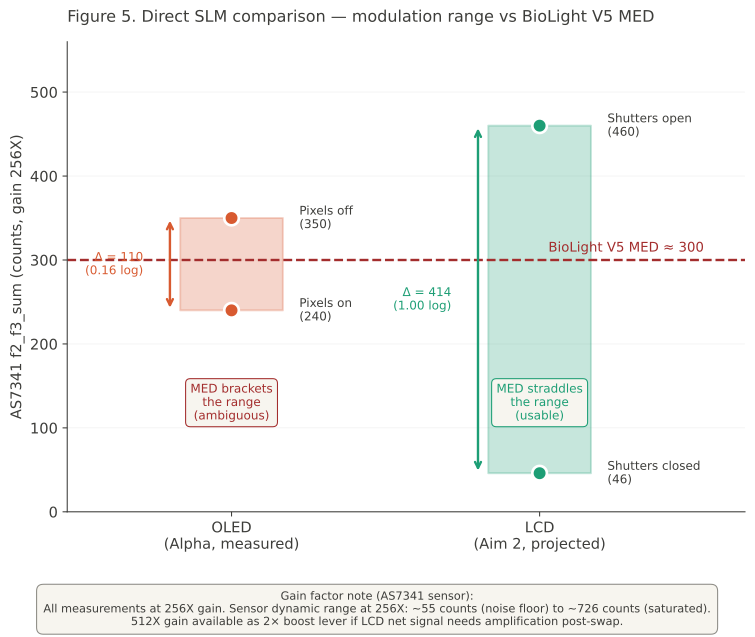
Figure 5.11. Direct SLM comparison expressed as modulation ranges at fixed gain. The OLED’s 0.16-log range fails to provide either a clean below-MED dark control or a clean above-MED activation state. The LCD’s projected 1.00-log range provides both, with the MED line falling near the middle of the operating range — the natural set-point for stepwedge characterization.
Gain selection diagnostic — Aim 2 measurement protocol
Figure 5.9 identified the measurement-protocol problem (Cree raw saturates the AS7341 at 256X gain) but did not resolve it. The AS7341’s gain ladder is multiplicative — each setting halves or doubles the analog amplification before the ADC — so the projected Cree raw counts at any candidate gain can be computed as Cree_counts(gain) = 2,300 × (gain / 256). Plotting this across the full gain ladder against the sensor’s working bounds (55-count noise floor, 726-count saturation ceiling) identifies the optimal operating window of usable gains: 8X, 16X, 32X, and 64X.
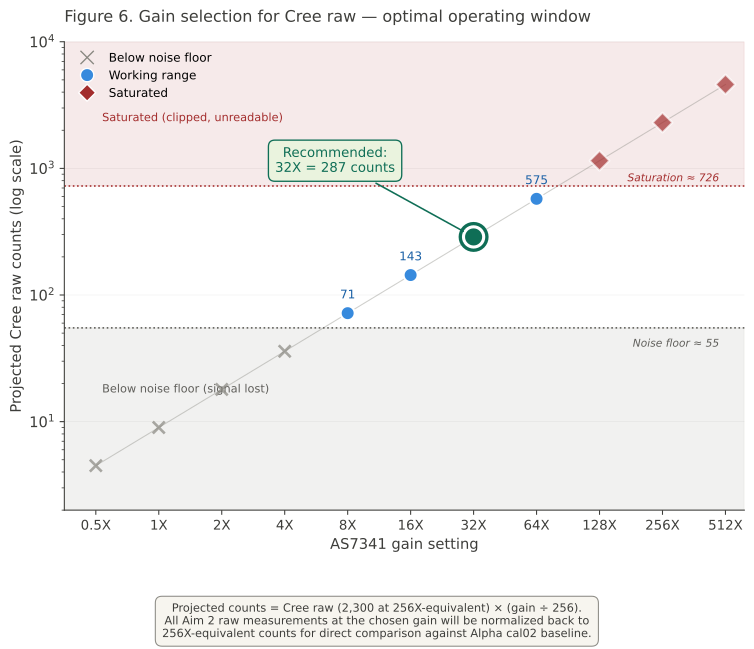
Figure 5.12. Gain selection diagnostic for Cree raw characterization. Each AS7341 gain setting is plotted against the projected counts for the Cree raw measurement, scaled from the 2,300-count reference at 256X-equivalent. The four working-range settings (8X = 72 counts, 16X = 144, 32X = 287, 64X = 575) provide candidate operating points; 32X is recommended as the balanced choice. All raw measurements at the chosen gain will be normalized back to 256X-equivalent counts for direct comparison against the Alpha cal02 dataset and the BioLight V5 MED reference.
Gain selection justification (the trade-off at 32X). Lower gain reduces analog amplification noise — gain amplifies signal and noise together, so a lower-gain reading of the same photon flux is intrinsically cleaner. This favors the lowest gain that still produces a readable signal. However, lower gain also produces fewer ADC counts per measurement, which means each count represents a larger fraction of the total signal — coarser quantization. At 8X (~72 counts) the signal occupies only ~10% of the sensor’s working range; quantization error becomes a meaningful fraction of the measurement. At 64X (~575 counts) the signal occupies ~80% of the working range with fine quantization, but the higher gain amplifies thermal and read noise more aggressively. At 32X (~287 counts) the signal occupies ~40% of the working range — deep enough into the ADC for clean quantization while keeping noise amplification minimal. A secondary consideration favors 32X: the normalization factor from measured gain back to 256X-equivalent is 8× at 32X versus 16× at 16X, so any measurement error at 32X is amplified less aggressively during normalization, preserving comparability with the Alpha cal02 baseline.
Expected Results
The Cree XP-E2 LED upgrade — delivering 10–20× higher output than the EBOOT array with a tighter 470 nm wavelength specification — is expected to clear the ≥100 µW/cm² irradiance gate at the substrate plane, bringing Photoplasm fully within the BioLightV5 exposure specification and enabling the first biological exposure runs at Genspace. With the ILI9341 transmissive LCD replacing the OLED as a true non-emissive mask, the optical stack will be free of the 470 nm emission confound discovered in calibration — producing a clean, controlled exposure field. The Raspberry Pi Camera Module will be installed during Aim 2, providing real-time machine vision feedback during duty cycle exposure runs.
In my view, Photoplasm is the novel contribution of this project to the greater synthetic biology community. As stated in the final presentation slide deck, it is unique, accessible, modifiable — hackable — and released as a fully open-source contribution under the MIT License attribution model, with detailed documentation and branching version control via GitHub to invite community innovation and rapid improvement. It is built to the same philosophy stated in the abstract: not in isolation from the research community, but in direct collaboration with it. Observing the 2026 HTGAA Final Project presentations confirmed what the design already anticipated — strong community interest in spatial modifiers, biosensors, and light-wavelength triggers across a wide range of applications.
Photoplasm is preparing to serve that interest: the current 470 nm blue light ring is the first in a planned expansion toward full RGB and color spectrometry capability, enabling a wider range of optogenetic systems to be profiled on the same open platform — the same way photographic film characteristic curves were measured across emulsions. From art and design to materials science, therapeutics, and environmental sensing, an analog light source paired with a digital LED mask will be an invaluable bench tool at scale. Many as-yet-undocumented tangential experiments and discoveries are likely to emerge as communities learn, build, calibrate, and deploy the device — and that possibility is not incidental to the project. It is the point.
Figures referenced:
- Photoplasm parts guide (refer to full build documentation and Github repository)
- AS7341 calibration data — Bayer dither H&D curve (Figure 5.1 — attach on submission)
- OLED emission discovery plot (Figure 5.2 — attach on submission)
- cal02 three-state OLED analysis (Figure 5.7)
- Light source baseline vs. Aim 2 comparison (Figures 5.8, 5.9)
- Image mask baseline vs. Aim 2 comparison (Figures 5.10, 5.11)
- Gain selection diagnostic for Aim 2 Cree characterization (Figure 5.12)
Results Block 3 — Aim 2: Test & Analyze (Development) · Expected Results
What I expect to happen is straightforward, and I say that with full appreciation of how much work it represents: a Twist order will be received, and I will be onboarded to Genspace through hands-on lab activities following a carefully designed and executed protocol. The entire project will become real the moment I see the first indication of bacterial transformation — verified by a simple 470 nm dark box exposure that confirms BioLightV5 is doing exactly what the design predicted. That moment — a glowing tube held under blue light in a dark room — is the proof point that fourteen weeks of literature review, construct design, hardware build, and calibration work has been pointing toward.
The work unfolds in three rounds:
Round 1 — Establish the baseline (Genspace Lab Block A, May 29 – June 1)
The following steps are drawn from the Aim 2 protocol currently under review — to be finalized at Genspace orientation on May 28, 2026. Specific methods, equipment access, and sequencing approach will be confirmed at that time.
- Twist DNA received, resuspended, and gel-verified at P1
- DH5α transformation, LB+Amp plating, colony picking under red safelight at P2
- Miniprep, sequence verification (method confirmed at orientation May 28), glycerol stock banking per Genspace BSL-1 SOP at P3
- MVFP induction test — 470 nm exposed tube vs dark control, sfGFP emission confirmed visually and by AS7341 sensor
- Expected result: measurable fluorescence in light tube, minimal signal in dark control (Figure 5.3 — pending)
- Gate: pass → proceed to Round 2 · fail → activate pDawn-sfGFP backup protocol
Round 2 — Initiate Photoplasm (Genspace Lab Block B, June 22–25)
- Agarose slab casting from verified working stock (OD₆₀₀ measured, low-melt agarose at 42–45°C)
- Timed duty cycle exposure through OLED digital image mask at calibrated f/8 aperture
- Three planned exposures: full step-wedge for H&D curve · Photoplasm logo binary test print · one original image mask from the 12-piece Photoplasm Art Gallery series
- AS7341 time-series data exported to CSV, fluorescence plotted vs. logarithmic light exposure
- Raspberry Pi Camera Module installed and providing real-time machine vision feedback during duty cycle
- Re-run cal02 protocol on Aim 2 hardware using gain-stepped acquisition per Figure 5.12 (32X for S1 raw to avoid saturation, 256X for S2/S3 net); normalize raw values to 256X-equivalent counts before comparison against the Alpha cal02 baseline
- Expected result: calibrated bacterial H&D curve with toe, linear, and shoulder regions documented (Figure 5.4 — pending); at least one bacteriograph demonstrating spatial sfGFP patterning from the OLED image mask (Figures 5.5, 5.6 — pending)
Round 3 — Begin Aim 3 (ongoing, Genspace ↔ MakerSpace Charlotte)
Round 3 is less a protocol and more a curriculum — a shift from validation to creative and scientific expression. Participants will build, test, and design the next level of light-reactive exposures on biosensor circuits of their choosing, using the Photoplasm platform as the shared instrument and the bacterial H&D curve as the calibrated reference.
- Genspace ↔ MakerSpace Charlotte parallel build sessions ongoing
- Photoplasm hardware and software open-sourced on GitHub under MIT License
- Transfyr.ai observational data model capturing participant engagement and experimental outcomes
- Machine vision self-correction data accumulating as the foundational training dataset for the Aim 3 fleet-level neural network
- MakerSpace Charlotte BioArt Lab advancing toward HTGAA Node authorization and Addgene MTA-ready status
- Ginkgo Bioworks CFPS pathway under development — direct line from community lab to cell-free biosensor consumable
Figures — Master List
Confirmed figures — exist or captured
| Figure | Description | Source | Status |
|---|---|---|---|
| 2.1 | BioLightV5 in Benchling — construct map | Benchling screenshot | ✅ exists |
| 3.1 | ChimeraX — dark-state RsLOV dimer, PDB 4HJ4, slate gray, yellow FMN, red Cys55, 4.324 Å | ChimeraX render | ✅ exists |
| 3.2 | ChimeraX — dark-state with teal-green DNA helix, pColE408 operator | ChimeraX render | ✅ exists |
| 4.2 | Asimov Kernel simulation graph — sfGFP expression spike | Asimov screenshot | ✅ exists |
| 4.3 | BioLightV5 non-linear design network | SVG exported | ✅ exists |
| 5.1 | AS7341 Bayer dither H&D curve — R²=0.968, 16-step logarithmic response | Python plot | ✅ exists |
| 5.2 | OLED 470 nm emission discovery — +58.7% across density range | Python plot | ✅ exists |
| 5.7 | cal02 three-state measurement — quantitative OLED additivity proof (S1=390, S2=240, S3=350) | Python plot | ✅ exists |
| 5.8 | Baseline vs. Aim 2 light source comparison with BioLight V5 MED reference | Python plot | ✅ exists |
| 5.9 | Light source raw-vs-net diagnostic with SLM transmission percentages | Python plot | ✅ exists |
| 5.10 | OLED vs. LCD modulation comparison — shutters open and closed states | Python plot | ✅ exists |
| 5.11 | SLM modulation range diagnostic — OLED brackets MED, LCD straddles MED | Python plot | ✅ exists |
| 5.12 | Cree raw gain selection diagnostic — optimal operating window at 32X | Python plot | ✅ exists |
Pending figures — wet-lab and submission
| Figure | Description | Source | Status |
|---|---|---|---|
| 5.3 | MVFP result — light tube vs dark control fluorescence | Photo / AS7341 | ⚠️ pending May 29 |
| 5.4 | Bacterial H&D curve — fluorescence vs log exposure | AS7341 CSV → Python | ⚠️ pending June 25 |
| 5.5 | First bacteriograph — spatially resolved sfGFP gradient | Transilluminator photo | ⚠️ pending June 23 |
| 5.6 | Photoplasm Art Gallery — one original image mask exposure | Transilluminator photo | ⚠️ pending June 23 |
Additional figures to be added in the v1.0 final pass as wet-lab work produces results.
Challenges
The challenge of designing a plasmid for the first time is an exciting prospect — and with excellent coaching and mentoring, along with trying different constructs, making beginner mistakes, and researching papers and literature, it has opened up an entirely new language and domain. As an industrial designer and photographer, I have found the perfect blend of modalities to apply to an established scientific industry, embarking on a revolutionary moment in history given the influence of AI, neural networks, generative algorithms, microcontrollers, and core synthetic bioscience. All of which are inherently challenging. When pulled together, each now has a more centralized focus and leads to innovation.
I embrace the challenge of learning a new domain — even with ten years of pharma and biotechnology industry experience and fifteen years of manufacturing experience — because I feel like I have reset the clock at the perfect time, to present solutions that lead to deeper understanding, learning, and practical knowledge transfer. As I stated in my earliest opening ideas on these topics, I seek to provide engaging experiences to peers, colleagues, and learners. From a practicality perspective, the advent of powerful models such as Claude have made it possible to pull together disparate pieces of information into meaningful, connected rapid prototypes that can be iterated and actualized — as shown by the results of this endeavour. I plan on analyzing all prompt turns to identify key themes that helped lead to this point, assessing what worked and what did not with the help of AI platforms of choice — looking for trends such as confidence, accuracy, corrections, and reusable prompt libraries in support of the project.
Specific challenges encountered and how each was addressed:
Plasmid design from scratch — eLightOn not on Addgene. Unlike pDawn-sfGFP which could be ordered directly, BioLightV5 had to be reconstructed from the Li 2020 paper and supplemental data — extracting protein sequences, converting to DNA via the IDT Codon Optimization Tool, and assembling the full circular plasmid in Benchling. Addressed: iterative rebuild across Benchling → Asimov Kernel → Benchling, with TA mentorship from Yehuda Binik (SBOL correction) and Anastasia Bernaz. (spacer guidance). Three sequence issues (SD17 spacing, EcoRI/XhoI sites, neutral spacer) identified and resolved in BioLightV5 V5 prior to Twist submission.
Twist order ORF/in-frame failures. The absence of restriction cut sites for future sfGFP replacement, combined with promoter and terminator in-frame dependencies, caused multiple Twist order validation failures. Addressed: iterative refinement between Benchling and Twist across multiple submission attempts, ultimately resolved in V5.
Asimov Kernel simulation dark-state gap. The circuit simulation produced an sfGFP expression spike without capturing dark-state repression — traced to the mammalian-derived model not simulating FMN chromophore photochemistry in an E. coli context. Addressed: documented as a known model artifact, not a construct flaw. The MVFP empirical validation at Genspace is the designed correction — wet-lab observation replaces what simulation cannot predict.
AlphaFold FMN photochemical gap. AlphaFold predicted a strong LexRO dimer fold but cannot simulate the FMN chromophore energy transfer that drives the dark/light transition. Addressed: ChimeraX exploration of PDB 4HJ4 confirmed the 4.324 Å Cys55–FMN distance and DNA binding/release geometry — providing mechanistic confidence the simulation could not.
EBOOT LED insufficient irradiance. Consumer-grade LED ring measured 2.0 µW/cm² at the substrate plane — 50× below the eLightOn activation threshold. Addressed: Cree XP-E2 LED upgrade ordered; irradiance gate (≥100 µW/cm² confirmed by AS7341 at plate height) defined as prerequisite before Aim 2 exposure work begins.
Pie-wedge step-wedge sensor geometry finding. The initial calibration approach using a projected pie-wedge mask caused the AS7341 to read spatial variation in the mask rather than uniform field irradiance — discovered during the April 27 calibration run. Addressed: pie-wedge retired for calibration; Bayer ordered dither pattern adopted as the calibration standard.
OLED 470 nm emission discovery. The OLED digital image mask was found to emit 470 nm light proportional to pixel density — +58.7% across the full density range — invalidating the earlier three-state transmission result. Addressed: documented as a key finding; the corrected cal02 three-state protocol quantified the additive behavior as a 145.8% pixel attenuation signature (Figure 5.7); ILI9341 transmissive LCD upgrade planned as a true non-emissive variable density mask.
Cree raw output exceeds sensor saturation at 256X gain. The Cree XP-E2 projected raw output (~2,300 counts at 256X-equivalent) substantially exceeds the AS7341’s saturation ceiling (~726 counts), preventing direct re-measurement of S1 at the same gain used for Alpha cal02. Addressed: gain-selection diagnostic developed (Figure 5.12) identifying 32X as the optimal balance of noise performance, ADC quantization precision, and normalization-error amplification; Aim 2 cal02 will use gain-stepped acquisition (32X for raw, 256X for net) and normalize raw values back to 256X-equivalent counts for direct comparison against the Alpha baseline.
Protocol dependency on Genspace confirmation. The Aim 2 wet-lab protocol is under review and will not be finalized until Genspace orientation on May 28 — meaning specific methods, equipment access, and sequencing approach remain TBD at time of submission. Addressed: protocol framed as a living document; orientation scheduled as a fixed anchor; pDawn-sfGFP backup protocol fully documented and ready to activate at any decision gate.
AI-assisted design — accuracy and verification. The use of generative AI tools across the design pipeline introduced a category of challenge unique to this moment in synthetic biology: distinguishing AI-generated approximations from verified biological facts. Addressed: every AI-assisted output was cross-referenced against primary literature, TA review, or experimental data. The prompt turn analysis planned as a post-project deliverable will formalize this verification workflow into a reusable methodology — contributing to the emerging practice of AI-assisted synthetic biology design as a documented, auditable process.