Week 7 HW: Genetic Circuits Part II
This week covers neuromorphic genetic circuits, showing how engineered gene networks can implement neural-network “perceptron”-like computation and learning.
Homework
Assignment Part 1: Intracellular Artificial Neural Networks (IANNs)
- What advantages do IANNs have over traditional genetic circuits, whose input/output behaviors are Boolean functions?
Traditional Boolean circuits are limited because they only understand “on” or “off” (0 or 1), which doesn’t reflect the noisy and analog reality of a cell. IANNs allow for weighted inputs and non-linear integration, meaning the cell can make decisions based on the concentration of signals rather than just their presence. This allows for complex pattern recognition, like identifying a specific metabolic state or a signature of multiple biomarkers, making the decision-making process much more robust and “intelligent” than a simple AND/OR gate.
- Describe a useful application for an IANN; include a detailed description of input/output behavior, as well as any limitations an IANN might face to achieve your goal.
A really great application would be a Smart Cancer Detector. The inputs (X_1, X_2, … X_n) would be the concentrations of different microRNAs or proteins that are slightly elevated in cancer cells but also present in healthy ones. An IANN could “weight” these signals so that only a specific combination above a certain threshold triggers the output ($Y$), which could be a pro-apoptotic protein to kill the cell.
- Below is a diagram depicting an intracellular single-layer perceptron where the X1 input is DNA encoding for the Csy4 endoribonuclease and the X2 input is DNA encoding for a fluorescent protein output whose mRNA is regulated by Csy4. Tx: transcription; Tl: translation.
Draw a diagram for an intracellular multilayer perceptron where layer 1 outputs an endoribonuclease that regulates a fluorescent protein output in layer 2.
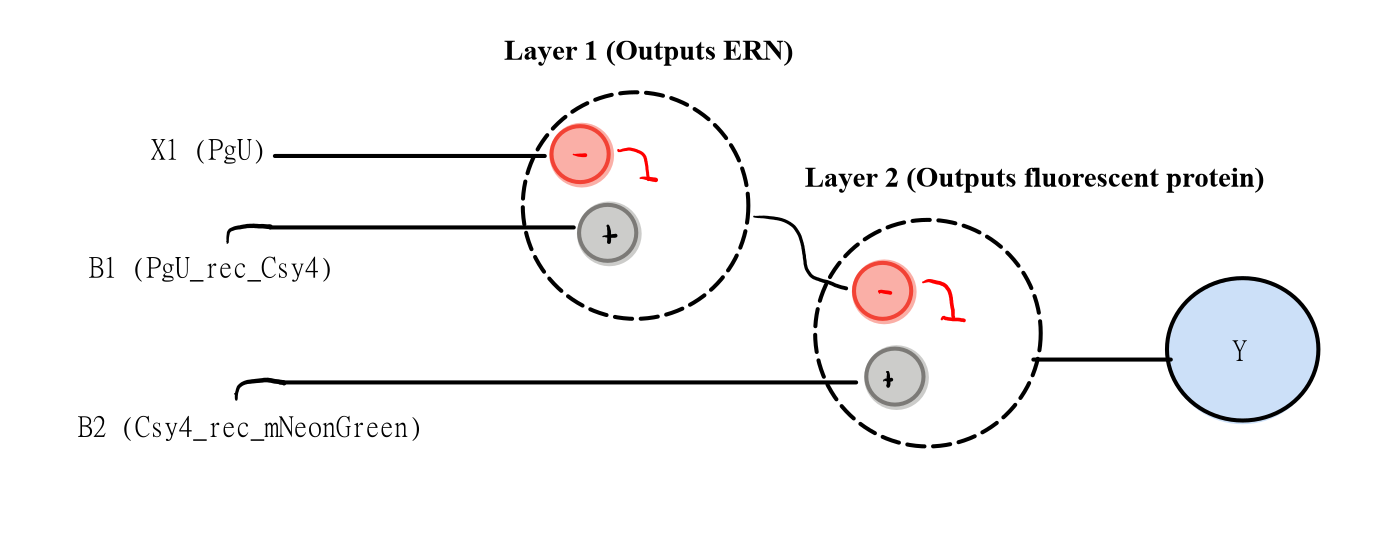
So I made the diagram for an intracellular multilayer perceptron, where the output of the first promoter must directly feed into the target regulation sequence of the subsequent node. Since the input X_1 introduces CasE via the PgU plasmid, the Bias 1 ($B_1$) node must carry the specific target loop for CasE while encoding the next layer’s enzyme (Csy4).
Corrected Component Mapping Matrix
- Input X_1:
PgUDNA (Synthesizes the functional CasE endoribonuclease). - Input X_2:
PgU_rec_mNeonGreenDNA - Bias 1 (B_1):
PgU_rec_Csy4DNA (carrying the CasE target loop) $\rightarrow$ This is the first hidden processing gate. - Bias 2 (B_2):
Csy4_rec_mNeonGreenDNA (carrying the Csy4 target loop) $\rightarrow$ This is the second processing gate regulating the final output. - Final Output (Y): mNeonGreen fluorescence signal.
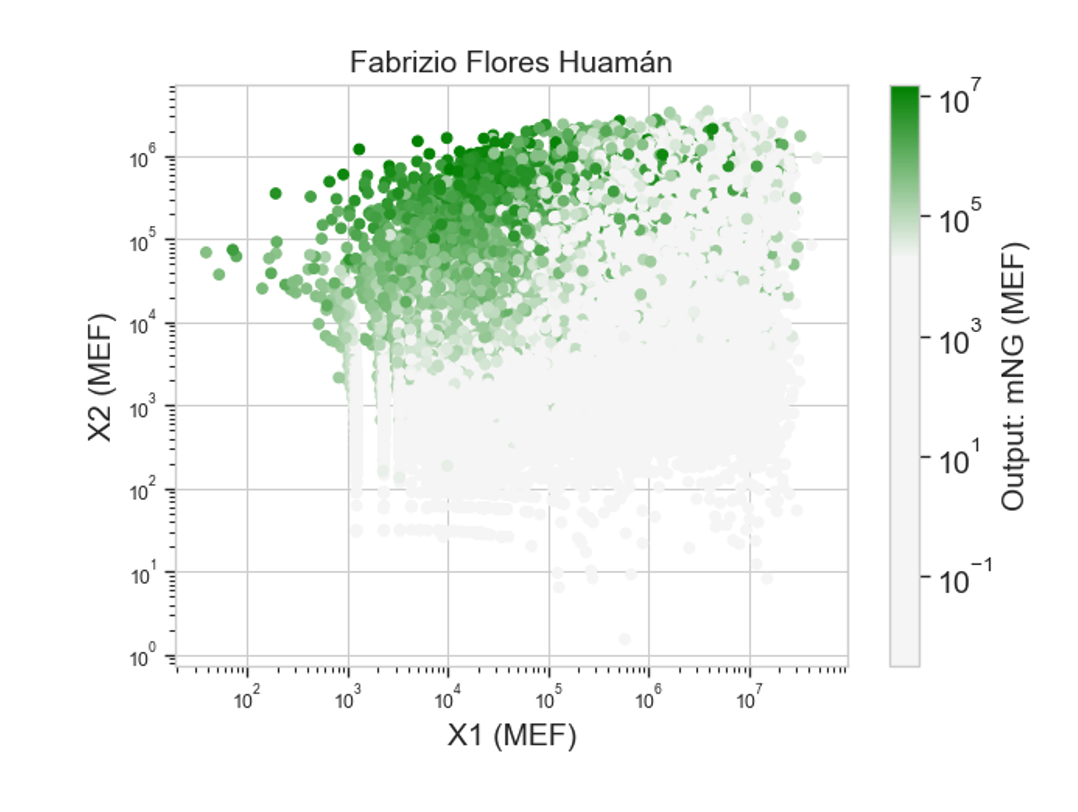
Here’s my submission for the Neuromorphic Wizard lab and result!

Assignment Part 2: Fungal Materials
- What are some examples of existing fungal materials and what are they used for? What are their advantages and disadvantages over traditional counterparts?
Some of the most well-known fungal materials are mycelium-based packaging, fungal leather like Mylo, and structural bricks used in bio-construction. The main advantage is that they are completely biodegradable and carbon-negative since they grow from agricultural waste, which fits perfectly into a circular economy model. However, they still face disadvantages compared to traditional materials because their mechanical strength is lower than concrete or plastic and their properties vary a lot depending on the substrate used, making industrial standardization quite difficult.
- What might you want to genetically engineer fungi to do and why? What are the advantages of doing synthetic biology in fungi as opposed to bacteria?
In my case, I would use genetic engineering to make fungi secrete specific enzymes or cross-linking proteins like tyrosinases directly into the mycelium mat, allowing the material to gain stiffness and water resistance automatically as it grows. The advantage of using fungi instead of bacteria is that being eukaryotes, they can perform complex post-translational modifications on proteins. Also, their filamentous growth through hyphae allows them to bridge physical gaps and create 3D structures with inherent mechanical integrity, which is something bacteria cannot achieve since they mostly form biofilms without such an organized physical structure.
Assignment Part 3: First DNA Twist Order
Assignees for the following sections
| MIT/Harvard students | Required |
| Committed Listeners | Required |
- Review the Individual Final Project documentation guidelines. Done
- Submit this Google Form with your draft Aim 1, final project summary, HTGAA industry council selections, and shared folder for DNA designs. DUE MARCH 20 FOR MIT/HARVARD/WELLESLEY STUDENTS Submitted
- Review Part 3: DNA Design Challenge of the week 2 homework. Design at least 1 insert sequence and place it into the Benchling/Kernel/Other folder you shared in the Google Form above. Document the backbone vector it will be synthesized in on your website.