Week 3 HW: Lab Automation
Assignment: Python Script for Opentrons Artwork
https://opentrons-art.rcdonovan.com/?id=44nd2j8trb218x2
Post-Lab Questions
In this study, researchers at Colorado State University demonstrate a novel application of the Opentrons OT-2 liquid handling robot to automate the scale-up of protein crystallization. Protein crystallization is a critical bottleneck in structural biology and the development of protein-based biomaterials, yet traditional manual methods are time-consuming, labor-intensive, and prone to variability between researchers. The team sought to determine whether an affordable, general-purpose liquid handling system could reliably perform the complex steps required for sitting drop vapor diffusion experiments at the 24-well scale.
To achieve this, the researchers developed custom Python scripts to control the OT-2 with precision, enabling it to mix reservoir solutions with precise gradients of precipitants, buffers, and salts before combining small volumes of these mixtures with protein samples on crystallization pedestals. A significant technical hurdle was the incompatibility of the non-standard Hampton Research CrysChem 24-well plates with the OT-2’s deck. The team overcame this by designing and 3D-printing a custom adapter to securely hold the plates, demonstrating the flexibility and customizability of the Opentrons platform. All protocols, scripts, and design files were made openly available on GitHub.
The automated system was successfully validated using two different proteins: hen egg white lysozyme (HEWL), a model protein, and an engineered periplasmic protein from Campylobacter jejuni , which the lab uses as a biomaterial for nanotechnology applications. The OT-2 produced crystals for both proteins, with the HEWL trial yielding crystals in 18 out of 24 wells within 24 hours. When compared directly to manual plate setup by multiple researchers with varying experience levels, the OT-2 produced crystals more consistently, reducing well-to-well variability. While the robot took slightly longer to set up plates than an experienced scientist (approximately 30-40 minutes), it freed the researcher to focus on other tasks. Accuracy testing revealed that while pipetting errors increased with viscosity (reaching 13.5% for 1 μL of 100% glycerol), errors were minimal for more moderate viscosity solutions commonly used in crystallization screens.
Figure 4 shows the proof-of-concept sitting drop plates prepared with food coloring to visualize correct mixing. The OT-2 prepared a plate with a blue gradient increasing from left to right and a red gradient increasing from top to bottom, compared to an identical plate prepared manually. No differences were discernable between the robot-prepared and manually prepared plates, confirming the OT-2’s ability to accurately dispense and mix liquids according to the programmed gradients.
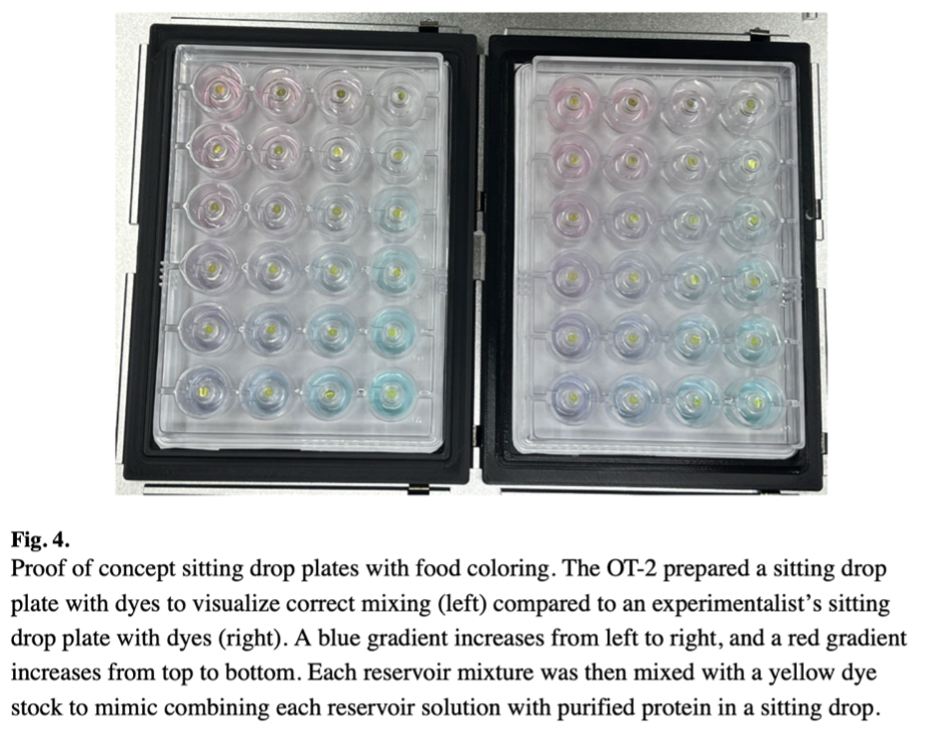
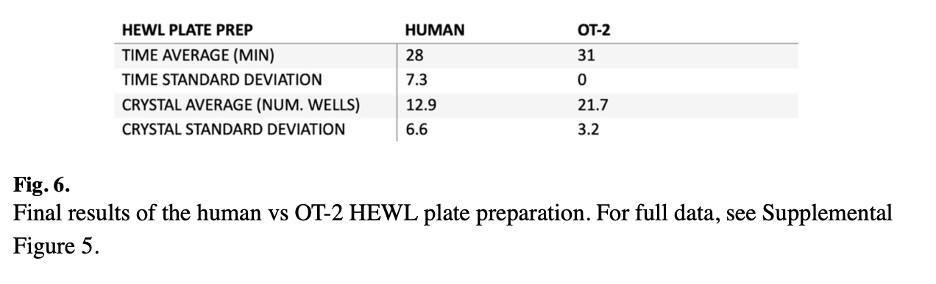
Figure 6 presents the final results of the human versus OT-2 HEWL plate preparation comparison. The robot demonstrated more consistent crystal production across multiple plates compared to human researchers with varying levels of wet lab experience, highlighting the automation advantage in reducing person-to-person variability.
DeRoo, J. B., Jones, A. A., Slaughter, C. K., Ahr, T. W., Stroup, S. M., Thompson, G. B., & Snow, C. D. (2025). Automation of protein crystallization scaleup via Opentrons-2 liquid handling. SLAS technology, 32, 100268. https://doi.org/10.1016/j.slast.2025.100268
2.
I intend to develop an automated workflow to study microbial resistance patterns in pathogens isolated from cystic fibrosis (FC) patients in Ecuador. Cystic fibrosis patients are particularly susceptible to chronic respiratory infections, often involving multi-drug resistant organisms that require precise susceptibility testing to guide clinical treatment. My project will leverage the Opentrons OT-2 liquid handling robot to automate minimum inhibitory concentration (MIC) testing, enabling high-throughput screening of patient isolates against a panel of clinically relevant antibiotics.
This automated workflow will enable systematic resistance surveillance in a vulnerable patient population while demonstrating the power of open-source automation tools in resource-limited settings. By combining the affordability of the Opentrons platform with custom 3D-printed adapters and open-source Python scripts, this project provides a template for laboratories in Ecuador and similar settings to implement sophisticated antimicrobial susceptibility testing without prohibitive equipment costs. Importantly, by automating the most labor-intensive and error-prone steps of MIC testing, this approach frees skilled microbiologists to focus on interpretation and patient care rather than repetitive pipetting. Ultimately, this work aims to improve clinical outcomes for cystic fibrosis patients in Ecuador by providing faster, more reliable, and more comprehensive susceptibility data to guide antibiotic therapy decisions in an era of rising antimicrobial resistance.}
Sample Processing Module: After patient sputum samples are cultured on selective media and individual colonies are isolated, the automated workflow begins. For each confirmed pathogen, a single colony is inoculated into a Mueller-Hinton broth in culture tubes and placed in the shaking incubator at 35°C until logarithmic growth phase is achieved.
MIC Testing Workflow: The antibiotic susceptibility testing will follow established high-throughput MIC protocols using 96-well plates . Using the Ginkgo Nebula platform for experimental design, I will create a randomized block design to test multiple patient isolates against a panel of 8-10 antibiotics commonly used in Ecuadorian clinical settings. The OT-2 will perform serial dilutions of antibiotic stocks directly in the 96-well plates, followed by inoculation with standardized bacterial suspensions normalized to 0.5 McFarland standard. This automation eliminates the manual pipetting errors that often plague MIC testing and ensures consistent dilution series across all samples.
Python Control Scripts: The OT-2 will run custom Python scripts incorporating deck layout definitions, tip tracking, and error handling. Techniques from the crystallization paper, such as tip touching for complete dispensing and slow aspirate speeds for foaming antibiotics, will be included. Scripts will include pause points for manual interventions like transferring plates to the incubator.
This automated workflow enables systematic resistance surveillance in a vulnerable population while demonstrating open-source automation in resource-limited settings. By combining the affordable Opentrons platform with existing lab infrastructure and custom 3D-printed adapters, this project provides a template for laboratories in Ecuador to implement sophisticated susceptibility testing without prohibitive costs. The system can process dozens of isolates simultaneously with minimal hands-on time, freeing microbiologists for interpretation and patient care. For Ecuador, where antimicrobial resistance is an emerging threat but surveillance resources are limited, this open-source approach democratizes access to high-quality testing.
Ultimately, this work aims to improve clinical outcomes for cystic fibrosis patients by providing faster, more reliable susceptibility data to guide antibiotic therapy. By establishing baseline resistance patterns and tracking changes over time, the project can inform empiric treatment guidelines and contribute to global antimicrobial resistance surveillance. All protocols, scripts, and design files will be openly available for adaptation by other laboratories facing similar challenges.