Week 7 HW: GENETIC CIRCUITS PART II: NEUROMORPHIC CIRCUITS
Assignment Part 1: Intracellular Artificial Neural Networks (IANNs)
1. IANNs have a major advantage in computational efficiency. A traditional Boolean circuit needs many logic gates to compute a complex function, but a single IANN layer can perform weighted summation of multiple inputs at once. This allows an IANN to solve problems like linear classification using far fewer genetic parts. IANNs are naturally robust to cellular noise. Boolean circuits require sharp thresholds to distinguish a 0 from a 1, so small fluctuations in gene expression can cause logic errors. IANNs use smooth, analog activation functions, meaning noise only causes small, gradual errors in the output rather than complete failure. IANNs can process analog signals directly. Most natural cellular signals, like metabolite concentrations, are continuous values, not binary ones. A Boolean circuit must first convert these into discrete 0/1 states, losing information. An IANN accepts the raw analog value and computes with it directly. IANNs scale better with input complexity. Adding a new input to a Boolean circuit often requires redesigning multiple logic gates to avoid combinatorial explosion. In an IANN, adding an input simply means creating one new weighted connection, making it more practical for multi-sensor applications. Finally, IANNs can be trained using machine learning approaches. The weights in an IANN correspond to measurable biological parameters like promoter strengths, which can be tuned through directed evolution or feedback. Boolean circuits lack this continuous, tunable parameter space.
2. Application: A cancer-discriminating cell therapy. An IANN is engineered into a therapeutic cell (a T-cell) that must decide whether a nearby cell is cancerous or healthy based on multiple surface protein markers. Input behavior: The IANN takes three continuous analog inputs, each representing the measured concentration of a specific cancer-associated antigen on the target cell’s surface. Input A = HER2 level, Input B = EpCAM level, Input C = MUC1 level. These inputs are not binary (present/absent) but graded values from 0 to 1, normalized to physiological ranges.
Output behavior: The IANN computes a weighted sum: Score = w1A + w2B + w3*C. It then passes this score through a sigmoid activation function. If the output exceeds a threshold (e.g., 0.7), the therapeutic cell releases a cytotoxic agent (like granzyme B) to kill the target. If the output is below threshold, the therapeutic cell does nothing. Critically, the IANN can learn that healthy cells may express low levels of one antigen, but only the combination of all three at moderate levels indicates cancer. Limitations to achieve this goal: First, dynamic range compression. Natural promoters have limited output ranges (often only 10- to 100-fold). If input signals saturate at high antigen concentrations, the IANN loses its ability to distinguish between a very cancerous cell and a moderately cancerous one. This requires engineering promoters with wider linear response ranges. Second, weight precision. The weights (w1, w2, w3) are determined by relative promoter strengths, transcription factor binding affinities, and degradation rates. Biologically, these parameters have inherent variability of 20-50% between cells. For reliable cancer discrimination, the IANN needs weight precision within about 10%, which is currently very difficult to achieve. Third, crosstalk and resource burden. All three input pathways share the cell’s limited transcriptional machinery. High expression of multiple sensors can titrate away RNA polymerase or cause metabolic load, distorting the intended weighted sum. This requires careful circuit insulation and orthogonal parts. Fourth, evolutionary stability. Cancer cells mutate rapidly. If the IANN’s weights are genetically fixed, a cancer cell could escape detection by downregulating just one of the three antigens. A practical system would need a mechanism to retrain or adapt the IANN over time, which remains an open research challenge. Despite these limitations, this application is actively pursued because an IANN can solve a pattern recognition problem that no simple Boolean AND or OR gate can handle: detecting cancer based on a specific combination of continuous biomarker levels rather than just their presence or absence.
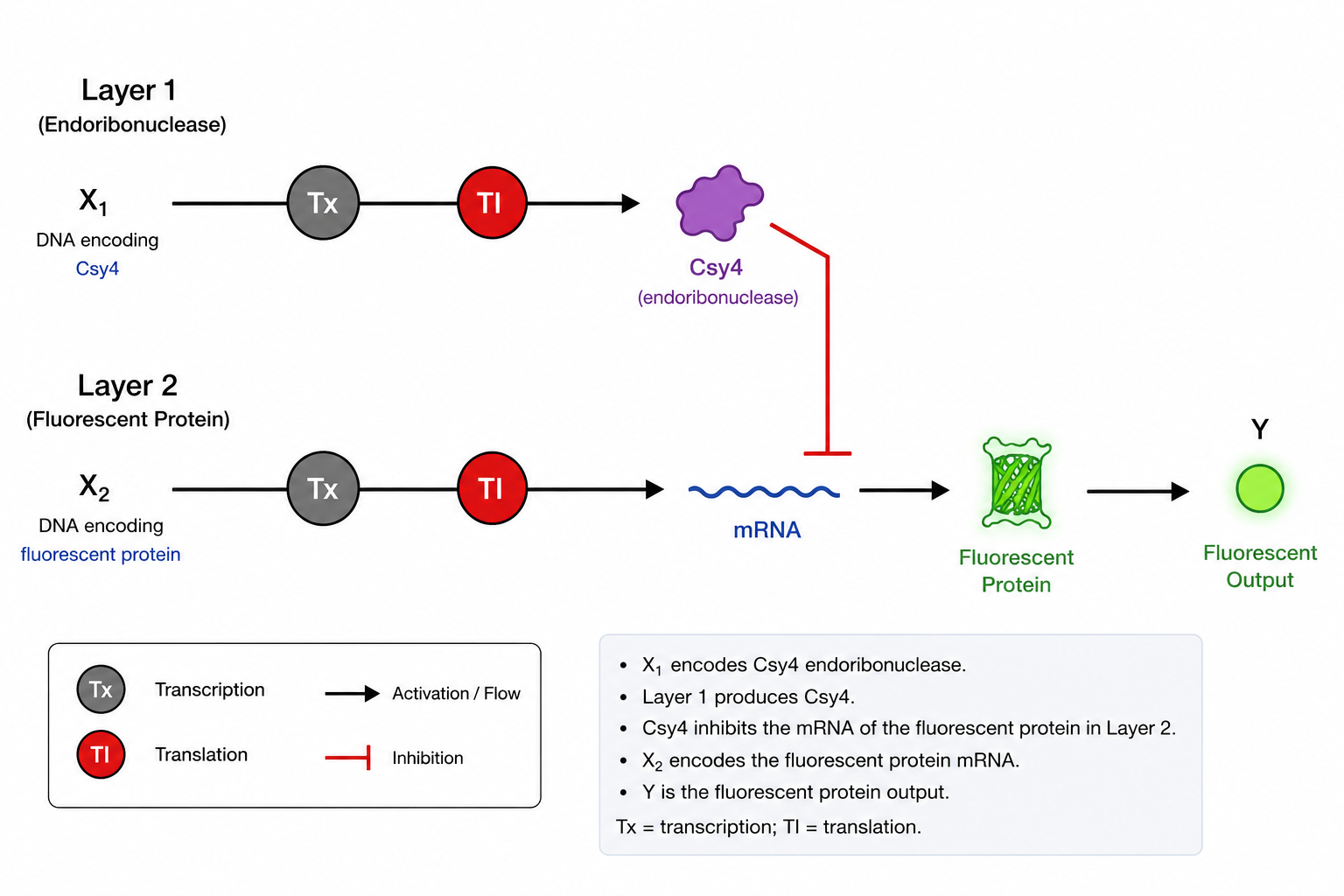
3.
Assignment Part 2: Fungal Materials 1. Mycelium-based composites (MBCs) are among the most developed fungal materials. These are created by growing fungal mycelium on agricultural waste products like straw, sawdust, or rice husks, which the fungi bind together into a solid material. They are currently used for thermal and acoustic insulation in construction, as well as for packaging, furniture, and panelling. Mycoprotein is another major fungal material, produced by fermenting fungi like Fusarium venenatum to create a protein-rich food ingredient. It is sold as a meat alternative with a texture and flavor that closely resembles meat. Fungal-synthesized nanoparticles represent an emerging category. Fungi such as Aspergillus niger can reduce metal precursors to produce silica, silver, and gold nanoparticles. These have applications in biomedicine (antimicrobials, biosensing), agriculture, and environmental remediation. Advantages: Mycelium composites are cost-effective, lightweight, biodegradable, and have a low carbon footprint. They offer exceptional thermal insulation, excellent acoustic absorption, and superior fire safety compared to synthetic foams and engineered wood. Mycoprotein production requires 70% less land than chicken farming and reduces freshwater pollution risk by 78%. Fungal nanoparticle synthesis is an eco-friendly, low-waste alternative to energy-intensive chemical methods. Disadvantages: MBCs have foam-like mechanical properties and high water absorption, restricting them to non-structural roles like insulation and furniture rather than load-bearing applications. Mycoprotein from natural fungal strains has thick cell walls that make nutrients difficult for humans to digest. For fungal nanoparticles, inconsistencies in yield and reproducibility remain major challenges 2. Improving food sustainability is a primary goal. Researchers have already used CRISPR to remove genes for chitin synthase (thinning cell walls for better digestibility) and pyruvate decarboxylase (reducing nutrient requirements). The engineered strain requires 44% less sugar and produces protein 88% faster. Enhancing material properties offers another avenue. Engineering fungi to produce denser or water-resistant mycelial networks could enable load-bearing construction materials. Modifying the chitin-to-glucan ratio in hyphal walls could improve mechanical strength.
Producing high-value compounds is a third goal. Fungi could be engineered to synthesize pharmaceuticals, industrial enzymes, or specialized chemicals more efficiently than current methods Eukaryotic protein processing is a key advantage. Fungi perform post-translational modifications like glycosylation that bacteria cannot, making them better hosts for producing complex therapeutic proteins that require proper folding. Superior secretion capabilities set fungi apart. Filamentous fungi can secrete large quantities of proteins and enzymes into their growth medium—sometimes exceeding 100 g/L—which dramatically simplifies downstream purification compared to bacterial systems where products often remain intracellular. Ability to degrade complex substrates gives fungi an edge. Many fungi naturally break down lignocellulosic plant matter, enabling them to grow on low-cost agricultural waste rather than refined sugars. This makes fungal production more economical for bulk materials. Safety advantages exist for certain applications. Fungi are generally recognized as safe for food production, and unlike E. coli, they do not produce endotoxins that complicate therapeutic manufacturing. Disadvantages compared to bacteria include slower growth rates, less extensive genetic toolkits, and more limited fundamental genetic knowledge, though these gaps are rapidly closing with advances in CRISPR and fungal genomics.