Week 3 HW: Lab Automation
Lab Automation Article of Interest:
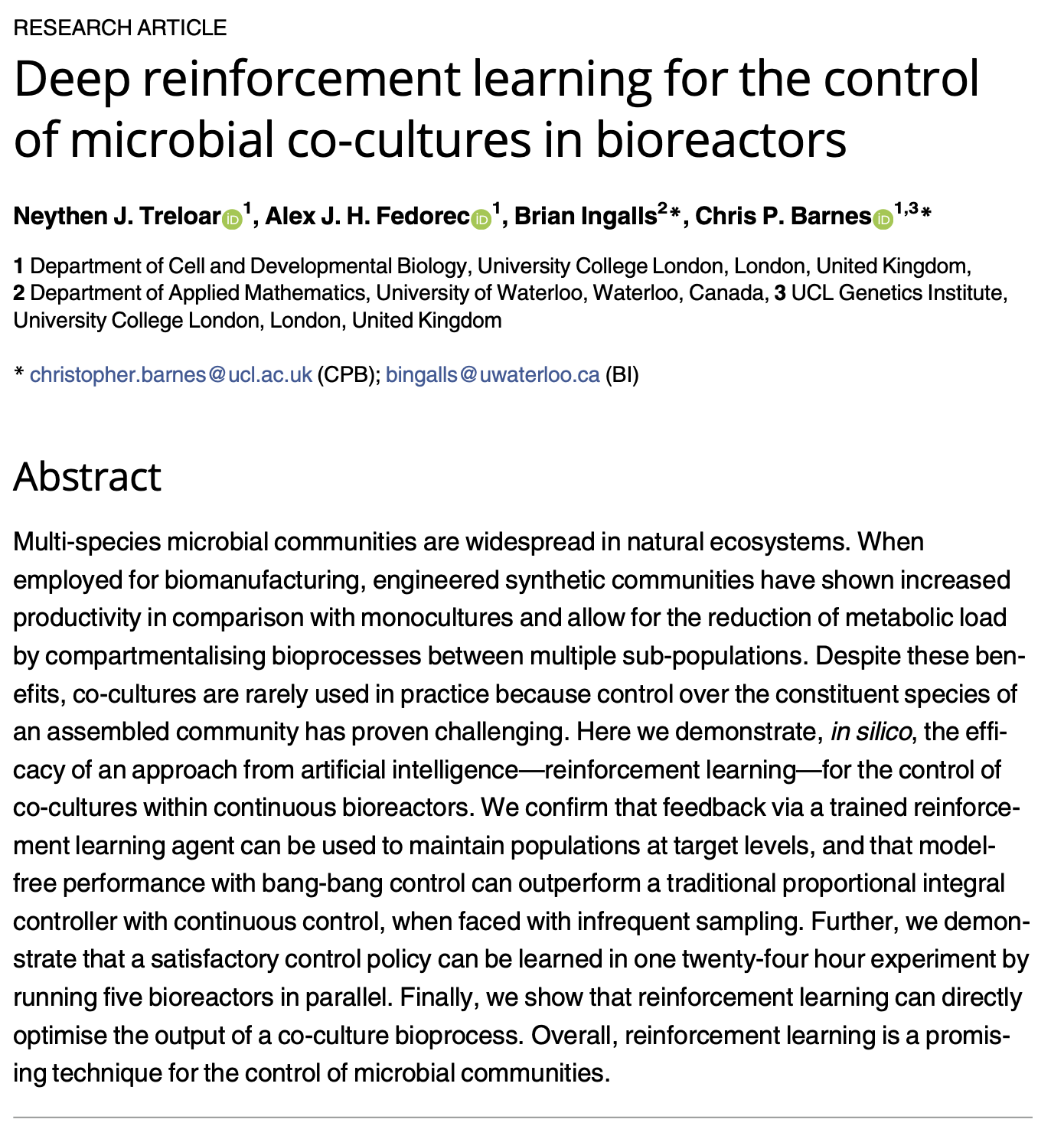
Deep reinforcement learning for the control of microbial co-cultures in bioreactors
This study uses an automation tool in the form of AI-based process control, deep reinforcement learning. Instead of manually tuning bioreactor conditions, the authors train an algorithm to make control decisions that regulate nutrient inputs and maintain stable microbial populations in co-culture. The novel biological application is dynamic control of multi-species microbial communities, which is a major challenge in synthetic biology and biomanufacturing because species can outcompete each other or become unstable over time. The paper shows that reinforcement learning can effectively stabilize co-cultures and optimize bioprocess performance in silico, demonstrating a promising path toward autonomous bioreactor operation. This is significant because reliable co-culture control could improve production efficiency and enable more complex engineered biological systems.
Final Project Automation
For my final project, I intend to use automation tools to identify the best construct architecture (single plasmid vs. multi-plasmid system, promoter/RBS combinations, and coding sequence variants) needed to make the fungal bioluminescence pathway (FBP) + BRET system function across multiple host organisms.
My goal is to build a scalable design-test-learn workflow rather than test only a few manual designs. I will use lab automation to generate and evaluate many candidate sequence/plasmid combinations in parallel, then iteratively improve designs using data from each round.
Planned automation workflow
- Design Phase
- Build a combinatorial library of FBP + BRET constructs (promoters, copy number, linkers, fluorescent acceptors, plasmid architecture).
- Build Phase
- Use automated liquid handling (or cloud-lab style protocols) for DNA assembly setup, transformation setup, and plate preparation.
- Test Phase
- Measure luminescence, fluorescence, and growth (OD) in microplate format.
- Use standardized imaging conditions and, if needed, a simple 3D-printed holder/dark-box insert for reproducible camera-based signal capture.
- Learn Phase
- Use Python-based analysis to rank designs by brightness, brightness/OD, and BRET signal ratio.
- Select top performers for the next iteration and/or for testing in additional hosts.
Optional scale-up plan (Ginkgo Nebula)
If available, I would use Ginkgo Nebula to scale beyond local throughput: submit top construct sets for higher-throughput build/test cycles across multiple organisms and feed those results back into my design loop.
Overall, automation is central to my project because it enables systematic, reproducible, and data-driven optimization of a complex FBP + BRET system across diverse biological hosts.
Final Project Aims
Aim 1.
Build an automated design-build-test workflow and demonstrate baseline fungal bioluminescence pathway expression initially in E. coli.
- Include: at least a small construct panel (e.g., 4-12 variants)
- Success metric:
- Reproducible luminescence with automated assay + analysis pipeline working end-to-end
Aim 2.
Add BRET module and use automation to identify a better-performing construct architecture (single vs multi-plasmid and promoter/linker combinations) in both hosts.
- Success metric:
- Measurable spectral shift and improved BRET ratio vs donor-only control; identify at least one top-ranked architecture
- BRET luminescence/fluorescence improvement >20% vs bioluminescence alone
Aim 3
Design and pilot multi-host optimization strategy (with Ginkgo Nebula as scale-up path)
- Success metric:
- Transfer top designs to additional hosts, sucha as Plants, and improve brightness/OD + stability through multiple rounds