Week 7 HW: Genetic Circuits Part II
Intracellular Artificial Neural Networks (IANNs)
Questions
What advantages do IANNs have over traditional genetic circuits, whose input/output behaviors are Boolean functions?
- IANNs offer several advantages over traditional genetic circuits. Unlike the Boolean systems that produce binary ON/OFF outputs, IANNs generate continuous, graded responses that better reflect the analog nature of biological systems. They can also be trained by adjusting weights, allowing them to learn complex input–output relationships rather than relying on fixed logic. This enables IANNs to handle nonlinear interactions and integrate multiple inputs more effectively. Additionally, IANNs are more scalable and robust to biological noise, as their distributed architecture reduces sensitivity to fluctuations. Overall, IANNs enable more sophisticated information processing, such as pattern recognition and prediction, which is difficult to achieve with traditional genetic circuits.
Describe a useful application for an IANN; include a detailed description of input/output behavior, as well as any limitations an IANN might face to achieve your goal.
- A useful application of an Intracellular Artificial Neural Network (IANN) that aligns with my interest, would be a self-optimizing bioluminescent plant that dynamically adjusts its glow based on internal metabolic state and environmental conditions. The IANN could take continuous inputs such as glucose levels, ATP availability, oxygen concentration, and light exposure, and process them through weighted interactions to produce a graded output controlling expression of a bioluminescent pathway (e.g., fungal luciferase genes). Rather than a simple ON/OFF response, this system would enable fine-tuned luminescence, increasing brightness when energy is abundant and reducing it under stress to minimize metabolic burden, while also capturing complex interactions between inputs. However, implementing this system presents challenges, including biological noise, difficulty in precisely tuning network weights, increased metabolic load as network complexity grows, and the challenge of training or optimizing the network in living cells, especially when transferring designs between organisms such as microbes and plants.
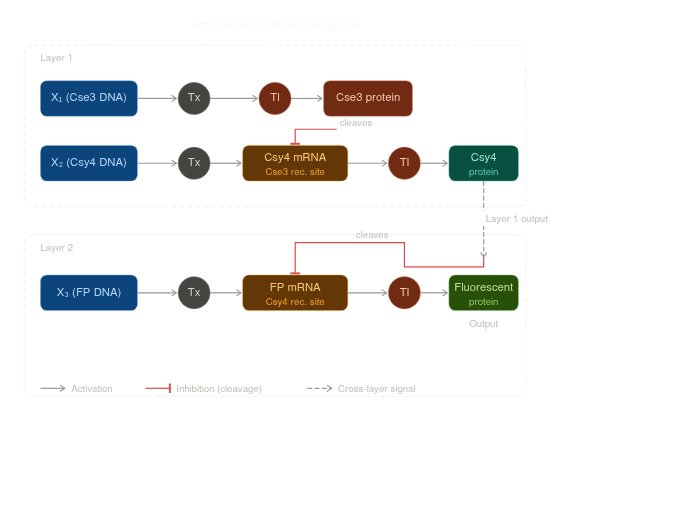
Draw a diagram for an intracellular multilayer perceptron where layer 1 outputs an endoribonuclease that regulates a fluorescent protein output in layer 2.
Fungal Materials
Questions
What are some examples of existing fungal materials and what are they used for? What are their advantages and disadvantages over traditional counterparts?
- Fungal materials are being used for things like biodegradable packaging, leather alternatives, insulation, furniture, and some building materials. Their biggest advantage over traditional materials like Styrofoam, plastic, and animal leather is that they are more sustainable, can be grown from agricultural waste, and are biodegradable instead of sitting in landfills for years. They can also be lightweight and provide decent insulation. However, their main disadvantages are that they are often weaker, absorb water more easily, and can be less durable than traditional materials, which makes them harder to use in high-performance or structural applications. Overall, fungal materials are a really promising sustainable alternative, but they still are not always as strong or reliable as the materials they are trying to replace.
What might you want to genetically engineer fungi to do and why? What are the advantages of doing synthetic biology in fungi as opposed to bacteria?
- If I were going to genetically engineer fungi, I would want to make them produce brighter bioluminescence or useful natural products, which is something I’m especially interested in. For example, engineered fungi could potentially be used to make self-reporting materials that glow when they are stressed, contaminated, or exposed to certain environmental conditions. Fungi are also attractive for synthetic biology because they are eukaryotes, so they are more similar to plants and animals than bacteria are, which makes them better for expressing more complex pathways and proteins. They can also naturally produce a lot of interesting metabolites and are often better at secreting proteins and enzymes. Compared to bacteria, fungi can be slower to grow and sometimes harder to engineer, but they offer a much better platform for building more complex biological systems and materials.
First DNA Twist Order
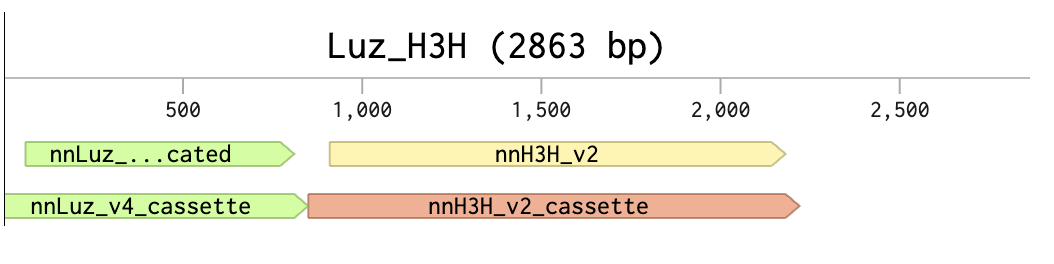
Insert:
 Backbone Vector: pBR322