Fungal Materials
1. Fungal materials and their applications
Fungal materials are biomaterials made out of fungi, a kingdom of organisms that includes yeasts, molds and mushrooms. The fruiting body of Fomes fomentarius (aka “tinder fungus”) is known for its ancient use as a fire-starter and has been used for centuries to make amadou, a buckskin-like fabric. However, the traditional craft of amadou-making is slowly dying and the vast majority of fungal materials are now made of mycelium, the root-like part of mushrooms and molds that consist of a vast network of microscopic thread-like filaments.
Contemporary examples: Mycelium-based materials can be used to make textiles, packaging, isolation panels, furniture, building materials and even funerary vessels. Yeasts (unicellular micro-organisms classified as fungi) have also been reported to be used to create glue and other adhesive materials. And while they are less popular, fruity bodies are also used to make packaging, leather-like textiles and waterproof sealants.
Contemporary mycelium-based material designs

Mycelium-based materials serve as seemingly non-toxic, sustainable, biodegradable, and low-density alternatives to a wide array of synthetic and traditional materials such as plastic, polystyrene or even wood.
Composite-mycelium materials grow a network that binds to a matrix and can be molded: they basically assemble themselves using waste products. They represent an interesting alternative to packaging materials such as plastic or polystyrene.
Construction is currently one of the most polluting industry sectors. While fungal materials represent a more sustainable alternative than concrete, their low density can be an asset when used as isolation panels but a drawback for structures that require more mechanical stability.
Another weakness of mycelium-based materials is their lack of resistance to moisture. AI mycelium-based furniture and constructions look esthetically and conceptually attractive, but how will they age over time?
2. Engineering fungal materials
Fungi are eukaryotes, meaning their cellular machinery is more similar to plants and animals. Bacteria can be useful for the fast production of simple molecules but fungi allows the production of more complex proteins and in higher quantities.
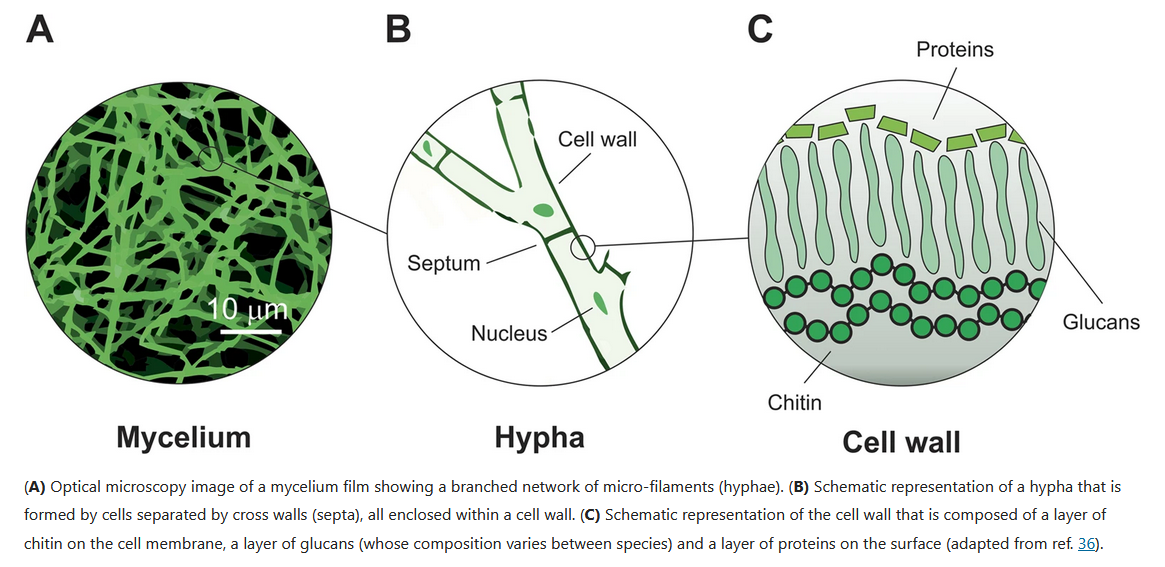
As explained by Ren Ramlan during recitation, engineering fungi would help overcome some of these current limitations. For instance, introducing mutations into genes involved in the regulation of chitin, glucans or other proteins composing the cell walls of the hifae may lead to produce mycelium-based materials with stronger mechanical or waterproof properties. Being said, some conceptual paradoxes can also appear when thinking about engineering mycelium: if we design mycelium-based materials to be stronger, they become harder to break down and thus, less eco-friendly.
Schematic representation of mycelium physiology at different scales from Advanced Materials From Fungal Mycelium: Fabrication and Tuning of Physical Properties:
When it comes to scaling up mycelium-based production, scientists working in the industrial sector may want to engineer mycelium to achieve better control over material production and quality (e.g. reduce contamination risks). Whether mass production can ever be truly sustainable without changing our consumption practices, however, remains an open question.
3. How To Grow A Mycelium-based Tampon
Period poverty affects over 500 million people world-wide and leads to missed education/work and health risks from using improper materials. And when available, single-use menstrual products create significant environmental damages including plastic pollution and an annual release of hundreds of thousands of tons of waste.
If invited to create a mycelium-based product, I would first aim to evaluate whether it is possible or not to create basic and safe DIY mycelium-based menstrual pads.
In a second step, I would design and engineering a mycelium-based tampon that presents reduced risk for toxic shock syndrome. I would try to stay as close as possible to the natural material, but explore how to engineer the fibers so that they can capture and possibly digest or neutralize toxins produced by bacterial strains such as Staphylococcus aureus or Streptococcus pyogenes.
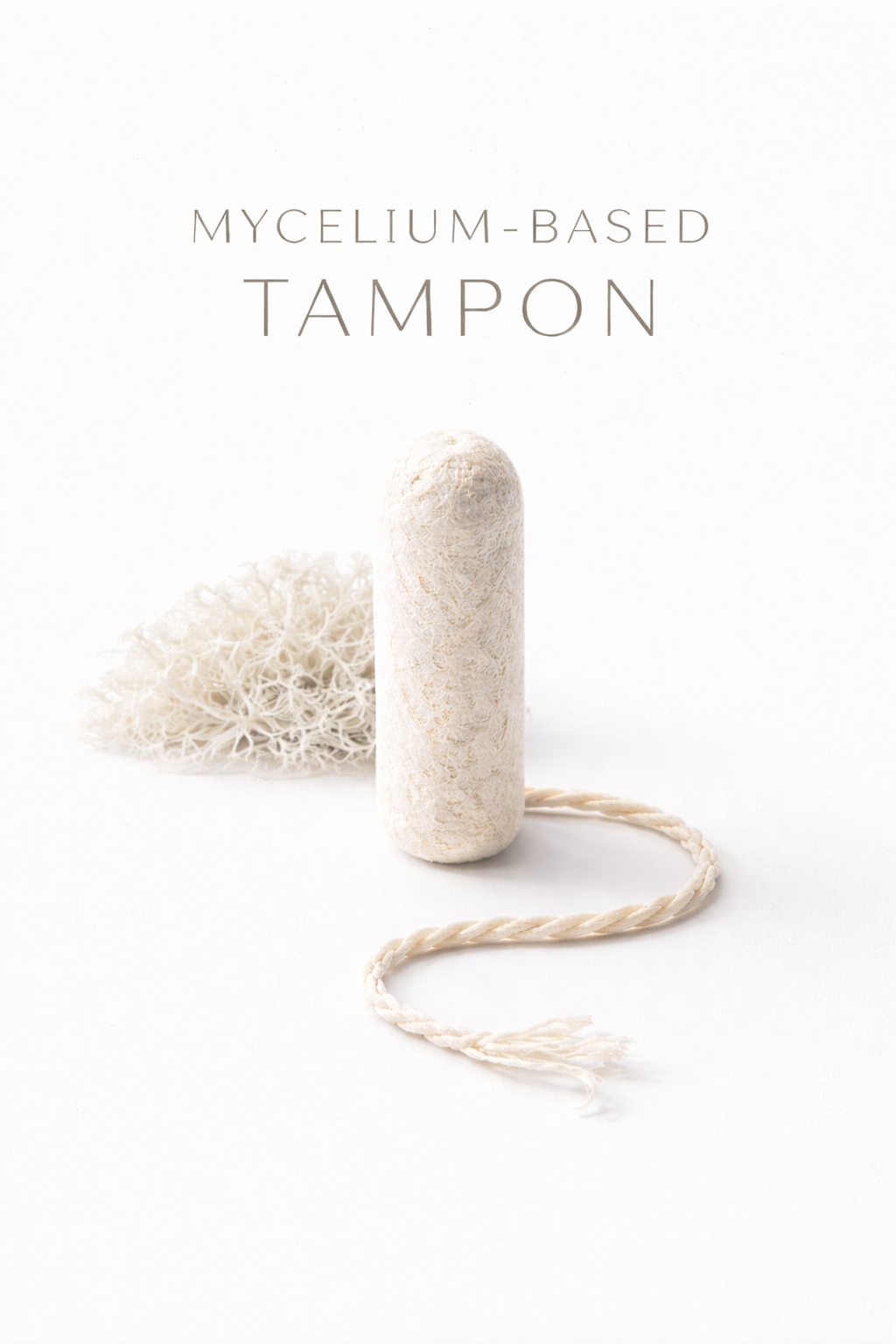 (c) Flo Razoux with use of AI
REFERENCES
The World’s Last Amadou Makers
Mycelium: Rethinking Materials in Design
Breaking Down the Barriers: The Future of Mycelium-Based Materials
Period Poverty and Stigma: A Matter of Human Rights
Toxic Shock Syndrome: A Literature Review
FURTHER READINGS
Engineering yeast for bioplastic production
Mycelium-based composites: An updated comprehensive overview