Freeze-Dried CFS in Space
Glow for Life: Detecting Biosignatures in Microgravity
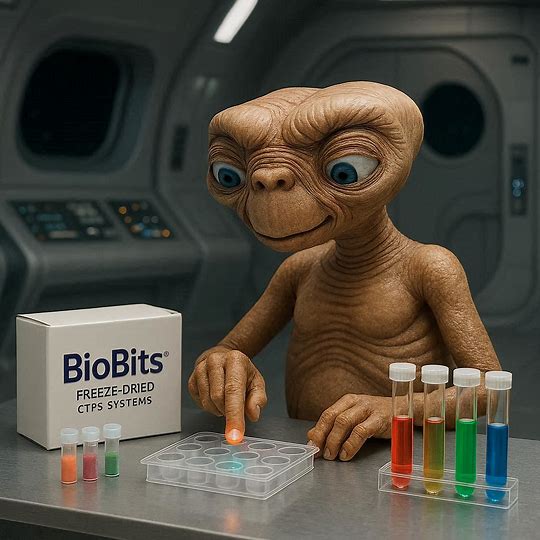 A BioBits® promo campaig generated by ChatGPT
Background
Long-duration space missions require compact systems capable of detecting possible biosignatures in extraterrestrial environments. Freeze-dried cell-free protein synthesis (CFPS) systems such as BioBits® are promising because they remain stable without refrigeration and function in microgravity. Rather than searching for specific organisms, this project investigates whether cell-free biosensors can detect molecular patterns associated with life-like chemistry, including nucleic-acid-like sequences and ATP-dependent enzymatic activity. Developing lightweight biosignature detection systems is important for future missions to Mars, icy moons, and returned planetary samples, while also improving portable diagnostic technologies for remote environments on Earth.
Molecular or Genetic Target
ATP-dependent fluorescence activation and synthetic RNA trigger sequences detectable by BioBits® cell-free transcription–translation reactions.
Relationship of the Target to the Challenge
ATP is used by all known life on Earth as a molecule for energy transfer, making ATP-related biochemical activity a strong candidate for a general biosignature. Synthetic RNA trigger sequences can also be used to test whether BioBits® biosensors maintain their sensitivity and specificity in microgravity conditions. If these cell-free systems can reliably detect biologically relevant molecules in space, they could become portable screening tools for future astrobiology missions. This experiment does not assume that extraterrestrial life would use the same genetics as life on Earth. Instead, it investigates whether stable molecular indicators associated with metabolism or information-carrying polymers can be detected using lightweight, freeze-dried biosensors that are compatible with spacecraft limitations in mass, power, and containment.
Hypothesis / Research Goal
This project tests the hypothesis that freeze-dried cell-free biosensors retain sufficient sensitivity and specificity in microgravity to detect molecular signatures associated with life-like biochemical activity. Previous ISS experiments demonstrated that BioBits® can successfully express fluorescent proteins and RNA biosensors in orbit, confirming that cell-free transcription and translation remain functional under spaceflight conditions.
The research goal is to evaluate whether these systems can be adapted into generalized biosignature detectors suitable for future planetary exploration missions. Fluorescent outputs generated after exposure to ATP-containing samples or synthetic RNA targets would indicate successful biosensor activation. Negative controls lacking target molecules should show minimal fluorescence. Demonstrating reliable operation of freeze-dried biosensors in space would support future development of compact astrobiology instruments for missions where mass, power, and biological containment are limited.
Experimental Plan
Freeze-dried BioBits® reactions containing fluorescent reporter constructs will be rehydrated with: (1) ATP-positive samples, (2) synthetic RNA trigger samples, and (3) negative-control samples lacking targets. Additional controls will include degraded ATP and randomized RNA sequences to test specificity. Reactions will be incubated aboard the ISS and fluorescence measured using the P51™ Molecular Fluorescence Viewer. Optional miniPCR® amplification of synthetic RNA targets can verify sequence-dependent activation. Quantitative fluorescence intensity and reaction timing will be compared between flight and ground controls to determine whether microgravity alters biosensor sensitivity, specificity, or reaction kinetics.