Cell-Free Reagents
1. Composition and role of the different reagents
BL21 (DE3) Star Lysate is a ready-to-use cell extract from E. coli that contains all the machinery needed to carry out transcription and translation processes, such as ribosomes, tRNAs, and enzymes etc. The star refers to a mutation that reduces the activity of the RNase E and thus, protects the system from mRNA degradation. This lysate also contains a special enzyme, the T7 RNA polymerase. This enzyme recognizes the T7 promoter and thus enables it to focus the transcription on target genes in a more efficient way than E. coli’s own polymerase.
Salts and buffers
Potassium Glutamate (KGlu) provides potassium ions (K⁺) that help ribosomes and enzymes work properly. It helps stabilize proteins and RNA and keeps the system balanced. The use of glutamate-based instead of Cl-based salts is gentler and less harmful to enzymes.
HEPES-KOH (pH 7.5) act as a buffer agent, meaning it keeps the pH stable (typically around 7.5). This prevents the acidification of the system and is crucial for the enzymes to keep functioning well while the reaction is happening.
Magnesium Glutamate (MgGlu2) supplies magnesium ions (Mg²⁺), which are essential for many reactions in the system. Notably, it helps ribosomes and enzymes to work properly and stay stable. It is also needed for energy-related reactions like using ATP.
Potassium Phosphate (Monobasic, KH2PO4 & Dibasic, K2HPO4) helps maintain a stable pH (it can be considered as a secondary buffer system). It provides inorganic phosphate (Pi), which is needed to regenerate ATP and thus, supports the ongoing production of energy during the reaction.
Energy / Nucleotide System
Ribose (C5H10O5) is the main energy source. It is involved in the creation of ATP and it also provides building blocks (C ring) to rebuild nucleotides. Glucose also generate ATP but it mainly supports long-lasting energy supply.
ATP, CTP, GTP and UTP are the basic building blocks for making RNA. Their high-energy level powers the transcription process but AMP, CMP, GMP and UMP can also be used to reduce costs and increase the stability of the system. Remark: In the NMP-ribose setup though, GMP is not added directly but through the conversion of guanine (a base molecule).
Translation Mix (Amino Acids) The 17 amino acids provide most of the building blocks needed to build the proteins. The tyrosine and the cysteine are added separately because they need a special preparation (the tyrosine doesn’t dissolve well at normal pH and the cysteine oxidizes easily).
Additives
Nicotinamide (NAM) serves as a precursor for the biosynthesis of nicotinamide adenine dinucleotide (NAD+) and its reduced form (NADH). NAD+/NADH is essential for the energy regeneration (ATP) of the system.
Backfill
Nuclease Free Water is ultra-purified water that is used to fill up the reaction to the right volume and doesn’t contain enzymes that can digest DNA nor RNA.
2. PEP-NTP vs NMP-Ribose-Glucose Master Mixes
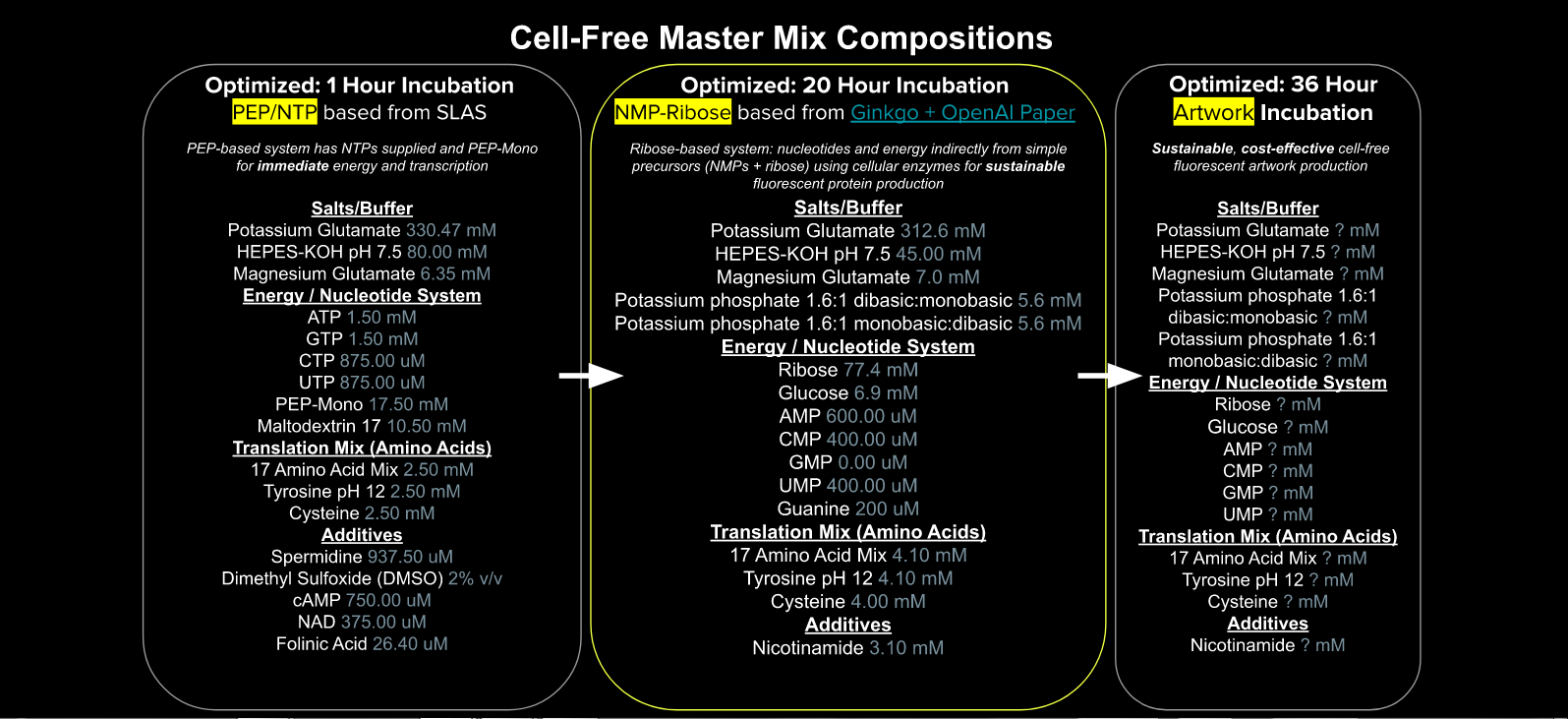
The PEP/NTP mix (1-hour incubation) gives the system “ready-to-use” energy and building blocks (high-energy NTPs and PEP with additional boosters), so it can produce proteins very fast but only for a short time (1 hour).
In contrast, the NMP-Ribose mix (20-hour incubation) provides low-energy precursors that the system can slowly metabolize and regenerate, enabling longer-lasting (20 hours), more cost-efficient protein production.
3. Documentation
Main references: https://pmc.ncbi.nlm.nih.gov/articles/PMC6481089/ HW Week 09
AI support Gemini: as a starting base, prompt: “role of reagent X in cell-free system” ChatGPT: proofreading/summary