Group Final Project
Bacteriophage Engineering
GROUP MEMBERS
Diogo Custodio https://pages.htgaa.org/2026a-diogo-custodio
Flo Razoux https://pages.htgaa.org/2026a-flo-razoux
Katharine Kolin https://pages.htgaa.org/2026a/katharine-kolin
Mariana Kanbe https://pages.htgaa.org/2026a-mariana-kanbe
Marisa Satsia https://pages.htgaa.org/2026a-marisa-satsia
PROJECT AIM
Increasing the stability of the L protein in the MS2 bacteriophage
GROUP STRATEGY
Update Week 06: We will use the same workflow than in previous HW (e.g. mutagenesis) but adapt it to specific aim(s) based on HW reading material of WEEK 04 (e.g. shorten the L protein to make it not dependant on bacterial chaperone DnaJ anymore).
INDIVIDUAL PROPOSAL
Proposal: Shorten the length of the L protein.
Rationale: MS2 bacteriophages kill E. coli bacteria via the protein L. L proteins insert themselves into the membrane and cause the lysis of the bacteria. A weakness of the L protein is that its folding and/or stabilization depends on a bacterial chaperone (DnaJ), making it vulnerable to adaptive mutations of the latter. A mutational study demonstrated that shorter versions of the L protein do not depend on the chaperone anymore [1], making it more resistant to adaptve mutations of DnaJ. With some shorter versions of the L protein, the lysis even happened faster.
Strategy: Engineer a shorter version of L protein that permits an independent folding and conserves essential parts of the sequence such as the transmembrane domain needed for the insertion of the L protein into the membrane [2] and the C-terminal domain needed for the clustering of the L proteins that leads to the lysis of the bacteria [3].
Possible pitfalls:
- We lack knowledge about the precise interactions between the L protein and DnaJ and thus, can’t exclude other purposes than the folding
- The absence of folding in the shortened versions of the protein might make them more susceptible to aggregation or/and degradation by endoribonucleases/proteases
- We might underestimate the role of the “non-essential” regions
- The bacteria can still keep adapting to survive (e.g. membrane composition, upregulation of proteases)
Alternative strategy “Bacteriophage 2-in-1 cocktail”: engineering the bacteriophage to produce both versions of the L-protein (full length version + shortened one)
“We propose a dual-L system in which a DnaJ-independent truncated variant ensures lysis robustness under host variability, while the full-length protein preserves optimal lysis timing. By tuning their relative expression, we aim to identify regimes that maximize phage fitness while minimizing susceptibility to host resistance.” ChatGPT feedback on the proposal: https://chatgpt.com/s/t_69dd849c66bc8191978de0f9e8c80741
Alternative approach: Identify minimal L variants that retain function AND robustness across host conditions
[1] MS2 Lysis of Escherichia coli Depends on Host Chaperone DnaJ Chamakura et al. Journal of Bacteriology (2017) [2] Mutational analysis of the MS2 lysis protein L. Chamakura et al. Microbiology (2017) [3] In vitro characterization of the phage lysis protein. Microbiome Res Rep (2023)
GENERATION AND SELECTION OF THE MUTANTS
See DIOGO’s page: https://pages.htgaa.org/2026a/diogo-custodio/projects/group-final-project/index.html
CONCLUSION
Update Week 14:
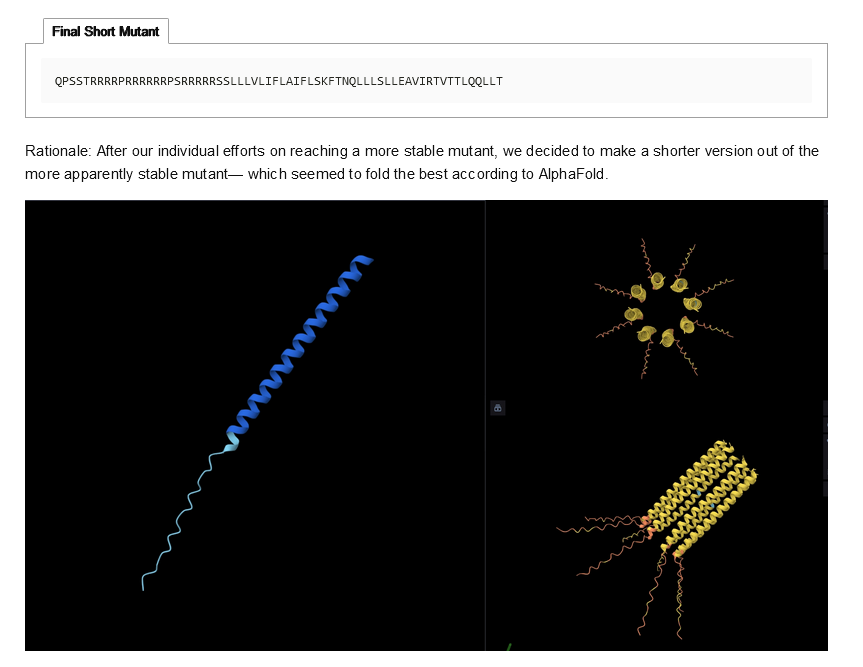
(screenshot from Diogo’s page)
PERSONAL DOCUMENTATION: SUMMARY OF WEEK 04 READING MATERIAL
- MS2 Lysis of Escherichia coli Depends on Host Chaperone DnaJ Chamakura et al. Journal of Bacteriology 2017 https://pmc.ncbi.nlm.nih.gov/articles/PMC5446614/pdf/e00058-17.pdf Original Research Article
MS2 bacteriophages kill E.Coli breaking them open. This killing, called lysis, is mediated by the protein L. Scientists don’t know how the protein L causes this lysis. Research question: does MS2 rely on some bacterial protein for their protein L to work? Experimental strategy: (1) E.Coli is engineered to produce MS2 L protein. (2) Mutated the bacteria and selected the rare bacteria that survived. (3) Sequenced their genome and identified a mutation in one gene called DnaJ that codes for a molecular chaperone (a protein that helps other proteins fold properly). (4) Results confirmation: E.Coli develops resistance (blockage or delay) to lysis when the DnaJ gene is mutated. (5) Engineered shorter versions of L protein: molecular chaperone DnaJ is no longer needed for the L protein to kill E.Coli. The lysis even happens faster. Conclusion: The phage’s killing protein does not work alone. It needs help from a host bacterial protein (DnaJ). The proposed mechanism: The phage produces L protein. DnaJ helps fold or stabilize it. The L protein then interacts with some target in the cell. This triggers self-destruction of the bacterial cell wall, causing lysis. Without DnaJ, the L protein doesn’t work properly, so the bacteria survive longer.
- Mutational analysis of the MS2 lysis protein L Chamakura et al., Microbiology 2017 https://pmc.ncbi.nlm.nih.gov/articles/PMC5775895/pdf/mic-163-961.pdf Original Research Article
Some phages use many proteins to kill bacteria, but RNA phages like MS2 use only the protein L. L protein stops cell wall synthesis, causing the bacteria to die. Research question: which parts of the L protein are needed for the killing process?
Experimental strategy: (1) Mutational analysis: creation of mutant versions of protein L. (2) E.Coli is engineered to produce mutated L protein. If the bacteria survives, it means the mutation destroyed an important function of the L protein. (3) Map which regions of the protein matter: by comparing many mutants, the authors were able to identify the parts of the L protein that are essential and the parts that are less important. They found that a transmembrane domain is essential for the lysis process: without it, the L protein can’t insert into the bacterial membrane. They also identified key amino acids that are important for the interaction with the target in the cell wall synthesis pathway. Some mutations only delayed the lysis or reduced its efficiency. This suggests that the protein works through a precise mechanism, and small changes can weaken it.
- In vitro characterization of the phage lysis protein Microbiome Res Rep 2023 https://pmc.ncbi.nlm.nih.gov/articles/PMC10688784/pdf/mrr-2-4-28.pdf Original Research Article
Research questions: How does the MS2-L protein behave in the bacterial membrane? Does it work alone or in groups of proteins? What role does the bacterial helper protein DnaJ play?
Experimental strategy: (1) Produce the L protein without bacteria. Normally MS2-L kills bacteria very quickly, which makes it hard to study. So the authors used a cell-free expression system*. This allowed them to safely produce the toxic protein. (2) Insert the protein into artificial membranes. They inserted MS2-L into nanodiscs*. This allowed them to observe whether the protein inserts into membranes and how it behaves once there. (3) Measure whether the proteins cluster together. They used native mass spectrometry to determine whether MS2-L proteins assemble into oligomers (groups of many proteins). (4) Compare full protein vs shortened versions. They also created truncated versions of MS2-L that lacked part of the N-terminal region. This helped them see which part of the protein is responsible for membrane activity. (5) Study interaction with the bacterial chaperone. They tested whether the bacterial protein DnaJ interacts with MS2-L and whether it changes how the lysis protein works. The lysis protein forms large clusters in the membrane. When MS2-L inserts into a membrane, the proteins assemble into large oligomeric complexes. Instead of working as a single molecule, many MS2-L proteins group together. These clusters likely create large lesions or holes in the bacterial envelope. The C-terminal transmembrane domain drives this clustering. The N-terminal soluble domain is not essential for killing. However, it seems to control or regulate how oligomers form. DnaJ binds the protein but does not affect membrane insertion nor control oligomerization. So DnaJ interacts with the protein but may not be required for the final killing mechanism. The damage to the bacterial envelope happens step-by-step. Cryo-electron microscopy suggested a sequence of events. Lesions start forming in the outer membrane. Then the peptidoglycan cell wall breaks and finally, the inner membrane collapses. Conclusion: instead of acting like an enzyme, MS2-L behaves more like a membrane-disrupting toxin.
*See HW WEEK 09 for explanation of CFPS (cell-free protein synthesis) systems.
- Phage Therapy: From Biologic Mechanisms to Future Directions Strathdee et al. Cell 2024 https://pmc.ncbi.nlm.nih.gov/articles/PMC9827498/pdf/nihms-1861394.pdf Review article
INTRO: Phages are viruses that infect bacteria. They attach to a bacterium, inject their genetic material, multiply inside it, and eventually break the bacterial cell open. This natural ability to kill bacteria makes them promising alternatives to antibiotics, especially for drug-resistant infections. They also explain that phages are not only useful for therapy. They are also tools in biotechnology, vaccine development and gene delivery.
UPDATED MECHANISMS OF PHAGE ACTION: This section explains how phages infect and kill bacteria. The infection process generally follows these steps: (1) Attachment. The phage attaches to a specific receptor on the bacterial surface. (2) Injection of genetic material. The phage injects its DNA or RNA into the bacterium. (3) Replication. The phage uses the bacterium’s machinery to produce new viral particles. (4) Release of new phages. The bacterium bursts (lysis) and releases many new phages.
PHAGE LIFE CYCLES: Lytic cycle: the phage immediately replicates and kills the bacterium; Lysogenic cycle: Phage DNA integrates into the bacterial genome and stays dormant until activated.
SAFETY AND REGULATORY CONSIDERATIONS. Although phage therapy is a promising alternative to antibiotics, safety and regulatory approval must still be addressed before this technology becomes routine medical treatment. Safety:
- Phage preparations must be tested for safety, purity, and effectiveness.
- Bacterial resistance: just like antibiotics, bacteria can evolve resistance to phages. Future research should focus on engineered phages and phage cocktails.
- Delivery issues: it can be difficult to deliver phages to the correct location in the body.
- Immune responses: the human immune system may recognize phages and produce antibodies against them which could lead to unwanted inflammation.
- Genetic safety: because phages contain genetic material, researchers must ensure they do not transfer harmful genes between bacteria. Regulation:
- Phages are living viruses that evolve, which makes standard drug approval complicated.
- Agencies such as the FDA and EMA regulate clinical trials and therapeutic use in the USA and Europe. Different countries have different rules for phage therapy, and the field still needs standardized international guidelines.
- Ethical issues such as informed consent and patient education.
OTHER APPLICATIONS
- Phage therapy for intracellular bacteria. Some bacteria hide inside human cells, which makes them hard to treat with antibiotics. Examples include Mycobacterium tuberculosis, Salmonella, Chlamydia. The review explains that phages might still help because they can enter infected cells, replicate inside bacteria and destroy them from within. This makes phage therapy potentially useful for infections that antibiotics struggle to treat.
- Vaccines and immune stimulation. Phages can also be used in vaccine technology. Researchers can attach antigens to phages. These phage particles then stimulate the immune system by activating immune cells, increasing antigen presentation and stimulating both T cells and B cells. Because phages are easy to engineer, they may become useful tools for developing new vaccines.
- Cancer therapy. Scientists can engineer phages to bind specifically to cancer cells, deliver therapeutic molecules to tumors and stimulate immune responses against tumors. The idea is that phages could help target cancer cells while leaving healthy cells unaffected.
- Drug delivery systems. Phages can also work as vehicles for delivering drugs or genes. Advantages: they can carry genetic material. They can be engineered to target specific cells. Possible applications include gene therapy, CRISPR gene editing and targeted drug delivery. However, challenges include improving targeting accuracy and increasing stability of phage particles.
Phage Therapy: Past, Present and Future Barron, American Society for Microbiology, 2022 (updated 2026) https://asm.org/articles/2022/august/phage-therapy-past,-present-and-future Review Article
Generative design of novel bacteriophages with genome language models King et al. Biorxiv 2025 https://www.biorxiv.org/content/10.1101/2025.09.12.675911v1.full.pdf Review Article