week-09-hw-cell-free-systems
Homework Part A: General and Lecturer-Specific Questions
Advantages: Cell-free systems allow direct control of reaction conditions without maintaining cell viability. They are especially useful for toxic proteins and membrane proteins.
Main components: Cell extract or Tx/Tl machinery, DNA template, amino acids, nucleotides, energy source, salts, and buffer. Together, these support transcription, translation, and reaction stability.
Energy regeneration: ATP and GTP are rapidly consumed during transcription and translation. Continuous supply can be maintained with phosphoenolpyruvate- or maltodextrin-based regeneration systems.
Prokaryotic vs eukaryotic cell-free systems: Prokaryotic cell-free systems are faster, simpler, and cheaper, making them useful for proteins such as GFP or bacterial enzymes. Eukaryotic systems are better for proteins that require more complex folding or post-translational modifications, such as membrane receptors or glycosylated proteins.
Optimizing membrane protein expression To optimize membrane protein expression, I would test the protein in a cell-free system supplemented with liposomes or nanodiscs to support folding and insertion. The main challenge is aggregation caused by hydrophobic regions, so providing a membrane-like environment and testing different reaction conditions would help improve yield and functionality.
Low yield: possible causes and troubleshooting One possible cause is poor DNA template quality, which can be addressed by improving template purity or concentration. A second cause is insufficient energy supply, which can be improved by optimizing the ATP regeneration system. A third cause is protein misfolding or aggregation, which can be addressed by changing temperature, adding chaperones, or using liposomes or nanodiscs.
Homework question from Kate Adamala
- Function: A synthetic minimal cell that senses extracellular lactate and triggers reporter release.
- Input / Output: Input = extracellular lactate. Output = fluorescence outside the vesicle after pore activation.
- Cell-free alone?: Only partially. Encapsulation is needed for boundary formation and controlled release.
- Natural engineered cell?: Yes, but a minimal cell is simpler and more controllable.
- Desired outcome: OFF without lactate, ON with lactate.
- Membrane: POPC + cholesterol.
- Inside: Bacterial Tx/Tl system, amino acids, nucleotides, ATP regeneration system, DNA circuit.
- Tx/Tl source: Bacterial.
- Communication: Lactate enters by permeability or transport; output exits through a pore.
- Lipids / genes: POPC, cholesterol; lactate-responsive module, reporter gene, alpha-hemolysin.
- Readout: Measure fluorescence outside the vesicle with and without lactate.
Homework question from Peter Nguyen
A replaceable underarm textile patch with freeze-dried cell-free sensing chemistry that detects breast-cancer-associated sweat VOC patterns as an exploratory early-risk screening tool, producing a visible color change. :contentReference[oaicite:0]{index=0}
How it works: The patch would be embedded into the axillary region of a shirt and activated by sweat moisture during wear. The sensing layer would respond to a selected VOC proxy or small panel of sweat-associated metabolites linked to breast-cancer volatilomic signatures, generating a colorimetric readout visible on the fabric. This concept is exploratory rather than diagnostic, since current evidence supports altered sweat/VOC patterns in breast cancer but also shows major variability and the need for standardization and larger validation studies. :contentReference[oaicite:1]{index=1}
Need addressed: The idea targets the need for low-cost, noninvasive, wearable screening technologies that could complement—not replace—conventional breast-cancer detection. Current VOC research suggests promise for noninvasive screening, but not yet clinical readiness. :contentReference[oaicite:2]{index=2}
How to address cell-free limitations: The sensing module would be freeze-dried for storage stability, packaged as a replaceable one-time-use cartridge, and designed to activate only when hydrated by sweat. To reduce false positives, the patch would be framed as a research or screening-support device rather than a diagnostic tool, and future versions would likely need multiplexed sensing instead of relying on a single metabolite. :contentReference[oaicite:3]{index=3}
Relevant DOIs
10.3390/cancers1511293910.1177/1177271922110070910.1016/j.physbeh.2023.114307
Homework question from Ally Huang
Background: Long-term spaceflight causes bone loss because microgravity disrupts the balance between bone formation and bone resorption. This is significant for human health in space and for future long-duration missions. It is also scientifically interesting because bone loss reflects broader cellular stress and tissue adaptation under microgravity. :contentReference[oaicite:0]{index=0}
Target: CDKN1A (p21) nucleic acid signature associated with microgravity-related osteogenic stress. :contentReference[oaicite:1]{index=1}
Relation to the challenge: CDKN1A/p21 has been reported to increase in bone under microgravity-associated conditions and is linked to osteogenic cell-cycle arrest. Detecting this target would provide a molecular readout connected to space-induced bone loss. :contentReference[oaicite:2]{index=2}
Hypothesis / goal: I hypothesize that a BioBits-based fluorescence assay can be used to detect a bone-loss-associated molecular marker relevant to microgravity stress. The goal is to create a simple proof-of-concept workflow in which a selected target sequence is amplified with miniPCR and linked to a fluorescent readout using BioBits and the P51 viewer. This would model how portable molecular tools could support astronaut health monitoring in resource-limited environments. :contentReference[oaicite:3]{index=3}
Experimental plan: I would test synthetic DNA samples representing negative, low, and high levels of the CDKN1A target, plus a no-template control. The target would be amplified with miniPCR, coupled to a BioBits fluorescence readout, and measured with the P51 viewer. The main data would be fluorescence intensity and signal-to-background differences across conditions. :contentReference[oaicite:4]{index=4}
Relevant DOIs
10.1371/journal.pone.006137210.1038/s41526-022-00194-8
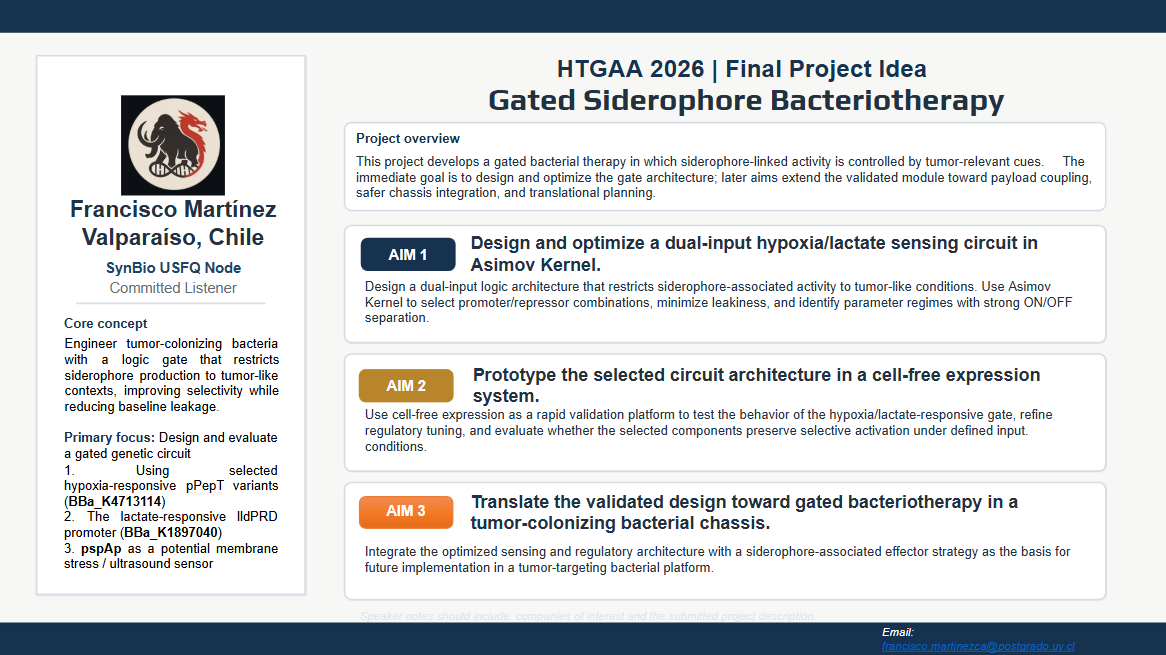
Homework Part B: Individual Final Project