week-11-hw-building-genomes
Part B: Cell-Free Protein Synthesis | Cell-Free Reagents
- Referencing the cell-free protein synthesis reaction composition (the middle box outlined in yellow on the image above, also listed below), provide a 1-2 sentence description of what each component’s role is in the cell-free reaction.
1.1 E. coli Lysate * BL21 (DE3) Star Lysate: Provides the essential molecular machinery, including ribosomes and translation factors, while the T7 RNA Polymerase drives the transcription of DNA into mRNA.
1.2 Salts/Buffer * Potassium & Magnesium Glutamate: Essential for maintaining ionic balance; Magnesium specifically acts as a cofactor for ribosome stability and enzymatic functions. * HEPES-KOH (pH 7.5) & Potassium Phosphates: Act as buffering agents to stabilize the pH, ensuring an optimal environment for biochemical reactions.
1.3 Energy / Nucleotide System * Ribose & Glucose: Serve as carbon sources and secondary energy substrates to power the regeneration of ATP within the system. * AMP, CMP, GMP, UMP & Guanine: These are the fundamental nucleotide building blocks required for the synthesis of mRNA during the transcription phase.
1.4 Translation Mix (Amino Acids) * 17 Amino Acid Mix, Tyrosine & Cysteine: These are the primary monomers or “building blocks” that are polymerized to form the specific protein sequence.
1.5 Additives * Nicotinamide: Helps maintain metabolic flux and prevents the degradation of key energy cofactors like NAD+.
1.6 Backfill * Nuclease-Free Water: Used to adjust the reaction to its final volume while ensuring the absence of enzymes that could degrade DNA or RNA templates.
Main Differences (PEP-NTP vs. NMP-Ribose-Glucose)
- The 1-hour PEP-NTP mix uses high-energy PEP and direct NTPs for immediate, rapid protein synthesis, whereas the 20-hour mix relies on slower, sustainable energy regeneration from Ribose and Glucose using NMPs. This shift from “ready-to-use” fuels to “precursor-based” metabolism allows the 20-hour system to maintain reaction stability for a significantly longer duration.
Bonus Question: Transcription without GMP
- Transcription can still occur because the cell-free lysate contains endogenous enzymes (such as phosphoribosyltransferases) that can salvage Guanine by attaching it to a ribose-phosphate provider. This pathway converts the free Guanine base into GMP and subsequently into the GTP required by the RNA polymerase to build the mRNA strand.
Part C: Planning the Global Experiment | Cell-Free Master Mix Design
- Properties of Fluorescent Proteins in Cell-Free Systems
1.1 sfGFP (superfolder GFP): Known for its exceptionally fast folding and high stability, which allows for rapid detection and high expression levels even in robust cell-free environments.
1.2 mRFP1: This protein has a relatively slow maturation time and lower photostability compared to newer variants, which can lead to a delayed or weaker signal readout during the reaction.
1.3 mKO2: It is highly bright and has fast maturation, but like many orange/red proteins, its fluorescence can be sensitive to the pH levels maintained by the buffer system.
1.4 mTurquoise2: Characterized by its high quantum yield and superior photostability, providing a very bright and consistent signal that is ideal for precise quantitative readouts.
1.5 mScarlet-I: One of the brightest red fluorescent proteins available, it features a fast maturation rate that is specifically optimized for efficient folding in various expression systems.
1.6 Electra2: Designed for high photostability and rapid maturation, making it particularly effective for real-time monitoring of protein synthesis in long-duration cell-free reactions.
- Hypothesis for Improving Long-Term Fluorescence
- Protein: Electra2
- Reagent(s) Adjustment: Increase the initial concentration of Glucose and Nicotinamide in the master mix.
- Expected Effect: By increasing these reagents, we enhance the secondary energy regeneration pathway, ensuring a steady ATP supply over the full 36-hour period. Combined with Electra2’s inherent rapid maturation and high photostability, this sustained energy flux will maximize the number of correctly folded fluorescent molecules throughout the entire reaction duration, maintaining a strong and consistent fluorescence signal without the reaction running out of fuel prematurely.
- Final Phase Reaction Protocol The final reaction will consist of a 20 µL total volume, incorporating 2 µL of custom reagent supplements. My experimental goal will be to use these 2 µL to deliver the adjusted concentrations of Glucose and Nicotinamide proposed in my hypothesis, maximizing ATP availability throughout the full 36-hour period to support Electra2’s rapid maturation and maintain consistent fluorescence signal over the entire reaction duration.
Part D: Build-A-Cloud-Lab
CELL-FREE SYNTHESIS OPTIMIZATION & LAB AUTOMATION DESIGN
- Reagent Roles & Hypothesis** My project focuses on extending the protein synthesis reaction from 20 to 36 hours.
RAC-15 (Preparation): Used for the high-precision addition of the 2 µL custom supplements (Glucose/Nicotinamide) into the master mix.
RAC-16 (Incubator): Dedicated to maintaining a stable thermal environment for the entire 36-hour duration.
Lunatic (Analysis): Integrated into the loop to perform real-time fluorescence measurements without interrupting the experiment.
Workflow Logic: The circular Magnum Motion track allows for an automated, iterative cycle. Samples move from incubation (RAC-16) to measurement (Lunatic) and back to incubation without manual intervention or thermal shock. This ‘Infinite Loop’ design is critical for documenting the full 36-hour fluorescence curve and proving that the increased ATP availability from the adjusted reagents maximizes Electra2’s fluorescence output throughout the entire reaction duration.
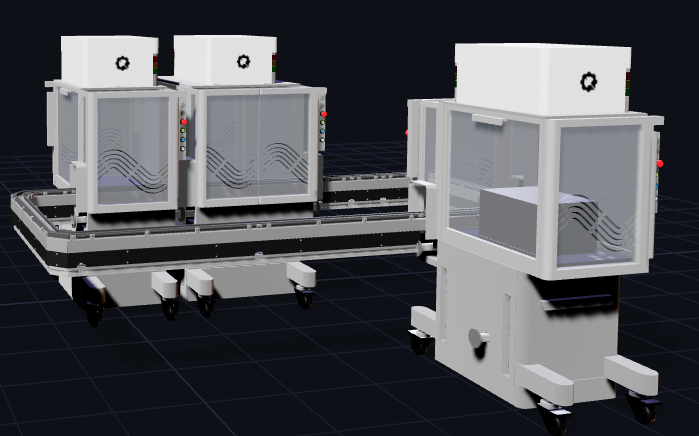
Conclusion and Scalability: The primary advantage of this automated circular design is its capacity for High-Throughput Screening (HTS). Beyond simple monitoring, the RAC-15 can be programmed to dispense a gradient of different Glucose and Nicotinamide concentrations across a single 96-well plate. By cycling this plate through the Lunatic every hour, the system will simultaneously characterize multiple experimental conditions. This allows us to identify the precise “sweet spot” for protein yield and maturation over the 36-hour window in a single, autonomous run.