Week 1 HW: Principles and Practices
Part I
1. First, describe a biological engineering application or tool you want to develop and why.
I am interested in the development of engineered bee gut bacteria or similar that help bees resist viral infections, pesticide stress but especially harmful varroa mites. The presence of varroa mites in bee colonies place an important pressure on bee health since they attack and feed on them in a parasitism relationship. 1 Instead of genetically modifying bees themselves, I aim to modify their symbiotic bacteria to strengthen colony resilience while minimizing ecological risks. Bees are increasingly threatened by habitat loss, unsustainable agricultural practices, climate change and pollution. Their decline jeopardizes food production, increases costs and exacerbates food insecurity, particularly for rural communities. I am convinced that supporting pollinators will get more and more critical for global food systems and biodiversity and this approach could offer a scalable and ecologically sensitive alternative to chemical treatments currently used in agriculture. Even if it needs human intervention into nature to keep our ecosystem in balance, I think supporting these small often unnoticed pollinators could make a real difference.
Inspiration: Leonard, S. P., Perutka, J., Powell, J. E., Geng, P., Richhart, D. D., Byrom, M., Kar, S., Davies, B. W., Ellington, A. D., Moran, N. A., & Barrick, J. E. (2018). Genetic engineering of bee gut microbiome bacteria with a toolkit for modular assembly of broad-host-range plasmids. ACS Synthetic Biology, 7(5), 1279–1290. https://doi.org/10.1021/acssynbio.7b00399
1: Le Conte, Y., Ellis, M. & Ritter, W. (2010). Varroa mites and honey bee health: can Varroa explain part of the colony losses?. Apidologie, 41, 353–363. https://doi.org/10.1051/apido/2010017
2. Next, describe one or more governance/policy goals related to ensuring that this application or tool contributes to an “ethical” future, like ensuring non-malfeasance (preventing harm). Break big goals down into two or more specific sub-goals.
1. Prevent ecological harm
- Require controlled field trials and ecological risk assessments before environmental release.
- Develop containment or reversibility strategies, such as microbes that cannot survive outside bee hosts.
- Monitor impacts on wild pollinators and microbial communities long-term.
2. Avoid technology dependancy in nature
- Ensure solutions complement ecological practices instead of replacing them.
- Link deployment to reduction of harmful pesticide use, rather than allowing continued pollution.
3. Ensure fair access and prevent corporate control
- Prevent exclusive patents that make beekeepers dependent on private companies. (monsanto scandal)
- Encourage open-access or public research partnerships.
- Ensure affordable access for small-scale and community beekeepers.
4. Transparency and public participation
- Include beekeepers and environmental groups in decision-making.
- Maintain international cooperation since pollinators cross borders.
- Raise awareness about the relevance of bees around May 20th and beyond.
5. Ensure safe and responsible deployment of engineered microbes
- Implement strict laboratory containment protocols.
- Require biosafety training and certification for researchers.
- Establish traceability and monitoring systems so released microbial strains can be tracked and evaluated over time.
3. Next, describe at least three different potential governance “actions” by considering the four aspects below (Purpose, Design, Assumptions, Risks of Failure & “Success”)
Transparency Standards for DNA Synthesis Providers
Purpose
I believe that many DNA synthesis companies voluntarily screen orders against limited threat models to block synthesis of harmful sequences, but standards vary widely. That’s why, we need an universal regulatory requirement for all commercial DNA synthesis providers (domestic and international selling into regulated markets) to implement robust sequence screening, standardized reporting and data sharing with trusted authorities to build transparency.
Design
What is needed to make it work?
- A regulatory body defines minimum screening criteria and risk thresholds.
- All providers must opt-in by compliance through certification, non-compliant firms cannot legally sell into the regulated market.
- Public funding or tax credits to support smaller providers implementing screening software.
Actors involved:
- Federal regulators (standard setting and enforcement)
- DNA synthesis companies (compliance)´
- Independent auditors (certify implementation)
Assumptions
- That most synthesis providers will respond to regulatory pressure and that screening software is reliable.
- That standards can keep pace with rapid advances in gene editing and novel organisms.
- That international firms will comply or that governments will enforce import controls tied to compliance.
- That smaller companies can hold against the competitiveness of certification costs.
Risks of Failure & “Success”
Failure risks
- Providers find loopholes or perform minimal compliance without effective safety.
- Adversaries migrate to unregulated markets or underground vendors, worsening risk.
- High compliance costs drive small innovators out of business, reducing competition.
Risks of “success”
- Genuine research slows due to increased cost and time to order DNA.
- Fragmented global adoption creates asymmetries: robust safety in some countries, weak in others.
Involvment of local stakeholders & community
Purpose
From what I have read, bee-related synbio solutions are mostly developed in labs and tested with limited involvement of local beekeepers or communities who depend on pollinators. The proposed change is to actively involve beekeepers, farmers and local communities (most practical knowledge because of living with/around them) before deploying biotech solutions affecting bee populations.
Design
- Projects deploying engineered microbes or treatments in hives must include local beekeeper collaboration.
- Workshops and pilot projects with beekeeping associations allow practical feedback.
- Farmers, urban beekeepers, and conservation groups participate in decision-making.
Actors involved
- Researchers & biotech companies
- Local governments & environmental authorities
- Farmers & beekeper associations
Assumptions
- Beekeepers are willing and able to participate.
- Public engagement improves trust and project outcomes.
- Communication between scientists and practitioners works effectively.
Risks of Failure & “Success”
Failure risks
- Engagement becomes symbolic rather than meaningful.
- Misinformation or fear blocks beneficial projects.
- Participation dominated by a few voices, not representative groups.
Risks of “success”
- Projects become slowed by lengthy consultation processes.
- Communities may expect veto power over projects beyond reasonable risk concerns.
Secure Testing & Containment Framework for Bee Biotechnology
Purpose
Currently, biotechnology innovations may move from lab testing to real hives without fully coordinated safeguards if unexpected ecological effects occur. This action proposes a controlled testing environment (sandbox ecosystem) combined with mandatory containment and emergency response plans before wider deployment.
Design
- New bee biotech solutions are first tested in regulated pilot environments with selected partner beekeepers and oversight from authorities.
- Engineered microbes or treatments must include biological containment mechanisms (e.g., limited survival outside managed hives).
- Continuous monitoring tracks spread and bee health impacts.
- Emergency protocols allow rapid withdrawal or containment if problems appear.
Actors involved
- Researchers
- Biotech companies
- Beekeeper networks (monitoring)
- Environmental and agricultural authorities
Assumptions
- Small-scale sandbox ecosystems manage to imitate natural ecosystems.
- Containment mechanisms work reliably in real ecosystems.
- Monitoring detects problems early enough to intervene.
- Beekeepers cooperate in reporting unexpected outcomes.
Risks of Failure & “Success”
Failure Risks
- Containment fails or spread occurs before detection.
- Response measures may be too slow.
Risk of “success”
- Confidence in safe testing could encourage faster or riskier deployments.
- Strict requirements might limit participation by small innovators.
Bügl, H., Danner, J. H., Molinari, R. J., Mulligan, J. T., Park, H., Reichert, B., Roth, D. A., Wagner, R., Budowle, B., Scripp, R. M., Smith, J. A. L., Steele, S. J., Church, G. & Endy, D. (2007). DNA synthesis and biological security. Nature Biotechnology, 25(6), 627–629
Leckenby, E., Dawoud, D., Bouvy, J. & Jónsson, P. (2021). The Sandbox Approach and its Potential for Use in Health Technology Assessment: A Literature Review. Applied Health Economies Health Policy, 19, 857–869. https://doi.org/10.1007/s40258-021-00665-1
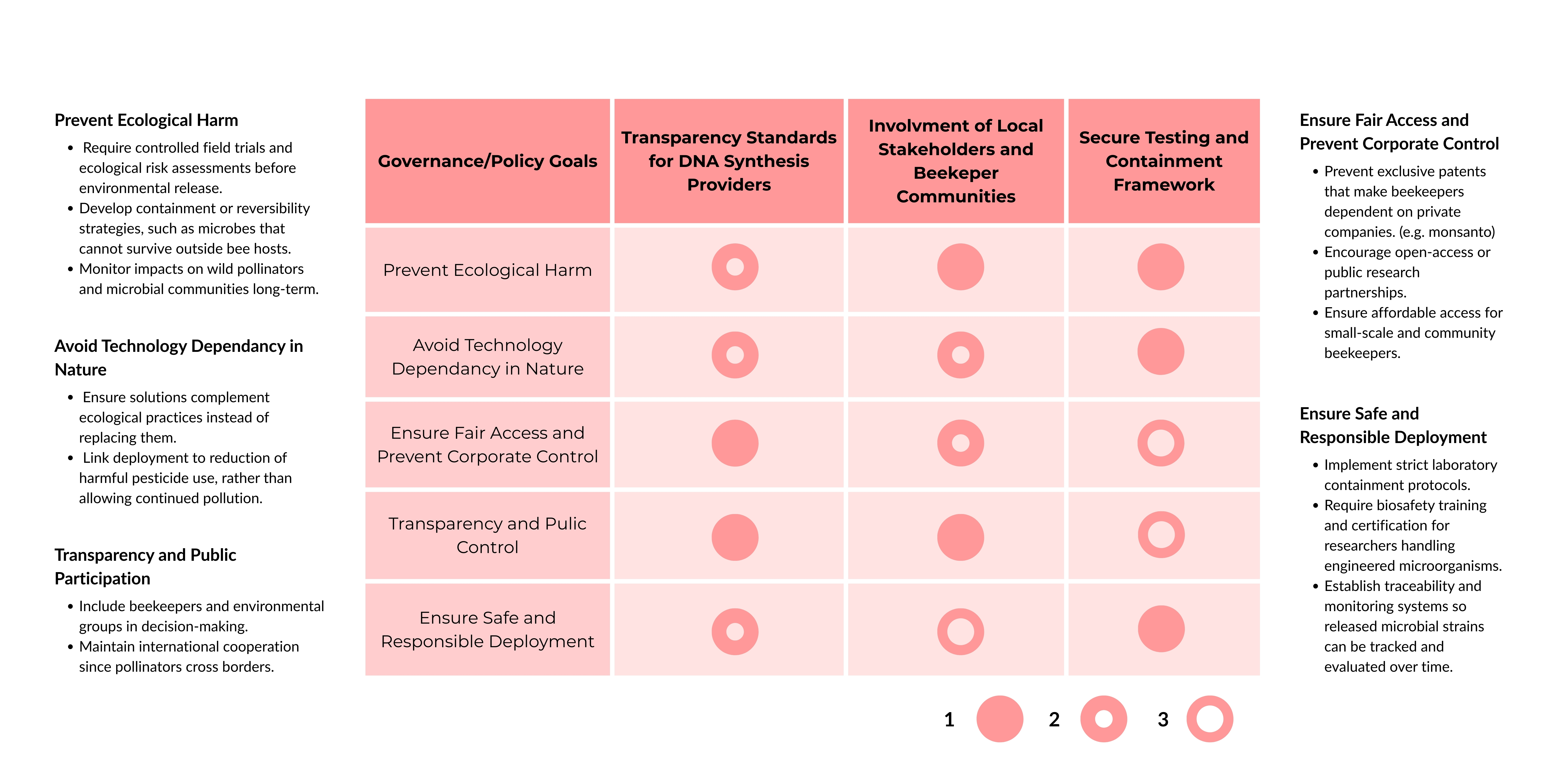
4. Next, score (from 1-3 with, 1 as the best, or n/a) each of your governance actions against your rubric of policy goals. The following is one framework but feel free to make your own:
5. Last, drawing upon this scoring, describe which governance option, or combination of options, you would prioritize, and why. Outline any trade-offs you considered as well as assumptions and uncertainties.
Based on the evaluation of the governance options, I would prioritize Transparency Standards, combined with a Secure Testing and Containment Framework.
Transparency is essential for building trust in new biotechnological tools and for ensuring accountability. If projects, testing procedures and releases are openly documented and traceable, it becomes possible to identify where problems arise and address them early. Similar to other industries - for example, the fashion industry, where lack of supply chain transparency hides environmental and social impacts - insufficient transparency in biotechnology makes it difficult to understand risks or intervene effectively when things go wrong.
However, transparency alone is not sufficient. Even if processes are visible, interventions must also be safe in practice. Therefore, I would combine transparency with a Secure Testing and Containment Framework that ensures technologies are tested in controlled environments and include emergency response mechanisms before large-scale deployment. In the case of bee-related biotech applications, unintended spread or ecological effects could impact entire ecosystems. A containment and rapid-response system would help minimize damage if interventions do not behave as expected.
The main trade-off considered is that stronger transparency and safety requirements may slow innovation or increase costs for smaller research groups. There is also uncertainty about whether containment mechanisms will always function reliably in complex natural environments. Nevertheless, given the ecological importance of pollinators and the potential scale of unintended consequences, prioritizing safety and accountability over rapid deployment seems justified.
Part II
Nature’s machinery for copying DNA is called polymerase. What is the error rate of polymerase? How does this compare to the length of the human genome. How does biology deal with that discrepancy?
Error Rate of Polymerase: 1:108
Length of Human Genome: 3.2 Gbp = 3.2 * 109 base pairs
If the error rate is 1 in 10⁸, copying the whole genome would lead to roughly:
3*109 / 108 ~ 30
That means there are about 30 errors per cell division without additional repair. To deal with this decrepancy biology developed a error correcting polymerase including proofreading mechanisms and mismatch repair systems.
How many different ways are there to code (DNA nucleotide code) for an average human protein? In practice what are some of the reasons that all of these different codes don’t work to code for the protein of interest?
Formula from the Slides:
The complexion for the total number of different ways to arrange N blocks of Q different types (where each type has the same number) is given by:
((20!)/(((20/4)!)(4))) = 11732745024 ~ 11.7 * 109
What’s the most commonly used method for oligo synthesis currently?
Phosphoramidite solid-phase synthesis
Why is it difficult to make oligos longer than 200nt via direct synthesis?
The main problem is stepwise synthesis errors. Each nucleotide addition is not perfect. Typical coupling efficiency: ~99–99.5% per step.
0.995200 ~ 0.37
Why can’t you make a 2000bp gene via direct oligo synthesis?
Direct oligonucleotide synthesis adds nucleotides step by step, and each step has a small error rate (≈99–99.5% efficiency). Over thousands of steps, these small errors accumulate, leading to very low yields of full-length, correct DNA. As a result, direct chemical synthesis becomes impractical beyond ~150–200 nucleotides. So companies like Twist Bioscience instead assemble long genes (up to 7kbp) from short oligos and then clone and sequence-verify them.
What are the 10 essential amino acids in all animals and how does this affect your view of the “Lysine Contingency”?
There are 9 essential amino acids: phenylalanine, valine, tryptophan, threonine, isoleucine, methionine, histidine, leucine, and lysine.
However, amino acids such as arginine and histidine may be considered conditionally essential because the body cannot synthesize them sufficiently during specific physiological periods of growth, including pregnancy, adolescent growth or recovery from trauma.1
As I understand it, the “Lysine Contingency” is derived from Jurassic Park and is fictional. I believe it raises important ethical questions about human intervention in nature. In the movie, the dinosaurs depend on lysine supplements provided by the park’s staff, so they cannot survive or escape without them. This system was intended to prevent the dinosaurs from disrupting the global ecosystem. Although the idea aimed to protect the environment, it also involved engineering organisms to depend on a single nutrient for survival which is questionable. All in all, it is striking to me that the absence of just one essential amino acid could determine life or death.[^2]
1: Lopez, M.J. and Mohiuddin, S.S. (2024) Biochemistry, essential amino acids, National Library of Medicine. Available at: https://www.ncbi.nlm.nih.gov/sites/books/NBK557845/ (Accessed: 10 February 2026).
2: Lysine contingency (no date) Jurassic Park Wiki | fandom. Available at: https://jurassicpark.fandom.com/wiki/Lysine_contingency (Accessed: 10 February 2026).
Other References from Part II: Slides from Lecture 2