Week 7 HW: Genetic Circuits Part II
Part I: Intracellular Artificial Neural Networks (IANNs)
1. What advantages do IANNs have over traditional genetic circuits, whose input/output behaviors are Boolean functions?
Continuous Signal Processing
- Boolean circuits output only 0 or 1 (OFF/ON) states.
- IANNs operate on continuous, graded gene expression levels.
Ability to Model Complex Relationships
- Boolean logic is limited to simple combinations of AND/OR/NOT gates.
- IANNs can approximate complex, nonlinear input–output functions.
Efficient Integration of Multiple Inputs
- Boolean circuits: combining many inputs requires many layers of logic gates, which increases circuit size and burden.
- IANNs: Combininbg inputs through weighted interactions means processing many signals in parallel.
IANNs outperform Boolean genetic circuits by enabling continuous, tunable, and scalable processing of complex, multi-input signals, making them more robust and biologically realistic.
2. Describe a useful application for an IANN; include a detailed description of input/output behavior, as well as any limitations an IANN might face to achieve your goal.
Idea: An intracellular artificial neural network (IANN) can be engineered into bacteria to detect and degrade textile dye pollutants in wastewater, while adapting its response to varying environmental conditions.
Inputs (continuous signals):
The IANN processes multiple environmental inputs simultaneously, for example:
- Dye concentration (e.g., azo dyes)
- Toxic byproducts (aromatic amines)
- pH levels
- Oxygen availability
- Presence of heavy metals or inhibitors
Each input is graded (not just present/absent), allowing the system to distinguish between low, medium, and highly polluted water.
Processing (IANN behavior):
- Each input is assigned a weight (via promoter strength, TF affinity, etc.).
- The network integrates signals and computes a nonlinear response:
- e.g., high dye + low oxygen + neutral pH → strong activation
- low dye + extreme pH → weak or no activation
Outputs:
The IANN controls expression of:
- Dye-degrading enzymes (e.g., azoreductases, laccases)
- Stress response proteins
- Optional: reporter signals (color/fluorescence to indicate pollution level)
The output is graded:
- Low pollution → minimal enzyme production
- High pollution → strong enzyme expression
IANNs are particularly useful for wastewater bioremediation because real wastewater is highly variable and noisy, meaning traditional Boolean circuits would often fail or overreact. Instead, IANNs can integrate multiple weak and continuous signals into a meaningful decision, enabling adaptive and energy-efficient responses. For example, they can activate dye-degrading enzymes only under suitable conditions, such as optimal pH, preventing unnecessary metabolic cost. However, there are limitations: environmental variability may exceed the network’s operating range, and the system can impose a metabolic burden on the host cell. Additionally, crosstalk with native pathways, evolutionary instability over time, challenges in scaling from lab to real-world systems, and biosafety concerns related to releasing engineered organisms must all be considered.
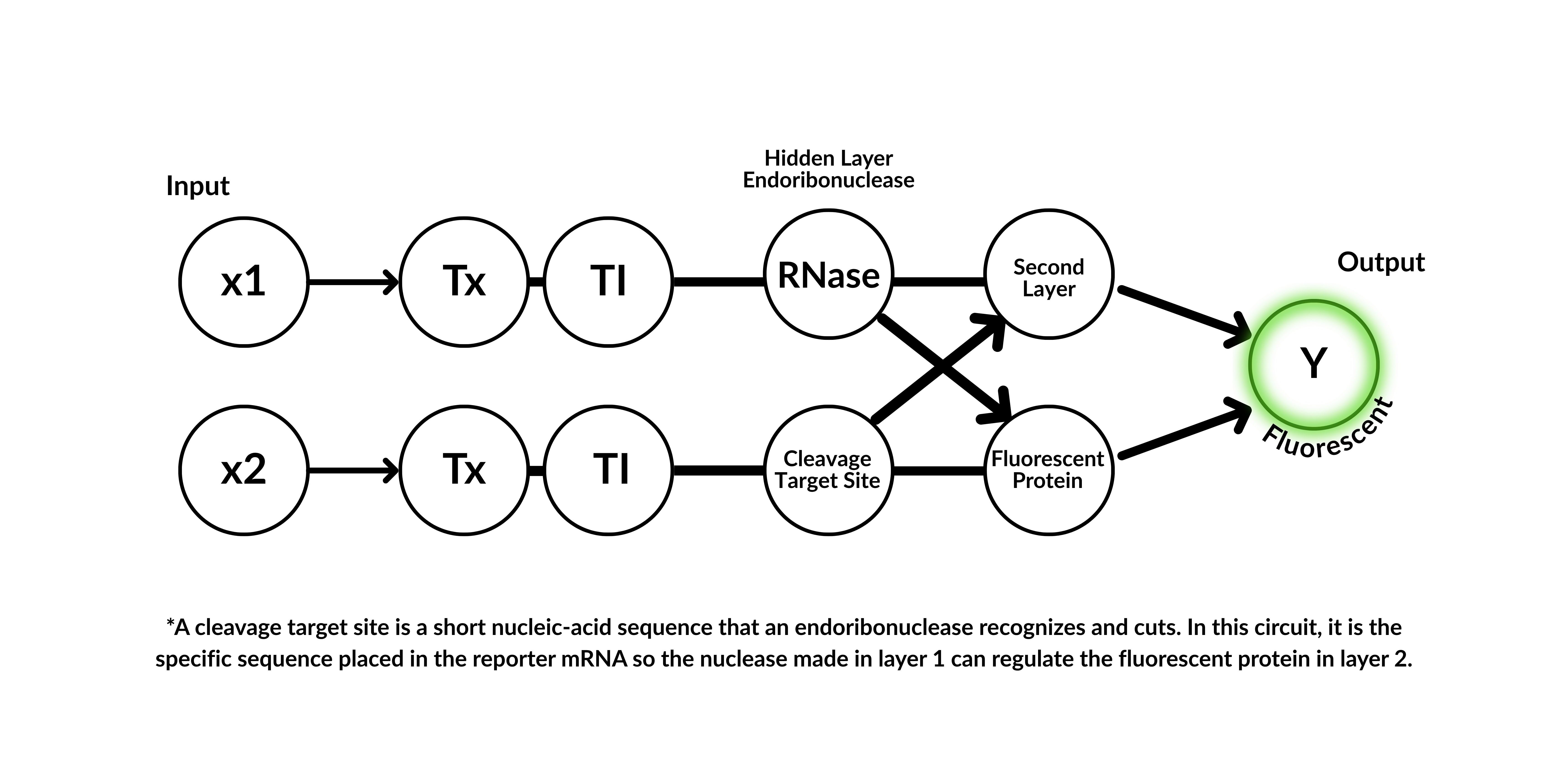
3. Below is a diagram depicting an intracellular single-layer perceptron where the X1 input is DNA encoding for the Csy4 endoribonuclease and the X2 input is DNA encoding for a fluorescent protein output whose mRNA is regulated by Csy4. Tx: transcription; Tl: translation. Draw a diagram for an intracellular multilayer perceptron where layer 1 outputs an endoribonuclease that regulates a fluorescent protein output in layer 2.
Definition Csy4 endoribonuclease: Csy4 is a highly specific bacterial CRISPR-associated endoribonuclease from Pseudomonas aeruginosa that processes precursor CRISPR RNA (crRNA) by recognizing and cleaving a 16-nucleotide hairpin stem-loop. It is widely used in biotechnology for controlling gene expression, RNA imaging, and creating inducible gene switches due to its high-affinity RNA binding, including a catalytic H29A mutant that binds but does not cleave.1
Diagram:
Part II: Fungal Materials
1. What are some examples of existing fungal materials and what are they used for? What are their advantages and disadvantages over traditional counterparts?
mycelium bricks/biocement:
- used for: Sustainable construction materials (e.g., insulation panels, lightweight bricks), packaging as an alternative to polystyrene
- advantages:
- Biodegradable and compostable
- Low energy production (grown, not manufactured)
- Uses agricultural waste as feedstock
- Good insulation properties (thermal and acoustic)
- disadvantages:
- Lower mechanical strength than conventional bricks or concrete
- Sensitive to moisture if not properly treated
- Limited structural applications (not yet suitable for load-bearing walls in most cases)
- Variability in material properties
mycelium leather:
- used for: Fashion products (bags, shoes, clothing), Upholstery and accessories, Alternative to animal leather and synthetic (PU/PVC) leather - because even the common vegan leather is bad for the planet
- advantages:
- Animal-free and more ethical than traditional leather
- Lower environmental impact (less water, no livestock emissions)
- Can be grown into desired shapes → reduces waste
- Potentially biodegradable (depending on finishing)
- disadvantages:
- Durability and longevity may be lower than high-quality animal leather
- Often still requires chemical treatments or coatings
- Not always fully biodegradable in commercial forms
- Higher cost and limited large-scale production (still emerging technology)
2. What might you want to genetically engineer fungi to do and why? What are the advantages of doing synthetic biology in fungi as opposed to bacteria?
- To make them grow in speciic directions. (for building without waste)
- To make them grow more structural mycelium. (for creating objects e.g. vases, furniture, …)
- To make them degrade environmental pollutants e.g., dyes, plastics, pesticides (fungi naturally secrete powerful enzymes, so engineering them could enhance bioremediation)
- To make them improve agricultural systems (for enhancing plant growth, nutrient uptake, or protect against pathogens)
Fungi offer several advantages over bacteria in synthetic biology, particularly due to their ability to form macroscopic, three-dimensional structures, such as mycelium networks, which makes them ideal for applications in construction and textile-like materials. They naturally secrete large amounts of extracellular enzymes, enabling efficient breakdown of complex substrates like lignin or synthetic dyes, which is highly valuable for bioremediation. As eukaryotic organisms, fungi can also perform post-translational modifications, allowing them to produce more complex and functional proteins than bacteria - an important feature for pharmaceutical applications. Additionally, fungi can grow on low-value waste streams, such as agricultural residues, making them especially attractive for sustainable production systems. Their mycelial networks also provide intrinsic material properties, allowing functional materials to be grown directly. However, compared to bacteria, fungi typically grow more slowly, are more difficult to genetically engineer, and currently have fewer standardized synthetic biology tools available, although this field is rapidly advancing.
Part III: First DNA Twist Order
N/A for Lifefabs node because we haven’t had feedback for final project.
Borchardt, E. K., Meganck, R. M., Vincent, H. A., Ball, C. B., Ramos, S. B. V., Moorman, N. J., Marzluff, W. F., Asokan, A. (2017) Inducing circular RNA formation using the CRISPR endoribonuclease Csy4 23(5):619-627. doi: 10.1261/rna.056838.116. ↩︎