Week 7 HW: Genetic Circuits Part II: Neuromorphic Circuits
Assignment Part 1: Intracellular Artificial Neural Networks (IANNs)
1. What advantages do IANNs have over traditional genetic circuits, whose input/output behaviors are Boolean functions?
An advantage of IANNs is that gene expression can vary continuously, meaning that—unlike Boolean functions, whose outputs are limited to ON or OFF states—IANNs can weigh inputs and produce graded responses based on their relative strengths, enabling more nuanced, flexible, and biologically realistic decision-making within the cell.
2. Describe a useful application for an IANN; include a detailed description of input/output behavior, as well as any limitations an IANN might face to achieve your goal.
IANNs can be used to detect cancer by integrating multiple biomarkers as inputs and producing a specific, graded output. For example, biomarkers such as PSA (prostate), CA-125 (ovarian), CEA (colorectal), HER2 and BRCA1/2 (breast), and AFP (liver) could serve as weighted inputs, allowing the circuit to distinguish between cancer types based on their combined expression patterns rather than simple presence or absence. The output could be the expression of a fluorescent reporter for diagnosis or a therapeutic protein, such as one that induces apoptosis, only when the integrated signal crosses a defined threshold. However, limitations include variability and noise in biomarker expression, difficulty in precisely tuning and maintaining stable weights in vivo, potential off-target interactions with native cellular pathways, and challenges in safely delivering and controlling such complex systems in patients.
3. Draw a diagram for an intracellular multilayer perceptron where layer 1 outputs an endoribonuclease that regulates a fluorescent protein output in layer 2.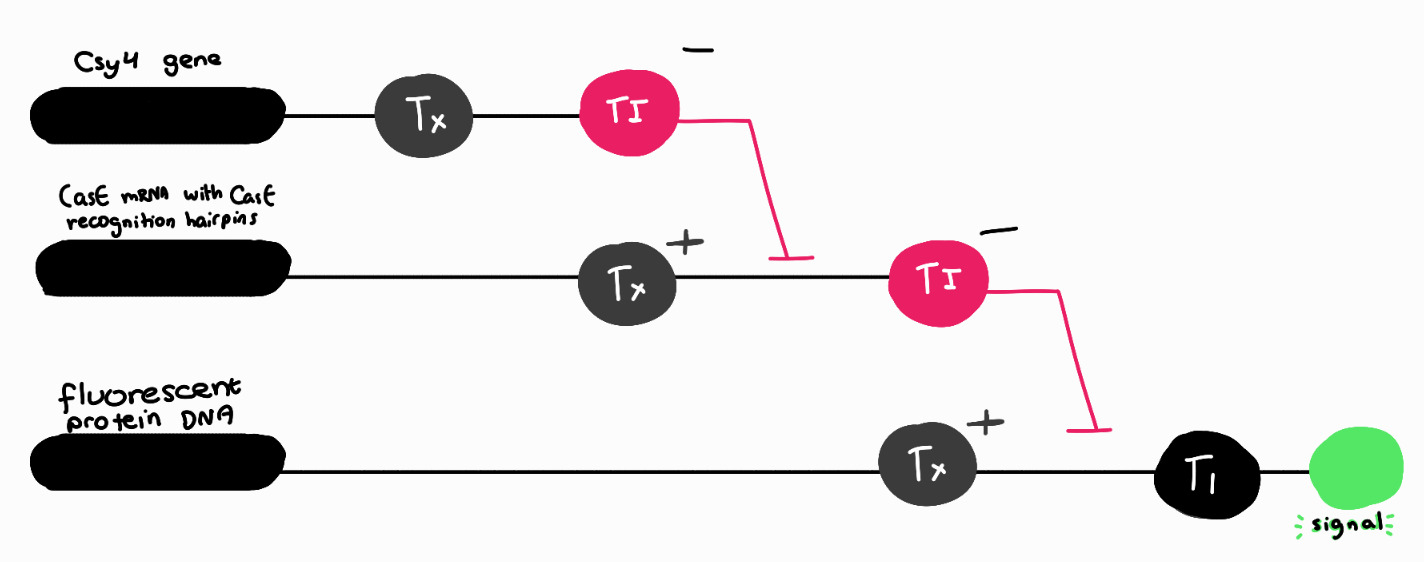
Assignment Part 2: Fungal Materials
1. What are some examples of existing fungal materials and what are they used for? What are their advantages and disadvantages over traditional counterparts?
Existing fungal materials include mycelium-based packaging (used as a sustainable alternative to Styrofoam), building materials like bricks and insulation, leather-like fabrics (e.g., Mylo), and even furniture. I know about an NGO that uses mycelium to make surf-related products like boards, showing how versatile and lightweight the material can be. Their main advantages are that they are biodegradable, renewable, and require low energy to produce, but disadvantages include lower mechanical strength, sensitivity to moisture, and challenges in scaling and standardization compared to plastics or concrete.
2. What might you want to genetically engineer fungi to do and why? What are the advantages of doing synthetic biology in fungi as opposed to bacteria?
We might genetically engineer fungi to produce stronger materials, sense environmental signals, or self-heal, making them useful for smart construction or environmental monitoring. Fungi are advantageous over bacteria because they naturally grow into large, structured networks (mycelium), making them ideal for materials, and they can secrete complex proteins and enzymes more efficiently. However, they are slower to grow and harder to genetically manipulate than bacteria.