Week 9 HW: Cell-Free Systems
General homework questions
1. Explain the main advantages of cell-free protein synthesis over traditional in vivo methods, specifically in terms of flexibility and control over experimental variables. Name at least two cases where cell-free expression is more beneficial than cell production.
Cell-free protein synthesis (CFPS) offers much greater flexibility and experimental control than in vivo expression because protein production occurs outside living cells, typically in a test tube using cellular extracts. This means variables such as DNA concentration, ion composition, temperature, cofactors, chaperones, and energy substrates can be precisely adjusted without worrying about cell viability, metabolism, or toxicity. Another notable example is time, as to perform CFPS takes 1 –2 days, whereas in vivo protein expression may take 1–2 weeks. Here are two examples of when CFPS can be efficiently used:
- Toxic proteins: proteins that would kill or stress living cells can still be produced using CFPS
- Proteins with non-canonical aminoacids: as the system used allows way more flexibility and just choosing its components, CFPS facilitates translation with non-canonical aminoacids
2. Describe the main components of a cell-free expression system and explain the role of each component.
A cell-free expression system usually contains: a cell extract (lysate), which contains all the molecular machinery (polymerases, ribosomes, tRNAS etc.) needed for transcription and translation; a template that provides the coding sequence of the target protein, it could be DNA or mRNA; the aminoacids, which are the building blocks for the target protein; an energy regeneration system (common sources are phosphoenol pyruvate, acetyl phosphate, and creatine phosphate) which is important for maintaining high-level protein production, preventing the accumulation of inhibitory phosphatesnucleotides; (ATP,GTP,CTP,UTP) which are requires for transcription; also salts and ccofactors such as Mg2+, so the enzymes can work properly.
3. Why is energy provision regeneration critical in cell-free systems? Describe a method you could use to ensure continuous ATP supply in your cell-free experiment.
Because a cell-free system requires energy (ATP) to make the reactions happen, but it doesn’t contain any metabolism to continue the production of ATP thus mantaining the protein synthesis. Therefore, an energy provision system is needed. A common method to maintain ATP supply is using an ATP regeneration system based on phosphocreatine and creatine kinase.
Phosphocreatine + ADP → ATP + Creatine
This continuously converts ADP back into ATP during the experiment.
4. Compare prokaryotic versus eukaryotic cell-free expression systems. Choose a protein to produce in each system and explain why. Prokaryotic systems (for example E. coli lysate) are faster, cheaper, and produce high yields, but they are less suitable for proteins requiring complex post-translational modifications (PTMs). A good protein to produce in this system would be GFP because it is small, simple and folds quickly. Eukaryotic systems (for example from CHO cells, rabbit reticulocyte, or insect extracts) are better for proteins requiring disulfide bonds, glycosylation, or other types of PTMs. A good example would be a histore, as it has many PTMs.
5. How would you design a cell-free experiment to optimize the expression of a membrane protein? Discuss the challenges and how you would address them in your setup. It’s already been described that the lack of a natural membrane would impede the synthesis of membrane proteins. Therefore, to make this synthesis fesasible, the setup should include adding membrane-mimicking structures such as micelle-forming detergents, nanodiscs, liposomes, or exogenous microsomes
6. Imagine you observe a low yield of your target protein in a cell-free system. Describe three possible reasons for this and suggest a troubleshooting strategy for each. I imagine each component mentioned on question 2 can go wrong. One common component that can lower the yield is the conditions of the DNA template, such as low concentration, degradation, or a weak promoter, which can be addressed by checking DNA integrity and increasing the amount or improving the construct design. Another common issue can be reaction conditions, especially incorrect ions such as magnesium and potassium, or temperature settings, so a possible troubleshooting strategy is to systematically optimize these variables in test reactions. A third reason is the lack of energy coming from a disfunctional energy provision system, which causes translation to stop early; in this case, adding or improving an energy regeneration system, such as phosphoenolpyruvate or phosphocreatine with the appropriate enzyme, can help maintain continuous protein synthesis.
Homework question from Kate Adamala
Homework question from Peter Nguyen
Freeze-dried cell-free systems can be incorporated into all kinds of materials as biological sensors or as inducible enzymes to modify the material itself or the surrounding environment. Choose one application field — Architecture, Textiles/Fashion, or Robotics — and propose an application using cell-free systems that are functionally integrated into the material. Answer each of these key questions for your proposal pitch:
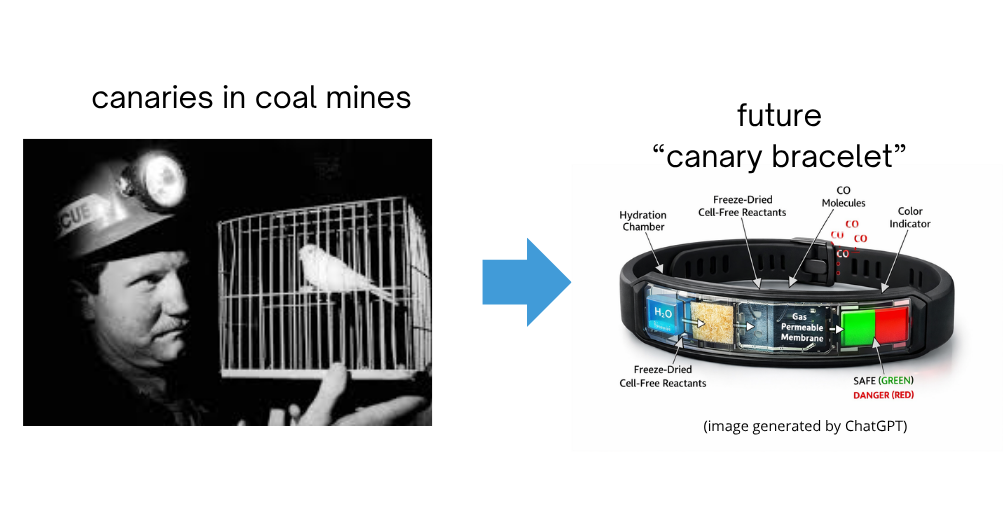
Write a one-sentence summary pitch sentence describing your concept. A wearable bracelet containing a freeze-dried cell-free biosensor that changes color in the presence of carbon monoxide, serving as a modern “canary in the coal mine” for mine workers.
How will the idea work, in more detail? Write 3-4 sentences or more. The bracelet would contain a small patch or microfluidic chamber embedded in the band, loaded with a freeze-dried cell-free expression system programmed with a carbon monoxide–responsive sensing circuit. When activated, the system begins functioning and continuously samples air diffusing through a gas-permeable membrane. Upon exposure to dangerous concentrations of carbon monoxide, the biosensor triggers expression of a chromogenic or fluorescent reporter protein, causing the bracelet window to visibly change color from green to red.
What societal challenge or market need will this address? Carbon monoxide poisoning remains a major public health and occupational safety problem because the gas is odorless, colorless, and often undetectable without specialized equipment. This wearable design could protect miners, firefighters, industrial workers, mechanics, and even families using gas heaters or stoves in poorly ventilated environments.
How do you envision addressing the limitation of cell-free reactions (e.g., activation with water, stability, one-time use)? The main limitations are activation, reaction lifetime, and one-time use. To address activation, the bracelet could include a sealed hydration pouch that the user presses before entering a hazardous environment, initiating the reaction only when needed. For stability, the freeze-dried components would remain shelf-stable for weeks to months inside a sealed moisture-proof compartment. For the one-time use problem, maybe the sensing patch could be designed to be replacable.
Homework question from Ally Huang
Background Information Inspired by Project Hail Mary by Andy Weir, this proposal explores how biological systems might survive extreme radiation during deep-space travel. In the novel, the microorganism “Astrophage” not only survives near stars, but also feeds on stellar energy itself, meaning it must tolerate enormous amounts of radiation — something even Rocky and his species did not fully understand, which lead to a disaster (not spoiling it!). In real biology, some organisms such as tardigrades possess proteins that protect their DNA from radiation damage. Understanding these mechanisms is important for future long-duration missions, where protecting biological systems from cosmic radiation will be essential for human survival and biotechnology in space.
Molecular or Genetic Target The tardigrade DNA-protective protein Dsup (Damage suppressor protein) and radiation-damaged plasmid DNA exposed to UV radiation.
Relationship Between the Target and the Space Biology Question Cosmic radiation is one of the greatest biological dangers in deep-space missions because it damages DNA, proteins, and cells. The tardigrade protein Dsup is known to reduce DNA damage caused by radiation on Earth. By studying whether Dsup can protect DNA in a freeze-dried cell-free system, we can investigate whether protective biomolecules could help stabilize biological tools used during long-term missions. This is scientifically interesting because it combines synthetic biology, astrobiology, and radiation biology while testing whether biological resilience mechanisms can function outside living cells in extreme environments.
Hypothesis or Research Goal I hypothesize that adding the Dsup protein to a freeze-dried BioBits® cell-free expression reaction will reduce radiation-induced damage to DNA templates and improve protein production after UV exposure. The reasoning is based on studies showing that Dsup binds chromatin and helps shield DNA from hydroxyl radicals generated by radiation. In space, freeze-dried biological systems may be used for diagnostics, medicine production, or environmental monitoring, but radiation could degrade their DNA components during storage and transport. If Dsup improves the stability of cell-free reactions after radiation exposure, it could become part of future protective biotechnology systems for space exploration. More broadly, this experiment explores whether natural evolutionary solutions from extremophiles could inspire biotechnology for surviving harsh extraterrestrial environments.
Experimental Plan Freeze-dried BioBits® reactions containing a fluorescent reporter plasmid will be prepared in two groups: one expressing Dsup and one without Dsup (control). Samples will be exposed to different levels of UV radiation to simulate DNA damage. After rehydration, fluorescence intensity will be measured using the P51 Molecular Fluorescence Viewer as an indicator of successful protein expression. Additional controls will include non-irradiated samples. The experiment will compare fluorescence levels between groups to determine whether Dsup improves the resistance of the cell-free system to radiation-induced damage.