Week 11 HW: Bioproduction & Cloud Labs
Part A: The 1,536 Pixel Artwork Canvas | Collective Artwork
Unfortunately, I didn’t have a chance to contribute because I never received the personalized URL. I guess I’ll have to make up for it by becoming a TA this fall :)
That said, I really loved the idea of collaborative bioart. My favorite part was the upper right section with the gene expression, it looks so cool.
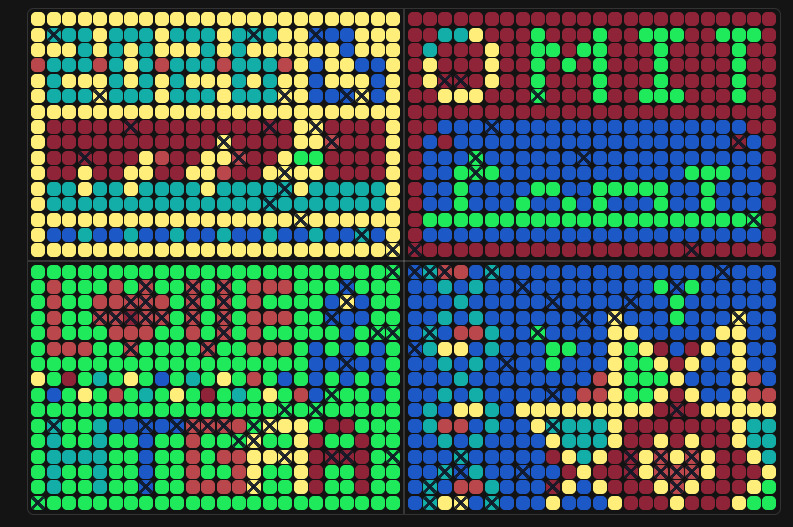 For next year, I think it could be even more engaging if there were multiple canvases or themes (for example, one per node or topic), so more people could contribute and explore different ideas within the same project.
Part B: Cell-Free Protein Synthesis | Cell-Free Reagents
Question 1
E. coli Lysate
- BL21 (DE3) Star Lysate (includes T7 RNA Polymerase)
Gives the system the molecular machines (ribosomes, tRNAs, enzymes) needed for transcription and translation. The T7 RNA polymerase is known for a highly efficient, single-subunit enzyme utilized for rapid, high-yield in vitro RNA synthesis
Salts/Buffer
Potassium Glutamate
Mimics intracellular ionic conditions and stabilizes ribosomes and enzymes for efficient protein synthesis.HEPES-KOH pH 7.5
Maintains a stable pH environment, which is critical for optimal enzyme activity during transcription and translation.Magnesium Glutamate
Supplies Mg2+ ions, essential cofactors for ribosome function, tRNA charging, and enzymatic reactions in protein synthesis.Potassium phosphate monobasic
Importanbt for buffering capacity and phosphate balance, essential to support metabolic and enzymatic reactions.Potassium phosphate dibasic
Works with the monobasic form to maintain pH stability and provide phosphate for energy-related processes.
Energy / Nucleotide System
Ribose
Serves as a precursor for nucleotide synthesis and supports regeneration of nucleotides during the reaction.Glucose
Fuels energy regeneration pathways, helping sustain ATP production over time.AMP
A nucleotide building block that participates in energy metabolism and nucleotide recycling.CMP
Provides cytidine nucleotides required for RNA synthesis.GMP
Supplies guanine nucleotides for RNA transcription.UMP
Provides uridine nucleotides necessary for RNA synthesis.Guanine
Acts as a precursor for GTP synthesis, which is required for both transcription and translation processes.
Translation Mix (Amino Acids)
17 Amino Acid Mix
Supplies most of the amino acids required for protein synthesis.Tyrosine
Added separately due to stability or solubility constraints, ensuring sufficient availability for translation.Cysteine
Provided separately because it is prone to oxidation, ensuring proper incorporation into proteins.
Additives
- Nicotinamide
Supports redox balance and enzyme function by contributing to NAD⁺/NADH-related metabolic processes.
Backfill
- Nuclease Free Water
Adjusts the final reaction volume and ensures no degradation of nucleic acids occurs.
Question 2
The 1-hour PEP–NTP system supplies fully formed NTPs and uses PEP as a high-energy donor, enabling fast, high-rate transcription and translation but with rapid resource depletion. In contrast, the 20-hour NMP–ribose–glucose system starts from NMPs and simple carbon sources, relying on metabolic enzymes in the lysate to regenerate NTPs more slowly. This makes it much more sustainable over long periods, though with lower instantaneous expression rates.
Question 3
Transcription can still occur because guanine can be salvaged and converted enzymatically into GMP (and then GTP) within the lysate, supplying the necessary nucleotide for the RNA synthesis.
Part C: Planning the Global Experiment | Cell-Free Master Mix Design
Fluorescent Protein Properties
sfGFP
sfGFP (superfolder GFP) is engineered for extremely efficient folding, even under stressful conditions, making it highly robust in cell-free systems. It also matures relatively quickly, allowing strong fluorescence signals to appear early during incubation.
mRFP1
mRFP1 has a slower maturation time compared to many green fluorescent proteins, which can delay fluorescence development in long incubations. Its folding efficiency is also lower than newer red fluorescent proteins, potentially reducing total signal output.
mKO2
mKO2 is a bright orange fluorescent protein with fast maturation, which improves early fluorescence detection. However, it is somewhat sensitive to acidic conditions, meaning pH changes during long incubations may decrease fluorescence intensity.
mTurquoise2
mTurquoise2 is known for its very high quantum yield and brightness, making it highly sensitive for fluorescence readout. However, cyan fluorescent proteins can be more sensitive to oxidative conditions and folding stress in cell-free reactions.
mScarlet-I
mScarlet-I is an improved red fluorescent protein with exceptionally high brightness and fast maturation relative to older red proteins. Its efficient folding and photostability make it well suited for long-term fluorescence measurements.
Electra2
Electra2 is designed for strong fluorescence output and improved performance in engineered systems, but like many fluorescent proteins, its chromophore formation depends on oxygen availability. Limited oxygen diffusion in sealed reactions may therefore reduce fluorescence development.
Hypothesis
I hypothesize that increasing the concentration of molecular chaperones and optimizing magnesium ion concentration in the cell-free mastermix will improve folding efficiency and fluorescence intensity for mRFP1 during a 36-hour incubation. Because mRFP1 folds less efficiently and matures more slowly than several other fluorescent proteins, improved protein folding conditions should increase the amount of correctly folded fluorescent protein produced. Additionally, maintaining sufficient magnesium levels may support translation efficiency and overall protein stability, leading to stronger fluorescence signals over time.