Individual Final Project

Individual Final Project Document (HTGAA 2026):
This document presents the complete final project report, including the design strategy, construct engineering workflow, structural analyses, and in silico validation steps. For a more interactive and visually detailed presentation including animated rotating views of the predicted protein structures, enhanced figures, additional simulations, and direct access to all Benchling design files and cloning maps, please refer to the project documentation webpages associated with this final project.
These resources provide a more comprehensive visualization of the project beyond the static figures included in this PDF document.
Project Title: Engineering Houseplants for Atmospheric Carbon Monoxide Capture: Chloroplast-Targeted Expression of the Bacterial CODH Enzyme Complex in Nicotiana tabacum
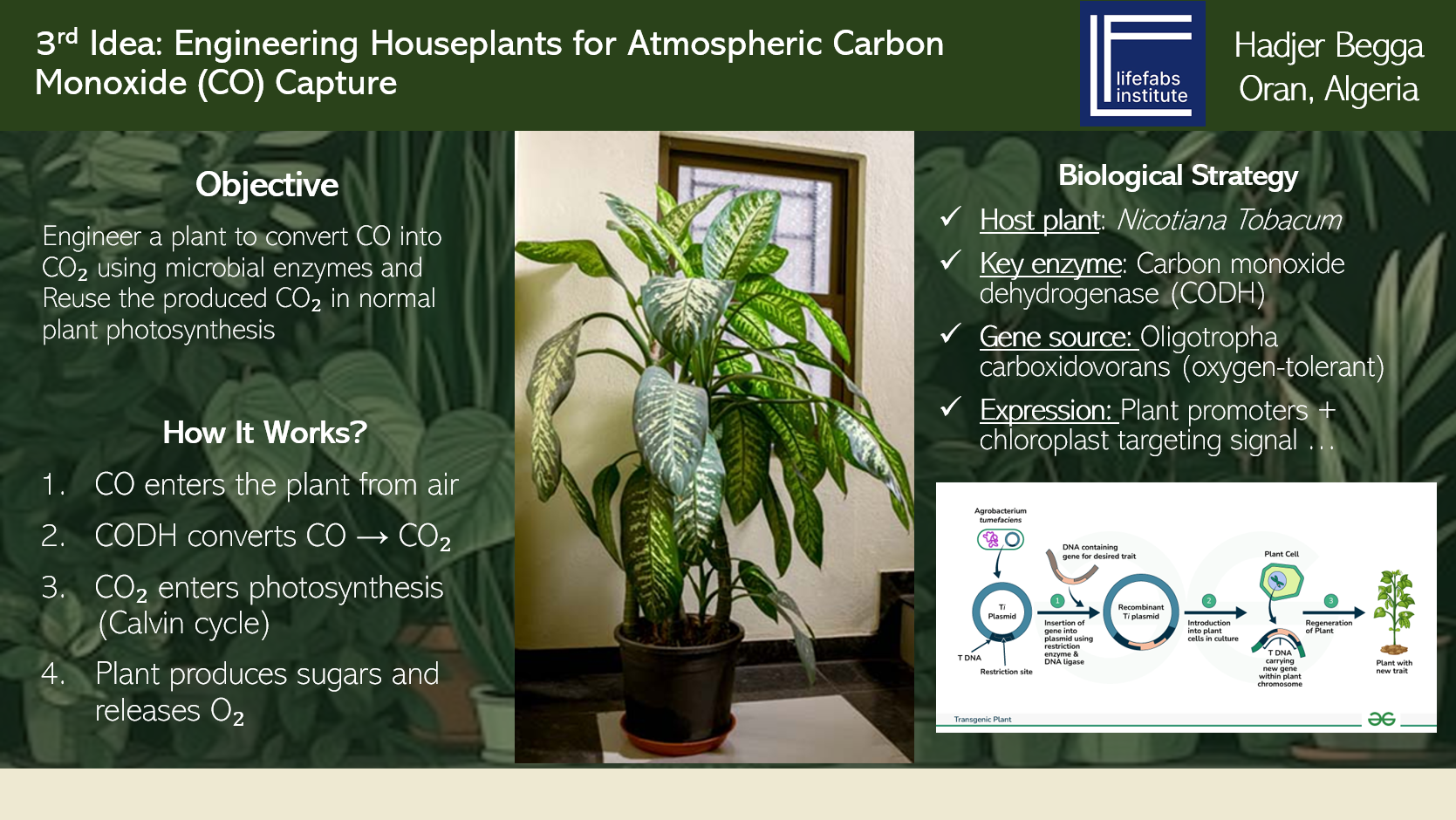
The Problem This Project Addresses
Carbon monoxide (CO) is a colorless, odorless, tasteless toxic gas that cannot be detected by human senses. It is produced whenever something burns incompletely — gas heaters, stoves, car engines, fireplaces, and wood-burning appliances all release CO. Indoors, CO accumulates silently and can reach dangerous or fatal concentrations before anyone notices. The current standard of protection is a battery-powered electrochemical CO detector. These devices are excellent at detecting CO and sounding an alarm , but they cannot remove the gas from the air. Once the alarm sounds, the occupants must evacuate and ventilate the space manually. Furthermore, CO detectors require regular battery replacement and eventually need to be replaced entirely. In low-income households worldwide, detectors are frequently absent, have dead batteries, or are past their useful lifespan.
–> This project proposes a fundamentally different approach: instead of detecting CO, make the plant remove it.
The Core Idea
Certain bacteria ,particularly Oligotropha carboxidovorans, have evolved the ability to use CO as a food source. They do this using an enzyme called Carbon Monoxide Dehydrogenase (CODH), which converts CO into CO₂ according to this reaction:
CO + H₂O → CO₂ + 2 electrons + 2 protons
The CO₂ produced by this reaction is not harmful at the quantities involved and supposed to be reused by a plant’s own photosynthesis through the Calvin cycle.
This project proposes to take the bacterial CODH system out of the bacterium and introduce it into a plant, specifically targeting it to the chloroplast (the organelle where photosynthesis happens). By placing CODH inside the chloroplast, two elegant outcomes occur simultaneously:
- The plant actively breaks down CO from the surrounding air
- The CO₂ produced by CODH is immediately captured by Rubisco and enters the Calvin cycle, making the plant slightly more productive
The scientific foundation for this idea is already established in the literature. Duffus et al. (2018) demonstrated that the complete CODH complex can be functionally expressed in Escherichia coli –> proving heterologous expression is achievable. South et al. (2019) demonstrated in Science that bacterial enzymes introduced into tobacco chloroplasts producing CO₂ directly in the stroma increased plant biomass by up to 40% –> proving that chloroplast-produced CO₂ is efficiently captured by photosynthesis. This project extends this logic to a new substrate: atmospheric CO.
The Complete Genetic System Required
The CODH enzyme from O. carboxidovorans is not a single protein. It is a complex system requiring seven genes organized into two functional groups:
- Group 1 — Structural subunits (the enzyme itself):
coxL –> the large catalytic subunit (~88 kDa) where CO is actually oxidized. Contains the unique [CuSMoO₂] active site coxM –> the medium subunit (~30 kDa) containing FAD, responsible for electron transfer coxS –> the small subunit (~18 kDa) containing [2Fe-2S] iron-sulfur clusters, part of the electron relay chain
These three proteins assemble into a (CoxL·CoxM·CoxS)₂ heterohexamer — a complex of six protein subunits working together.
- Group 2 — Maturation proteins (the assembly machinery):
coxD –> an AAA+ ATPase chaperone that acts as a “maturation protein,” responsible for the post-translational insertion of copper and the essential bridging sulfur into the apo-enzyme, converting it to active holo-enzyme. coxE, coxF and coxG –> “final processing” and “sulfur addition” are part of a complex pathway. According to research, coxF plays a role in copper acquisition/mobilization, and coxE and coxG are involved in the maturation pathway that leads to the properly sulfurated and copper-inserted active site. The exact individual functions of coxE and coxG are still being elucidated, though their role in the maturation complex is essential.
Overview of the Three Aims
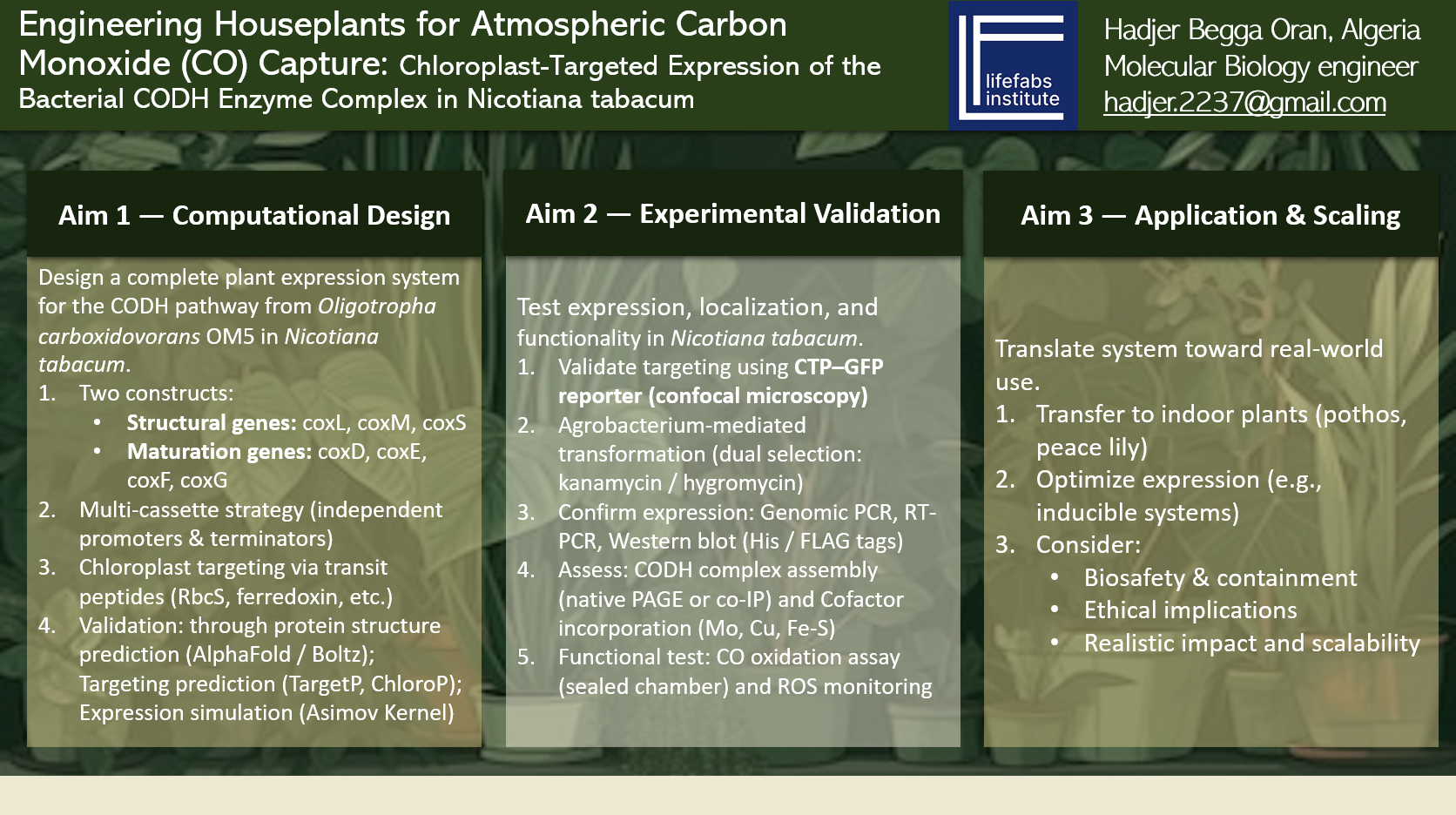
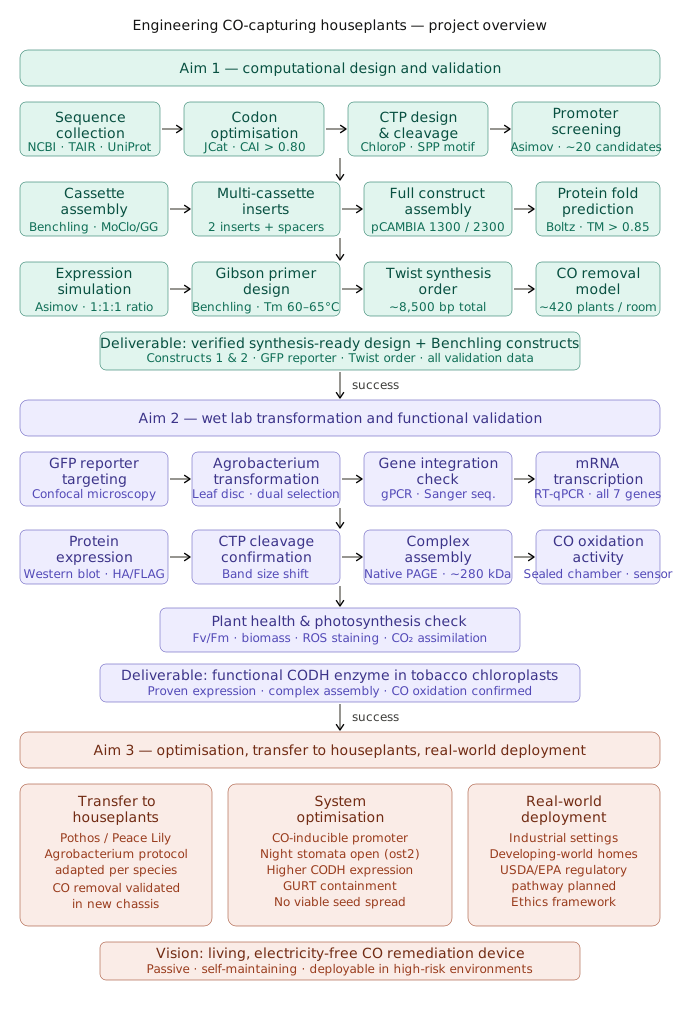
AIM 1 — Computational Design and Validation of the Complete Genetic System
In simple terms: Design the complete genetic blueprint for the CO-capturing plant system on a computer, verify every element computationally, and produce a synthesis-ready design.
The seven bacterial genes cannot simply be pasted into a plant. They need to be comprehensively redesigned for plant expression:
- Their DNA sequences must be rewritten in “plant language” through codon optimization
- Each protein needs a molecular address label (chloroplast transit peptide) added to its beginning so it is directed to the correct location inside the plant cell
- The address labels must be verified to ensure the plant’s processing machinery will correctly remove them after the protein arrives
- Each gene needs its own promoter (an on-switch for gene expression) and terminator (an off-switch), carefully chosen to prevent the plant from silencing all the genes simultaneously
- Translation enhancer sequences must be added to maximize protein production
- Spacer sequences must be placed between genes to prevent one gene’s transcription from accidentally running into the next
- The complete system must be distributed across two separate transformation vectors
All of this is done computationally using Benchling, A codon optimization tool, ChloroP 1.1, Boltz, and the Asimov Kernel –> producing a complete verified design ready for DNA synthesis through Twist Biosciences.
AIM 2 — Wet Lab Transformation and Functional Validation (The next step — beyond this course)
In simple terms: Actually build the constructs in the lab, put them into tobacco plants, and prove the enzyme works. Aim 2 begins where Aim 1 ends. The Twist-synthesized multicassettes fragments are assembled into the pCAMBIA vectors using Gibson Assembly. The constructs are introduced into Nicotiana tabacum via Agrobacterium tumefaciens-mediated leaf disc transformation , the standard method for introducing genes into tobacco. Transgenic plants are selected on dual antibiotic medium (hygromycin + kanamycin, confirming both constructs integrated).
The experimental progression follows strict logic — each step must succeed before the next begins:
- –> Step 1 — Chloroplast targeting validation
- –> Step 2 — Gene integration and transcription
- –> Step 3 — Protein expression and CTP cleavage
- –> Step 4 — Complex assembly
- –> Step 5 — CO oxidation activity
- –> Step 6 — Plant health and photosynthesis
for more details, please take a look on part I of week 10 homework.
AIM 3 — Optimization, Transfer to Houseplants, and Real-World Deployment(The long-term vision)
In simple terms: Assuming Aim 2 succeeds, optimize the system, transfer it to real houseplants, and develop it toward real-world deployment. If Aim 2 demonstrates functional CO oxidation in tobacco, Aim 3 pursues three parallel directions:
Direction 1 — Transfer to real houseplants: The validated genetic architecture from tobacco is adapted for transformation into Epipremnum aureum (Pothos) and Spathiphyllum wallisii (Peace Lily) — widely kept, hardy, aesthetically acceptable houseplants. Agrobacterium-mediated transformation protocols established for tobacco are adapted for these species.
Direction 2 — System optimization: Several improvements are pursued to increase CO removal efficiency and operational range:
A CO-responsive inducible promoter system replaces constitutive promoters, activating CODH expression only when CO is present and saving plant energy otherwise Constitutively open stomata engineering to maintain CO uptake during nighttime hours when CO poisoning risk is highest Expression levels are optimized based on the quantitative CO removal model to increase per-plant removal capacity
Direction 3 — Safety, containment, and deployment:
Genetic Use Restriction Technology (GURT): To prevent seed viability and uncontrolled environmental spread, I will implement Genetic Use Restriction Technology (GURT). This ensures that any engineered plants cannot reproduce outside controlled environments. Additional containment strategy — chloroplast genome integration:
As an alternative or complement to GURT, I can integrate the transgenes into the chloroplast genome instead of the nuclear genome. Chloroplast DNA is maternally inherited in most flowering plants, including tobacco (Nicotiana tabacum). This means the transgenes are not transmitted via pollen, virtually eliminating the risk of gene flow to wild relatives. This is a well-established biosafety strategy for plant synthetic biology.
Regulatory pathway planning begins under USDA APHIS (Regulation of genetically engineered plantsand) EPA (Regulation of plants producing pesticidal substances (if applicable))frameworks.
The deployment target is refined based on the quantitative CO removal analysis: rather than acute emergency protection in homes (which requires too many plants), the primary application is chronic CO reduction in high-exposure industrial and semi-industrial environments like workshops, garages, underground parking facilities, and developing-world indoor cooking spaces where CO concentrations are higher and more sustained.
The ethical framework for commercial deployment ,including informed consent, false assurance prevention, equity of access, and environmental risk, is fully developed and integrated into regulatory submissions.
Sources:
- Bährle, R., Böhnke, S., Englhard, J., Bachmann, J., & Perner, M. (2023). Current status of carbon monoxide dehydrogenases (CODH) and their potential for electrochemical applications. Bioresources and Bioprocessing, 10(1), 84. https://doi.org/10.1186/s40643-023-00705-9
- Dent, M. R., Weaver, B. R., Roberts, M. G., & Burstyn, J. N. (2023). Carbon Monoxide-Sensing Transcription Factors: Regulators of Microbial Carbon Monoxide Oxidation Pathway Gene Expression. Journal of Bacteriology, 205(5), e00332-22. https://doi.org/10.1128/jb.00332-22
- Erb, T. J. (2024). Photosynthesis 2.0: Realizing New-to-Nature CO2-Fixation to Overcome the Limits of Natural Metabolism. Cold Spring Harbor Perspectives in Biology, 16(2), a041669. https://doi.org/10.1101/cshperspect.a041669
- Kaufmann, P., Duffus, B. R., Teutloff, C., & Leimkühler, S. (2018). Functional Studies on Oligotropha carboxidovorans Molybdenum–Copper CO Dehydrogenase Produced in Escherichia coli. Biochemistry, 57(19), 2889–2901. https://doi.org/10.1021/acs.biochem.8b00128
- Liu, C., Zhang, N., Sun, L., Gao, W., Zang, Q., & Wang, X. (2022). Potted plants and ventilation effectively remove pollutants from tobacco smoke. International Journal of Low-Carbon Technologies, 17, 1052–1060. https://doi.org/10.1093/ijlct/ctac081
- Park, S., Mani, V., Kim, J. A., Lee, S. I., & Lee, K. (2022). Combinatorial transient gene expression strategies to enhance terpenoid production in plants. Frontiers in Plant Science, 13, 1034893. https://doi.org/10.3389/fpls.2022.1034893
- Qin, S., Liu, Y., Yan, J., Lin, S., Zhang, W., & Wang, B. (2022). An Optimized Tobacco Hairy Root Induction System for Functional Analysis of Nicotine Biosynthesis-Related Genes. Agronomy, 12(2), 348. https://doi.org/10.3390/agronomy12020348
- Schübel, U., Kraut, M., Mörsdorf, G., & Meyer, O. (1995). Molecular characterization of the gene cluster coxMSL encoding the molybdenum-containing carbon monoxide dehydrogenase of Oligotropha carboxidovorans. Journal of Bacteriology, 177(8), 2197–2203. https://doi.org/10.1128/jb.177.8.2197-2203.1995
- Siebert, D., Busche, T., Metz, A. Y., Smaili, M., Queck, B. A. W., Kalinowski, J., & Eikmanns, B. J. (2020). Genetic Engineering of Oligotropha carboxidovorans Strain OM5—A Promising Candidate for the Aerobic Utilization of Synthesis Gas. ACS Synthetic Biology, 9(6), 1426–1440. https://doi.org/10.1021/acssynbio.0c00098
- Tao, Y., Chiu, L.-W., Hoyle, J. W., Dewhirst, R. A., Richey, C., Rasmussen, K., Du, J., Mellor, P., Kuiper, J., Tucker, D., Crites, A., Orr, G. A., Heckert, M. J., Godinez-Vidal, D., Orozco-Cardenas, M. L., & Hall, M. E. (2023). Enhanced Photosynthetic Efficiency for Increased Carbon Assimilation and Woody Biomass Production in Engineered Hybrid Poplar. Forests, 14(4), 827. https://doi.org/10.3390/f14040827
- Thagun, C., Odahara, M., Kodama, Y., & Numata, K. (2024). Identification of a highly efficient chloroplast-targeting peptide for plastid engineering. PLOS Biology, 22(9), e3002785. https://doi.org/10.1371/journal.pbio.3002785