Week 7 HW: Genetic Circuits Part II
Intracellular Artificial Neural Networks (IANNs)
What advantages do IANNs have over traditional genetic circuits, whose input/output behaviors are Boolean functions?
IANNs are able to process multiple inputs and gradients, unlike Boolean functions that largely process “black or white” options. This allows them to make more nuanced “decisions.”"
Describe a useful application for an IANN; include a detailed description of input/output behavior, as well as any limitations an IANN might face to achieve your goal.
An IANN could be used to predict a cell’s response to a combination of environmental signals/ligands at various combinations of concentrations. Since ligands can elicit multiple responses by triggering multiple pathways and pathways that impact other pathways, an IANN could be a good choice to deal with this complexity. Some limitations that an IANN might face is that there are so many parts involved in this situation that molecules could interact with the IANN, and a large IANN would place a large metabolic burden on the cell it’s in.
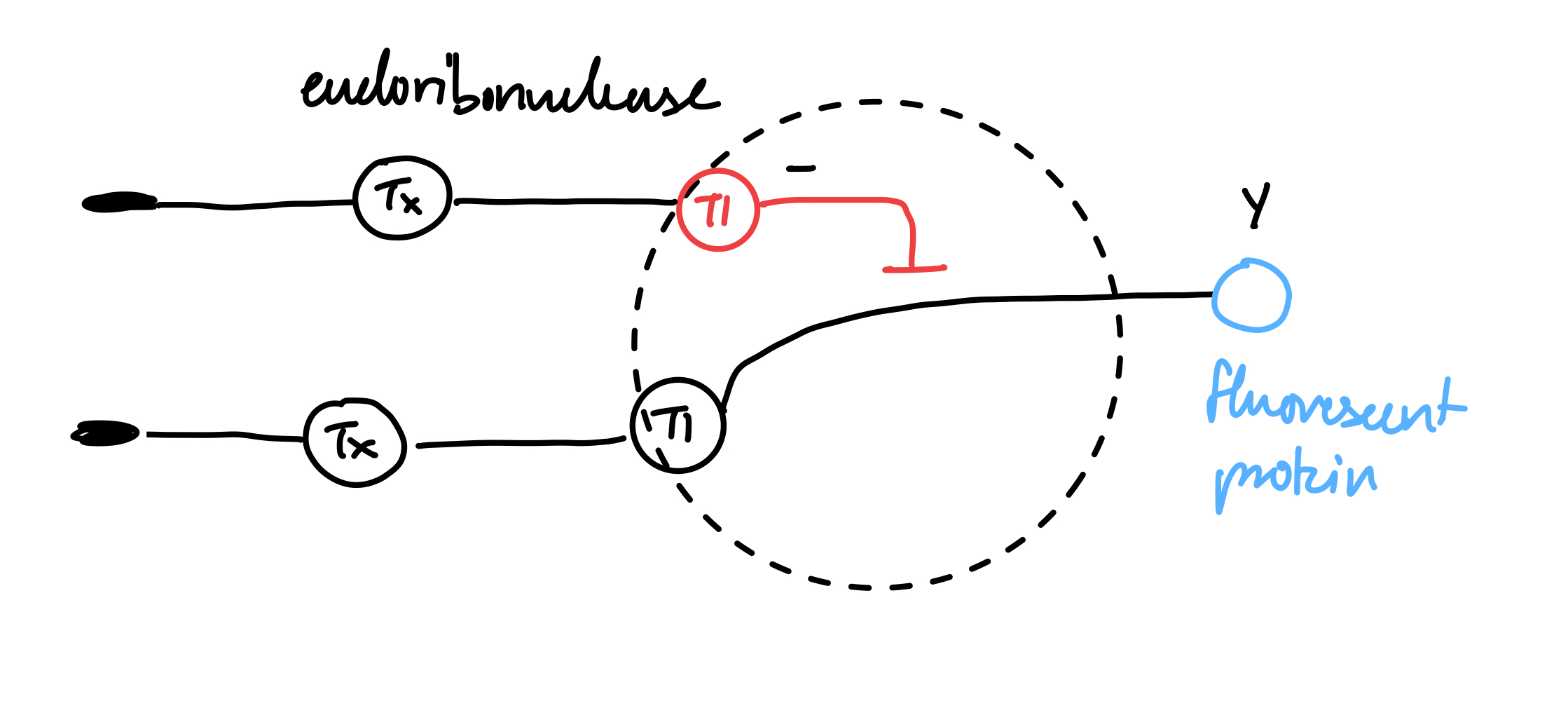
Below is a diagram depicting an intracellular single-layer perceptron where the X1 input is DNA encoding for the Csy4 endoribonuclease and the X2 input is DNA encoding for a fluorescent protein output whose mRNA is regulated by Csy4. Tx: transcription; Tl: translation.
Fungal Materials
What are some examples of existing fungal materials and what are they used for? What are their advantages and disadvantages over traditional counterparts?
Fungal materials have been used as biomedical scaffolds Antinori et al., 2021. An advantage is that this material is cheap, regenerates itself, and is sustainable. A disadvantage is that in general, fungal materials are not well-studied, so more investigation must be done before this is used widely.
What might you want to genetically engineer fungi to do and why? What are the advantages of doing synthetic biology in fungi as opposed to bacteria?
If I were to engineer fungi, I would choose to make it produce something that would help humans, so something like a pharmaceutical. One advantage of doing synthetic biology in fungi instead of bacteria are that fungi are eukaryotic, so proteins that would be found in humans may be able to be produced in fungi. Many human proteins are post-translationally modified in ways that aren’t done in bacteria such as glycosylation. This allows synthetic biologists to produce proteins that might be more directly applicable to humans.