Individual Final Project
Abstract
Project Aims
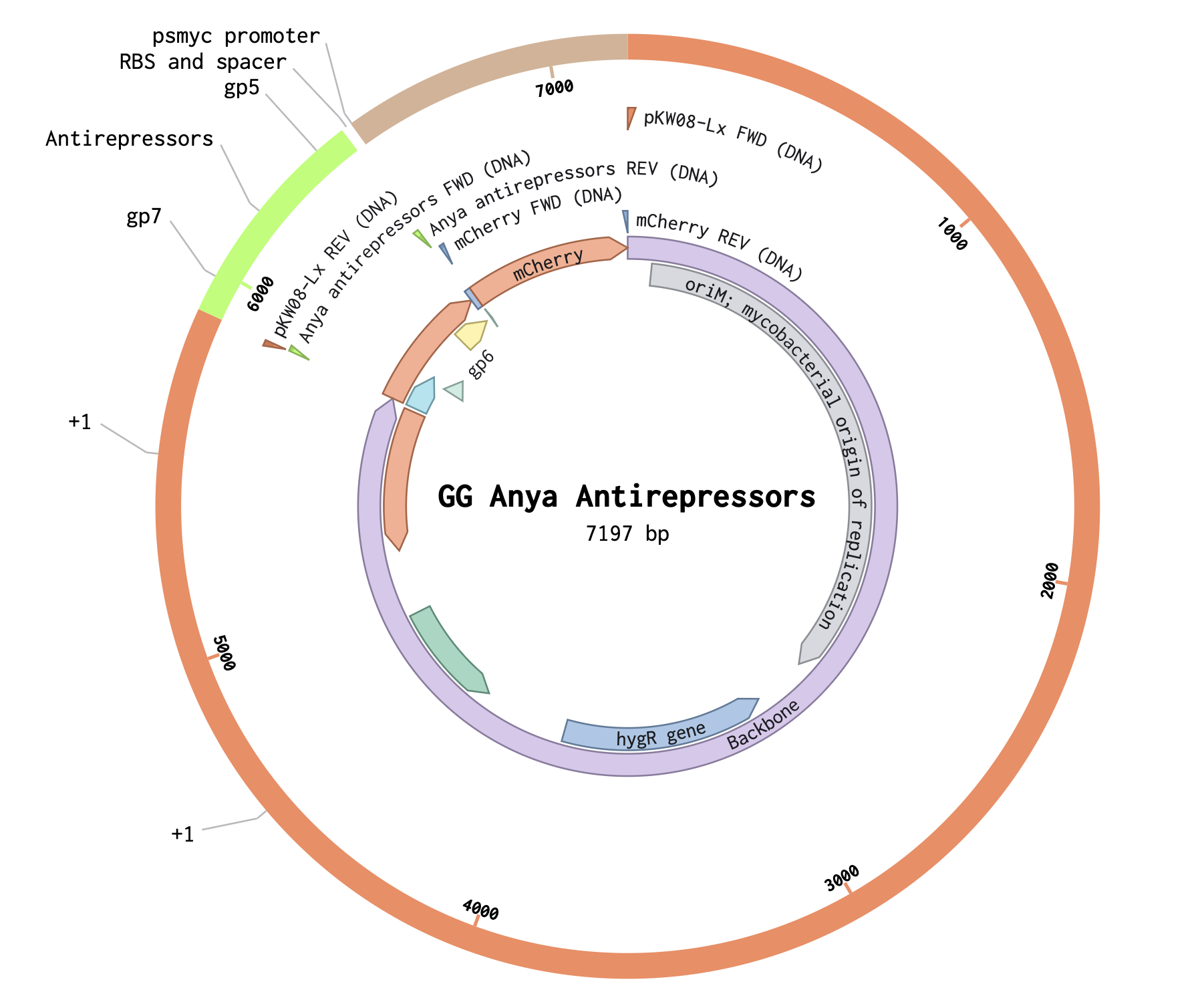
Aim 1: Assemble the antirepressor circuit using Gibson Assembly. Parts will include the putative antirepressors from Extracellular Prophage-Inducing Particles (EPIPs), an inducible promoter, a fluorescent protein, and plasmid backbone. Then, electroporate the plasmid into Mycolicibacterium aichiense, and use fluorescence to evaluate the success of transformation and gene expression. Investigate the effect of putative antirepressors on M. aichiense growth by tracking OD600 over time.
Aim 2: See if the EPIP antirepressors are species specific and make them more generalist if they are. This way, they can be used for phage therapy to treat many types of bacterial infections.
Aim 3: Test antirepressors in vivo, assessing safety and efficacy. If they are successful in inducing prophages and minimizing superinfection immunity, they would be extremely helpful in progressing phage therapy.
Background
Briefly summarize two peer-reviewed research citations relevant to your research.
Qian HL, Roman AN, Paudel S, Hussey GE, Carline KBR, Saha MS. A novel phage satellite class induced prophage excision in Mycolicibacterium aichiense. Virology 2026; 620: 110911. 10.1016/j.virol.2026.110911
This paper characterizes EPIPs, describing the BRO domains within most of the EPIP genomes. It states that the proteins are truncated, solely consisting of the BRO domains, so it is unknown whether the proteins retain the transcriptional activity described in the following paper. It additionally points out other conserved proteins among the EPIP isolates, including a serine integrase and tape measure protein. Furthermore, it notes that EPIPs are the first phage satellites isolated in Mycobacteriaceae, the family containing pathogens like Mycobacterium tuberculosis, making EPIPs promising for bioengineering tools designed to treat such infections.
Zemskov EA, Kang W, Maeda S. Evidence for nucleic acid binding ability and nucleosome association of Bombyx mori nucleopolyhedrovirus BRO proteins. J Virol 2000;74:6784-9. 10.1128/jvi.74.15.6784-6789.2000
This paper explains that BRO domain-containing proteins in phages function as DNA-binding proteins and may influence transcription and replication. The paper studies Bombyx mori, a virus infecting insects that consists of five BRO domain-containing proteins. The authors used immunohistochemistry to determine that the BRO domain-containing proteins localize to the nucleus and thus hypothesize that they may influence transcription. They also showed that certain parts of the proteins’ sequences were necessary for DNA binding.
Explain how your project is novel or innovative.
Currently, there are no known phage satellites that infect Mycobacteriaceae aside from EPIPs. This means that the EPIPs can be used for novel synthetic biology tools to edit species within Mycobacteriaceae. On example includes developing a lytic-lysogenic switch from the putative antirepressors (BRO domains) that would be able to induce prophages that could be conferring immunity to Mycobacteriaceae pathogens.
Explain why your project matters and what impact it could have.
Tuberculosis infections remain one of the hardest infections to treat with antibiotics (Pai et al., 2016). Phage therapy is a promising way to treat antibiotic resistant infections; however, there are many obstacles to overcome, including prophage-conferred immunity to the host. Using antirepressors in these phage satellites, EPIPs, could be a promising way to overcome this problem. Overcoming this problem would help phage therapy progress so that it may one day be used widely as a treatment. Using phage therapy as a treatment would help combat the rising antimicrobial resistance crisis.
Describe the ethical implications associated with your project and identify relevant ethical principles (e.g., non-maleficence, beneficence, justice, or responsibility).
This project involves beneficence. Developing a lytic-lysogenic switch to help phage therapy progress would benefit many people, as antimicrobial resistance becomes an even larger problem. If phage therapy could be developed enough to be widely used, it could revolutionize how bacterial infections are treated, helping preserve the patient’s microbiome among other benefits.
To ensure this project is ethical, any synthetic tools developed from the EPIPs should only be used to benefit people. For example, if an integration vector were to be developed from the EPIPs’ serine integrases, researchers should not insert genes that would make Mycobacterium tuberculosis more virulent, for example. For this project specifically, a lytic-lysogenic switch that is misused could potentially disrupt a patient’s microbiome, as the microbiome likely has prophages that are stable within commensal bacteria. Inducing those prophages could upset the balance of the microbiome, leading to adverse effects, so the lytic-lysogenic switch should be tested extensively for “host range” prior to use in vivo.
Experimental Design, Techniques, Tools, and Technology
Create a detailed experimental plan for your final project. Include a timeline for each part of your experimental plan (i.e., how long you would expect each step in your final project to take).
- Identify parts (backbone with Tet-inducible promoter, mCherry, antirepressors, primers)
- Identify cut sites and choose enzyme (BbsI) with the fewest cut sites
- Mutate internal cutsites out (induce silent mutations)
- Design Golden Gate assembly parts using Benchling
- Design primers that would amplify the parts so that they don’t have to be reordered
- Order parts (gene fragements and primers) from Twist Biosciences
- Amplify parts using PCR
- Clone into a PCR cloning vector (pMiniT 2.0)
- Run a restriction digest using BbsI to create sticky ends
- Use Golden Gate assembly to assemble the parts
- Electroporate the construct into M. aichiense
- Allow both transformed and untransformed M. aichiense to grow
- Add tetracycline to induce the tetracycline-inducible promoter
- Measure fluorescence and OD600 at specific time points and plot over time
- Analyze data and determine if the EPIP antirepressors are inhibiting M. aichiense growth
We discussed and practiced various techniques related to synthetic biology throughout the semester. Place a check next to the techniques relevant to your project. (I just listed the ones that are relevant)
- Pipetting
- Lab safety
- Bioethical considerations
- DNA editing
- DNA construct design
- Restriction enzyme digestion
- Gel electrophoresis
- Databases
- Designing a Twist order
- Bacterial culturing
- Primer design
- PCR reactions
- Golden Gate assembly
- Use of benchling
Expand upon two techniques you checked in the previous question by describing how you would utilize those techniques in your final project.
Golden Gate assembly: I am using this to assemble my parts, creating a complete plasmid with my genes of interest, the EPIP antirepressors. This technique has been used successfully to assemble mycobacteriophages, which are high in GC content, while Gibson assembly has not worked as successfully, so Golden Gate assembly is the better choice.
DNA editing: I am using this to mutate out internal cut sites within my parts. To do this, I translated the DNA sequence into amino acids and created mutations that would be silent using a codon chart.
Results and Quantitative Expectations
What aspect of your final project did you choose to validate?
I am aiming to validate whether the putative antirepressors inhibit bacterial growth. I am measuring this by measuring the OD600 at various time points after inducing the expression of the antirepressors.
Write down a detailed protocol of how you validated this aspect of your final project.
- Grow M. aichiense to ~2 days to allow cells to reach log phase
- Add tetracycline to induce expression of EPIP antirepressors and mCherry
- At various time points after adding Tet, sample the culture and measure OD600 using a spectrophotometer and fluorescence using a plate reader.
- Plot the results over time and see whether the antirepressors decrease bacterial growth
What synthetic biology techniques did you utilize in validating this aspect of your final project?
Gel elctrophoresis to determine that Golden Gate assembly successfully assembled all the parts. Also, as mentioned above, I would measure OD600 and fluorescence to determine the effect of EPIP antirepressors on M. aichiense growth, though these are not synthetic biology techniques.
You must present data as part of your final project and include some analysis of that data. The data may be collected experimentally in the lab or generated as simulated data
The data will eventually be collected experimentally as the antirepressors have never been characterized and cannot be simulated. However, there was not enough time to order, assemble, and electroporate the construct to do this.
Did you encounter any unexpected challenge(s) when performing your validation? If so, describe the challenge(s) and strategies to overcome it. If not, discuss potential problems, difficulties, limitations, and/or alternative strategies to overcome challenges in your final project.
I have not yet tried to perform my validation, but I expect that assembling the construct using Golden Gate assembly will require some troubleshooting. To troubleshoot this, I would alter the conditions of the reaction or even the PCR to ensure that the fragments are completely amplified. Additionally, I anticipate that there would be challenges in electroporating the construct into M. aichiense. The protocol for creating electrocompetent M. aichiense needs to be optimized.
Additional Information
List all references cited in this assignment (bullet-point list)
- GBD 2021 Antimicrobial Resistance Collaborators. Global burden of bacterial antimicrobial resistance 1990-2021: a systematic analysis with forcasts to 2050. Lancet 2024;404:1199-226. 10.1016/S0140-6736(24)01867-1
- Ibarra-Chávez R, Frederik Hansen M, Pinilla-Redondo R, Seed KD, Trivedi U. FEMS Microbiol Rev 2021;45:fuab031. 10.1093/femsre/fuab031
- Pai M, Memish ZA. Antimicrobial resistance and the growing threat of drug-resistant tuberculosis. J Epidemiol Glob Health 2016;6:45-7. 10.1016/j.jegh.2016.02.001
- Qian HL, Roman AN, Paudel S, Hussey GE, Carline KBR, Saha MS. A novel phage satellite class induced prophage excision in Mycolicibacterium aichiense. Virology 2026; 620: 110911. 10.1016/j.virol.2026.110911
- Zemskov EA, Kang W, Maeda S. Evidence for nucleic acid binding ability and nucleosome association of Bombyx mori nucleopolyhedrovirus BRO proteins. J Virol 2000;74:6784-9. 10.1128/jvi.74.15.6784-6789.2000
Create a supply list and budget for your project
Antirepressor and mCherry gene fragments: $89.60 from Twist
Plasmid backbone: already have in the lab, will use PCR to isolate backbone and spacer
Primers: ~$70 from IDT