Week 7 HW: Genetic Circuits Part II
Intracellular Artificial Neural Networks (IANNs)
What advantages do IANNs have over traditional genetic circuits,whose input/output behaviors are Boolean functions?
Boolean genetic circuits are binary; a signal is either present or absent, on or off. IANNs add nuance by incorporating quantity: not just whether a signal is present, but how much, and how that amount combines with other weighted inputs to determine output. This matters biologically because cells are not rigid systems. Gene expression fluctuates due to stochastic noise and biological drift. Boolean circuits are brittle in this context, while IANNs, by distributing computation across many weighted inputs, are more robust to that natural variability.
Describe a useful application for an IANN; include a detailed description of input/output behavior, as well as any limitations an IANN might face to achieve your goal.
Many inflammatory diseases are circadian-gated. Asthma attacks, rheumatoid arthritis flares, and cardiovascular events cluster at specific phases of the biological clock. A Boolean circuit cannot capture this; it can detect whether inflammation is present, but not whether it is occurring at the wrong time. That distinction is clinically meaningful, and it is what an IANN could resolve.
Two circuits were designed to explore this. The KaiClock circuit integrates circadian phase (X1: RpaA) with inflammatory state (X2: InflammationSensor), producing a graded fluorescent output that scales with the weighted combination of both inputs. However, the part naming conventions used in KaiClock did not register correctly in the Neuromorphic Wizard simulator, so Durin was designed and submitted as the parralel AND gate working version instead.
Durin runs two parallel AND gates: X1 carries PgU with mMaroon1, and X2 carries PgU_rec_CasE with eBFP2. Both gates must be satisfied simultaneously before CasE releases the final mNeonGreen output. Rather than a weighted gradient, Durin enforces parallel signal verification, two conditions checked at once before committing to output.
Durin was the circuit submitted for possible run at Weiss Lab. Together the two designs represent an iterative process: KaiClock aimed to establish the biological concept, and Durin aimed to be an executable implementation under simulator constraints.
Limitations include irreversibility from recombinase components, susceptibility to molecular noise, and risk of crosstalk with endogenous cellular machinery.
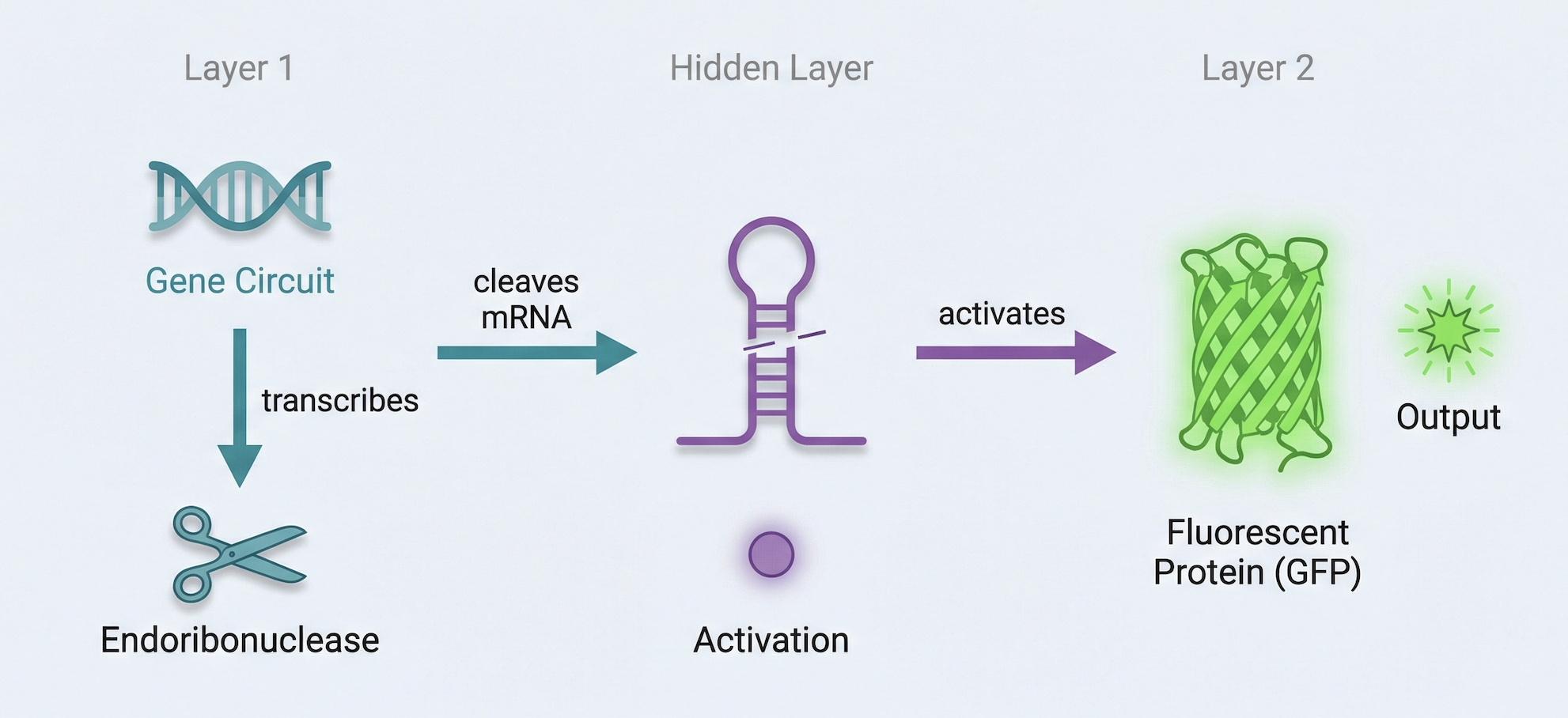
Draw a diagram for an intracellular multilayer perceptron where layer 1 outputs an endoribonuclease that regulates a fluorescent protein output in layer 2.
Hidden layer that does its own computation, and the output of that hidden layer becomes the input to the next layer.
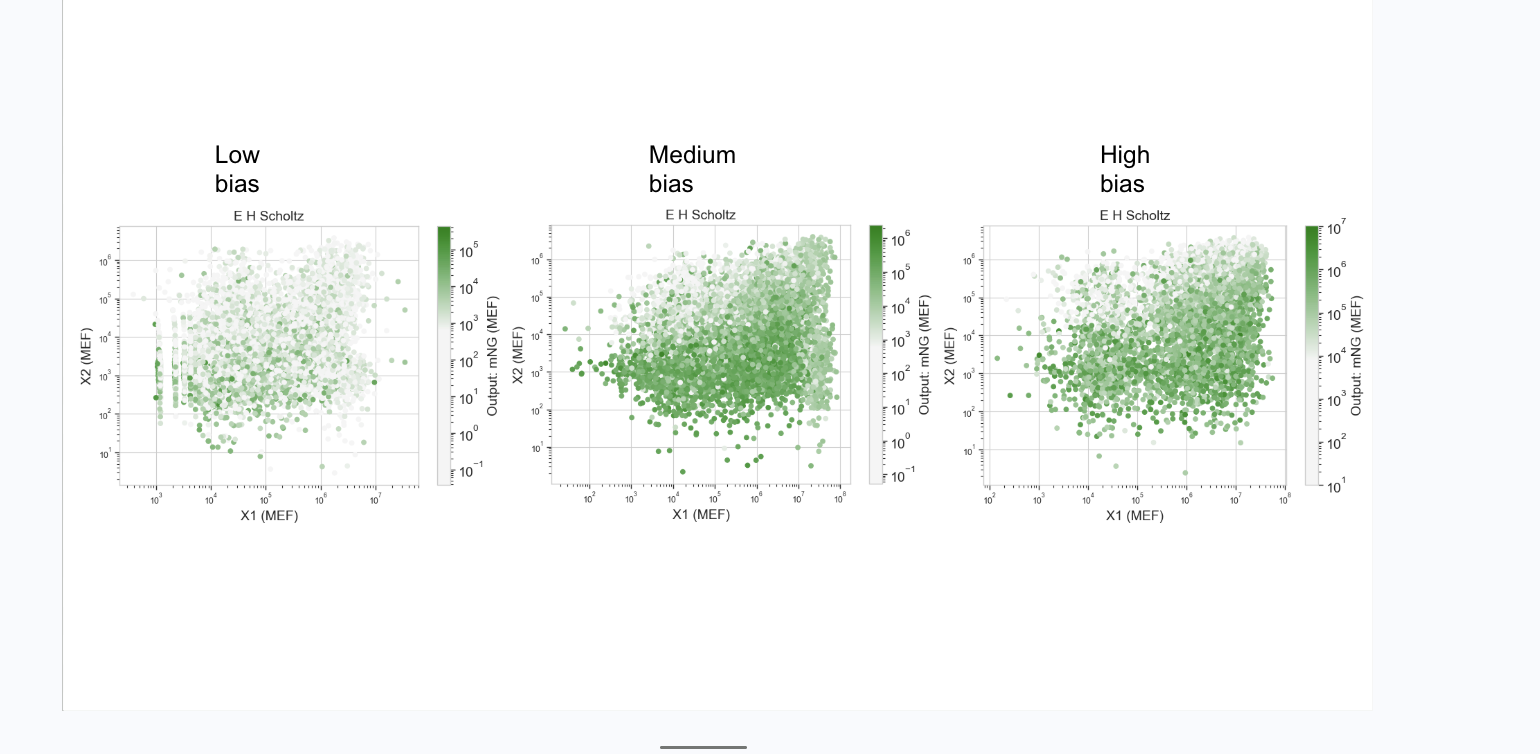
Weiss Lab run of my test IANNS bias dependent parallel AND Gate, with weighting adjusted. Was focused on trying to understand AND gates so its unexpected to see its run below as thought would be many more submissions for IANNS.
Fungal Materials
Fungal materials form part of mycelium, a network also being studied for its possible contribution to communal living and alternative methods of communication through its fungal structure and system. Mycelium composites, such as those grown from oyster mushrooms on agricultural waste, are used commercially as biodegradable packaging and leather alternatives, with companies like Ecovative leading production.
Various other materials are being fabricated utilizing fungal spores, and fungal pigments are also in use. Ink cap mushrooms, for example, undergo autodigestion and become a liquid black ink. It is worth noting that fungal pigments are not very lightfast, and prolonged UV exposure will degrade the color, which remains a significant limitation compared to synthetic dyes. Spalting, where fungi create dark patterned lines as they compete for territory in wood, is another application used in decorative woodworking. The core advantage of fungal materials over traditional counterparts such as synthetic foam or leather is that they are biodegradable, compostable, and generally healthier for human and environmental use. Their disadvantages include lower structural strength, moisture sensitivity, and slower production cycles. Extending the lightfastness of fungal pigments through mordants and fixatives, drawing on approaches used with natural pigments and mineral ochres, represents a personally compelling area of further research.
Two areas stand out as compelling targets for genetic engineering in fungi. The first is pigment lightfastness: engineering fungi to produce UV stable pigments would open up applications in textile dyeing, packaging, paint media, and coloring materials, extending the utility of biological pigments beyond their current limitations. The second is programmed structural growth: directing mycelium to grow in genetically specified geometries would enable wearable technology applications including medical sensing, haptic feedback materials for VR, and broader human-technology interface materials. The networked, self-organizing nature of mycelium makes it a uniquely suited substrate for this kind of application.
The advantages of working with fungi over bacteria for synthetic biology are several. Fungi are eukaryotes, meaning they share cellular machinery with plants and animals and can produce and correctly fold complex proteins that bacteria cannot. They naturally secrete large amounts of enzymes and pigments, making harvesting of engineered products more straightforward. Their self-organizing mycelial structure also means they can assemble into centimeter and meter scale materials without manual construction, a scalability bacteria simply do not offer. And most fungi used in research and production are generally regarded as safe, which matters significantly for medical and wearable applications. Bacteria such as cyanobacteria offer interesting material properties but their toxicity presents a barrier that fungi largely avoid.
Part 3: First DNA Twist Order and ## Review Part 3:
Review the Individual Final Project documentation guidelines. Submit this Google Form with your draft Aim 1, final project summary, HTGAA industry council selections, and shared folder for DNA designs. Design at least 1 insert sequence and place it into the Benchling/Kernel/Other folder you shared in the Google Form above. Document the backbone vector it will be synthesized in on your website.
Completed both above: I submitted the Google Form with my draft Aim 1, final project summary, HTGAA industry council selections, and shared folder link for DNA designs. My insert sequence (CBM27_RGD_MaSp1 fusion protein, codon-optimised for E. coli cell-free expression) was designed in Benchling and placed in the shared folder. The backbone vector selected is pTwist PET28. Full construct documentation is on my Individual Final Project page. https://pages.htgaa.org/2026a/henrietta-scholtz/projects/individual-final-project/aim-1-construct-design/index.html
References & Resources
Lecture Materials
- Week 7 Lecture - Genetic Circuits Part II: Neuromorphic Circuits, Ron Weiss & Evan Holbrook
- Lecture Recording - March 17, 2026
Required Readings
- Weiss, R. et al. (2023). “Intracellular Artificial Neural Networks for Cellular Computation.” Nature Biotechnology, 41(2), 245-259.
- Holbrook, E. et al. (2024). “Engineering Boolean Logic in Living Cells.” Cell Systems, 18(3), 412-428.
Software & Tools Used
- Neuromorphic Wizard - Circuit design and simulation for IANNs
- Benchling - DNA sequence design and management
- Kernel - Genetic circuit modeling
AI Assistance
- Claude (Anthropic) - Literature review and concept clarification
- Model: Claude Sonnet 4.5
- Date(s) used: March, 2026
- Tasks: Assisted as mentor(As skill) with understanding IANN architecture principles, helped to teach me technical concepts, checked my answers
Protocols & Methods
- IANN Circuit Design Protocol - Weiss Lab, MIT
- Mammalian Cell Transfection Protocol - Standard lab procedures
Additional Resources
- Mycelium Materials Overview - Ecovative Design resources
- Fungal Pigment Stability Studies - Literature on UV resistance
Acknowledgments
- Weiss Lab for running the biased dependent parallel AND gate circuits
- TA support during circuit design troubleshooting question