Week 9 HW: Cell Free Systems
Part A: General and Lecturer-Specific Questions
General Questions
Q1. Explain the main advantages of cell-free protein synthesis over traditional in vivo methods, specifically in terms of flexibility and control over experimental variables. Name at least two cases where cell-free expression is more beneficial than cell production.
Cell-free protein synthesis offers two main advantages over in vivo methods: direct control and speed. By removing the constraints of a living cell and working directly with ribosomes, enzymes, and energy molecules, protein synthesis becomes more direct and less time-consuming.
First, toxic proteins like spider silk MASP1 can be produced without harming a living system (this is relevant to my own final project, which plans to use cell-free expression precisely to bypass the toxicity that MASP1 poses to bacterial hosts).
Second, you can rapidly screen multiple protein or peptide variants in parallel, such as testing peptide candidates targeting cancer pathways, or testing antimicrobial peptide variants. This can be done without the overhead of growing and engineering individual cell lines. This makes cell-free ideal for both difficult or toxic proteins and high-throughput variant screening.
Q2. Describe the main components of a cell-free expression system and explain the role of each component.
A cell-free system needs five main components. The DNA or mRNA template gives the instructions (like my MASP1 spider silk sequence from UniProt for FP).
Ribosomes read the template and build the protein. Transfer RNAs bring amino acids to the ribosome. The amino acids are the actual building blocks. An energy system (ATP) powers the whole process. You also need the right salts and pH to keep everything working. Unlike living cells, all these parts are mixed directly in a test tube, so you have full control over the conditions.
Q3. Why is energy provision regeneration critical in cell-free systems? Describe a method you could use to ensure continuous ATP supply in your cell-free experiment.
Energy regeneration is critical in cell-free systems because protein synthesis requires continuous ATP. Without it, the ribosomes would run out of energy and stop building the protein mid-synthesis. In a living cell, metabolism constantly regenerates ATP, but in a test tube there’s no metabolism.
To ensure continuous ATP supply, you can add an energy regeneration system. For my final project using MASP1, I would use creatine phosphate and creatine kinase, since these are commonly used in eukaryotic cell-free systems. The creatine kinase enzyme transfers a phosphate group from creatine phosphate to ADP, regenerating ATP. If I were using a bacterial cell-free system instead, I would use PEP and pyruvate kinase, which serves the same purpose but aligns better with bacterial metabolism.
Q4. Compare prokaryotic versus eukaryotic cell-free expression systems. Choose a protein to produce in each system and explain why.
Prokaryotic cell-free systems (like E. coli extract) are faster, cheaper, and simpler. They work well for straightforward proteins that don’t need complex folding. Eukaryotic systems (like rabbit reticulocyte lysate) are better at folding complicated proteins correctly and handling post-translational modifications.
For my final project, if I was testing the tremella fusiformis protein I would produce it in a prokaryotic E. coli cell-free system because it’s a simpler protein that doesn’t require the advanced folding machinery.
I would produce spider silk MASP1 in a eukaryotic rabbit reticulocyte system because spider silk proteins need precise folding to achieve their characteristic mechanical strength and properties.
Q5. How would you design a cell-free experiment to optimize the expression of a membrane protein? Discuss the challenges and how you would address them in your setup.
Snow Fungus, membrane protein. Challenges: The hydrophobicity and aggregation and a way to address that is to optimize the sequence to reduce those hydrophobic regions or to add tags that help with solubility.
Q6. Imagine you observe a low yield of your target protein in a cell-free system. Describe three possible reasons for this and suggest a troubleshooting strategy for each.
Three possible reasons for low yield and troubleshooting strategies: (Have thought about these for FP)
Reason 1: Construct failure. Even if the construct looks correct in silico, it might fail during expression. Troubleshooting: order a backup construct to verify the sequence is actually functional.
Reason 2: Protein structure collapse. MASP1 is a beta sheet protein with repeating similar sequences, so it tends to collapse or fold in on itself. Troubleshooting: codon optimize the sequence fewer times (e.g., four repeats instead of eight) to reduce the repetitive elements that cause self-aggregation and structural collapse.
Reason 3: Energy system failure. The ATP regeneration system (creatine phosphate and creatine kinase in rabbit reticulocyte lysate) might deplete or fail. Troubleshooting: prepare a backup of the full fresh rabbit reticulocyte lysate system to ensure continuous energy supply.
Homework Question from Kate Adamala: Design a Synthetic Minimal Cell
Design an example of a useful synthetic minimal cell.
1. Function: Lyme Disease Biosensor
My synthetic cell detects Borrelia burgdorferi protein and produces a fluorescent signal as output. This function requires encapsulation in a lipid vesicle because without a membrane barrier, there would be no distinction between input and output. While a genetically modified natural cell could theoretically do this, a synthetic minimal cell is simpler to construct, doesn’t require living organisms, and avoids unwanted interactions with other biological systems. The desired outcome is that when Borrelia burgdorferi protein is present, the synthetic cell detects it and produces a measurable fluorescent signal for rapid Lyme disease diagnosis.
2. Components
The membrane would be made of biocompatible lipids (POPC and cholesterol) to avoid triggering an immune response. Inside the synthetic cell, I would encapsulate the rabbit reticulocyte cell-free Tx/Tl system, a Borrelia detection gene (receptor or aptamer), a GFP gene for fluorescent output, creatine phosphate and creatine kinase for energy regeneration, and amino acids. I would use a mammalian (rabbit reticulocyte) system because it works better in the human body. The membrane is permeable to Borrelia protein so it can enter and be detected, and GFP fluorescence is visible from outside.
3. Experimental Details
Lipids: POPC, cholesterol. Genes: Borrelia receptor/aptamer gene, GFP gene. Enzymes: rabbit reticulocyte lysate, creatine kinase. Measurement: collect a blood sample via finger prick, mix with synthetic cells, incubate, and measure GFP fluorescence using a fluorometer. Green fluorescence indicates Borrelia detection and Lyme disease diagnosis.
Homework Question from Peter Nguyen: Cell-Free Systems in Materials
I used my final project construct to answer this, as it relates. See the full construct for soft robotics design here: (https://pages.htgaa.org/2026a/henrietta-scholtz/projects/individual-final-project/index.html)
Field chosen: Robotics
One-sentence pitch:
Freeze-dried cell-free systems embedded in a soft robotic skin could produce structural silk proteins on-demand at the exact site of damage, allowing the robot to repair itself without any electronics or human intervention.
How will it work?
The freeze-dried cell-free mixture, loaded with the instructions to make a silk protein, sits dormant inside small pockets distributed across the robot’s outer skin. When part of the skin tears or wears out, a tiny water channel releases fluid into that specific pocket, waking up the cell-free system and triggering protein production right where it is needed. The silk proteins then assemble themselves into reinforcing fibres that patch the damaged area from the inside. A further development of the same skin, using a light-sensitive protein variant, could allow the skin to stiffen or move in response to light, acting as a simple actuator without any wiring.
Societal challenge:
Soft robots used in disaster response, deep-sea work, and space exploration often operate in places where human repair crews simply cannot reach them. Their flexible outer skins degrade quickly under mechanical stress, cutting missions short. A skin that can repair itself using biological machinery would extend the working life of these robots and reduce the cost and logistics of maintaining them in remote or dangerous environments.
Addressing cell-free limitations:
Activation with water: Sensors in the skin detect damage and trigger the release of a small controlled volume of water into the affected pocket, so the reaction only starts when and where it is needed.
Stability: The freeze-dried format stays stable at room temperature for months. The robot skin itself acts as a protective shell, keeping moisture and light away from the dormant mixture.
One-time use: Each pocket is a single-use repair unit. Many pockets are spread across the skin, so multiple damage events can each be addressed independently. A longer-term version could include a refillable central water reservoir that reloads used pockets.
Homework Question from Ally Huang: Mock Genes in Space Proposal
Your proposal must incorporate the BioBits® cell-free protein expression system. You may also use the miniPCR® thermal cycler and the P51 Molecular Fluorescence Viewer.
I used my final project chosen construct to answer this, as it relates. See the full construct design here: (https://pages.htgaa.org/2026a/henrietta-scholtz/projects/individual-final-project/index.html)
Q1. Background
Spider silk is one of the toughest biological materials known, and it forms entirely on its own when the right protein is mixed with water. This self-assembly process may behave differently in the weightlessness of space, because gravity normally helps protein fibres settle and organise as they form. Understanding whether silk proteins can still assemble correctly in microgravity matters enormously for long space missions, where astronauts may need to fabricate medical bandages, soft robotic components, or structural patches on site. The BioBits cell-free system offers a safe, simple way to test protein production in space without living organisms.
Q2. Molecular / Genetic Target
The MaSp1 spider silk protein domain, and specifically whether its characteristic self-assembly into structural fibres is affected by the absence of gravity aboard the ISS.
Q3. Relevance to the Space Biology Challenge
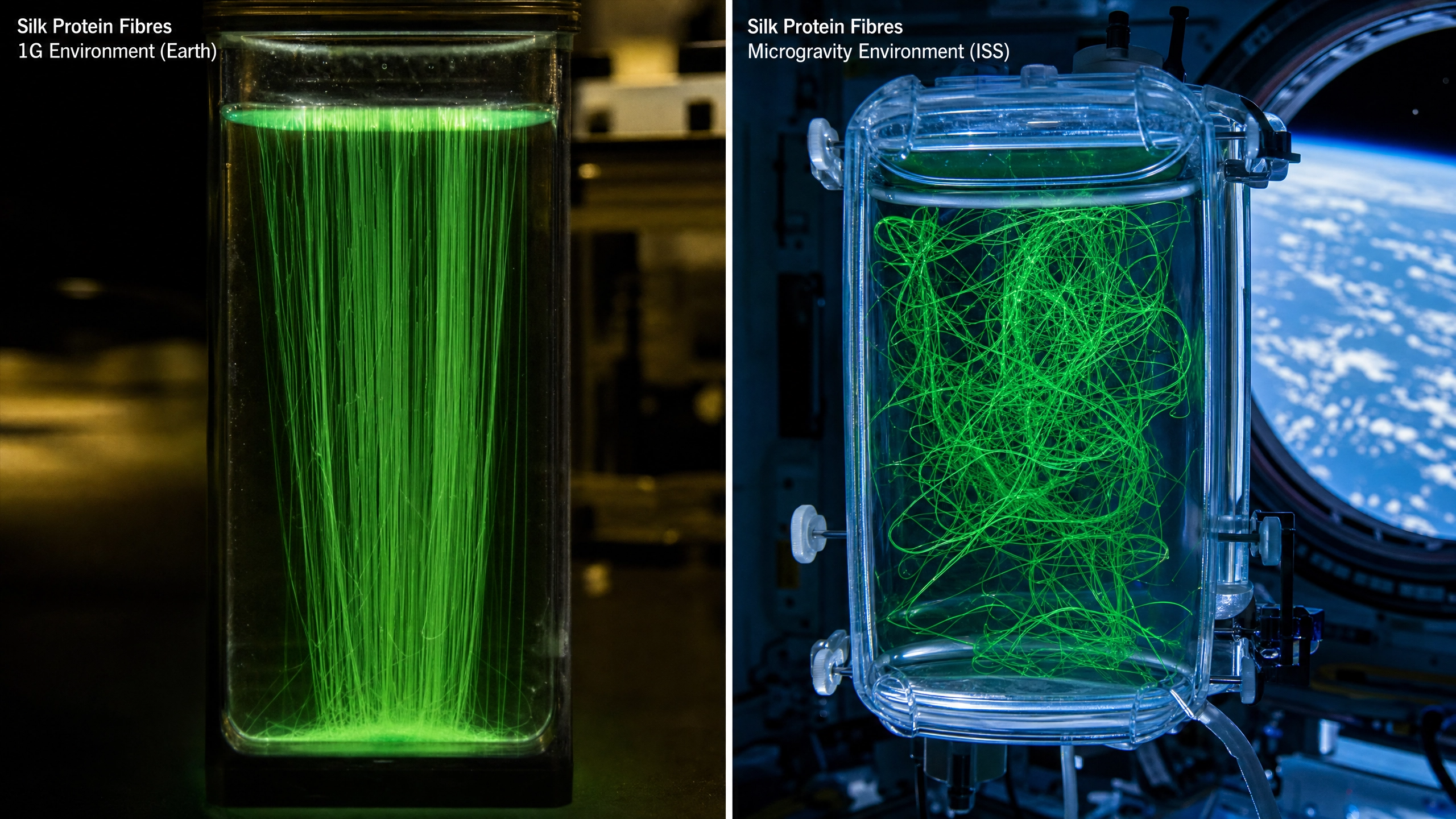
Silk fibres form when proteins fold and stick together in a very specific pattern. On Earth, gravity gently helps organise this process as fibres settle and compact. In space, that settling does not happen, and the proteins are left to find each other purely by random movement through the liquid. This could mean fibres come out longer, more tangled, or slower to form than expected. If the structure of the silk changes in space, then any material made from it, whether a wound dressing or a robotic actuator, might not perform the way it was designed to. This experiment is a necessary first check before committing silk-based materials to any space mission.
Q4. Hypothesis and Reasoning
I would think that the silk fibres produced in microgravity will look and behave differently from those produced on the ground, and that this difference will be visible under fluorescence imaging. The logic is straightforward: the chemistry that makes silk proteins stick together is built into the protein sequence itself and does not need gravity to work. However, the way those fibres then organise into a larger network depends heavily on how the proteins drift and collide through the liquid, a process that gravity normally shapes. Without it, I would expect fibrils to be more randomly distributed and take longer to form a cohesive structure. I would test this by using a BioBits reaction loaded with a silk protein tagged with a green fluorescent marker, so we can watch the fibres appear in real time using the P51 Fluorescence Viewer and compare what happens in orbit to what happens on the ground at the same moment.
Q5. Experimental Plan
I would run three BioBits reactions in orbit: one expressing the fluorescent silk protein, one expressing only the fluorescent tag with no silk component as a control, and one expressing nothing as a baseline. Identical reactions will run simultaneously on the ground. Before starting, we will use the miniPCR thermal cycler to confirm that the DNA templates survived the journey to the ISS intact. I would image all reactions with the P51 Fluorescence Viewer at 30-minute intervals for two hours, recording when fibres first appear, how densely they form, and how their pattern compares between the space and ground samples.
 ---
---Part B: Individual Final Project
I completed all below before the deadline, including adding my Twist DNA order to the Node and MIT Twist spreadsheet.
- [Y ] Put your chosen final project slide in the appropriate slide deck (following the instructions on slide 1)
- [Y ] Submit the Final Project selection form (if not already done)
- [Y ] Begin planning your final project documentation (see guidelines)
- [Y ] Prepare your first DNA order and add it to the Twist ordering spreadsheet