Week 3 Lab: Opentrons
Python Script for Opentrons Artwork
Since I am not present to interact directly with the Opentrons output, I thought about why I would want to pipette an image and what that image should represent and decided to use Ndebele bead patterns as inspiration.
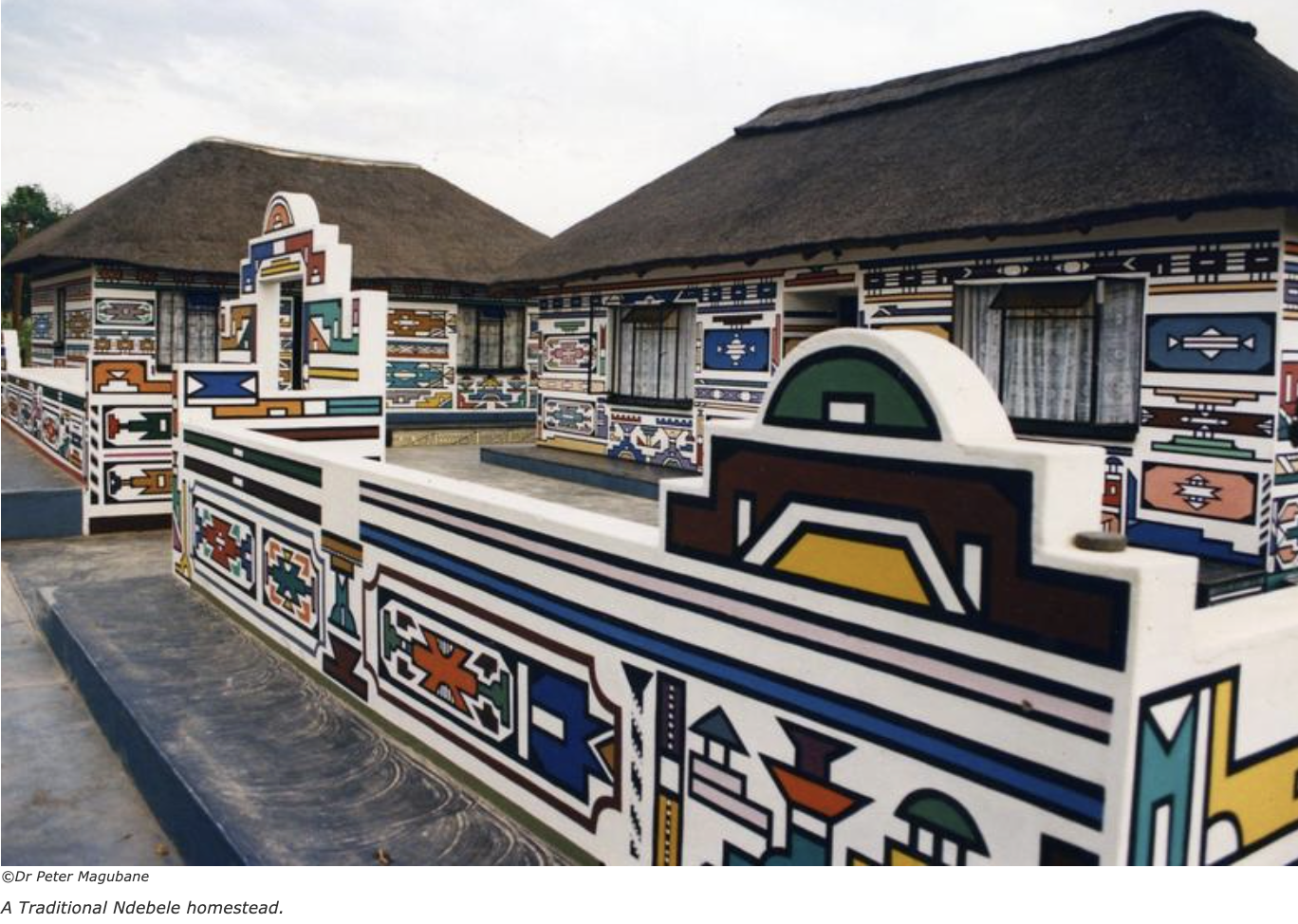
Ndebele bead patterns have a very specific geometric logic. They are built on a grid of “bead units” arranged in bold, angular, symmetric designs. The traditional South Ndebele aesthetic uses high-contrast colors in step-like diagonal and horizontal bands, often with thick outlines and mirrored symmetry.
They are also studied as Ethno mathematics, which often promotes a more humanistic and inclusive perspective on mathematics, focusing on how different groups manage, understand, and navigate their reality.
I found it interesting to bring the mathematical and social aspects of this indigenous knowledge to the biochemical level, as this layering of meaning creates interesting avenues for reflection on various levels.
Example of Ndebele paintings and beadwork:

Python Visuals & Scripts Ex.
I am not a coder, but playing around with the example scripts, I ended up using Claude to vibe-code the desired patterns and position. It required some debugging and made various output versions.
Although the co-lab script runs without error, I am not sure if this will work on Opentrons.
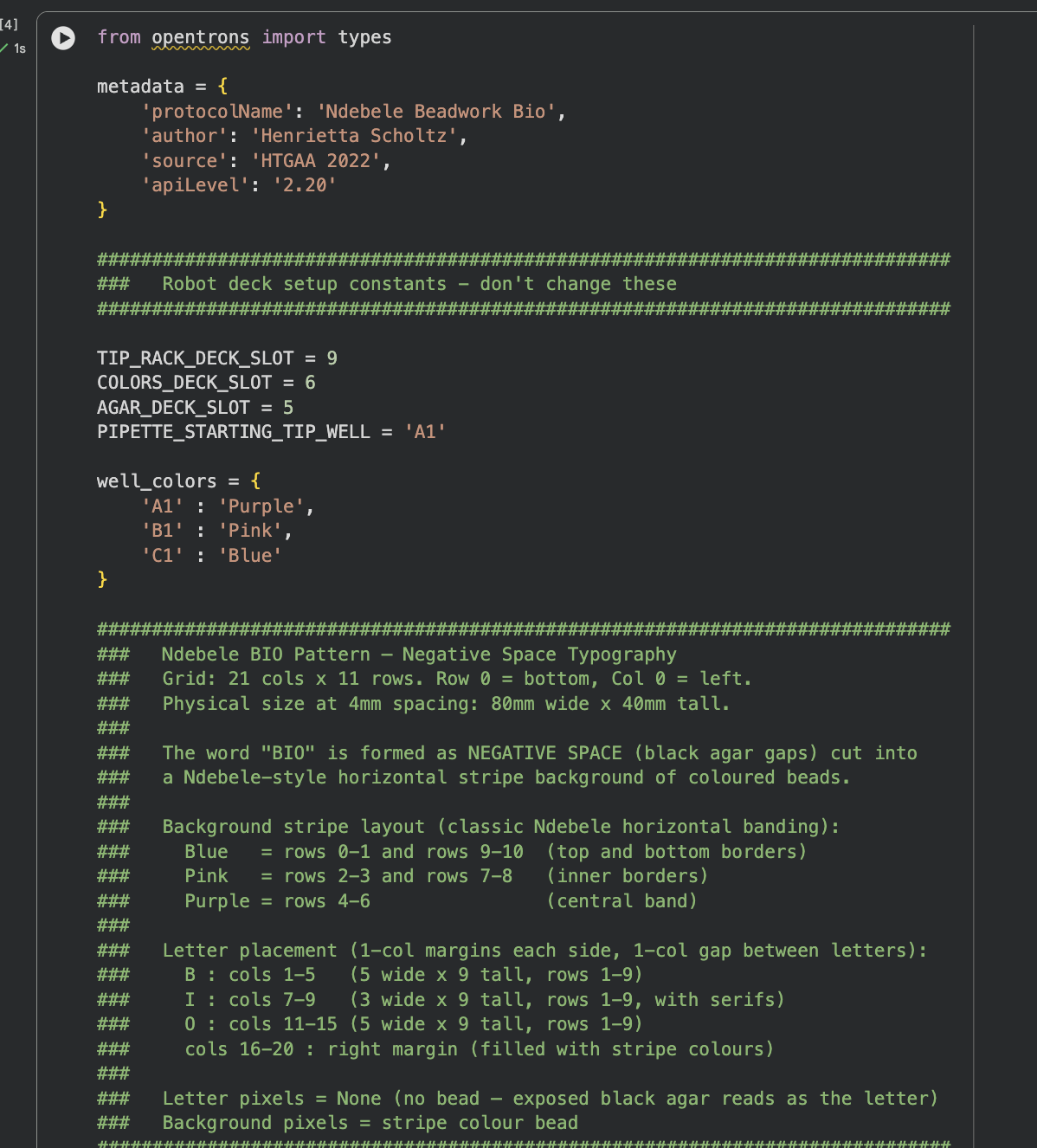
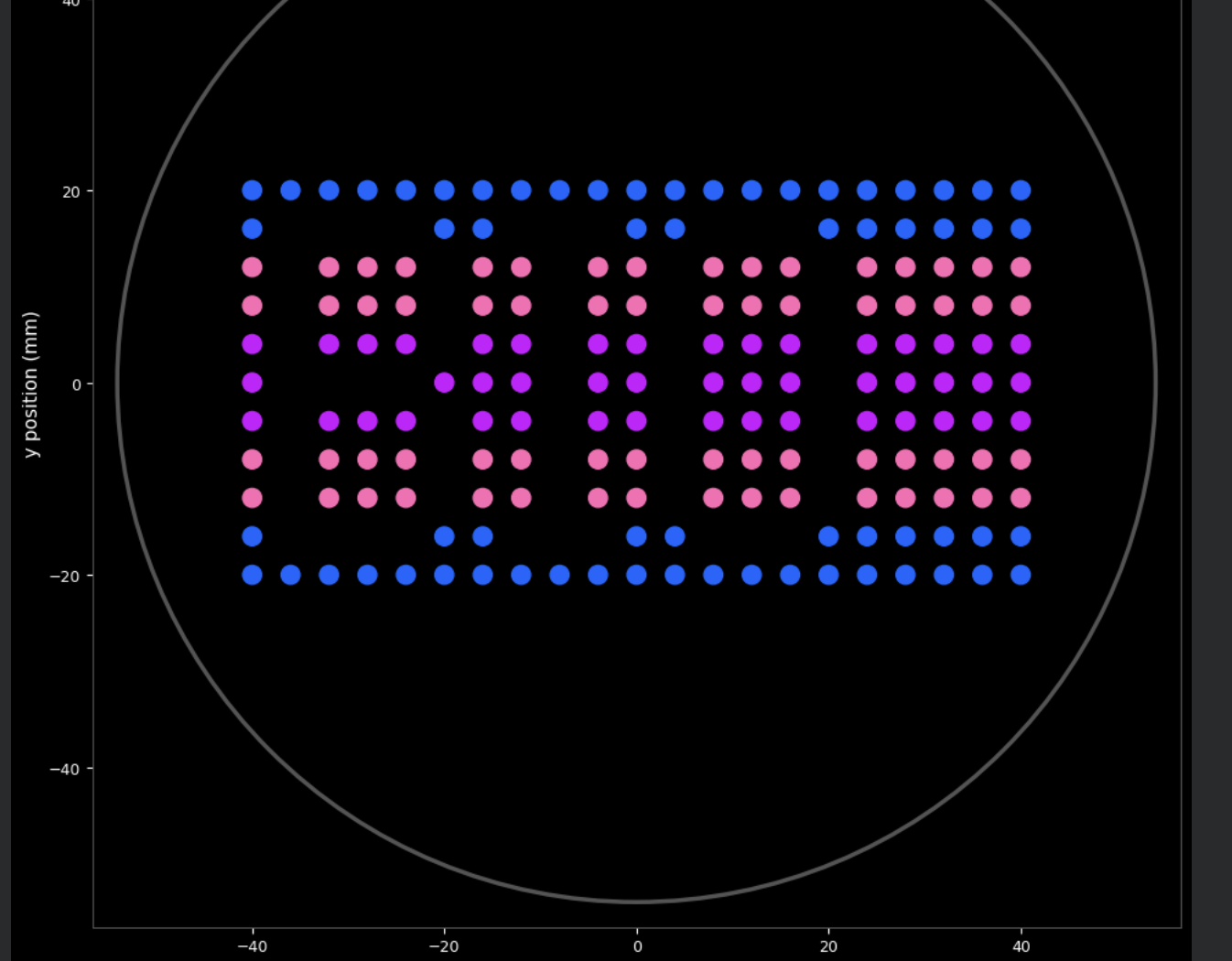


EARLY VERSIONS BEFORE KNOWING COLOUR AVAILABILITY

Post Lab Homework
Published Paper
A directly relevant paper is Fang et al. (2025) in Nature Communications, which demonstrates circadian-gated gene expression circuits in bacteria, using automated temporal sampling to characterize rhythmic protein output over 24-hour cycles. This paper is not a peripheral reference; it is one of the primary foundational sources for my final project concept and is already cited in my main project documentation. The automation approach used to verify rhythmic expression in that work is precisely what I intend to replicate and extend with the Opentrons platform.
What I Intend to Automate
My project proposes a bacterial AND gate where the antimicrobial peptide Magainin is only expressed when two conditions are simultaneously true: the circadian regulator RpaA is active, and a pathogen signal is present. The core experimental challenge is verifying this gate actually works as designed, which requires sampling bacterial expression levels repeatedly across a full 24-hour cycle, under multiple conditions, without human error or gaps overnight. This is the automation task.
The Opentrons OT-2 would run an unattended 24-hour sampling protocol across three experimental conditions:
- RpaA active + pathogen signal present (AND gate should trigger)
- RpaA active + no pathogen signal (gate should stay silent)
- RpaA inactive + pathogen signal present (gate should stay silent)
At each 2-hour timepoint, the robot samples each culture well, transfers to a measurement plate for fluorescence reading, and replaces the sampled volume with fresh media to keep cultures alive. This builds a full temporal expression profile across all three conditions without any overnight manual intervention.
I would use Claude for the coding and guidance in the technical parts of this.
Why This Automation Matters
The AND gate only has meaning if you can show it is silent when it should be silent and active only at the right circadian phase with the right pathogen or other signal. That requires clean data across all three conditions at every 2-hour window through the night. Manual pipetting at 2am introduces the exact inconsistency that would make the rhythmic signal unreadable. The Opentrons removes that variable entirely.
Future Extensions
If access to Ginkgo Nebula becomes available, the next step would be submitting the AND gate genetic construct for scaled fermentation and characterization; using Nebula’s high-throughput infrastructure to screen circuit variants with different RpaA promoter strengths or pathogen-sensing thresholds, generating the kind of combinatorial data that would take months on a single benchtop robot.
References & Resources
Lecture Materials
- Week 3 - No lecture this week
- Week 3 Lab - Opentrons Art, February 19-20, 2026
Required Readings
- Fang et al. (2025). “Circadian-gated gene expression circuits in bacteria.” Nature Communications
- UCSD (2024). “Researchers Rebuild Microscopic Circadian Clock.” University of California San Diego press release
- Bilska et al. (2021). “Circadian rhythm in skin barrier function and antimicrobial peptides.” Experimental Dermatology
Software & Tools Used
- Google Colab - Python script development and testing for Opentrons protocols
- Python - Opentrons protocol scripting and pattern generation
- Imgur - Image hosting for project visualization and Ndebele pattern references
Cultural & Mathematical Inspiration
- Ndebele bead patterns and geometric design principles
- Ethnomathematics - Indigenous mathematical knowledge systems
- Traditional South Ndebele aesthetic and symmetry patterns
Project Concepts Explored
- Circadian-controlled bacterial pigment systems
- Light-responsive color-changing bacteria
- UV-protective bioplastic materials with bacterial pigments
- Mechanotransduction experiments with bacterial cultures
- Bacterial AND gate with circadian gating (RpaA + pathogen signal triggering Magainin expression)
Cost Considerations
- Twist Bioscience DNA synthesis pricing
- Remote lab assistance availability assessment
- UK-based protein order logistics and costs
AI Assistance
- Claude (Anthropic) - Code development and technical guidance
- Model: Claude Sonnet 4.5
- Date(s) used: February, 2026
- Tasks: Assisted with Python script development for Opentrons Ndebele pattern generation (“vibe-coding”), debugging protocol scripts and verifying scientific terminology.
Future Platforms
- Ginkgo Nebula - Potential platform for scaled fermentation and high-throughput circuit variant screening
Additional Resources
- HTGAA final project guidelines and requirements
- Twist Bioscience pricing documentation
- Remote lab capabilities at available nodes
- Opentrons protocol documentation and API reference
- Ndebele art and design pattern libraries
- Ethnomathematics literature
Acknowledgments
- Course instructors
- TAs
- Ndebele cultural heritage for geometric design inspiration