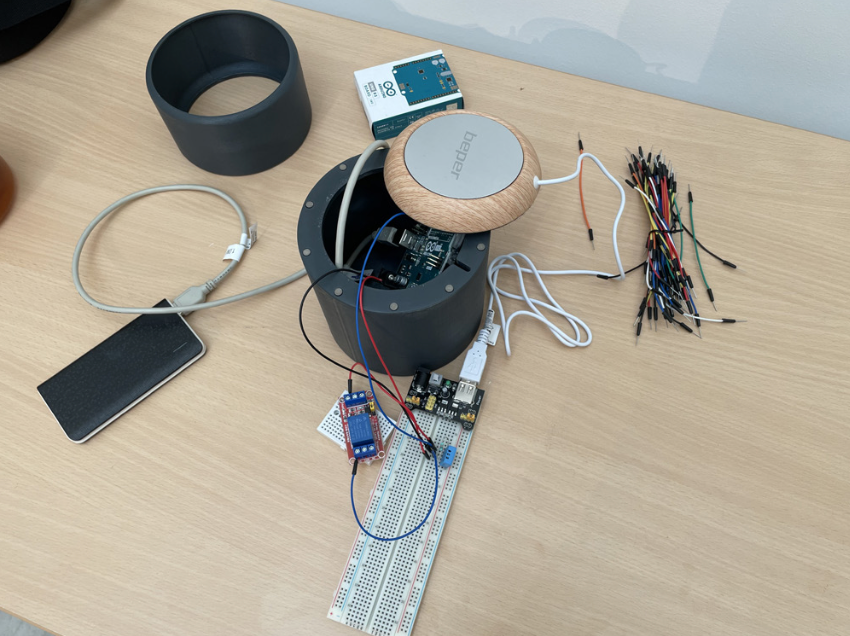
“Governing Microbial Kinship through Care-Based Technologies // The Nomadic Care Station for Scoby” 1. Biological engineering application or tool The biological engineering application proposed in this project is the Nomadic Care Station for SCOBY (NCS4S), a portable technological system designed to support the continuous care of a SCOBY (Symbiotic Culture of Bacteria and Yeast) while traveling with it. Drawing upon Donna Haraway’s concept of making kin and my long-term involvement with the NGO Thr34d5, this project reframes microbial life not as a resource to be optimized, extracted, or scaled, but as a companion species embedded in a relationship of interdependence with humans. Rather than asking how bacteria can better serve human needs, the project asks how technologies can be designed to enforce ethical obligations toward microbial life.
Subsections of Homework
Week 1 HW: Principles and Practices
“Governing Microbial Kinship through Care-Based Technologies // The Nomadic Care Station for Scoby”
1. Biological engineering application or tool
The biological engineering application proposed in this project is the Nomadic Care Station for SCOBY (NCS4S), a portable technological system designed to support the continuous care of a SCOBY (Symbiotic Culture of Bacteria and Yeast) while traveling with it.
Drawing upon Donna Haraway’s concept of making kin and my long-term involvement with the NGO Thr34d5, this project reframes microbial life not as a resource to be optimized, extracted, or scaled, but as a companion species embedded in a relationship of interdependence with humans. Rather than asking how bacteria can better serve human needs, the project asks how technologies can be designed to enforce ethical obligations toward microbial life.
Technically, the Nomadic Care SCOBY Station is a 3D-printed device equipped with an Arduino-based control system. A temperature sensor continuously monitors the internal environment of the station, activating a cup warmer when the temperature drops below approximately 22°C. The device also protects the SCOBY from light exposure, responding to its biological sensitivities. While functional, the system remains a prototype and is intentionally not designed for industrial scalability or efficiency.
The primary function of the station is not to improve fermentation performance or standardize outcomes, but to introduce care, attention, and constraint into the human–microbe relationship. By requiring continuous monitoring, maintenance, and responsiveness, the device challenges dominant paradigms in biological engineering that prioritize productivity, control, and economic value. The Nomadic Care Station for SCOBY thus operates both as a practical care technology and as a speculative intervention into how bioengineering tools can shape ethical futures.
2. Governance and policy goals for an ethical future
Primary governance goal
The primary governance goal of this project is to ensure that biological engineering tools involving microbial life contribute to an ethical future by promoting non-malfeasance, care, and relational accountability, rather than extraction and domination.
While traditional governance frameworks often emphasize biosafety and biosecurity in narrow technical terms, this project expands ethical governance to include the prevention of relational harm: harm that occurs when living systems are reduced to resources, stripped of autonomy, or rendered invisible within technological processes.
Sub-goals
a) Prevent extractive and industrial misuse of microbial life
This includes limiting the transformation of culturally embedded organisms such as SCOBYs into standardized industrial inputs and resisting the assumption that scalability and optimization are inherently desirable.
b) Promote care-based and relational bioengineering practices
Governance should encourage technologies that require ongoing human attention, responsibility, and responsiveness, shifting ethical evaluation from outcomes alone to the quality of relationships sustained over time.
c) Preserve microbial autonomy and vulnerability
Rather than engineering away fragility and dependency, governance should recognize vulnerability as an ethical signal and a condition for interspecies responsibility.
d) Support pluralistic and non-industrial futures of biotechnology
Ethical governance should legitimize small-scale, situated, artistic, and activist bioengineering practices alongside academic and commercial ones, preventing policy frameworks from implicitly favoring large institutions.
3. Governance options and actions
Option 1: Care-by-Design Requirement
a) Purpose :
Currently, governance mechanisms in biological engineering prioritize biosafety compliance and risk mitigation, while ethical considerations such as care are often informal or discretionary. This option proposes introducing a care-by-designrequirement for certain categories of bioengineering tools, particularly those used in educational, artistic, DIYbio, or non-industrial research contexts.
b) Design :
This requirement would be implemented through institutional review processes, funding criteria, or ethical oversight mechanisms. Designers would be required to demonstrate how organism-specific care parameters—such as temperature stability, environmental protection, or rest cycles—are embedded into the technical system. Key actors include academic institutions, ethics review boards, funding agencies, and community laboratories.
c) Assumptions :
This option assumes that care can be meaningfully operationalized without being reduced to a superficial checklist, and that institutions are willing to accept ethical constraints that may limit efficiency or scalability.
d) Risks of failure and success :
Failure could occur if care becomes bureaucratized or symbolic. Conversely, the “success” of this option risks standardizing and commodifying care, potentially undermining its relational and contextual nature.
Option 2: Incentives for non-scalable and situated biotechnologies
a) Purpose :
Current funding and recognition systems overwhelmingly reward scalable, efficient, and commercially viable bioengineering projects. This option proposes the creation of incentives—such as grants, fellowships, or ethical labels—for non-scalable, situated, and care-centered biotechnologies.
b) Design :
Public research funders, cultural institutions, NGOs, and foundations would define criteria that explicitly value locality, maintenance, relational engagement, and resistance to replication. This approach draws analogies to funding structures that support site-specific art or community-based environmental projects.
c) Assumptions :
This option assumes that non-scalability can be defended as a legitimate policy goal and that such incentives will not be captured by actors simply rebranding extractive practices.
d) Risks of failure and success :
Failure may result in these projects being marginalized as non-serious or non-scientific. A key risk of success is the emergence of “care-washing” or “slow bio” branding without substantive ethical change.
Option 3: Recognition of microbial companion status
a) Purpose :
At present, microorganisms are legally treated as property, materials, or risks. This option proposes the speculative development of a governance category recognizing certain organisms—such as SCOBYs in cultural or relational contexts—as microbial companions, neither objects nor legal persons.
b) Design :
This framework would be developed by legal scholars, ethicists, NGOs, and cultural policymakers, drawing inspiration from rights-of-nature initiatives and animal welfare regulations. Rather than granting rights, it would impose obligations on human actors involved in these relationships.
c) Assumptions :
This option assumes that legal and policy systems can accommodate non-anthropocentric categories and that conceptual ambiguity can be productive rather than obstructive.
d) Risks of failure and success :
Failure risks include legal incoherence or institutional rejection. A potential risk of success is selective recognition that reinforces hierarchies among living beings.
4. Scoring governance options against policy goals
Does the option:
Option 1
Option 2
Option 3
Enhance Biosecurity
• By preventing incidents
2
1
n/a
• By helping respond
2
3
n/a
Foster Lab Safety
• By preventing incident
1
2
3
• By helping respond
2
3
3
Protect the environment
• By preventing incidents
2
1
1
• By helping respond
2
3
2
Other considerations
• Minimizing costs and burdens to stakeholders
2
1
3
• Feasibility?
1
2
3
• Not impede research
2
1
3
• Promote constructive applications
1
1
2
5. Prioritization and recommendation
Based on this scoring, I would prioritize a combined governance approach centered on Option 1 (Care-by-Design Requirement) and Option 2 (Incentives for Non-Scalable and Situated Biotechnologies), while treating Option 3 (Microbial Companion Status) as a longer-term normative horizon.
Option 1 is the most immediately actionable and feasible, embedding ethical responsibility directly into technological design and improving lab safety and environmental protection through prevention rather than response.
Option 2 addresses a structural governance blind spot by challenging the assumption that scalability and efficiency are always desirable, thereby reducing upstream risks and promoting pluralistic, constructive applications of biotechnology.
Option 3, while less feasible in the short term, plays a critical role in challenging the conceptual foundations of extractive biotechnology. It provides a speculative reference point that can inform and reshape how care-based design and incentive structures are interpreted over time.
The main trade-offs considered include prioritizing feasibility over radical legal transformation, the risk of slowing innovation by discouraging scalability, and the potential instrumentalization of care. These trade-offs are accepted under the assumption that incremental but structural change is preferable to symbolic radicalism without institutional traction.
This recommendation is directed primarily toward university leadership, research institutions, public funding bodies, and NGOs, which are well positioned to implement design requirements and incentive structures without waiting for large-scale legal reform.