DIY Electroporation Project: BioVolt - First rolled out at DEFCON 32- Now revisted from END to END
Project Overview: BioVolt - DIY Electroporation Device & Full Transformation Pipeline
Biological engineering application/tool to develop:
BioVolt is a portable, ultra-low-cost DIY electroporation device (~$10-20 in parts) that uses a piezoelectric crystal from a barbecue lighter to generate ~2,000 V pulses for temporary cell membrane permeabilization. This enables DNA/RNA uptake in bacteria (e.g., E. coli), yeast, plant protoplasts, or even stem cells for genetic transformation. Inspired by the DEFCON 32 talk “You got a lighter I need to do some Electroporation” (presented by Dr. James Utley (Me), Phil Rhodes, and Josh Hill from Viva Securus/Syndicate Laboratories), it builds on frugal biohacking principles: piezoelectric trigger pulsing, custom microfluidic cuvettes from aluminum tape/magnets/glass slides, and simple high-voltage testing.
DEFCON 32 Presentation — Where It Started for me
At DEFCON 32 the talk I presented focused on the device itself — proving that a barbecue lighter’s piezoelectric crystal could generate sufficient voltage to temporarily permeabilize cell membranes for DNA uptake. The talk covered design details, demos, troubleshooting (e.g., arc gap tuning with Post-it notes), and the biohacking ethos behind building a ~$10 electroporator.
Key highlights from the talk: ~2,000 V pulses via lighter clicks, high cell mortality (50-70%) but viable transformants, GFP reporter demos, open protocols encouraged.
Next Phase: End-to-End Pipeline with Efficiency Focus
The next phase of BioVolt moves beyond the device and brings the entire workflow end to end, with a focus on efficiency and frugal validation. The goal: take a piezoelectric electroporator built from a barbecue lighter and prove — through a full pipeline — that it actually works. The pipeline includes:
Plasmid amplification via thermal cycling — Before electroporation, the initial plasmid source will be amplified using the MJ Research PTC-100 thermal cycler (Peltier-effect programmable controller) available in the lab. This ensures sufficient plasmid DNA concentration for transformation.
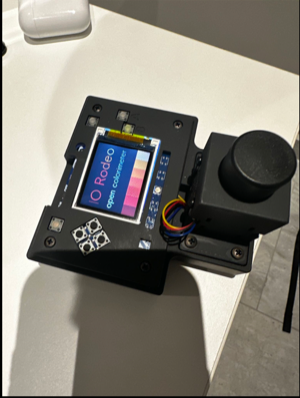
DNA concentration measurement — Using the Rodeo open colorimeter (visible light version for OD600 cell density measurements) and, if possible, the UV version for DNA concentration quantification. This provides pre- and post-transformation metrics.
Electroporation — Transformation of cells with the amplified plasmid DNA using the BioVolt piezoelectric device, followed by recovery and plating.
Post-transformation PCR verification — For good measure, PCR will be run after transformation using the same thermal cycler to check whether the insert is present in the recovered cells. This triangulates and correlates with plating results to provide a hasty “close enough” frugal validation.
Gel electrophoresis confirmation — Agarose gel electrophoresis to visualise PCR products and verify successful transformation (e.g., presence of reporter genes like GFP via band patterns under UV).
The aim is to triangulate multiple data points — plasmid amplification, colorimetric/UV measurement, transformation plating, and post-transformation PCR — to build confidence that the piezo electroporator from a lighter actually delivers. Fingers crossed, this provides a credible, frugal, end-to-end validation of a DIY electroporation workflow.
This democratizes synthetic biology for education, citizen science, and personal biohacking in resource-limited settings.
Lab Setup & Tools in Action - You can see I got some goods to work with!
My biohacker lab integrates the device with the full verification pipeline.

On to the assignement - Interactive Governance Assessment Form
An interactive Python application (app.py) is provided to assess governance and risk mitigation strategies for the BioVolt project. The form uses a block-based rating scale where more filled blocks mean more effective:
| Blocks | Rating | Meaning |
|---|---|---|
| ●○○ | Minimally Effective | Low impact — unlikely to achieve the goal |
| ●●○ | Moderately Effective | Moderate impact — partial success likely |
| ●●● | Most Effective | High impact — highly likely to achieve goal |
Project File Structure
Prerequisites
- Python 3.x installed on your system
- tkinter (usually included with Python; on Linux you may need
python3-tk)
Installation
Navigate to the project directory:
Install required dependencies:
Running the Application
How to Use the Form
Launch — The application opens a dark-themed window with the assessment matrix.
Read the instructions — System instructions are displayed at the top of the form explaining the block-based rating system.
Review each concern category — Three categories are presented, each with context questions:
- Biosecurity Concerns — preventing GMO release, high-voltage mishandling, pathogen engineering
- Equity Concerns — access, regulation, educational barriers, global equity
- Environmental Concerns — microbial activity, non-human organisms, public concerns
Rate each action — For every action under each stakeholder (Researchers, Manufacturers, Industry, Organizations), click one of three block-rating buttons:
- ●○○ — Minimally Effective (button highlights red)
- ●●○ — Moderately Effective (button highlights amber)
- ●●● — Most Effective (button highlights green)
Visual feedback — When you click a rating:
- The selected button stays highlighted with its rating colour
- A status indicator appears to the right showing your selection
- Other buttons in the same row reset to their default state
Export to PDF — Click the “EXPORT TO PDF” button to generate a report containing:
- Cover page with assessment date and completion count
- Rating scale legend with colour-coded descriptions
- Full assessment tables for each concern category
- Colour-coded rows: green tint for Most Effective, amber for Moderate, red for Minimal
- Block indicators (●●● / ●●○ / ●○○) printed in every row
- Summary page with counts and percentages for each rating level
Reset — Click “RESET MATRIX” to clear all selections and start over.
Application Features
- Block-based rating scale — intuitive system where more blocks = more effective (no ambiguity)
- Dark theme UI — dark background with neon accent colours for readability
- Persistent button state — selected buttons remain highlighted with their rating colour
- Status indicators — each row shows the current selection in text beside the buttons
- Scrollable interface — mouse wheel support for navigating the full assessment matrix
- Neon accent bars — left-side accent bars on each concern card for visual hierarchy
- Colour-coded PDF output — rating cells are tinted to match their effectiveness level
- Summary statistics — PDF includes a final page with counts and percentages
- Empty export protection — warns you if no ratings are selected before exporting
- Form reset — one-click reset with confirmation dialog
Screenshots
Application UI — Dark-themed interface with block-based rating buttons and colour-coded status indicators:

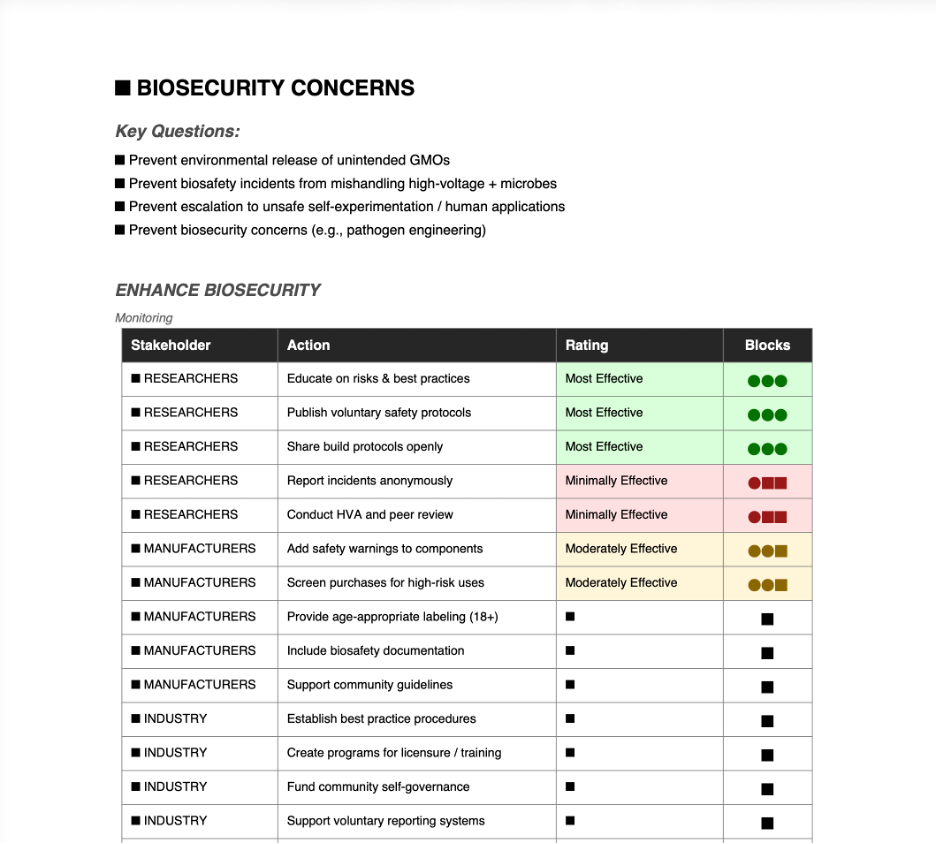
PDF Report Output — Exported assessment with colour-coded rows, block indicators, and stakeholder ratings:
Governance / Policy Goals (Preventing Harm)
Focus on non-tool-function risks: Prevent environmental release of unintended GMOs, biosafety incidents from mishandling high-voltage + microbes, escalation to unsafe self-experimentation/human applications, or biosecurity concerns (e.g., pathogen engineering).
Core aims: Minimize biosafety/biosecurity harms, promote responsible use, avoid stifling innovation with heavy regulation, encourage informed DIYbio practices, and address public/environmental concerns.
Three Potential Governance/Policy Actions
Action 1: Community-Led Self-Governance with Voluntary Guidelines and Reporting
Goal: Foster peer accountability and safe practices through DIYbio networks, reducing risks via shared norms without external mandates.
Design:
- Opt-in: DIYbio communities, forums (e.g., Discord, Reddit, The ODIN users), and makerspaces.
- Fund: Crowdfunding, donations, or volunteer time.
- Approve: Community-elected moderators or biosafety working groups.
- Implement: Publish voluntary guidelines (e.g., “BioVolt Safety Protocol” on protocols.io or GitHub), require protocol sharing for builds, anonymous incident reporting (expand “Ask a Biosafety Expert” services).
Risks / What could go wrong (incorrect assumptions, uncertainties):
Assumes broad ethical participation - rogue actors may ignore; self-reporting misses hidden issues; low adoption if seen as “extra work.”
Assumptions, “Success” and “Failure” rubric:
- Success (best - 1): High adoption -> fewer accidents, strong norms against risky uses (e.g., no human trials), community self-corrects.
- Mid (2): Partial uptake -> safety improvements in visible projects, but gaps remain.
- Failure (worst - 3): Guidelines ignored -> no risk reduction, or “forbidden fruit” effect increases experimentation.
- Unintended consequences: Overly cautious norms suppress legitimate educational uses.
Action 2: Targeted Product Restrictions (e.g., Safety Warnings / Age Limits on Kits & Components)
Goal: Reduce impulsive or uninformed misuse by requiring clear hazard labels on high-voltage components (e.g., piezoelectric lighters, capacitors) or full kits, without banning access.
Design:
- Opt-in/compliance: Online sellers (Amazon, AliExpress), hardware stores, kit makers.
- Fund: Seller-borne costs.
- Approve: Consumer safety agencies or state-level consumer protection (e.g., modeled on CRISPR kit labeling laws).
- Implement: Mandatory labels (“Not for human use; biological hazard when combined with genetic material; 18+ recommended”).
Risks / What could go wrong:
Warnings may not deter determined users (parts sourced separately); patchy enforcement online/global; could increase black-market activity.
Assumptions, “Success” and “Failure” rubric:
- Success (best - 1): Warnings raise awareness, reduce naive accidents while preserving access.
- Mid (2): Labels added but often ignored by experienced users.
- Failure (worst - 3): Little impact on bad actors; adds cost/delays for legitimate builders.
- Unintended consequences: Drives activity underground, reducing community visibility/oversight.
Action 3: Treat as if it has a Regulatory Classification as Restricted Biotech Equipment (e.g., Licensing for High-Voltage Builds) Pledge reporting and Safe use.
Goal: Treat advanced DIY electroporators like controlled lab tools - require permits/training for >1,000 V devices to prevent proliferation to high-risk genetic work.
Design:
- Opt-in: Individual builders/users via registration.
- Fund: User fees.
- Approve: Government agencies (e.g., expanding CDC/NIH biosafety rules or local health depts).
- Implement: Permits, training requirements, inspections for community labs/shared spaces.
- Hazard Vulnerability Assessment (HVA) and Peer Review: Conduct a comprehensive HVA and require peer review through a pseudo-IRB-like entity - a multidisciplinary and independent review board focusing on environmental and human safety. This entity would evaluate proposed uses, assess risks, and provide guidance on safe protocols before high-voltage builds are deployed.
Risks / What could go wrong:
Hard to define safe thresholds; bureaucracy kills accessibility; overreach chills innovation globally.
Assumptions, “Success” and “Failure” rubric:
- Success (best - 1): Blocks worst misuse (e.g., pathogen work), funnels activity to supervised settings.
- Mid (2): Some compliance, but many unlicensed builds continue.
- Failure (worst - 3): Broad restrictions eliminate DIY benefits, push activity to unregulated regions.
- Unintended consequences: Harms global equity/education; favors institutional labs only.
Overall Tradeoffs & Prioritization
Prioritize Action 1 (community self-governance) as primary: Lowest overregulation risk, aligns with DIY ethos, adaptable to low current misuse evidence, leverages community goodwill.
Combine with Action 2 (targeted warnings) as secondary: Adds minimal external safeguard for public health, deters casual risks without bans.
Avoid/minimize Action 3 unless clear evidence of high-risk proliferation: Highest chance of killing accessibility and innovation, poor fit for low-harm tool like BioVolt.
Key uncertainties (misuse rates, community response, enforcement feasibility) favor lighter interventions. Monitor via voluntary reporting; escalate only if serious incidents arise. This balances empowerment with responsible governance for biosafety and preventing broader DIY genetic risks.
Made with love and the AI Slop is from Cursor-GLM 4.7