Week 6 HW: Genetic Circuits
🧬 Week 6 Homework: Genetic Circuits
Genetic Circuits — PCR, restriction digests, Gibson cloning, transformation, and DNA assembly methods.
📋 Overview
This week covers:
- Phusion High-Fidelity PCR Master Mix components
- Primer annealing temperature factors
- PCR vs. restriction digests (compare & contrast)
- Gibson cloning compatibility
- E. coli transformation mechanism
- Alternative assembly methods (e.g., Golden Gate)
- Benchling / Asimov Kernel modeling ✓
Assignment Questions
1. Phusion High-Fidelity PCR Master Mix Components
What are some components in the Phusion High-Fidelity PCR Master Mix and what is their purpose?
| Component | Purpose |
|---|---|
| Phusion DNA Polymerase | A Pyrococcus-like enzyme with a processivity-enhancing domain; provides extremely high fidelity (error rate ~4.4 × 10⁻⁷, ~50× lower than Taq). Has 5’→3’ polymerase and 3’→5’ exonuclease activity; generates blunt-ended PCR products. |
| dNTPs (nucleotides) | Building blocks for DNA synthesis during extension. |
| Optimized reaction buffer (HF or GC) | Provides ionic environment; contains MgCl₂ (1.5 mM final). HF Buffer maximizes fidelity; GC Buffer is optimized for GC-rich or structurally complex templates. |
| DMSO (optional) | Recommended for GC-rich amplicons; improves polymerase performance on difficult templates. |
2. Primer Annealing Temperature
What are some factors that determine primer annealing temperature during PCR?
| Factor | Description |
|---|---|
| GC content & length | Higher GC content increases hydrogen bonding and thus melting temperature (Tm); primers typically 18–25 bp. Aim for 40–60% GC. Annealing temp is usually 3–5°C below Tm. |
| 3’ end stability | The 3’ end should bind stably; avoid runs of the same base, hairpins, and self-dimers that interfere with primer binding. |
| Salt concentration (Na⁺) | Higher salt increases Tm and thus annealing temperature. |
| Magnesium concentration [Mg²⁺] | Free Mg²⁺ reduces electrostatic repulsion between primer and template, influencing Tm. |
| Additives (DMSO, formamide, betaine) | Lower Tm; decrease annealing temp by ~1°C per 1% DMSO. |
| Primer concentration | Higher primer concentration can slightly increase Tm. |
| Tm calculation method | Nearest-neighbor (most accurate), salt-adjusted formula, or Wallace Rule. Gradient PCR is recommended for empirical optimization. |
3. PCR vs. Restriction Enzyme Digests
There are two methods from this class that create linear fragments of DNA: PCR, and restriction enzyme digests. Compare and contrast these two methods, both in terms of protocol as well as when one may be preferable to use over the other.
| Aspect | PCR | Restriction enzyme digest |
|---|---|---|
| Protocol | Thermal cycling: denaturation (94–98°C) → annealing (50–65°C) → extension (72°C). Uses DNA polymerase, primers, dNTPs. | Incubation of DNA with restriction enzyme in appropriate buffer at 37°C (typically). No thermal cycling. |
| Mechanism | Amplifies specific regions via primer-directed synthesis; creates many copies of a target. | Cleaves DNA at specific recognition sites (4–12 bp, often palindromic); fragments existing DNA. |
| Output ends | Blunt or defined by primer design (e.g., with overhangs for cloning). | Blunt or sticky (overhanging) ends depending on enzyme. |
| When preferable | When you need to amplify a specific region from low copy number, add sequences (e.g., overlaps for Gibson), or work without restriction sites in your sequence. | When you have existing restriction sites in your vector/insert, need defined sticky ends for traditional cloning, or are subcloning from one vector to another. |
| Requirements | Template DNA, primers, polymerase, dNTPs. | DNA with recognition sites, restriction enzyme, buffer. |
| Typical use | Gene amplification, cloning with custom ends, diagnostics, sequencing prep. | Plasmid linearization, subcloning, RFLP analysis, genetic fingerprinting. |
4. Gibson Cloning Compatibility
How can you ensure that the DNA sequences that you have digested and PCR-ed will be appropriate for Gibson cloning?
Gibson assembly requires complementary overlapping sequences (15–40 bp, typically 20–25 bp) at the ends of adjacent fragments. To ensure compatibility:
Overlap design: Adjacent fragments must share identical overlap sequences. Design overlaps with 40–60% GC content and Tm >48°C. Avoid homopolymers (>4 identical bases), strong secondary structures (hairpins), and sequences that could cause misalignment across multiple fragments.
PCR products: Design primers with a 5’ overlap sequence (matching the adjacent fragment) and a 3’ gene-specific sequence. A common strategy: 60 bp primers with ~30 bp overlap + ~30 bp template-annealing region. The overlap is incorporated into the PCR product.
Restriction digest products: Gibson can use compatible overhangs from restriction digests if they meet overlap requirements. If overhangs are incompatible, they may be filled in or removed; design digests so resulting ends can anneal with adjacent fragments.
Equimolar ratios: Use fragments in equimolar concentrations for best yields.
Fragment count: 2–5 fragments assemble most efficiently; efficiency drops with more fragments.
5. E. coli Transformation
How does the plasmid DNA enter the E. coli cells during transformation?
Plasmid DNA enters E. coli through one of two main methods:
Heat shock (chemical transformation): Cells are made “competent” by suspension in CaCl₂ at 0°C. Plasmid DNA is added, then a brief heat pulse (e.g., 0°C → 42°C for ~90 s) is applied, followed by a cold shock back to 0°C. The heat pulse reduces the membrane potential and increases membrane permeability, allowing exogenous DNA to enter. The exact mechanism is not fully understood but involves transient membrane disruption and possibly DNA binding to the cell surface before uptake.
Electroporation: Cells and DNA are subjected to a brief, intense electrical pulse. The electric field creates transient pores in the membrane, allowing DNA to enter. Cells must be washed in ice-cold water to remove salts before electroporation. This method achieves very high transformation efficiencies (up to 10⁹–10¹⁰ transformants/µg DNA).
6. Alternative Assembly Method — Golden Gate (or similar)
Describe another assembly method in detail (such as Golden Gate Assembly).
Explain the other method in 5–7 sentences plus diagrams (either handmade or online).
Description
Golden Gate Assembly is a molecular cloning method that uses Type IIS restriction enzymes (e.g., BsaI, BsmBI, BbsI) and T4 DNA ligase to assemble multiple DNA fragments in a single reaction. Unlike standard Type II enzymes, Type IIS enzymes cut outside their recognition sites, producing variable sticky ends—BsaI alone can generate 256 different 4-bp overhangs—so the recognition site is removed from the final product. Digestion and ligation occur simultaneously in one tube: the thermal cycler alternates between 37°C (optimal for restriction) and 16°C (optimal for ligation). Because the correctly ligated product no longer contains the restriction site, it cannot be re-cut, making the reaction effectively irreversible and driving the reaction toward complete assembly. Golden Gate is scarless when overhangs are designed so that no extra bases remain between fragments, and it can assemble 2–20+ fragments in ordered fashion. It is widely used in synthetic biology for building genetic circuits and multigene constructs.
Diagram
7. Model Assembly Method — Benchling / Asimov Kernel ✓
Model this assembly method with Benchling or Asimov Kernel!
Bacterial Construct Simulator Homework Summary
Project Repository
A new repository was created in Asimov Kernel for this homework project.
Repository name:
Bacterial_Circuit_Homework_James_Utley
The repository was used to store the notebook entry and the genetic constructs created during the assignment. It is found under All Repositories in the HTGAA 2026 program.
Notebook Entry
A blank notebook entry was created in the repository to document the homework.
Notebook title:
Bacterial Construct Simulator Homework
The notebook was used to record the design process, construct logic, simulator results, screenshots of construct glyphs, and simulator graph outputs.
Bacterial Demos Repository Exploration
The Bacterial Demos repository was explored to understand how example bacterial genetic circuits are organized in Kernel.
The simulator instructions were reviewed using the Info panel. Several demo constructs were opened and simulated using the play button. These examples helped show how promoters, ribosome binding sites, coding sequences, repressors, reporters, and terminators work together in bacterial genetic circuits.
The Repressilator construct in the Bacterial Demos repository was used as the main reference example. This construct demonstrates cyclic negative feedback using three transcriptional repressors.
Repressilator Construct
A blank construct was created in the project repository.
Construct name:
Recreated_Repressilator
The Repressilator was recreated using parts from the Characterized Bacterial Parts repository. Parts were found using the Search function in the right-side menu and added to the construct by dragging and dropping them into the design area.
The recreated Repressilator was built from three transcriptional units:
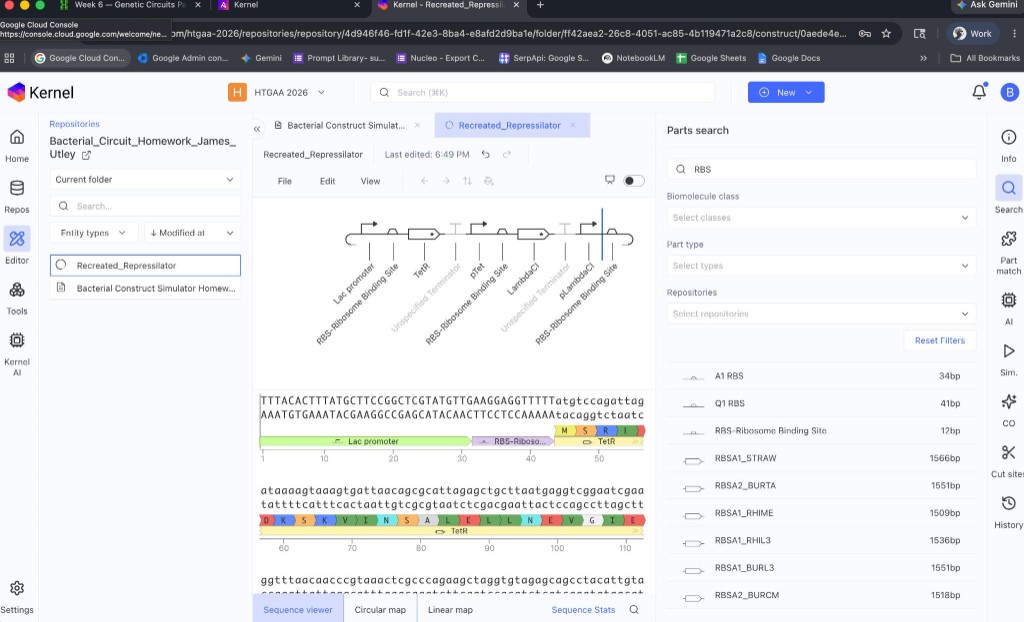
The construct was simulated in E. coli over 72 hours (10-minute time steps, transient transfection).
Simulation Results (E. coli, 72 h)
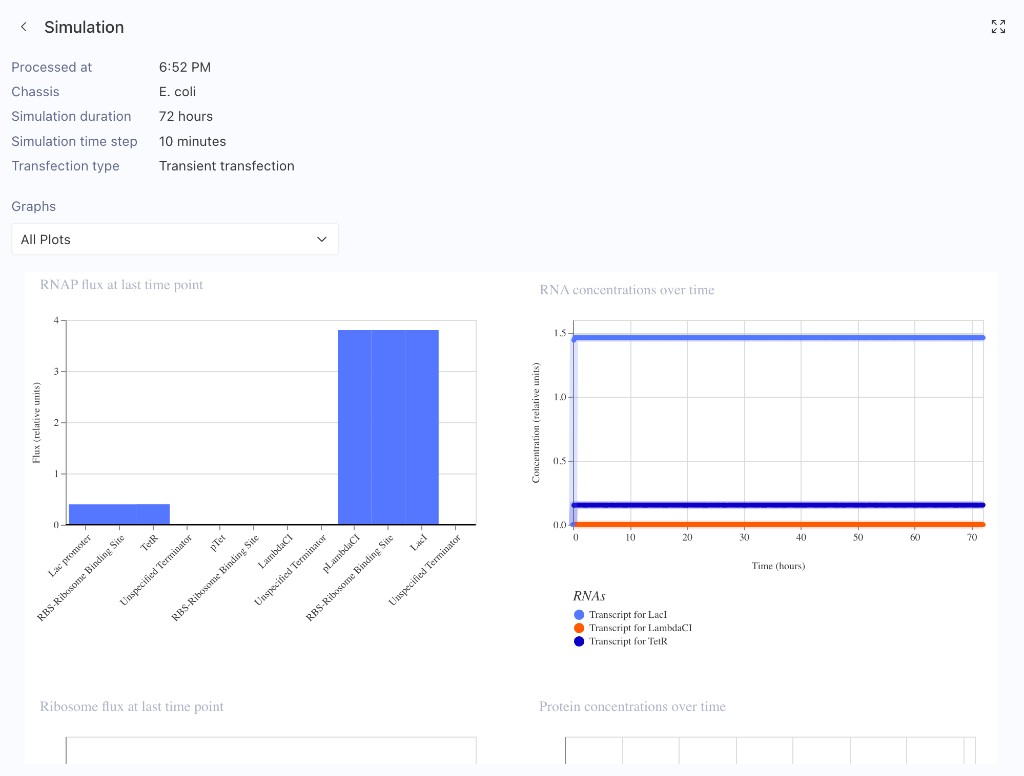
Simulation output shows RNAP flux at the last time point and steady-state RNA concentrations for LacI, TetR, and LambdaCI transcripts over the 72-hour run.
Summary
| # | Topic |
|---|---|
| 1 | Phusion High-Fidelity PCR Master Mix components |
| 2 | Primer annealing temperature factors |
| 3 | PCR vs. restriction enzyme digests |
| 4 | Gibson cloning compatibility |
| 5 | E. coli transformation |
| 6 | Golden Gate (or similar) assembly method + diagram |
| 7 | Asimov Kernel — Bacterial_Circuit_Homework_James_Utley (All Repositories) ✓ |