Week 7 HW: Genetic Circuits Part II
Week 7 Homework: Genetic Circuits Part II
Due by Mar 31, 2:00 PM ET (assignment text).
Part 1: Intracellular Artificial Neural Networks (IANNs)
1. Advantages of IANNs over traditional Boolean genetic circuits
Traditional genetic circuits are often built from logic gates whose idealized input/output behavior is Boolean (ON/OFF). Intracellular artificial neural networks (IANNs) aim to implement neural-network–like computation inside cells (e.g., weighted sums and nonlinear “activation”), not only AND/OR/NOT wiring.
| Advantage | Why it matters vs Boolean-only circuits |
|---|---|
| Graded, continuous signals | Biological regulation is often analog (promoter strength, RNA/protein levels). IANNs can treat inputs as continuous levels and combine them with weights, whereas pure Boolean abstractions discard nuance. |
| Nonlinear decision boundaries | A single perceptron or small network can implement linear classification with a threshold; stacked layers (multilayer) can approximate more complex input–output maps than a minimal gate network for the same task. |
| Design via math, not only gate lists | Neural models are specified by weights and architecture; this can map more directly to “tunable” biological parameters (expression, cleavage rates, binding) than redrawing a new gate diagram for every function. |
| Pattern-like / classification tasks | Boolean circuits excel at crisp logic; IANN-style circuits are a natural fit when the “correct” output depends on combinations of graded cues (stress, metabolites, multiple inducers). |
| Adaptability (in principle) | With external tuning of weights (e.g., regulatory strengths), the same architecture may be retargeted; Boolean networks often need re-wiring for new functions. |
Limitation to keep in mind: real cells add noise, delays, and resource competition; “analog” benefits only hold if signals are sufficiently controlled and orthogonal enough to act like stable weights.
2. Example application of an IANN (with I/O behavior and limitations)
Application (example): Multi-signal stress classifier — classify whether the cell is in “moderate” vs “severe” combined stress using two continuous inputs: (1) a ROS-responsive promoter driving a “sensor” RNA, and (2) a nutrient-limitation–responsive input. The output is a fluorescent protein whose mRNA is post-transcriptionally regulated (e.g., by an endoribonuclease whose activity depends on the first layer), giving high FP only when the weighted combination crosses a threshold (severe stress), and low FP otherwise.
| Aspect | Description |
|---|---|
| Inputs | Graded transcriptional activity (e.g., relative promoter output for X₁, X₂), not only 0/1. |
| Output | Fluorescence level (continuous), interpreted as a class label above/below a threshold. |
| Useful behavior | Implements a soft boundary between states that are hard to capture with a small set of Boolean gates without many layers and promoters. |
Limitations for this goal
- Noise and overlap: Biological signals fluctuate; false positives/negatives near the decision boundary.
- Burden: Multiple expressed regulators (e.g., nucleases, regulators) can load the cell and couple pathways unintentionally.
- Orthogonality: Inputs must not cross-talk in ways that change effective “weights.”
- Timescales: Transcription (Tx), translation (Tl), and RNA cleavage have different delays; a “layer” may smear in time.
- Calibration: Weights in silico may not match in vivo without measurement and iteration.
Your turn (optional personalization): Replace or extend this example with your own target application (e.g., specific sensors, chassis, readout). Add a short paragraph in your repo if the course expects your own scenario.
3. Reference: single-layer intracellular perceptron (course diagram)
The assignment describes a single-layer perceptron where:
- X₁ = DNA encoding Csy4 endoribonuclease.
- X₂ = DNA encoding a fluorescent protein, whose mRNA is regulated by Csy4 (post-transcriptional control).
- Tx = transcription; Tl = translation.
Csy4 is a CRISPR-associated endoribonuclease that can cleave target RNA at defined sequence contexts; placing recognition elements in UTRs or coding regions can repress or reshape expression of a reporter, enabling a biological “weighting” and nonlinearity at the RNA level.
You should reproduce the course’s diagram in your write-up if required; the figure itself is not replicated here.
4. Diagram: intracellular multilayer perceptron (layer 1 → endoribonuclease → layer 2 FP)
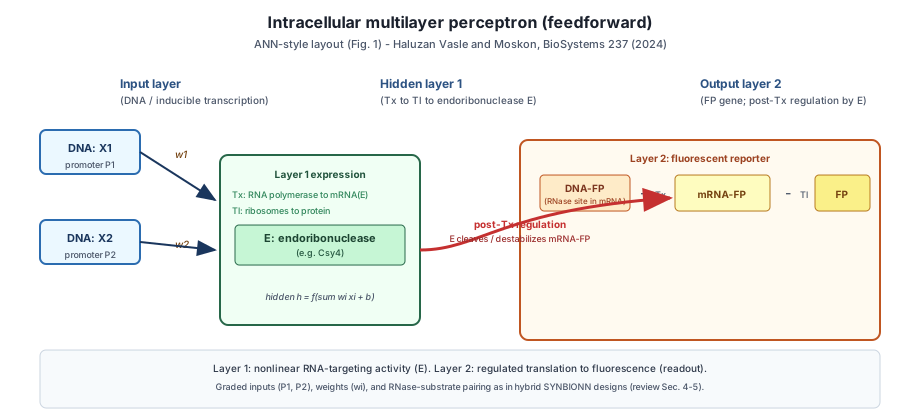
The layout follows feedforward multilayer structure as in artificial neural networks (Halužan Vasle & Moškon, 2024, Fig. 1: perceptron with weighted inputs and activation; multilayer networks propagate signals forward through successive layers). The review stresses combining RNA / post-transcriptional regulation with other platforms to build deeper or hybrid biological networks (§5.3 — scaling and hybrid layers).
Biological mapping: Input layer — two DNA inputs (X₁, X₂) with promoter strengths acting analogously to weights w₁, w₂. Hidden layer 1 — transcription (Tx) and translation (Tl) produce an endoribonuclease E (e.g. Csy4), analogous to a hidden activation h = f(Σ wᵢ xᵢ + b). Output layer 2 — separate DNAFP is transcribed to mRNAFP carrying an E recognition site; E performs post-transcriptional cleavage or destabilization, so Tl yields a graded FP readout. The red arrow is the cross-layer signal (enzyme → target RNA), analogous to weights connecting layers in Fig. 1B.
Reference: Halužan Vasle, A., Moškon, M. Synthetic biological neural networks: From current implementations to future perspectives. BioSystems 237, 105164 (2024). https://doi.org/10.1016/j.biosystems.2024.105164
Part 2: Fungal Materials
1. Examples of fungal materials, uses, pros/cons vs traditional materials
| Material / product area | What it is | Typical uses | Advantages vs traditional | Disadvantages / tradeoffs |
|---|---|---|---|---|
| Mycelium leather (e.g., Pleurotus, commercial strains) | Mat of fungal hyphae grown into sheets, often tanned or compressed | Fashion, bags, upholstery, automotive trims | Lower animal agriculture than leather; can be plastic-free and biodegradable in some formulations; vertical farming can be space-efficient vs cattle land use | Consistency and batch variation; scale-up cost; durability/water resistance often needs post-processing; price vs commodity leather/synthetics |
| Packaging / foam replacements (e.g., Ecovative-style mycelium) | Mycelium bound to agricultural feedstocks | Protective packaging, insulation | Renewable feedstocks; home-compostable options; can mold 3D shapes | Sterile culture burden; processing energy; property tuning vs EPS plastics |
| Food (mycoprotein) | Biomass from Fusarium venenatum etc. | Meat alternatives | High protein; established process (Quorn); fungal texture | Allergen labeling; flavor and consumer acceptance; competition with plant proteins |
| Enzyme / acid production (Aspergillus, Trichoderma) | Fermentation products | Industrial enzymes, citric acid | Long industrial track record; secretion of enzymes | Containment; GRAS / regulatory path for food vs materials |
Compared to petroleum plastics: fungi-based materials can reduce fossil use and offer biodegradability; compared to animal leather: avoid slaughter but may lag on feel, durability, and supply chain maturity. Compared to cotton/hemp: different land/water profile—mycelium can use indoor systems but needs controlled growth.
2. What to genetically engineer fungi to do — and fungi vs bacteria for synbio
Examples of engineering goals
- Tune hyphal morphology → denser mats, faster sheet formation, stronger biomaterials.
- Alter cell-wall biochemistry (chitin/glucan ratios) → stiffness, water resistance, or degradability on demand.
- Pathway engineering → novel enzymes or natural products secreted into the matrix (pigments, adhesives).
- Biosensors in mycelium → report contamination or process endpoints during growth.
Why use fungi instead of bacteria (advantages)
| Fungi | Bacteria (e.g., E. coli) |
|---|---|
| Filamentous fungi secrete large amounts of enzymes and metabolites; mycelial growth can fill molds for materials. | Often non-secretory for complex proteins unless engineered; no inherent tissue-like macrostructure. |
| Eukaryotic machinery → glycosylation, complex proteins, some post-translational processing closer to other eukaryotes. | Prokaryotic folding; different PTMs. |
| GRAS yeasts/fungi for food; established large-scale fermentation for acids, enzymes, mycoprotein. | Strong for plasmids and fast cycles; containment and phage issues in industrial settings. |
| Low-cost solid-state / submerged fermentation on lignocellulosic or waste streams in some processes. | Versatile chassis but not a direct substitute for macroscopic material formation. |
Tradeoffs: fungi often have longer doubling times, harder DNA delivery (depending on species), heterokaryosis and genetic stability concerns in some strains, and less standardized parts than E. coli.
Summary
| Section | Your action |
|---|---|
| Part 1 — Diagram | Done: intracellular-multilayer-perceptron-rnase-fp.svg (see §4). |
| Part 1 — Application | Optional: tailor the example application to your own scenario if the course asks for originality. |
| Part 2 | Add course-specific examples or citations if your instructor requests primary literature links. |