Week 11 HW: Cloud Laboratories & Cell-Free Master Mix
Week 11 Homework: Cloud Laboratories & Cell-Free Design
Cell-free composition, long-run energy strategy, and fluorescent-protein–aware master mix planning for the collaborative Nebula experiment.
1. Community bioart — done
Completed on my website per the assignment (contribution described, what I liked about the collaboration, one idea for next year).
2. Cell-free protein synthesis — reagent roles
2.1 One–two sentences per component
| Component | Role in the cell-free reaction |
|---|---|
| E. coli lysate | Provides ribosomes, tRNAs, aminoacyl-tRNA synthetases, translation factors, and endogenous enzymes that support coupled or translation-coupled expression from your template. |
| BL21 (DE3) Star lysate (+ T7 RNA polymerase) | Supplies T7 RNA polymerase so DNA under a T7 promoter is transcribed in the same compartment as translation; BL21-derived extracts are common backgrounds for soluble protein expression. |
| Potassium glutamate | Primary kosmotropic salt / potassium source that tunes ionic strength and macromolecular stability so ribosomes and proteins behave closer to physiological E. coli cytoplasm. |
| HEPES–KOH, pH 7.5 | Maintains stable pH for polymerases, ribosomal activity, and chromophore maturation of many FPs across the incubation. |
| Magnesium glutamate | Supplies magnesium required for NTP coordination, ribosome function, and nucleic acid stability; magnesium must be balanced with NTPs and phosphate to avoid precipitation or elongation slowdown. |
| Potassium phosphate (mono- and dibasic) | Adds buffering capacity and phosphate for phosphoryl-transfer–based energy chemistry that helps recycle nucleotide pools. |
| Ribose | Pentose substrate feeding pentose-phosphate / salvage-related routes that help regenerate sugar phosphates tied to nucleotide recycling in long reactions. |
| Glucose | Central carbon and energy substrate for residual glycolytic flux in extract, yielding ATP and cofactors over many hours. |
| AMP, CMP, GMP, UMP | Nucleoside monophosphates that enter salvage and kinase networks to rebuild triphosphate pools consumed by transcription and translation. |
| Guanine (free base) | Purine base for salvage phosphoribosylation to GMP (and onward to GDP/GTP); supplements the purine branch when formulation omits excess pre-formed GMP. |
| 17-amino-acid mix | Supplies most canonical amino acids when cysteine and tyrosine are titrated separately. |
| Tyrosine & cysteine (separate) | Solubility- and oxidation-sensitive residues; separate addition improves accurate stoichiometry and reduces side chemistry in long incubations. |
| Nicotinamide | Precursor for NAD(P)+; supports enzymes in redox-balanced paths that persist over extended reactions. |
| Nuclease-free water | Diluent for final formulation; minimizes nuclease-mediated template degradation during preparation. |
2.2 PEP–NTP (1 h optimized) vs NMP–ribose–glucose (20 h) master mixes
The one-hour PEP–NTP formulation uses phosphoenolpyruvate with extract kinases for high-flux ATP regeneration together with supplied NTPs, which favors strong early yield in a short window. The twenty-hour NMP–ribose–glucose formulation feeds nucleoside monophosphates plus ribose and glucose so salvage and glycolytic pathways sustain gradual triphosphate rebuilding, better matched to long incubations where burst regeneration would exhaust pools. In short: the first favors early power; the second favors sustained endurance.
2.3 Bonus: transcription when GMP is omitted but guanine is present
Purine salvage enzymes in crude lysate convert guanine to GMP via PRPP-dependent phosphoribosylation even when free GMP is omitted from the mix; further phosphorylation restores GDP and GTP for transcription. Guanine is not a nucleotide by itself—it feeds the salvage pathway upstream of GMP—so RNA polymerase still sees normal triphosphate pools once recycling runs.
3. Planning the global experiment — proteins and hypothesis
3.1 At least one property per fluorescent protein
| Protein | Property affecting CF expression or readout |
|---|---|
| sfGFP | Superfolder folding is fast; signal rises quickly and is less maturation-limited than most reds; mild pH sensitivity remains. |
| mRFP1 | Oxygen-dependent chromophore maturation and slower maturation than gfp-class FPs delay peak fluorescence relative to translation. |
| mKO2 | Orange emitter with acid sensitivity; slow pH drift in long reactions can change apparent brightness. |
| mTurquoise2 | Cyan FP with favorable quantum yield; folding and early dark states still gate signal early in CF. |
| mScarlet-I | Fast-maturing red engineered to shorten dark intermediates versus older reds, improving time-to-readout over long incubations. |
| Electra2 | Engineered teal/green line for multiplexing; maturation kinetics, magnesium / ionic strength, and folding yield set plate reader signal per molecule in bulk lysate. |
3.2 Hypothesis for 36 h fluorescence
Example (swap when your FP and supplement limits are assigned): Protein mRFP1. Adjustment: tune magnesium glutamate and HEPES buffer together within instructor-allowed concentration ranges. Expected effect: more stable elongation and oxidative red chromophore maturation over tens of hours, increasing integrated fluorescence at 36 h compared with a formulation optimized only for a one-hour PEP-driven burst.
4. Build-a-cloud-lab simulation (optional)
The build-a-cloud-lab exercise was optional bonus work—not required for homework credit. I used the 3D simulator to lay out a collaborative cloud laboratory with multiple Nebula (System) units arranged in rows, using the floor-plan tools, assembly controls, and camera views to think about how automated capacity (liquid handling, connected modules, and workflow spacing) would support the global Nebula cell-free experiment described in the sections above.
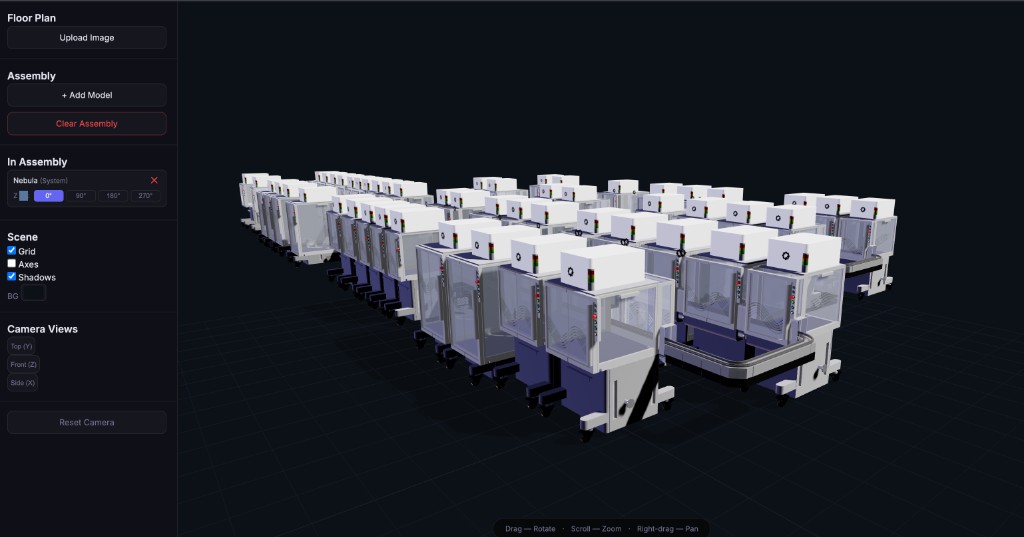
Section 6 generic Nebula JSON remains an operational resource for final projects, not a homework item itself.
Lab phases
Get more information on this.
Course links
Add the same recitation, Google Slide, and Benchling links your instructor posted on the main assignment page.