Week 3 HW: Lab Automation
I designed a drawing with the website that was made available to us https://opentrons-art.rcdonovan.com/. It made it easier to get used to the way the points would be done inside the plate to create our art. Personally I decided to create a flower, took the exact points for each color, green (sfGFP) and red (mrFP1). I integrated the points to the base code, and customized it for the design to be possible, especially with the high quantity of points and the limit of the 20ul pipette.
Mock Opentrons
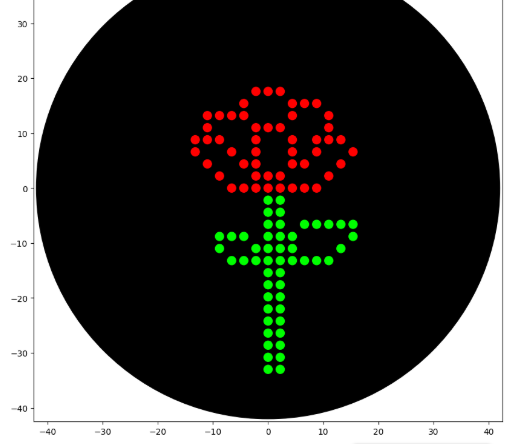
Code: https://colab.research.google.com/drive/1daKqHbVzLKhGoDKQutGwPzQFPNckCArT?usp=sharing
HOMEWORK QUESTIONS
1. Find and describe a published paper that utilizes the Opentrons or an automation tool to achieve novel biological applications.
In this paper, they use Opentrons to automate the assembly of bisoensors. The team created a flouride responsive genetic biosensor that produces a measurable florescent signal when positive. They compared ht precision and consistency of hte building between manually prepare and the automatic assembly done by the robot, which ended up giving as realible results. The paper highlights how the automatization can increase throughtput, reduce human error, and standardize the workflows in synthetic biology for the development and screening of biosensors.
ACS Synth. Biol. 2025, 14, 3, 979–986
https://doi.org/10.1021/acssynbio.4c00703
2. Write a description about what you intend to do with automation tools for your final project. You may include example pseudocode, Python scripts, 3D printed holders, a plan for how to use Ginkgo Nebula, and more. You may reference this week’s recitation slide deck for lab automation details.
For my final project ideas, Im thinking of creating biosensors for multiple things, so essentially I could use as an example the paper, and create a code to work with Opentrons to create the workflow of the engineering and producing them. To create the biosensor for biomarkers, and being a comitted listener distnat from the node, automatization robots are my chance to do the wet lab of the synthetizing of the assembling of the circuit for biosensor, quantify the flourensence, and create data dirven profiling.