Week 11 HW:Bioproduction & Cloud Labs
Part A: Art Pixel
I was not able to complete this portion because I did not receive the email containing the project link. By the time I realized the issue, it was too late to contribute.
Part B: Cell-Free Protein Synthesis | Cell-Free Reagents
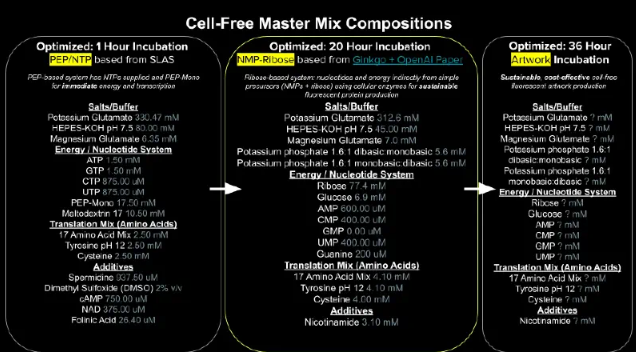
Referencing the cell-free protein synthesis reaction composition (the middle box outlined in yellow on the image above, also listed below), provide a 1-2 sentence description of what each component’s role is in the cell-free reaction.
E. coli Lysate
- BL21 (DE3) Star Lysate (includes T7 RNA Polymerase): it provides the core transcription/translation machinery including ribosomes, tRNAs, enzymes and T7 rna polymerase for the transcribing of dna into mrna.
Salts/Buffer
Potassium Glutamate: mantains ionic strength similar to the intracellular conditions suporting the enzymes acitivty and ribosome function.
HEPES-KOH pH 7.5: acts like a buffer to stabilize pH ensuring the optimal conditions for the transcription and translation enzymes.
Magnesium Glutamate: are essential cofactors for risobomes and polymerases
Potassium phosphate monobasic/dibasic: togehter from a phosphate buffer system that helps mantain the pH stability and provides phosphate for metabolic reactions.
Energy / Nucleotide System
Ribose: substrate for nucleotide regeneration pathways helping with the sustainability of the transcription over long time
Glucose: provides a slow sustain
AMP: serves as a precursor for ATP
CMP: when converted into CTP, which is needed as susbtrate for RNA for transcription
GMP: Converts into GMP, essential for both RNA synthesis and as energy source during translation
UMP: converts into UTP, required for mRNA synthesis
Guanine: acts as a saving precursor that can be converted into GMP -> GTP to supprot nucleotide regeneration pathways.
Translation Mix (Amino Acids)
17 Amino Acid Mix: provides most aminoacids needed for the protein synthesis
Tyrosine: required for protein synthesis, needed to be added seperately because of having a lower solubity, ensuring its sufficient availibity for translation.
Cysteine: has a reactive thiol group which makes it prone to oxidation, so it is added separately to mantain stability and ensure its proper introduction into proteins.
Additives
- Nicotinamide: Supports redox balance and metabolic activity by contributing NAD+ AND NADH related pathways, helping sustain the energy regeneration.
Backfill
- Nuclease Free Water: is used to bring th ereaction to the correct final volume needed without adding any unwanted nucleases that coudl degrade or genetic information.
Describe the main differences between the 1-hour optimized PEP-NTP master mix and the 20-hour NMP-Ribose-Glucose master mix shown in the Google Slide above. (2-3 sentences)
1hr PEP-NTP uses PEP and pre supplied nucleotides triphosphates for rapid and high yield production over a short time. The 20hr NMP system relies on a slower metabolic regeneration of nucleotides and energy. This makes it last longer and it has a lower rate expression when comparing.
Bonus question: How can transcription occur if GMP is not included but Guanine is?
Trancription could still occur because guanine can go into a pathway that converts it into GMP and then phosphorylated to GTP. This allows the system to regenerate even if this ingredient has finished or it wasnt added.
Part C: Planning the Global Experiment | Cell-Free Master Mix Design
- Given the 6 fluorescent proteins we used for our collaborative painting, identify and explain at least one biophysical or functional property of each protein that affects expression or readout in cell-free systems. (Hint: options include maturation time, acid sensitivity, folding, oxygen dependence, etc) (1-2 sentences each)
sfGFP: iS engineered for extremely efficient folding, so it tolerates poor conditions in cell free systems and still becomes flourescent. It has a fast maturation and is fairly acceptable to pH changes making it reliable as a baseline reporter.
mRFP1: has a slower chromophore maturation compared to gfp variants which delays the flourescense readout even if the protein expression is high. its sentsitive to misfolding if it s not in optimal conditions.
mKO2: matures relatively quickly but is pretty sensitive to acidic pH which can reduce its flourescence.
mTurquoise2: has a high yield but requires efficient folding to reach full brightness. it is sensible to oxidative conditions which can interfer with the chromophore formation.
mScarlet_I: is optimized for fast maturation compared to other red proteins. prodces a high brightness once matured; making the maturity time a limiting step if we are short of time for an experiment.
Electra2: depends on proper chromophore formation which is influenced by the O2 availibility and possibly other cofactros. Its output is sensitive to enviromental condiitons.
- Create a hypothesis for how adjusting one or more reagents in the cell-free mastermix could improve a specific biophysical or functional property you identified above, in order to maximize fluorescence over a 36-hour incubation. Clearly state the protein, the reagent(s), and the expected effect.
mScarlet 1
Limiting property: slow chromophore maturation rate compared to other GFPs
Hypothesis: If we increase the oxygen availibity in the cell free reaction we could enhance the maturation of the chromophore leading to a high florrescense output in lower tie.
Expectations: we improve the oxidation dependent chromophore formation = faster maturation = higher cumulative signal
- The second phase of this lab will be to define the precise reagent concentrations for your cell-free experiment. You will be assigned artwork wells with specific fluorescent proteins and receive an email with instructions this week (by April 24). You can begin composing master mix compositions here.
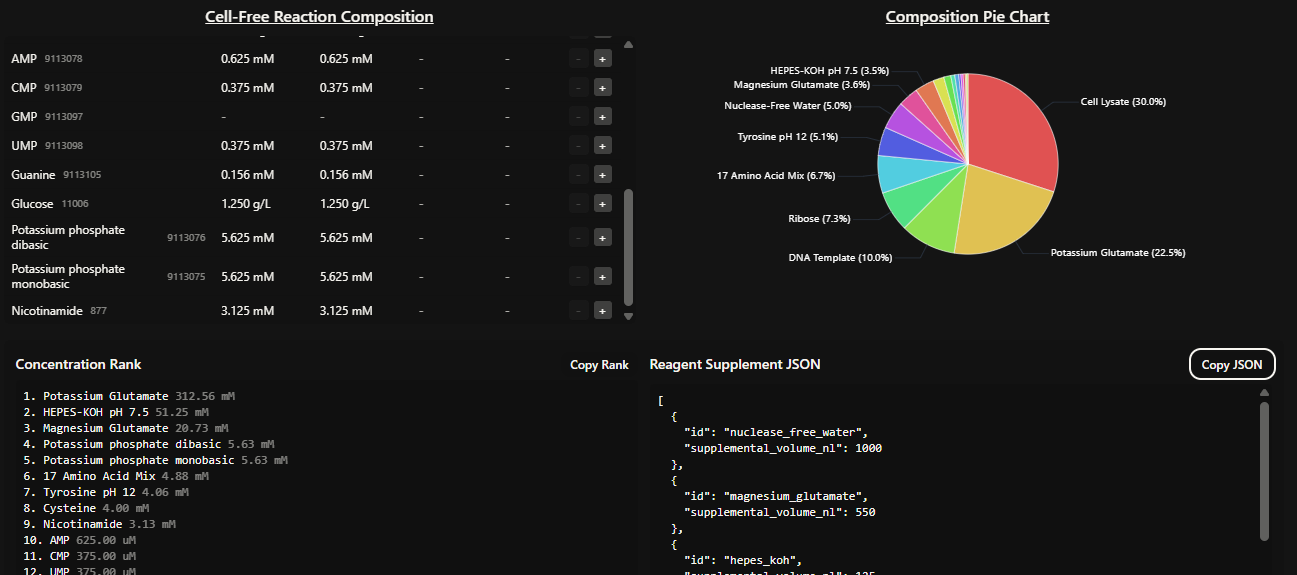
We increased Mg²⁺ concentration to enhance expression and reallocated water volume to increase buffering capacity via HEPES, aiming to balance protein yield with folding efficiency in a folding-sensitive fluorescent protein.
Concentration Rank
- Potassium Glutamate 312.56 mM
- HEPES-KOH pH 7.5 51.25 mM
- Magnesium Glutamate 20.73 mM
- Potassium phosphate dibasic 5.63 mM
- Potassium phosphate monobasic 5.63 mM
- 17 Amino Acid Mix 4.88 mM
- Tyrosine pH 12 4.06 mM
- Cysteine 4.00 mM
- Nicotinamide 3.13 mM
- AMP 625.00 uM
- CMP 375.00 uM
- UMP 375.00 uM
- Guanine 156.25 uM
- Ribose 11.625 g/L
- Glucose 1.250 g/L
- Nuclease-Free Water 1.000 uL
Reagent Supplementation
[ { “id”: “nuclease_free_water”, “supplemental_volume_nl”: 1000 }, { “id”: “magnesium_glutamate”, “supplemental_volume_nl”: 550 }, { “id”: “hepes_koh”, “supplemental_volume_nl”: 125 }, { “id”: “aa_mix_17”, “supplemental_volume_nl”: 325 } ]
- The final phase of this lab will be analyzing the fluorescence data we collect to determine whether we can draw any conclusions about favorable reagent compositions for our fluorescent proteins. This will be due a week after the data is returned (date TBD!). The reaction composition for each well will be as follows:
- 6 μL of Lysate
- 10 μL of 2X Optimized Master Mix from above
- 2 μL of assigned fluorescent protein DNA template
- 2 μL of your custom reagent supplements
Total: 20 μL reaction
Data still hasnt been return. No way to complete this part of the homework for this week.