Week 7: Neuromorphic Circuits
Overview | Background
In this two-day lab, you will design and build your very own IANN using a library of plasmids from the Ron Weiss lab and human embryonic kidney (HEK) 293 cells. IANNs differ from traditional synthetic genetic circuits because IANNs can perform analog computations, rather than being limited to digital computations. IANNs are also universal function approximators–given an adequate number of intracellular artificial neurons, you can use an IANN to achieve any input/output behavior you’d like.
Overview | Concepts Learned & Skills Gained
This is a lab with a dry and wet component. In the dry lab component, you will design a neuromorphic circuit in groups of 3. Once your design has been finalized, you will write instructions for an OT-2 to build your circuit for you. In the wet lab component, a TA will upload your OT-2 instructions and you will observe the OT-2 building and transfecting your IANN into HEK293 cells.
Circuit Assembling
Genetic Circuit Parts Available

My Circuit
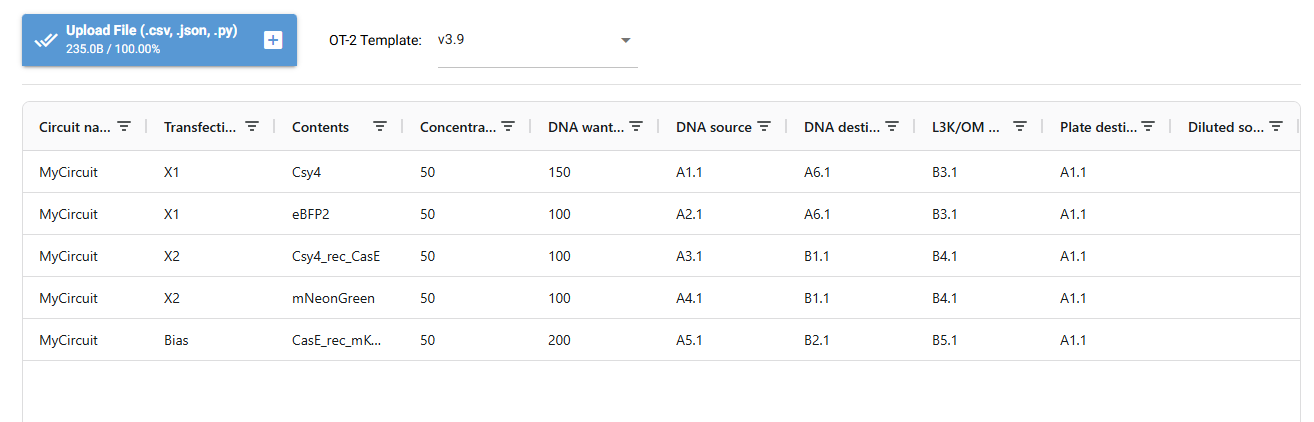
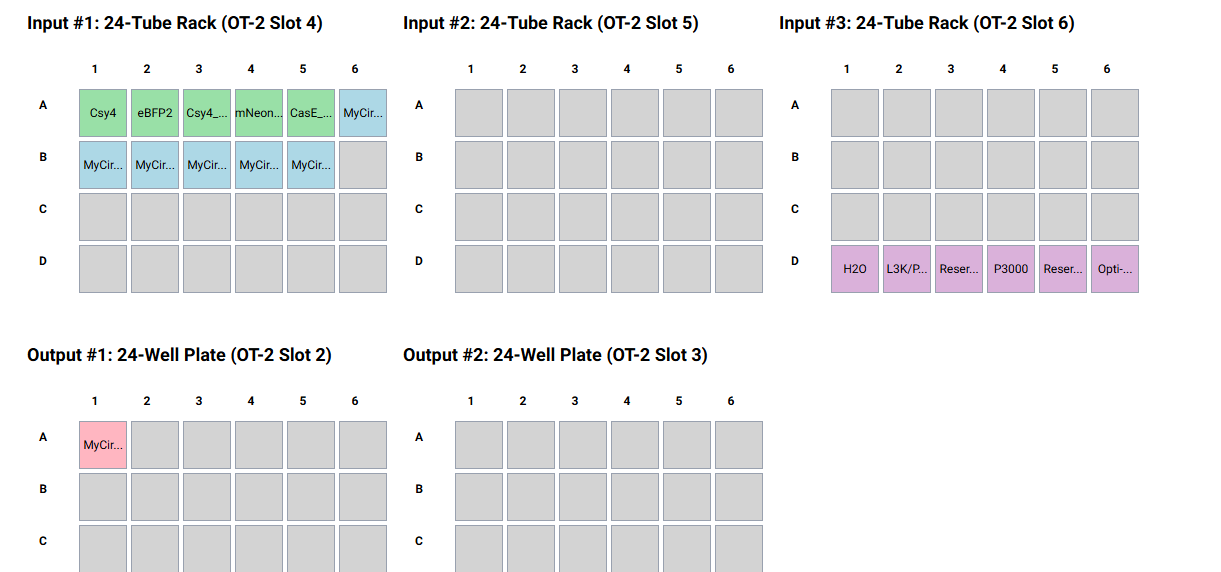
Experiment Layout
Prediction
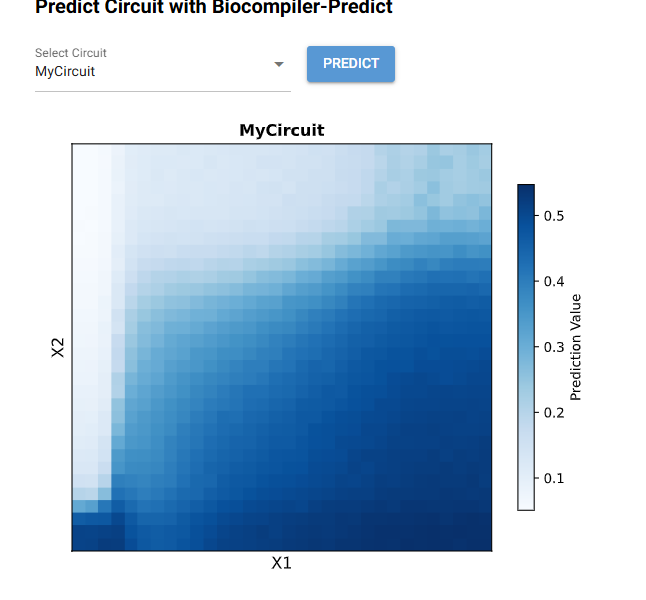
When looking at the template, the designed I ended up creating has the same 2-layered genetic network with a bias input. THe circuit uses endoribonucleases to process signals inside the cell and flourescent proteins to report activity we are looking for.
Components Chosen:
X1
Csy4: first layer ern enzyme
eBFP2: flourescent marker for X1 (BLUE)
Csy4 acts as a sensor detecting upstream signals and process DNA.
X2
Csy4_rec_CasE: CasE expression is controlled by the sequences recognized by Cys4 from X1.
mNeonGreen:reports activity in X2 (GREEN)
BIAS
CasE_rec_mKO2: the bias helps tune the overall circuit response, giving a baseline signal and it not being stricly ON/OFF.