Week 7 HW: Genetic Circuits Part 2

Genetic Circuits Part 2
Assignment Part 1: Intracellular Artificial Neural Networks (IANNs)
Unlike traditional genetic circuits, IANNs are analog, and as such correspond more closely to the nature of biological systems (i.e, we’re not always looking for strict 0/1 binary logic, sometimes we’re looking to establish control across a range of values or space/time). This analog nature means they are more responsive, efficient, and biocompatible.
Zoonotic Reservor IANNs (ZRIANNs)
- This is applying IANNs to proactively identify and eliminate zoonotic pathogens in host organisms (ex. cattle and other forms of livestock, bats). By establishing prior understanding of organism homeostatis, ZRIANNs can co-evolve their understanding of nominal organism cellular activity. Across ZRIANNs, this might act as a form of input. When there are deviations from said baselines due to the emergence of novel pathogens trigering events like elevated inflammation levels or unexpected apoptosis, this would act as another form of input, triggering the ZRIANNs to begin understanding novel pathogen behavior for elimination, which would be a form of output. Limitations might include the novel of an IANNs across diverse non-human hosts, difficulties in IANNs achieving homeostatic understanding and insights, and difficulties in IANNs detecting novel, essentially zero-day equivalent pathogens
See my attempt at a diagram below:
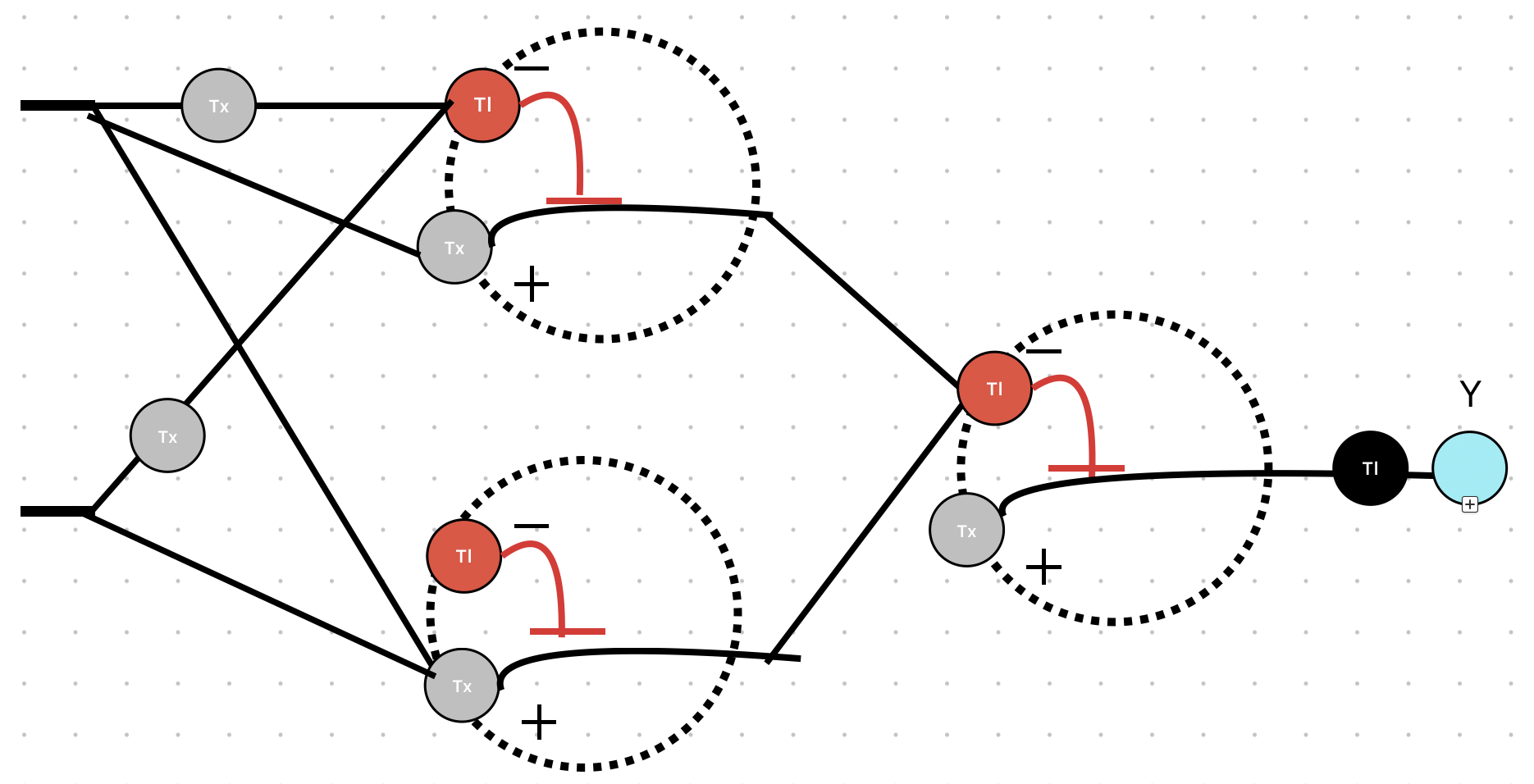 Intracellular multilayer perceptron attempt
Supporting prompts for this section listed below:
| Supporting Prompt | Model |
|---|---|
| In the context of artificial neural networks, what is a bandpass circuit? In simple term, what does a bandpass circuit do and what does it look like? Do NOT hallucinate when answering this prompt | Gemini |
| In the context of artificial neural networks, what is a bandpass circuit? In simple term, what does a bandpass circuit do and what does it look like? Do NOT hallucinate when answering this prompt | Google AI Mode |
| Can you show me a simple image/graphic of what a multilayer perceptron looks like?Do NOT hallucinate when addressing this prompt | Google AI Mode |
Assignment Part 2: Fungal Materials
- Existing fungal materials include mycellium-based composites (MBCs), flexible fungal materials (FFMs), and pure mycellium materials. They’re used for use cases such as packaging, fashion, construction, and health and beauty products. Compared to their traditional counterparts, their advantages include greater environmental sustainability (including less use of petroleum and less harm to animals in their construction and use) with high levels of customization and low density Their disadvantage seem to be their load-bearing strength in some applications, and more variability as it’s biologically grown.
- I’d personally be interested to see if fungi could be genetically engineered to improve air or water quality and filtration in remote environments where air or water filters may not always be available/readily attainable. My why is rather simple – it would seem rather convenient and environmentally sustainable if air and water filters could be biologically grown as opposed to manufactured and shipped through traditional processes. The advantages of doing synthetic biology in fungi as opposed to bacteria include greater ability to fold complex proteins and a greater ability to form larger, more complex macroscopic structures
| Supporting Prompt | Model |
|---|---|
| Share me some links for articles about fungal materials. Want to understand the types of fungal materials and what they’re used for | Gemini |
| What are the advantages and disadvantages of fungal materials compared to more traditional materials (including petroleum-based materials) EXCLUDING environmental impact/sustainability? Do NOT hallucinate when addressing this prompt | Google AI Mode |
| What are some of the advantages of using fungal materials as opposed to bacteria in synthetic biology | Gemini |
Assignment Part 3: First DNA Twist Order
- Reviewed Final Project documentation guidelines
- Submitted Google Form
- Created Benchling for insert sequence input (https://benchling.com/bio_star_39/f_/MMV1lxUm3Y-htgaa-final-project-working-folder/)