Week 9 HW: Cell-Free Systems
Homework Part A: General and Lecturer-Specific Questions
Cell-Free Systems
General Homework Questions
- Explain the main advantages of cell-free protein synthesis over traditional in vivo methods, specifically in terms of flexibility and control over experimental variables. Name at least two cases where cell-free expression is more beneficial than cell production.
- Cell-free systems allow for a broader range of potential chemistries than those given to us from natural biology, expanding flexibility. Cell-free protein synthesis also allows for greater control over experimental variables because the entire protein expression construct is designed from scratch (i.e., we have the opportunity to bypass a lot of the compleity of natural cells). Cell-free expression is more beneficial than cell production if you want to rapidly protoype gene pathways and if you want an expression mechanism that’s more amenable to consistent, predictable modeling and analysis.
- Describe the main components of a cell-free expression system and explain the role of each component.
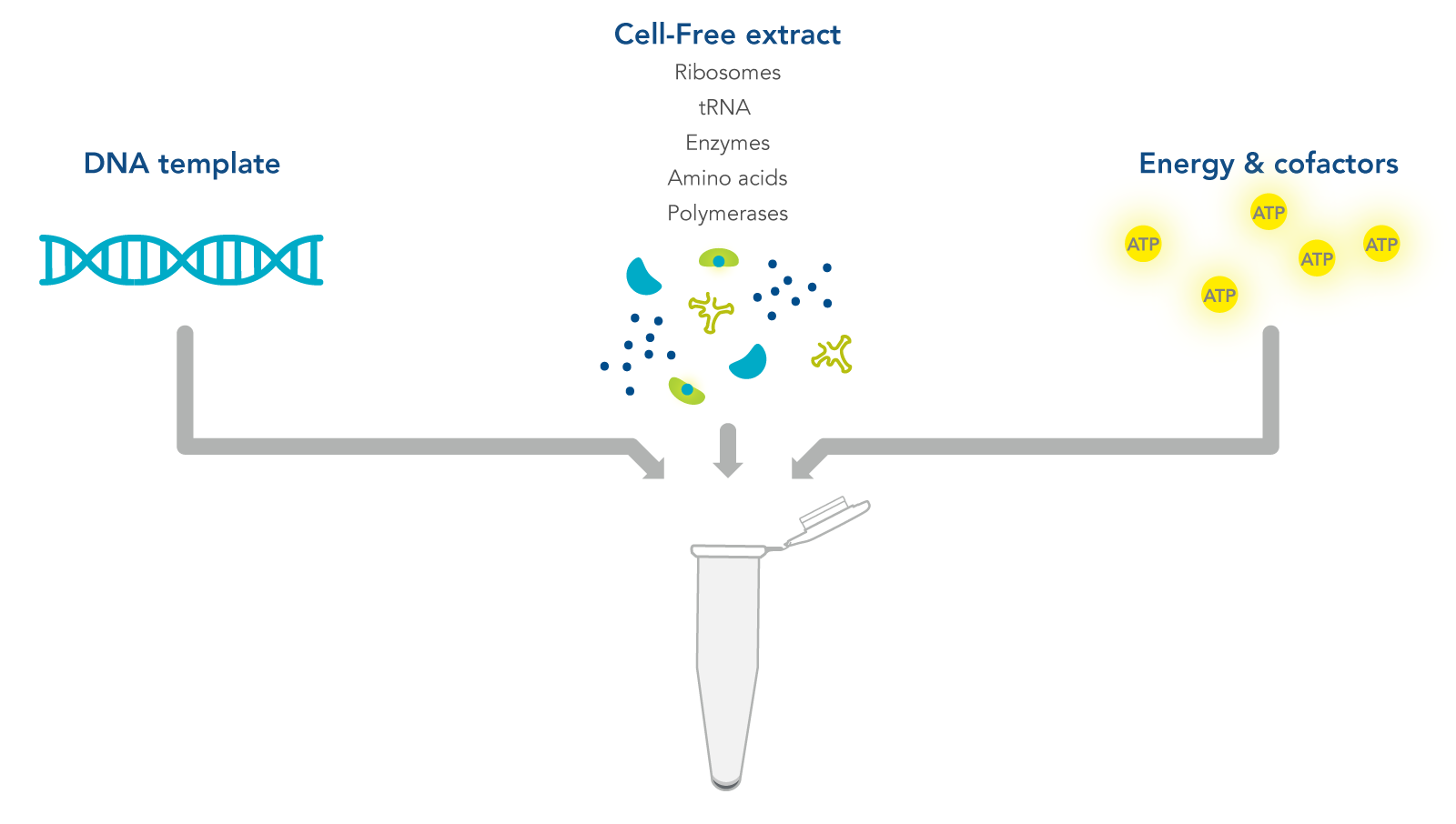
- The main components of a cell-free expression system are (based on elements described in this hyperlink 1):
- DNA template: Genetic code to begin Tx/Tl process
- Ribosomes: Assembling amino acids into polypeptides
- Enzymes: Catalyzing certain important chemical reactions necessary for the appropriate functioning of that cell-free expression system (ex. transcription and translation, energy generation)
- Amino Acids: The core chemical building blocks of the proteins the cell-free expression system will express
- Polymerases: Synthesizing DNA and RNA
- The main components of a cell-free expression system are (based on elements described in this hyperlink 1):
- Why is energy provision regeneration critical in cell-free systems? Describe a method you could use to ensure continuous ATP supply in your cell-free experiment
- Energy provision regeneration is critical in cell-free systems because cell-free systems don’t consume enzymes to produce energy. They also need external energy sources to remove waste products. A workaround might be to have analogous enzymatic reactions (possibly based off shared common charges) within the cell-free system to produce energy
- Compare prokaryotic versus eukaryotic cell-free expression systems. Choose a protein to produce in each system and explain why.
- Prokaryotic cell-free expression systems allow for the colocation of transcription and translation. This might work well for proteins that need to be produced at high volume, like an industrial protease prtoein. Eukaryotic cell-free expression systems allow for more complex proteins to be built due to their nuclei. This might work well for the production of more advanced/technically complex proteins, like rabbit serum albumin.
- How would you design a cell-free experiment to optimize the expression of a membrane protein? Discuss the challenges and how you would address them in your setup.
- In a manner similar to Shuguang Zhang ‘molecular glove’ experiment, I’d try to essentially coat and/or surround the the membrane protein with hydrophilic proteins to attract and/or absorb water in the cell-free environment, so the membrane protein can incorporate into the liposome 2. Challenges might include appropriate hydrophilic concentrations (which might be discerned via calculations or trial and error) or bonding between the hydrophilic proteins and the membrane proteins. This might be mitigated and/or the amount of error reduced through the use of computaitonal modeling and simulation tools like AlphaFold
- Imagine you observe a low yield of your target protein in a cell-free system. Describe three possible reasons for this and suggest a troubleshooting strategy for each.
- Suboptimal Ribosome Function: Examine ribosome mRNA transcription processes and modify as necessary
- Suboptimal Transcription: Examine tRNAs for coding errors/misreads or inappropriate expression levels and modify as necessary
- Suboptimal External Communication (i.e., yields cannot properly exit system at desired levels): Examine and modify membrane channel functionality as necessary
Supporting prompts for this section listed below:
| Supporting Prompt | Model |
|---|---|
| When we’re saying ‘cell-free expression system’, we’re not saying the same thing as a ‘synthetic minimal cell’ correct? Do NOT hallucinate/make things up when replying to this query | Gemini |
| Believe a ribosome has a waste removal function within cells, but I could be wrong in this. Clarfy or confirm this is the case, and do NOT hallucinate/make things up when replying to this prompt | Gemini |
| Believe a polymerase’s job is to essentially make copies of certain things, but the specifics beyond this are evading me at the moment. What is the specific role of a polymerase generally speaking? Do NOT hallucinate/make things up when replying to this prompt | Gemini |
| Do cell-free systems contain polypeptides? Why or why not? Do NOT hallucinate/make things up when replying to this prompt | Google AI Mode |
| In essence, an enzyme’s function within a cell-free expression system is to catalyze certain important chemical reactions necessary for the appropriate functioning of that cell-free expression system, correct? If I’m mistaken here, or if some element of my thinking is off, say so. Do NOT hallucinate/make things up when replying to this prompt | Google AI Mode |
| In essence, amino acids’ function within a cell-free expression system is to serve as the core chemical building blocks of the proteins the cell-free expression system will eventually express, correct? If I’m mistaken here, or if some element of my thinking is off, say so. Do NOT hallucinate/make things up when replying to this prompt | Google AI Mode |
| Within the context of cell, I know ADP and ATP are phosphates (I believe an adenine-type phosphate), although I’m not sure. Tell me if this is correct, and tell me in simple terms how ADP and ATP work within the context of cells to generate appropriate energy levels for cell functionality. Do NOT hallucinate/make things up when replying to this prompt | Google AI Mode |
| Unlike a prokaryote, eukaryotes have nuclei, correct? What are the advantages and disadvantages of nuclei within the context of protein production? Is it simply that the complexity of eukaryotic cells allows for the production of more sophisticated, technically complex proteins, or are there more reasons? Answer this prompt in a relatively succinct fashion and do NOT hallucinate/make things up when doing so | Gemini |
| Tell me about what types of proteins don’t require excessive quality control, that require a large volume to be produced, and benefit from a prokaryotic setup (i.e., a cell where transcription and translation occur in the same location)? Do NOT hallucinate/make things up when replying to this prompt | Gemini |
| What is the name of the common rabbit protein traditionally used in biotechnology experimentation with mammalian cell culture? Blanking on the name. Do NOT hallucinate/make things up when replying to this prompt | Google AI Mode |
Homework question from Kate Adamala
Based on Iulianna, T., Kuldeep, N. & Eric, F. The Achilles’ heel of cancer: targeting tumors via lysosome-induced immunogenic cell death. Cell Death Dis 13, 509 (2022). 3
Design an example of a useful synthetic minimal cell as follows:
- Pick a function and describe it
- What would your synthetic cell do? What is the input and what is the output?
- Increase apoptosis in mammalian cells with defective lysosomes. Input: Protein kinase R-like endoplasmic reticulum kinase (PERK). Output: Phosphorylated eukaryotic initiation factor 2 α-subunit (elF2a)
- Could this function be realized by cell-free Tx/Tl alone, without encapsulation
- No, it appears that communication with the external environment as well as some form of an encapsulating membrane are necessary for these immunogenic cell death (ICD) reactions to properly work
- Could this function be realized by genetically modified natural cell?
- Believe this function could be realized by a genetically modified natural cell. If PERK expression levels could be increased, this could increase elF2a phosphorylation
- Describe the desired outcome of your synthetic cell operation.
- Increased PERK expression levels lead to increased elF2a phosphorylation
- Design all components that would need to be part of your synthetic cell
- What would be the membrane made of?
- Mostly phospholipids and some (a relative minority percentage) of cholesterol
- What would you encapsulate inside? Enzymes, small molecules.
- PERK, elF2a, Adeonsine Triphosphate (ATP), GTP, Creatine Phosphate, Reporter (likely GFP)
- Which organism your Tx/Tl system will come from? Is bacterial OK, or do you need a mammalian system for some reason? (hint: for example, if you want to use small molecule modulated promotors, like Tet-ON, you need mammalian)
- Believe a mammalian system would be needed as this is meant to mimic a homo sapiens-based eukaryotic system
- How will your synthetic cell communicate with the environment? (hint: are substrates permeable? or do you need to express the membrane channel?)
- It should have permeable substrates, as my understanding of the PERK pathway seems to indicate that external communication with the environment via a permeable membrane is necessary for the PERK pathway to appropriately function (i.e., for the increase in the PERK expression levels to induce greater elF2a expression)
- Experimental details
- List all lipids and genes. (bonus: find the specific genes; for example, instead of just saying “small molecule membrane channel” pick the actual gene.)
- Lipids: POPC, Cholesterol
- Enzymes: Binding immunoglobulin protein (BiP), PERK, ATP, elF2B, Growth arrest and DNA damage-inducible 34 (GADD34)
- Genes: HSPA5 gene/GRP78 (for BiP expression), ELF2AK3 (encodes PERK protein), EIF2S1 (encodes elF2a), ATF4, DDIT3, and PPP1R15A (latter 3 genes necessary for apoptotic response)
- How will you measure the function of your system?
- Measure presence of GFP reporter to show that ribosomes are shutting down and apoptosis is beginning
- List all lipids and genes. (bonus: find the specific genes; for example, instead of just saying “small molecule membrane channel” pick the actual gene.)
Supporting prompts for this section listed below:
| Supporting Prompt | Model |
|---|---|
| In this paper, what is the ER membrane? | Gemini |
| In this paper, the targeted ICD reactions require interfacing with elements outside the cell correct? Is the cell membrane essential for their function? Do NOT hallucinate when replying to this prompt | Gemini |
| If I wanted to make a synthetic cell that would allow for greater Protein Kinase RNA (PKR)-like ER Kinase (PERK) expression levels to induce increased eukaryotic initiation factor 2 α-subunit (elF2a) expression, would a cholesterol membrane make sense? Would some other type of membrane make sense? Why or why not? Do NOT hallucinate/make things up when replying to this prompt | Gemini |
| In a ’normal’/natural non-synthetic cell, where do PERK and elF2a sit (i.e., where are they located? What are the components within a ’normal’/natural non-synthetic cell necessary for them to appropriately function? Do NOT hallucinate/make things up when replying to this prompt | Gemini |
| When we say that PERK ‘reaches across the membrane into the cytoplasm’, do we mean to say that it reaches outside the cell? Do NOT hallucinate/make things up when replying to this prompt | Gemini |
| Ok. So if I was building a minimal synthetic cell to replicate the PERK pathway (and the increase in elF2a phosphorylation), then my necessary components inside the minimal synthetic cell to encapsulate this reaction would be the PERK itself, relevant ribosomes, tRNAs, cytoplasm, and DNA? Tell me what I’m missing, what’s incorrect, and do NOT hallucinate/make things up when replying to this prompt | Gemini |
| To clarify, is PERK an enzyme that induces a chemical reaction leading to increased elF2a expression? What enzymes are usually required for the perk pathway to appropriately function? Do NOT hallucinate/make things up when replying to this prompt | Gemini |
| If the PERK pathway requires the BiP as its upstream regulator, what genes are necessary for this protein to be produced? What genes are necessary for the pathway to successfully function? Do NOT hallucinate/make things up when replying to this prompt | Gemini |
Homework question from Peter Nguyen
- Write a one-sentence summary pitch sentence describing your concept.
- Robotics Use Case: Thinking about using cell-free systems delivered/facilitated by drones to collect metagenomic samples from remote environments, for the pupose of expanding biosurveillance beyond the traditional wastewater sampling
- How will the idea work, in more detail? Write 3-4 sentences or more.
- Drone (or potentially a larger drone ship like an evTOL) would deliver robots and kits with cell-free reactions. These robots might be similar to Mars rovers or bomb-defusing robots. The kit would ideally auto-unload once the drone has reached its given destination, the robot would have to complete a set (i.e., limited and discrete) number of specific steps to collect and store the metagenomic sample. If analysis of the metagenomic sample could be done in real-time or a short time duration, that would be beneficial. If this could not be done, there would essentially be a ‘packing’ step before the robot and the now-utilized kits return to their origin site for sample processing/analysis
- What societal challenge or market need will this address?
- The need to expand biosurveillance beyond the purely human environment into more remote locales and animal populations
- How do you envision addressing the limitation of cell-free reactions (e.g., activation with water, stability, one-time use)?
- Would need secure storage to maintain stability. Activation with water challenges would require an appropriate water disposal mechanism(s) either within/near the sample kit or facilitated by the robot without harming the robot (or the robot might have some form(s) of waterproof protection). One-time use isn’t an issue for this use case because there are ample examples from the world of biosurveillance where one-time sample collection is the aim
Homework question from Ally Huang
- Provide background information that describes the space biology question or challenge you propose to address. Explain why this topic is significant for humanity, relevant for space exploration, and scientifically interesting.
- As humans travel farther out into space, particularly on remote, potentially skeleton-crew missions, they may not be able to bring blood supplies for adverse events like necessary transfusions. Moreover, blood banks play an important terrestrial role that might need replication. The basic idea is to engineer liver cells to create blood proteins or blood-like fluid on demand a-la the high-level idea initially proposed in the hyperlinked Engineering Biology Research Consortium (EBRC) Roadmap document 4
- Name the molecular or genetic target that you propose to study. Examples of molecular targets include individual genes and proteins, DNA and RNA sequences, or broader -omics approaches.
- I’d like to study the albumin plasma protein
- Describe how your molecular or genetic target relates to the space biology question or challenge your proposal addresses.
- Albumin has a vital role in the liver’s production of blood-related proteins. Therefore, it would seem rather improbable to have engineered liver cells to create blood proteins without some sort of working albumin configuration or some analog
- Clearly state your hypothesis or research goal and explain the reasoning behind it.
- I’d like to study how to modulate or fine-tune albumin expression levels in microgravity, as it appears microgravity exposure can cause albumin levels to increase 5.
- Outline your experimental plan - identify the sample(s) you will test in your experiment, including any necessary controls, the type of data or measurements that will be collected, etc.
- I’d include purified albumin plasma protein as a sample in my experiment, as well as some form of small interfering RNA (siRNA) for lowering albumin expression, and GFP for measuring expression level change. I’d use Biobits and the P51 Molecular Fluorescence Viewer to measure the impact of siRNA modulation on albumin expression. I’d collect information on oncoctic pressure modulations across a microgravitty and terrestrial experimental configurations. The terrestrial configuration would serve as a control to indicate comparative rates of siRNA modulation efficacy. GFP expression would indicate certain levels of albumin expression post-siRNA modulation
| Supporting Prompt | Model |
|---|---|
| What exactly is the role of the human liver in creating blood or blood-relate proteins? Do NOT hallucinate/make things up when replying to this prompt | Google AI Mode |
| Show me research papers from the past 5-10 years on the impacts of microgravity on the production of albumin plasma protein. Do NOT hallucinate/make things up when replying to this prompt | Google Scholar Labs |
| When biotechnologists typically study albumin terrestrially, how is this done? How do they typically measure albumin’s impact on oncoctic pressure? Do NOT hallucinate/make things up when replying to this prompt | Google AI Mode |
Homework Part B: Individual Final Project
- Put your chosen final project slide in the appropriate slide deck following the instructions on slide 1
- Inserted slide in Committed Listener Deck
- Submit this Final Project selection form if you have not already.
- Submitted FInal Project selection form (see screenshots below)
- Begin planning how you will write your final project documentation based on these guidelines
- Began writing final project documentation based on hyperlinked guidelines
- Prepare your first DNA order and put it in the “Twist (MIT)” or “Twist (Nodes)” tab of the 2026 HTGAA Ordering: DNA, Reagents, Consumables spreadsheet, as appropriate.
- Prepared Twist order near end of Final Project completion
https://sfvideo.blob.core.windows.net/sitefinity/images/default-source/figure-images/cell-free-protein-synthesis.png?sfvrsn=56eff307_3 ↩︎
https://phys.org/news/2022-06-glucose-proteins-water-soluble.html ↩︎
https://roadmap.ebrc.org/wp-content/uploads/2024/10/Engineering-Biology-for-Space-Health_EBRC-28Oct2024.pdf ↩︎
https://d1wqtxts1xzle7.cloudfront.net/97903821/14789450.2017.125830720230128-1-1aecb96-libre.pdf?1674890991=&response-content-disposition=inline%3B+filename%3DSpaceflight_induced_changes_in_the_human.pdf&Expires=1775431892&Signature=VuZ~5lk8qWai7-K98d2EVTmh6JFxheLI~BwtNq6-c8v~L1leGj3rHb8p8h1Z5qlkhuWwXHQfbYJ26lWeiHe5OUaM0NMib0Fv4g2ZVMvgpVzTifWCVWQhgcChErZD4XUJBhsvPPsW0qY55P8jbF70fRVCwAelr1IMTF2rS1xckdpJNNYpy1OeIrHr8NOFt6HebOxPdxOavVAJJhe-piCuSXXYD6IfWoaLPhgNIYZ1-7j3fs3S6qbjtSeCv8LVwPnS0W46~MEtZlAEakukVFR-~M~SoR6nizpPN4eyIzrunzo8oeWFJKP2FrhyOyzfuIaMbQLaQy29DY6nd~gvM2e9ng__&Key-Pair-Id=APKAJLOHF5GGSLRBV4ZA ↩︎