Week 7 HW: Genetic Circuits Part II
PART 1: IANNs
- What advantages do IANNs have over traditional genetic circuits, whose input/output behaviors are Boolean functions?
Intracellular Artificial Neural Networks (IANNs) offer several advantages over traditional genetic circuits based on Boolean logic. While Boolean circuits operate in a binary manner (ON/OFF), IANNs can process continuous, graded inputs such as varying concentrations of metabolites or regulatory molecules. This enables more nuanced and biologically realistic responses. Additionally, IANNs integrate multiple inputs through weighted interactions, allowing for more flexible and complex decision-making compared to rigid logical gates like AND or OR.
- Describe a useful application for an IANN; include a detailed description of input/output behavior, as well as any limitations an IANN might face to achieve your goal.
A useful application of an IANN is in cell-based disease diagnostics and therapeutic response, particularly for conditions such as cancer. In this context, inputs could include biomarkers such as cancer-associated microRNA levels, oxidative stress, and metabolic indicators like elevated lactate concentrations. The IANN processes these signals by assigning weights to each input and integrating them into a combined output that reflects the likelihood of a diseased state. Based on this computation, the system can trigger the expression of a therapeutic protein, such as one inducing apoptosis, or activate a fluorescent reporter for diagnostic purposes. Compared to Boolean circuits, which rely on strict thresholds and may fail when signals are near cutoff values, IANNs can interpret intermediate levels and produce more graded and accurate responses. However, limitations include gene expression noise, challenges in precisely tuning interaction weights, metabolic burden on the host cell, and potential instability due to mutations over time.
- Below is a diagram depicting an intracellular single-layer perceptron where the X1 input is DNA encoding for the Csy4 endoribonuclease and the X2 input is DNA encoding for a fluorescent protein output whose mRNA is regulated by Csy4. Tx: transcription; Tl: translation. Draw a diagram for an intracellular multilayer perceptron where layer 1 outputs an endoribonuclease that regulates a fluorescent protein output in layer 2.
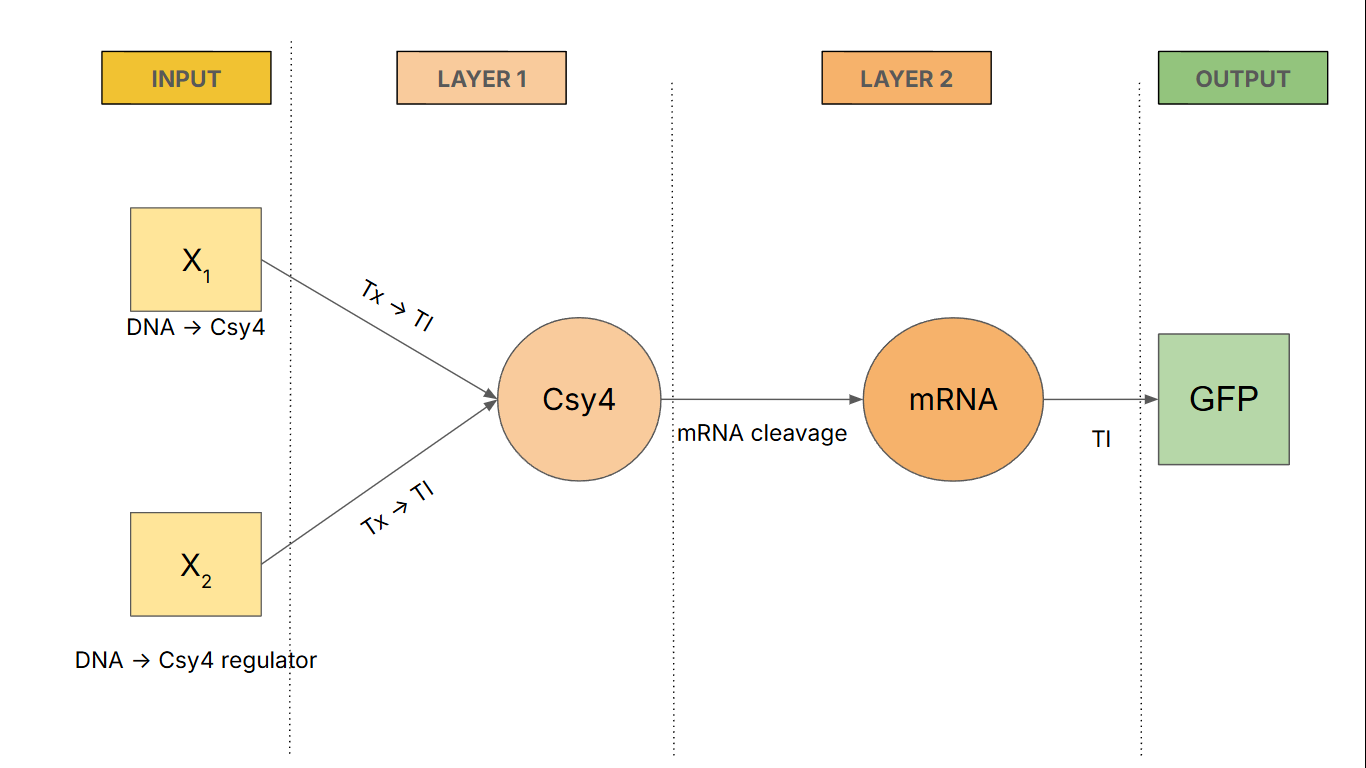
The system is organized into two functional layers: the first layer integrates DNA inputs to produce an endoribonuclease, while the second layer uses this intermediate signal to post-transcriptionally regulate a fluorescent reporter.
PART 2: Fungal Materials
- What are some examples of existing fungal materials and what are they used for? What are their advantages and disadvantages over traditional counterparts?
Fungal materials, particularly those derived from mycelium, have been increasingly developed for sustainable applications across multiple industries. Examples include mycelium-based leather used as an alternative to animal-derived leather, biodegradable packaging materials that replace petroleum-based foams such as polystyrene, lightweight construction materials for insulation or structural use, and environmentally friendly textiles. These materials offer several advantages, including biodegradability, low environmental impact, and the ability to grow on inexpensive and renewable substrates such as agricultural waste. Additionally, fungal materials exhibit self-assembling properties, reducing the need for energy-intensive manufacturing processes. However, they also present disadvantages, including lower mechanical strength compared to some synthetic materials, sensitivity to moisture and environmental conditions, slower production rates, and variability in material properties due to the inherent complexity of biological systems.
- What might you want to genetically engineer fungi to do and why? What are the advantages of doing synthetic biology in fungi as opposed to bacteria?
Potential modifications include altering cell wall composition, such as chitin or glucan content, to improve mechanical strength, engineering the production of antimicrobial compounds for functionalized materials, and designing fungi that respond to environmental stimuli like humidity or temperature. Additionally, fungi could be engineered to incorporate biosensing or signaling capabilities, enabling the development of responsive or “smart” materials. Compared to bacterial systems, fungi offer several advantages, including their eukaryotic cellular structure, which supports proper folding and post-translational modification of complex proteins, as well as their natural ability to form multicellular networks (mycelium) that are well-suited for material fabrication. They also tend to have greater secretion capacity and environmental tolerance. Despite these benefits, fungal systems are generally more complex and slower to engineer than bacterial models, which can present practical challenges in their development and optimization.