Week 11: Bioproduction & Cloud Labs

Cloud laboratories are making science accessible, affordable, and reproducible. Our aim this semester is to showcase how they can enable human creativity at scale, and how they provide a platform for collaboration and community.
How To Grow (Almost) Anything is about synthetic biology, bioengineering, robotics, automation, art, and AI. But it is also about friendship, shared purpose, and the freedom to build beyond what we know and to be inspired by what can be. To that end, the goal with this cloud lab unit and homework assignment is to inspire collaboration and creativity while designing a scientifically rigorous cell-free fluorescent protein optimization experiment together.
Lecture (Tues, Apr 14)
Bioproduction & Cloud Labs
(▶️Recording)
Reshma Shetty
Recitation (Wed, Apr 15)
Cloud laboratories
(▶️Recording | 💻Slides)
Ronan Donovan
Lab (Thurs-Fri, Apr 16 - 17)
Tip
As you plan for final projects, you may want to refer to the provided non-exhaustive list of common Nebula protocols and their parameters in the “Reading & Resources” section below.
Homework — DUE BY START OF APR 28 LECTURE
Info
Note that this homework is due a week later than it ordinarily would due to its release a week later than normal.
Part A: The 1,536 Pixel Artwork Canvas | Collective Artwork
Assignees for the following sections
| MIT/Harvard students | Required |
| Committed Listeners | Required |
- Contribute at least one pixel to this global artwork experiment before the editing ends on Sunday 4/19 at 11:59 PM EST.
- A personalized URL was sent to the email address associated with your Discourse account, and you can discuss the artwork on the Discourse.
- If you did not have a chance to contribute, it’s okay, just make sure you become a TA this fall! 😉
- Make a note on your HTGAA webpages including:
- what you contributed to the community bioart project (e.g., “I made part of the DNA on the bottom right plate”)
- what you liked about the project, and
- what about this collaborative art experiment could be made better for next year.
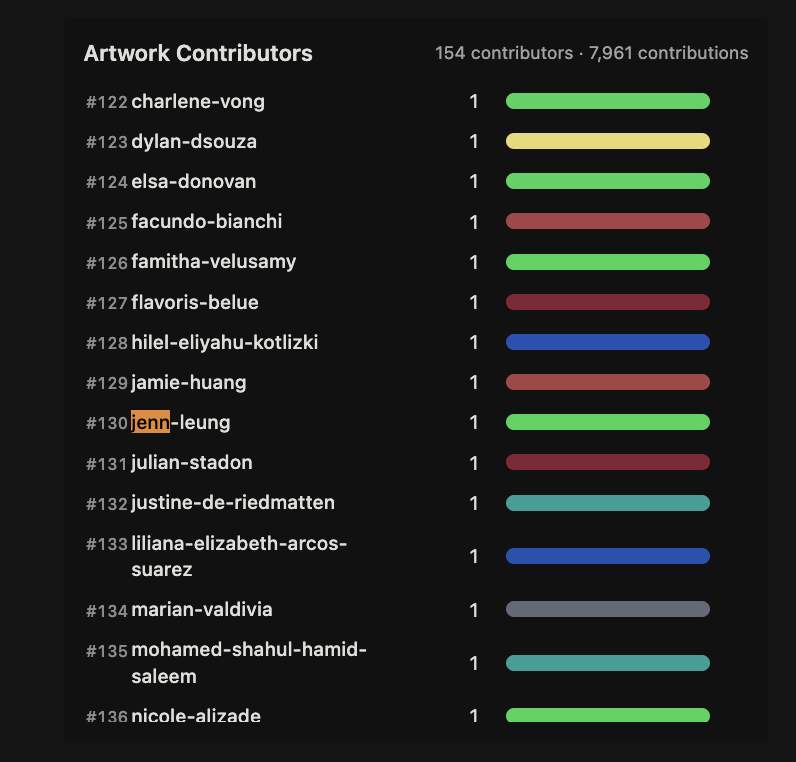
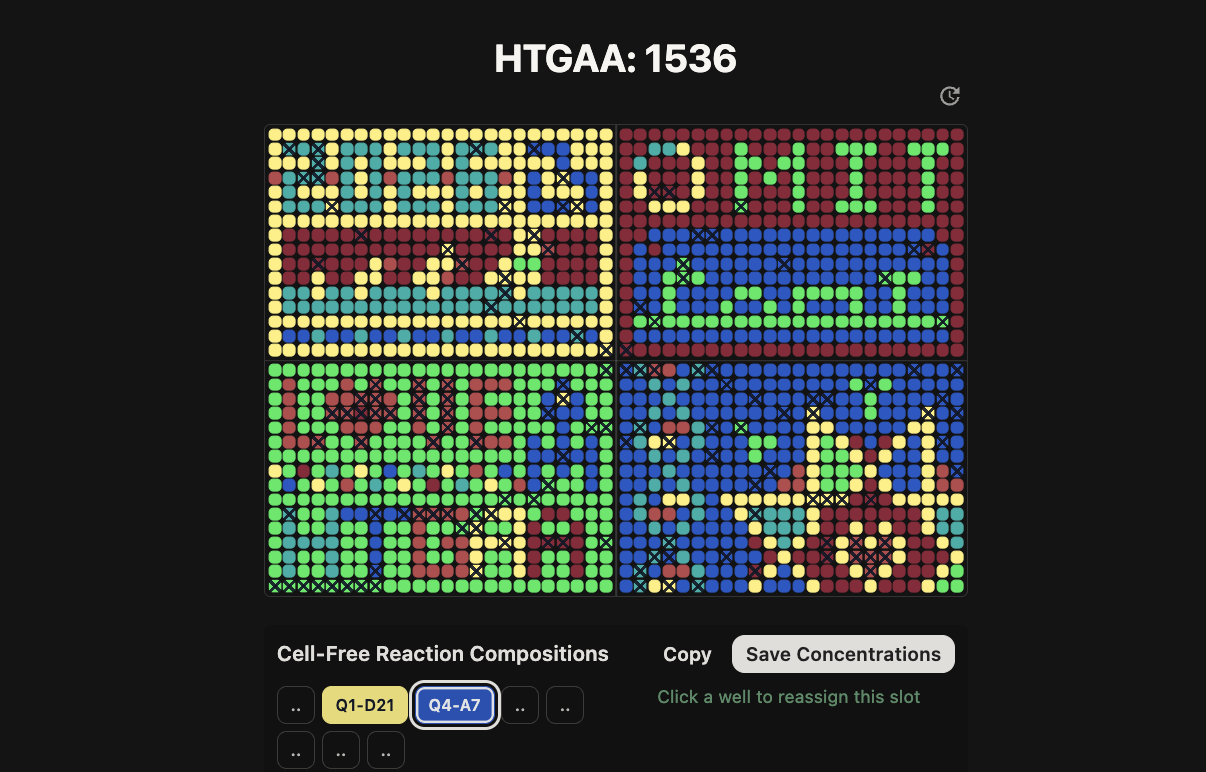
Here’s some evidence of what I contributed to the collective artwork: I had chosen specific pixels that were assigned different colors but adjacent to core shapes and forms. My most enjoyable part was during our recitation, our classmate Constantin found a way to hack the system and constantly draw LifeFabs representation onto the community art so we had a leading presence!
Part B: Cell-Free Protein Synthesis | Cell-Free Reagents
Assignees for the following sections
| MIT/Harvard students | Required |
| Committed Listeners | Required |
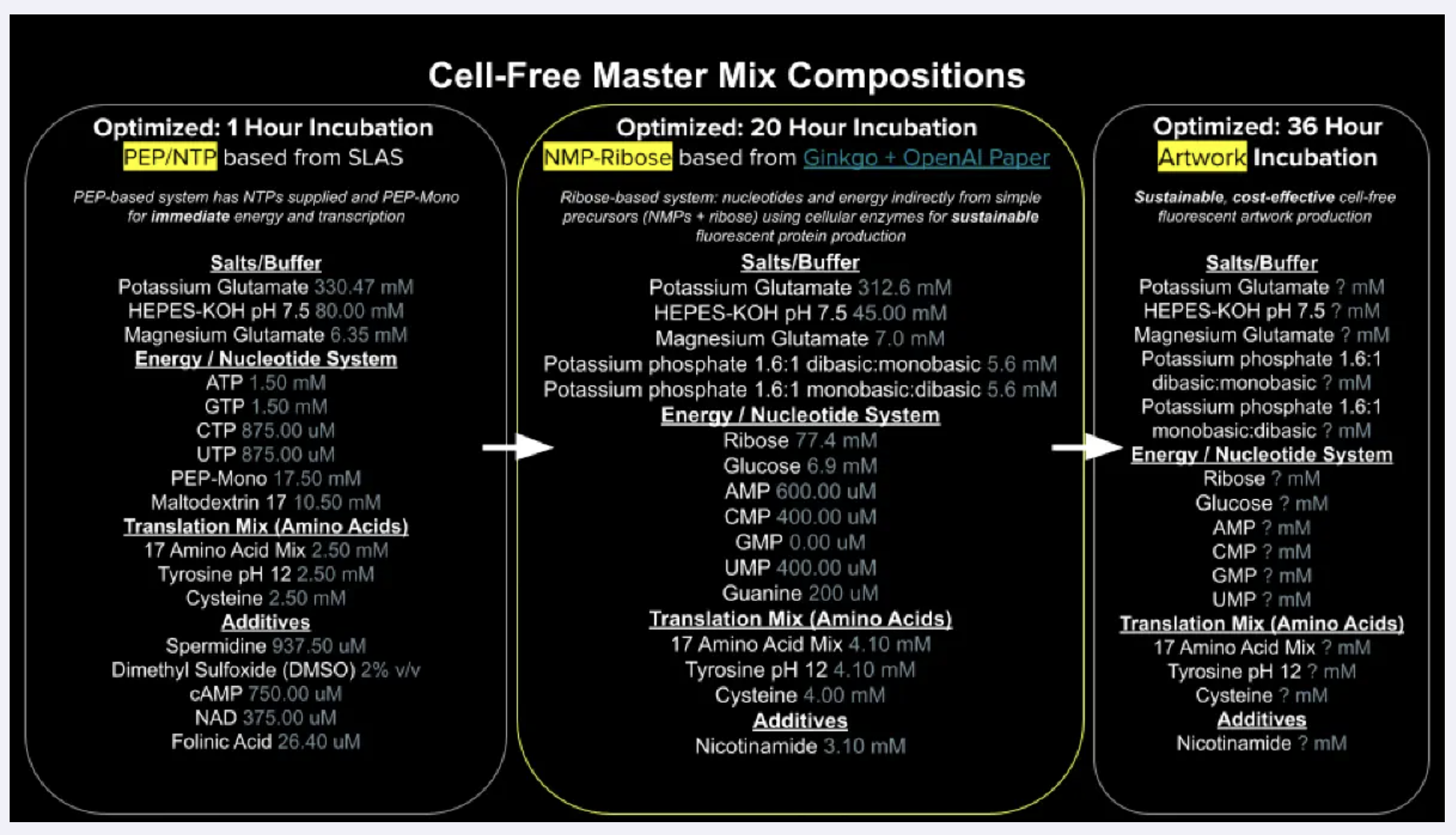
Referencing the cell-free protein synthesis reaction composition (the middle box outlined in yellow on the image above, also listed below), provide a 1-2 sentence description of what each component’s role is in the cell-free reaction.
E. coli Lysate
- BL21 (DE3) Star Lysate (includes T7 RNA Polymerase)
Clarified lysate of E Coli containing all transcription and translation machinery such as ribosomes,tRNA, aminoacyl-tRNA synthetases, and elongation factors.
BL21(DE3) is a derivative of the E. coli B strain that does not contain the lon protease and is also deficient in the outer membrane protease OmpT. The lack of two key proteases reduces degradation of heterologous proteins expressed in the strain. e.g. rne131 mutation that reduces levels of endogenous RNases and mRNA degradation
Is likely optimized for use with low copy n umber with T7 promoter based plasmids, will have fast growth in minimal medium and ability to reach high cell density
Salts/Buffer
- Potassium Glutamate
Salt creating monovalent ionic environment so that ribosomes can maintain their structure and function. flutamate used instead of chloride because high concentrations of chloride ions makes it hard for translation to take place.
- HEPES-KOH pH 7.5
keeps reaction stable and enzyme friendly pH during incubation. its to help make sure metabolism wont turn too acidic and denature proteins.
- Magnesium Glutamate
magnesium is essential for ribosome assembly and tRNA binding and for enzymes be involved in the nucleotide metabolism. a good concentration makes sure they can bind.
- Potassium phosphate monobasic
- Potassium phosphate dibasic
These two potassium phosphates help to supply phosphate that can feed back to nucleotide regeneration and help sustain ATP and NTP synthesis over time.
Energy / Nucleotide System
- Ribose
central substrate of this NMP-Ribose energy system. Endogenous kinases phosphorylate ribose into ribose-5-phosphate, which feeds both nucleotide biosynthesis and the pentose phosphate pathway, providing a sustained source of NTPs to drive transcription and translation
- Glucose
supplementary energy source that feeds glycolysis, generating ATP and NADH alongside the ribose pathway to extend the productive lifetime of the reaction.
- AMP
- CMP
- GMP
- UMP
Nucleoside monophosphates that serve as precursors to the activated NTP forms (ATP, CTP, UTP) required for mRNA synthesis and as the universal energy currency powering translation.
GMP here though is set to zero for guanine salvage pathway to produce ennough GTP without needing to supplement as GMP
- Guanine
purine salvage pathway, where it is converted to GMP and then phosphorylated up to GTP , more cost effective way to maintain the GTP pool than building it from scratch via de novo synthesis.
Translation Mix (Amino Acids)
- 17 Amino Acid Mix
substrates for ribosome, building blocks that can be loaded onto tRNAs and incorporated into peptide chain during translation
- Tyrosine
dissolved at pH12 bcs tyrosine is not very soluble at normal ph levels,
- Cysteine
oxidises in mixed solution and will form disulfide bonds or react with metal ions, it might deplete free cysteine available for target protein.
Additives
- Nicotinamide
learnt about this from skincare (haha): precursor to NAD+ that can replenish effects that drives glycolysis and other metabolic reactions.
Backfill
- Nuclease Free Water
making sure water is at a right working volume but also no contaminating RNases or DNases that would degrade mRNA trnasscription .
Describe the main differences between the 1-hour optimized PEP-NTP master mix and the 20-hour NMP-Ribose-Glucose master mix shown in the Google Slide above. (2-3 sentences)
Main difference between the two systems is how they supply energy and nucleotides. 1-hour PEP-NTP system delivers ready-made NTPs and fast-burning energy donors directly, so transcription and translation kick off immediately but te fuel runs out quickly as PEP is consumed and inhibitory phosphate builds up. The 20-hour NMP-Ribose-Glucose system instead supplies simpler precursors (NMPs, ribose, glucose) and lets the lysate’s own enzymes continuously regenerate NTPs from scratch, which is slower to get going but sustains productive protein synthesis much longer. The short-burst system also uses a richer cocktail of additives to squeeze maximum output from a brief reaction window, while the long-run system compensates with higher amino acid concentrations to keep the ribosomes fed over the extended incubation.
- Bonus question: How can transcription occur if GMP is not included but Guanine is?
Guanine is converted to GMP via the purine salvage pathway. GTP is the actual substrate incorporated by T7 RNAP during transcription
Part C: Planning the Global Experiment | Cell-Free Master Mix Design
Assignees for the following sections
| MIT/Harvard students | Required |
| Committed Listeners | Required |
Given the 6 fluorescent proteins we used for our collaborative painting, identify and explain at least one biophysical or functional property of each protein that affects expression or readout in cell-free systems. (Hint: options include maturation time, acid sensitivity, folding, oxygen dependence, etc) (1-2 sentences each)
The amino acid sequences are shown in the HTGAA Cell-Free Benchling folder.
sfGFP is a superfolder GFP is engineered to fold correctly even under stress conditions, and it matures so quickly that it produces a reliable green signal faster than almost any other variant, making it a great baseline readout in cell-free reactions. mRFP1 is the earliest or one of the earliest monomeric red proteins developed, it is notably slow to mature and not particularly bright, so in a cell-free context you often have to wait significantly longer before you see meaningful signal compared to newer red variants. mKO2 : mKO2 needs oxygen to complete its chromophore, and because cell-free reactions in small droplets or dense solutions can become oxygen-depleted, its orange signal may be weaker or delayed relative to what you’d see in a well-aerated system. mTurquoise2 this is very efficient at converting absorbed light into emitted fluorescence, meaning even modest expression levels produce a strong, stable signal that holds up well over long imaging periods. mScarlet_I - is newer type of rFP and matures much faster and produces a brighter signal sooner, making it well-suited for watching protein production happen in real time. >this could be good for my experiment for transient transfections? Electra2 optimized specifically for speed, Electra2 folds and forms its chromophore almost immediately after translation, so it’s particularly useful when you need to detect protein expression as early as possible in the reaction.
- Create a hypothesis for how adjusting one or more reagents in the cell-free mastermix could improve a specific biophysical or functional property you identified above, in order to maximize fluorescence over a 36-hour incubation. Clearly state the protein, the reagent(s), and the expected effect.
To maximise mKO2 fluorescence over a 36-hour incubation, we would increase nicotinamide to 1.5x its standard concentration and slightly raise the ratio of dibasic potassium phosphate to keep the reaction pH stable for longer. Nicotinamide sustains the metabolic pathways that regenerate NAD⁺ and keep translation running, while the adjusted phosphate balance prevents the gradual acidification that would otherwise slow or stall the ribosomes. Together these changes give mKO2 the stable, long-running reaction environment it needs to complete its slow, oxygen-dependent chromophore maturation and accumulate detectable fluorescence over the full incubation window.
The second phase of this lab will be to define the precise reagent concentrations for your cell-free experiment. You will be assigned artwork wells with specific fluorescent proteins and receive an email with instructions this week (by April 24). You can begin composing master mix compositions here.
Important
In order to be eligible for this, make sure that your final project slide is in the “2026 Committed Listener ONE FINAL PROJECT IDEA” slide deck.
i started doing some mixes, aprt from nicotinamide mentioned above, adding a low concentration of GMP and slightly increasing cysteine will likely change RFP slow to mature and not particularly bright, the strategy is to compensate by producing more total protein, more mRNA transcribed means more chances for mature fluorescent protein to accumulate by the end of the incubation. The extra GMP tops up the GTP pool that RNA polymerase draws on during transcription, helping sustain mRNA production over the full reaction window. cysteine is a structural amino acid that appears in mRFP1’s folding core, so keeping it in good supply reduces the chance of misfolding
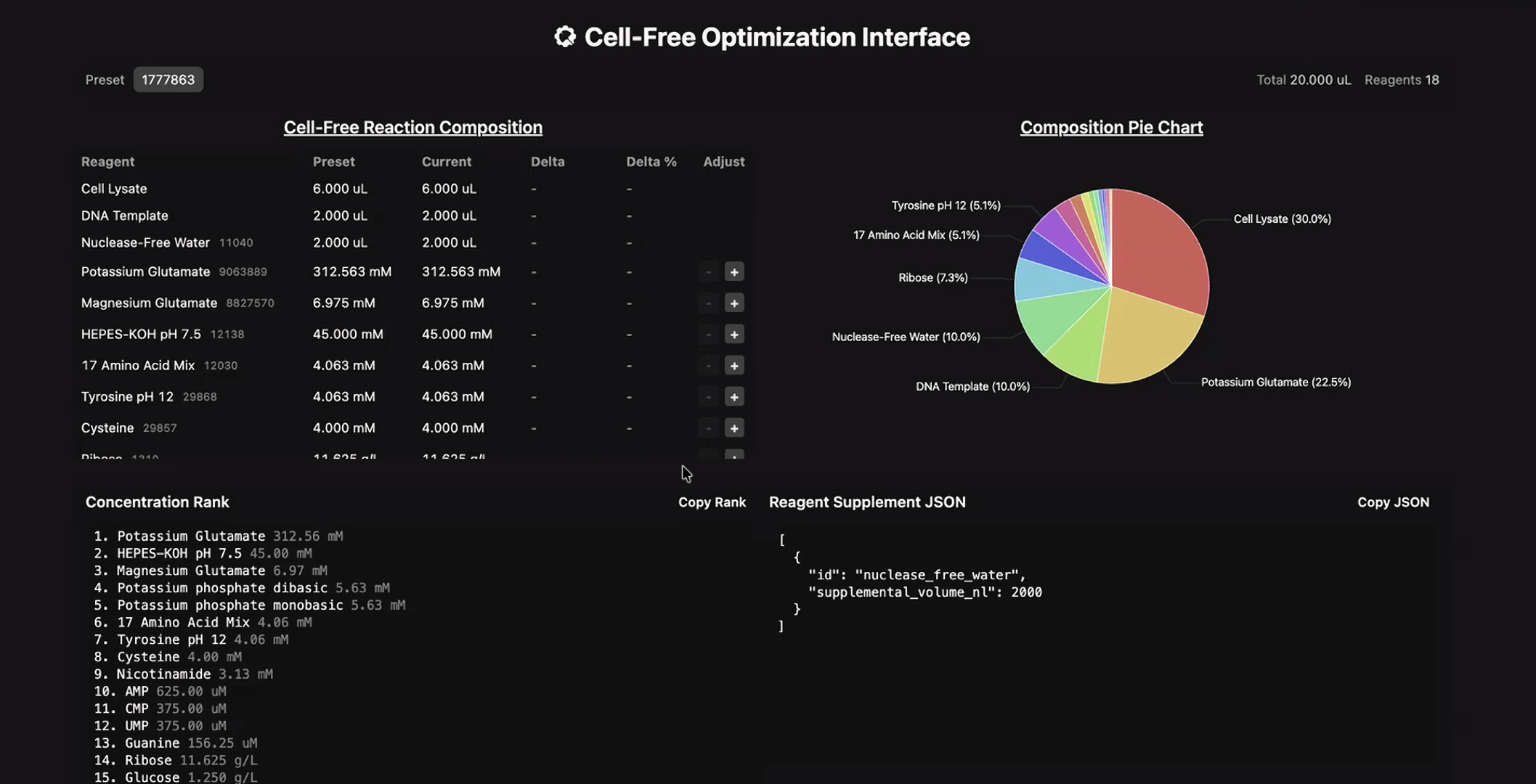
The final phase of this lab will be analyzing the fluorescence data we collect to determine whether we can draw any conclusions about favorable reagent compositions for our fluorescent proteins. This will be due a week after the data is returned (date TBD!). The reaction composition for each well will be as follows:
- 6 μL of Lysate
- 10 μL of 2X Optimized Master Mix from above
- 2 μL of assigned fluorescent protein DNA template
- 2 μL of your custom reagent supplements
Total: 20 μL reaction
N/A? No data was provided that week but we can use the existing data from earlier provision.
Part D: Build-A-Cloud-Lab | (optional) Bonus Assignment
Assignees for the following sections
| MIT/Harvard students | Optional |
| Committed Listeners | Optional |

Ginkgo Nebula Cloud Laboratory Rendering, 2025
- Use this simulation tool to create an interesting looking cloud lab out of the Ginkgo Reconfigurable Automation Carts. This is just a minimal implementation so far, but I would love to see some fun designs!
Tip
Note from Ronan: If you are interested in helping me build out future HTGAA cloud lab software, please fill out this form!
this was skipped!