Organoid-lab-on-a-chip for BSL-1 Labs Closed-loop biochemical reinforcement learning for brains-on-chips via mRNA-mediated dopaminergic differentiation of PC12 cells with Nurr1 and FoxA2 Jenn Leung | LifeFabs Institute | London
HTGAA 2026: Individual Final Project Documentation
Subsections of Projects
Group Final Project
Individual Final Project: Organoid-lab-on-a-chip (BSL-1)
Organoid-lab-on-a-chip for BSL-1 Labs
Closed-loop biochemical reinforcement learning for brains-on-chips via mRNA-mediated dopaminergic differentiation of PC12 cells with Nurr1 and FoxA2
Jenn Leung | LifeFabs Institute | London
HTGAA 2026: Individual Final Project Documentation
Section 1: Abstract
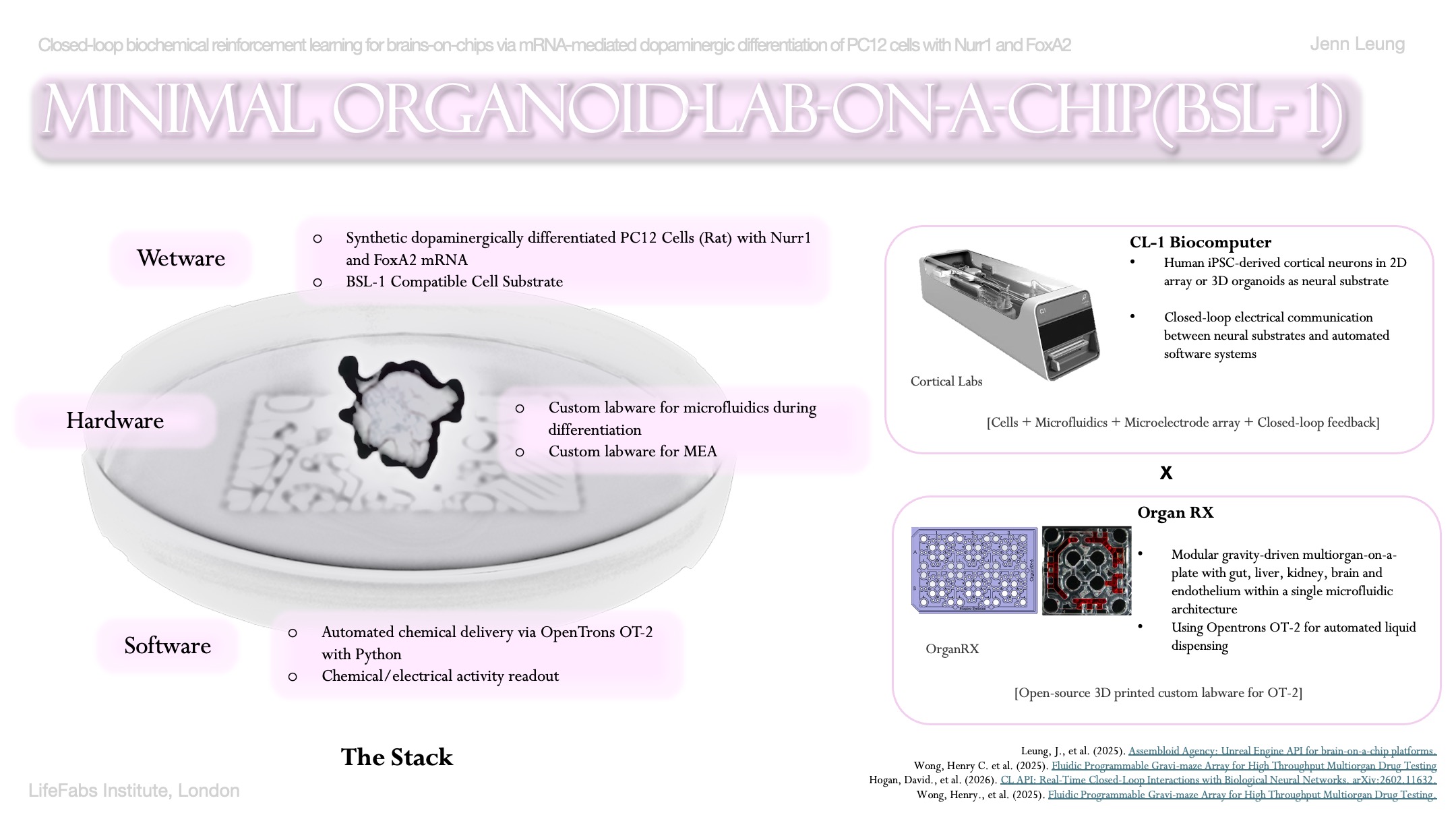
This project is an attempt at prototyping a minimal brain-on-chip platform designed to facilitate closed-loop biochemical communication between synthetic neural substrates and automated software systems. Inspired by Cortical Labs’ CL-1, and following up from my previous collaboration with the start-up on developing closed-loop reinforcement learning games or creative technology experiments with biocomputers.
The brain-on-chip generally is composed of human-derived cortical neurons, high-density microelectrode arrays, microfluidics, and a software system that analyzes the electrical activity of the neurons. For my final project, I am looking to build a minimal version of that with a focus on biochemical delivery.
The stack looks to integrate three major components: Wetware: Synthetic mRNA-Mediated Dopaminergic Differentiation of PC12 Cells with Nurr1 and FoxA2 mRNA; Software: Automated chemical delivery via Opentrons OT-2 with Python and chemical/electrical activity readout; and Hardware: 3D-printed microfluidics custom labware with Multi-Electrode Array to create biochemical I/O between neural substrates and liquid handling systems.
While various labs are already working towards organoid intelligence, treating living neurons as the computational substrate, for LifeFabs I have adapted my protocol to adhere to BSL-1 safety standards, using PC12 cells (rattus norvegicus) derived from rat pheochromocytoma as a basis for modeling neuronal differentiation for synaptic transmission (See PMC12696136). I am interested in studying dopamine synthesis in PC12 cells as a measurable signal for reinforcement learning, which is why I have looked into Nurr1 and FoxA2 as transcription factors that can drive neuron differentiation (10.1002/stem.294).
For the protocol for the synthetic biology component there are two general directions depending on costs and ease of delivery: 1) Twist synthetic DNA sequences to activate Nurr1 and FoxA2 transcription factors and promote gene expression
Direct mRNA synthesis for ready-to-transfect mRNA
With this, I can then transfect the mRNA into PC12 cells, using Opentrons OT-2 robot for lab automation and to facilitate synergistic dopaminergic differentiation. Dopamine synthesis will be measured.
Significance
Current platforms such as Cortical Labs’ CL-1 rely on human-derived cortical neurons requiring BSL-2 containment, which limits accessibility for independent researchers and creative technologists. There is a need for minimal, accessible brain-on-chip prototypes that maintain biological relevance while operating within BSL-1 safety constraints. The minimal set-up already provides useful contexts for the development of other hardware and physical systems such as microfluidics, custom labware, and microelectrode arrays (MEA).
Broad Objective
This project aims to prototype a minimal brain-on-chip platform integrating synthetic dopaminergic neural substrates, automated biochemical delivery, and multi-electrode array readout into a closed-loop biochemical I/O system, with the goal to start a foundation for reinforcement learning experiments with living neural tissue at BSL-1.
Hypothesis
Synthetic mRNA-mediated co-expression of Nurr1 and FoxA2 transcription factors in PC12 cells wis likely to drive measurable dopaminergic differentiation, producing quantifiable dopamine synthesis that can serve as a biochemical state signal in reinforcement learning experiments automated via liquid handling robotics.
Specific Aims
Common approaches to brains-on-chips use electrical stimulation or chemical stimulation as reinforcement learning methods. While studying genetically modified PC12 cells I am hoping to study dopamine synthesis with activated Nurr1 and FoxA2 transcription factors that will help facilitate neuron differentiation.
Methods
The wetware component employs PC12 cells derived from rat pheochromocytoma as a BSL-1 compatible model for dopaminergic neuronal differentiation. Cells are differentiated with NGF prior to transfection with synthetic Nurr1 and FoxA2 mRNA using Lipofectamine MessengerMAX.
Two synthesis routes are under consideration depending on cost and accessibility: Twist Bioscience DNA synthesis with subsequent in vitro transcription, or direct ready-to-transfect mRNA from a commercial synthesis service. Dopamine synthesis is quantified by high-sensitivity ELISA as the primary biochemical readout and reinforcement learning state signal. The software component uses Python on the Opentrons OT-2 platform to automate stimulus delivery and implement a closed-loop reward logic based on dopamine concentration thresholds. The hardware component integrates custom 3D-printed microfluidic labware with a multi-electrode array to enable simultaneous biochemical delivery and electrophysiological recording, creating bidirectional I/O between the neural substrate and the automated software system.
Section 2: Project Aims
Aim 1: Experimental Aim
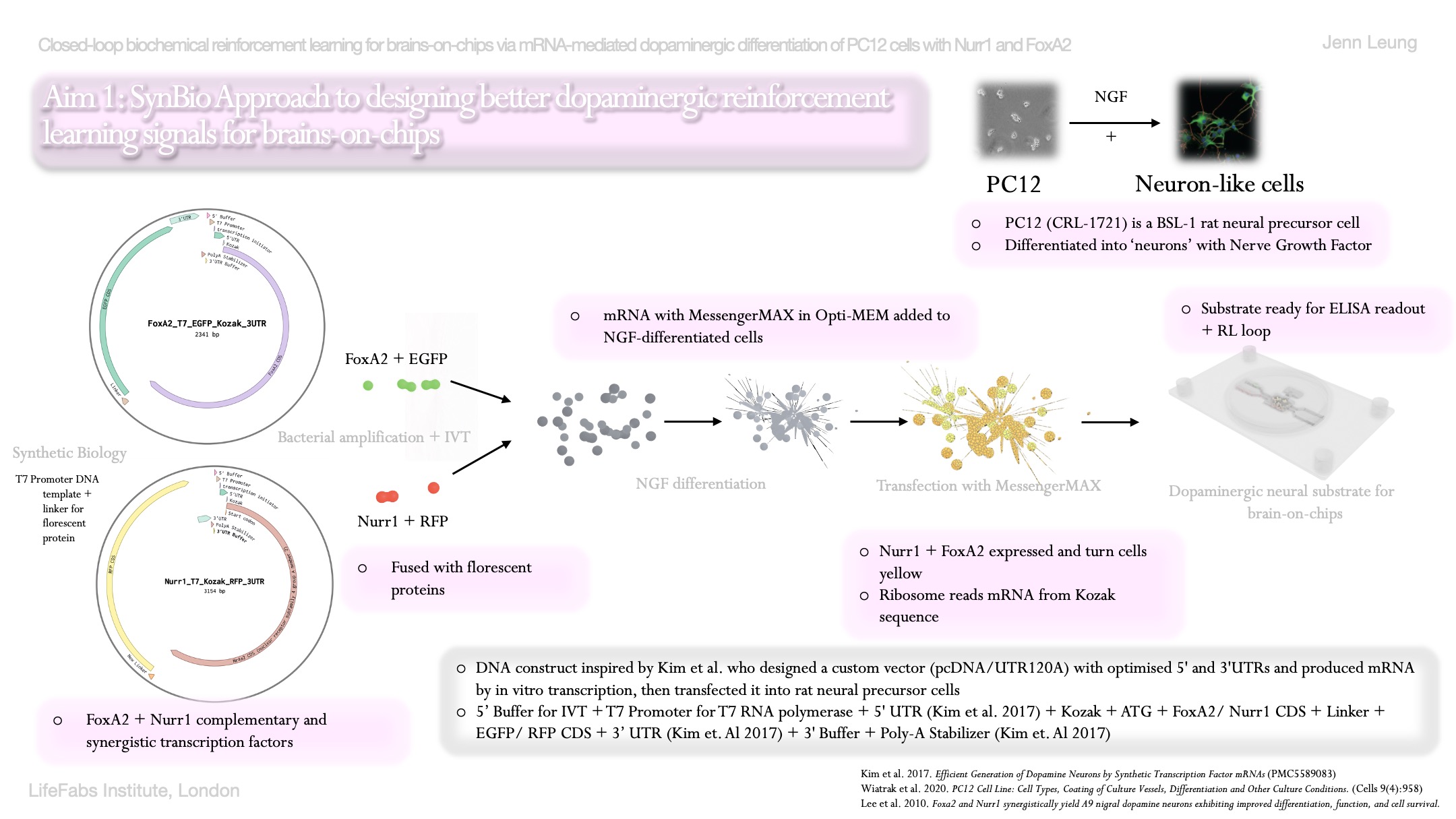
My aim 1 is to define and test a synthetic biology approach to designing better dopaminergic reinforcement learning signals for brains-on-chips. The experimental aim is to generate dopaminergically differentiated PC12 cells through synthetic Nurr1 and FoxA2 mRNA transfection as the computational substrate for minimal brains-on-chips, following established protocols for mRNA-based dopaminergic neuron generation from PC12 cells, methods and protocols include:
Designing DNA sequences to promote Nurr1 and FoxA2 via Benchling
Developing synthetic Nurr1, FoxA2 and GFP mRNA (commercial synthesis or Twist DNA + IVT)
Lipofectamine MessengerMAX transfection protocol (Kim et al. 2017, PMC5589083)
NGF differentiation protocol for PC12 cells
Dopamine ELISA readout (Eagle Biosciences)
Aim 2: Development Aim
Measure and respond to biochemical signals from the substrate real-time so that this could help support reinforcement learning experiments
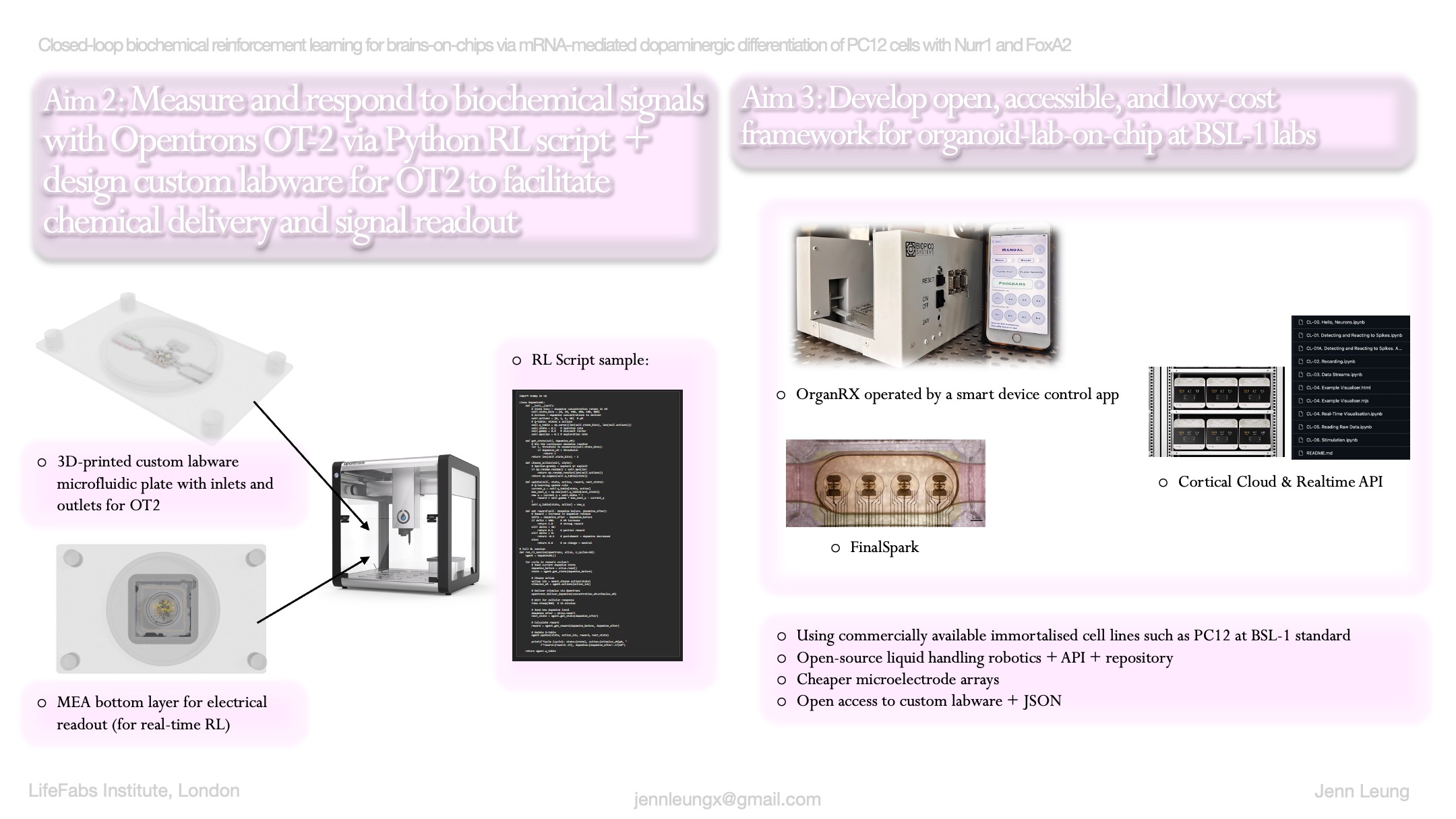
This will be developed alongside the Opentrons OT-2 with custom Python Reinforcement Learning script
Designing custom labware for OT2 to facilitate chemical delivery and signal readout (inspired by OrganRX)
Aim 3: Visionary Aim
Develop open, accessible, and low-cost framework for biological reinforcement learning in DIY brains-on-chips at BSL-1 labs.
This may include:
Using commercially available immortalised cell lines such as PC12
Developing open-source repositories and libraries for liquid handling automation for lab robotics
Designing custom labware ‘organoid-lab-on-a-chip’ and allowing open access to its Opentrons JSON
Using the organoid-lab-on-a-chip as a platform for developing and testing for cheaper microelectrode arrays for electrical interfacing
Section 3: Background
Background and Literature Context
Provide background research that explains the current state of knowledge and identifies the gap in knowledge or capability that your project addresses.
Briefly summarize two peer-reviewed research citations relevant to your research:
Foxa2 and Nurr1 Synergistically Yield A9 Nigral Dopamine Neurons
Lee et al. 2010
This paper establishes why it is critical to use both Nurr1 and FoxA2 together for improved differentiation from neural precursor cells (NPCs) such as PC12. FOXA2 (Forkhead Box A2)is a transcription factor critical for embryonic development, while Nurr1 is a transcription factor essential for the development, survival, and maintenance of midbrain dopaminergic neurons.
The authors showed that Nurr1 alone cannot generate fully mature midbrain dopamine neurons as it produces cells with only partial dopaminergic identity and fails entirely in mouse and human-derived precursors. FoxA2, a forkhead transcription factor expressed early in midbrain development, was identified as the critical co-factor.
Efficient Generation of Dopamine Neurons by Synthetic Transcription Factor mRNAs
Kim et al. 2017 (PMC5589083)
Kim et al. asked whether Nurr1 and FoxA2 could be delivered via synthetic mRNA rather than viral vectors. They designed a custom vector (pcDNA/UTR120A) with optimised 5’ and 3’UTRs and produced mRNA by in vitro transcription, then transfected it into rat neural precursor cells. mRNA transfection alone was sufficient to drive full dopaminergic differentiation — cells became electrophysiologically active, released measurable dopamine, and expressed the full synthesis machinery
Fluidic Programmable Gravi-maze Array for High Throughput Multiorgan Drug Testing
Wong et al. 2025 (bioRxiv 2025.06.18.660241)
Biopico Systems presents OrganRX™, a modular, gravity-driven multiorgan-on-a-plate (MOAP) system integrating gut, liver, kidney, brain and endothelium within a single microfluidic architecture.
OrganRX is compatible with the Opentrons OT-2 for automated liquid dispensing, which is exactly what I want to adapt for my project. Second, it references gravity-driven, pump-free design principles that I may be able to model after for the 3D-printed microfluidic labware that can help support the development of accessible, minimal brain-on-chip hardware.
PC12 Cell Line: Cell Types, Coating of Culture Vessels, Differentiation and Other Culture Conditions
Wiatrak et al. 2020 (Cells 9(4):958)
The paper systematically compared the two ATCC PC12 variants across coating types, NGF concentrations, and incubation times, and made several findings that directly affect my protocol design and choices. The authors concluded that only traditional PC12 (CRL-1721) should be used for neurobiological studies, as these immortalized cell lines, when combined with NGF (nerve growth factor), can stop dividing, develop neurites, and adopt a neuronal phenotype. The adherent variant (PC12 Adh, CRL-1721.1) behaves fundamentally differently and does not differentiate effectively with NGF. The protocol follows 100 ng/mL rat NGF for 14 days with 48-hour media changes.
Innovation
Typically, at BSL-2 level, brains-on-chips use human iPSC-derived neurons, which become extremely expensive to reproduce. While these typical brains-on-chips have demonstrated learning capabilities due to their rich electrical computation, they are not yet capable of producing dopamine as an alternative mode for reinforcement learning.
The project is novel in that it not only proposes a BSL-1 accessible method to learn and prototype minimal brains-on-chips, but it also offers a cheaper alternative to differentiating neuron-like cells from PC12 immortalized cell lines. This allows the project to be more democratizable without human-derived cells.
Secondly, the project takes on a unique synthetic biology approach to understanding brains-on-chips. As there is little research in using PC-12 cells for brains-on-chips right now, learning has not been demonstrated. Although PC-12 cells show only limited electrical activity, through an mRNA approach to differentiating PC-12 cells with two complementary transcription factors (FoxA2 and Nurr1) can help generate dopaminergic neurons, so that these cells can become electrically excitable and dopaminergically functional, which now makes biochemical and electrical reinforcement learning a possibility for these BSL-1 brains-on-chips.
Significance
Synthetic biological intelligence provides us with alternative frameworks to review our current silicon-based computational infrastructure. We look into the possibility of living neurons as the computational substrate for information processing when interfaced with MEA for electrical stimulation and recording, as a new framework for helping us reposition the current silicon based computational infrastructure.
As biology is neuroplastic and difficult to scale, they are currently underutilized in helping us study their potential in changing silicon-based computing infrastructure. Future synthetic biological intelligence comes in different cultures, assemblies, sizes, shapes, and forms, and also its dimensions will change based on MEAs - this means there isn’t a one-size fits all solution for us to actually understand these cognitive assemblies nor a good method. In order to develop meaningful communication across these intelligences, we must understand them through higher order behavioral traits, where intelligence should be interfaced with ‘at their scale’. This means we don’t try to understand biological intelligence through mechanistic interpretability but through communicating meaningfully.
The project also aims to address the privatization of brains-on-chips research. Since 2022, leading brains-on-chips research has been concentrated among a few start-ups and university institutions, such as Harvard’s Arlotta Lab, Swiss start-up FinalSpark, and Australian/Singaporean start-up Cortical Labs. Current biotechnology start ups are primarily concerned with serving biocomputing at scale, and needing to build a product quickly. But this era of biocomputing deserves research on more diverse methods of making meaningful communication. This project is instead more interested in democratizing the building, development, and networking of new biocomputers.
Bioethical Considerations
As we speculate these brains-on-chips systems to become democratized and decentralized, there will spawn many different configurations of physical/ neural assemblies with advances in MEA designs, bioprinting technologies, and microfluidic platforms. 1) benchmarking integrity and reproducibility, for example, how do we measure spiking activity across different systems? How do we make sure experiments are scientifically meaningful? How do we translate and deliver virtual environments to channels on different MEA geometries? 2) ensuring accessibility to independent researchers, for example, writing software environments not only for proprietary technologies such as Cortical Lab’s CL1 or FinalSpark’s Neuroplatform. Governance here means committing to abstraction layers that treat CL1 as one implementation among many 3) responsible scalability across new substrates, for example, new substrates includes increasingly complex organoids or assembloids that should go through rigorous bioethical frameworks. 4) Support sustainability & longevity of the substrates, there should be rate limitations so that cells aren’t overly stimulated and at risk of quick death.
This will mean that the project has to go through bioethical standards compliance, research ethics committee approvals, and wet-laboratory licensing requirements must be ensured through partner wet-lab facilities.
First, to develop a general-use minimal brain-on-a-chip model at BSL-1 labs, we will need to first benchmark across different currently commercially available platforms.
For example, there are multiple proprietary brain-on-a-chip platforms such as Cortical Labs’ CL1 and FinalSpark’s Neuroplatform, but there are no standardizations or comparisons metadata of these systems. I am proposing to create a metadata of existing platforms/ systems and develop an open access metadata standard that documents different MEA geometries, channel count, neural substrates, culture medium, experimental protocols.
This will involve mapping out a group of academic researchers who have been working on organoid intelligence/ synthetic bioengineered intelligence standardization, and manufacturers such as MaxWell Biosystems, Cortical Labs, etc., join community labs or open-source groups on open-source research. This action assumes that all parties are happy to share their manual or manufacturing details, however, some of this data might be protected under NDA. There are also some risks of failure and success through this approach as there’s a high chance the open-source projects will grow exponentially, making this metadata impossible to manage at scale.
Section 4: Experimental Design, Techniques, Tools, and Technology
Use Claude AI skills to refine your HTGAA final project experimental design here. All HTGAA projects must include some DNA design! Make sure this form is submitted.
The Stack
Neural Substrate (PC12 Cells)
DNA Construct Design
Two IVT template plasmids are designed on Benchling and ordered from Twist Bioscience in pTwist Amp High Copy: