Week 9 HW: Cell Free Systems
Contents
- General homework questions
- Homework questions from Kate Adamala
- Homework questions from Peter Nguyen
- Homework questions from Ally Huang
- Final project idea selection
General Homework Questions
- Explain the main advantages of cell-free protein synthesis over traditional in vivo methods, specifically in terms of flexibility and control over experimental variables. Name at least two cases where cell-free expression is more beneficial than cell production.
Cell-free protein synthesis avoids the requirements of a cold chain for shipping or storage, and it also can simplify complex living systems by instead adding in specific and known amounts of reagents (enzymes, nucleotides, amino acids, etc.). It is more beneficial than cell production in situations like biosensing in remote environments (infectious disease detection in remote or under-resourced locations) and biomanufacturing of toxic products (like some pharmaceuticals) because production won’t stop due to cell death. - Describe the main components of a cell-free expression system and explain the role of each component.
- template nucleic acid: DNA or RNA encoding the gene of interest for protein
- cell lysate (collection of active components, including the following - or the purified components could be added individually)
- tRNA: recognizes RNA codons and adds new amino acids onto a protein chain during translation
- polymerase: makes nucleic acids (DNA or RNA)
- nucleotides: used by polymerase to make nucleic acids
- buffer: maintains reaction pH to optimal level for enzyme function
- other enzymes and cofactors, depending on the goal of the system (sometimes these are included through a cell lysate)
- amino acids and ribosomes, if protein production is the goal
- Why is energy provision regeneration critical in cell-free systems? Describe a method you could use to ensure continuous ATP supply in your cell-free experiment.
Cell-free systems are essentially a series of chemical reactions (biological in nature, but still chemistry), which means that activation energy is required for some reactions. Energy provision regeneration is critical to ensure that the reactions continue to happen instead of stalling out early. Specifically, this is important in protein expression because translation is energetically expensive (requires ATP to attach amino acids to tRNAs). Cells generate ATP through a collection of metabolic processes; a cell-free system needs to be designed to ensure it has a way to generate ATP. One potential method is adding NAD and CoA to generate ATP from pyruvate without needing any additional enzymes. - Compare prokaryotic versus eukaryotic cell-free expression systems. Choose a protein to produce in each system and explain why.
Prokaryotic systems are simpler than eukaryotic systems. Eukaryotic systems might have more components, especially for production of functional proteins, for chaperones or post-translational modifications. A prokaryotic system might be good to produce antimicrobial peptides because you don’t need to worry about the product killing the host. A eukaryotic system might be better at producing functional antibodies because antibodies are eukaryotic proteins and therefore might be more functional in a eukaryotic system. - How would you design a cell-free experiment to optimize the expression of a membrane protein? Discuss the challenges and how you would address them in your setup.
A membrane protein is difficult to produce in a cell-free system because it likely has a hydrophobic area and a hydrophilic area because it is natively located within a membrane. This means that it is unlikely to be folded into the correct structure without a hydrophilic space for the hydrophilic component of the protein. To optimize the expression of a membrane protein in a cell-free experiment, you would need to stabilize it, for example, by providing liposomes or membrane vesicles in which the membrane proteins could localize for correct folding. - Imagine you observe a low yield of your target protein in a cell-free system. Describe three possible reasons for this and suggest a troubleshooting strategy for each.
Three possible reasons for a low protein yield in a cell-free system is insufficient transcription, insufficient translation, or a badly designed DNA template. Insufficient transcription could be due to not adding enough nucleotides into the reaction. This could be tested by adding an mRNA template into the reaction to see if this solves it. Insufficient translation could be due inactive tRNA, inactive ribosomes, or not enough amino acids. This could be tested by spiking more of those individual, purified components (or fresh cell lysate) into the reaction - it’s possible one of those has been degraded. A badly designed DNA template might have a promoter that isn’t recognized by the polymerase provided in the cell-free system; this could be tested with a control reaction that includes a DNA template known to work in this established system.
Reference
- Hunt, AC; Rasor, BJ; Seki, K; et al. Cell-Free Gene Expression: Methods and Applications. 2024. ACS Chemical Reviews 125(1): 91-149. DOI: 10.1021/acs.chemrev.4c00116
Homework questions from Kate Adamala
Design an example of a useful synthetic minimal cell as follows:
- Pick a function and describe it.
- What would your synthetic cell do? What is the input and what is the output?
The SMC would produce PHB (bioplastic) using atmospheric carbon dioxide as a carbon source (effectively, photosynthesis producing PHB as the carbon storage molecule). The input is CO2 and sunlight. The output is PHB (and oxygen). - Could this function be realized by cell-free Tx/Tl alone, without encapsulation?
Maybe, it would likely be at a low yield. The value of encapsulation here is to keep the intermediates in close spatial proximity to the biosynthetic enzymes for efficient biosynthesis of the final product. I’m also unsure if a thylakoid could exist without encapsulation. I’m not sure why it wouldn’t be able to; I just don’t think I’ve ever read of a cell-free thylakoid. - Could this function be realized by genetically modified natural cell?
No. A cell, even a genetically modified one, would have to devote some carbon flux towards biomass and cell replication. Ideally, the synthetic cell wouldn’t have to, and all the carbon (consumed from atmospheric carbon dioxide) would go exclusively towards PHB production. - Describe the desired outcome of your synthetic cell operation.
The synthetic cell would produce PHB from atmospheric carbon dioxide, with all carbon flux going towards PHB.
- What would your synthetic cell do? What is the input and what is the output?
- Design all components that would need to be part of your synthetic cell.
- What would be the membrane made of?
The membrane would be made up of lipids and cholesterol for flexibility. It also needs to include a thylakoid for light-harvesting. - What would you encapsulate inside? Enzymes, small molecules.
Inside the SMC, I’d want the enzymes for PHB synthesis. This includes PhaC (the PHA synthase), and also all the enzymes required to build the precursor monomers. We’d maybe need a couple of Calvin Cycle enzymes, but it’s hard to say without drawing out all possible pathways of carbon flux - the idea would be for PHB to be the “energy storage” product. This might be easiest by using a cyanobacterial cell lysate, but ideally, we’d want to get to something simpler than that. - Which organism your Tx/Tl system will come from? Is bacterial OK, or do you need a mammalian system for some reason? (hint: for example, if you want to use small molecule modulated promotors, like Tet-ON, you need mammalian)
It would be bacterial. Especially at first, it would have to come from a cyanobacterium, likely Synechocystis sp. PCC 6803 because it’s well-studied. It would be ideal to understand the system to the extent that we could use any bacterial system (such as E. coli), and simply include whatever cyanobacteria-specific proteins or metabolites are needed. - How will your synthetic cell communicate with the environment? (hint: are substrates permeable? or do you need to express the membrane channel?)
The SMC would have to export the PHB. So some kind of membrane channel would need to be included.
- What would be the membrane made of?
- Experimental details
- List all lipids and genes. (bonus: find the specific genes; for example, instead of just saying “small molecule membrane channel” pick the actual gene.)
Membrane: lipid, cholesterol, thylakoid membrane, chlorophyll, membrane channel
Enzymes: bacterial Tx/Tl, PHB biosynthetic enzymes - How will you measure the function of your system?
The system’s function would be measured by the PHB output, which could be BODIPY staining if PHB is not exported, or mass spectrometry if PHB is exported.
- List all lipids and genes. (bonus: find the specific genes; for example, instead of just saying “small molecule membrane channel” pick the actual gene.)
Homework questions from Peter Nguyen
Choose one application field — Architecture, Textiles/Fashion, or Robotics — and propose an application using cell-free systems that are functionally integrated into the material. Answer each of these key questions for your proposal pitch:
- Write a one-sentence summary pitch sentence describing your concept.
A chlorophyll-based paint for self-healing concrete can improve air quality in buildings suffering degradation. - How will the idea work, in more detail? Write 3-4 sentences or more.
Self-healing bioconcrete is either live cells, or a cell-free system, integrated into concrete that produces calcium carbonate from atmospheric CO2 when cracks are exposed to water (which then fills in the cracks). My idea is to create freeze-dry a cell-free system expressing chlorophyll to turn into a paint to go on the outside of this building material. The chlorophyll provides an energy regeneration capacity for the calcium-carbonate cell-free system, while also producing oxygen, thereby improving the local air quality; effectively, photosynthesis that generates calcium carbonate from CO2 and light instead of generating glucose. This would mean that any cracks or chips seen on the inside of the building could be sprayed with water and lit with a plant light, and the combination of the two cell-free systems would repair the crack. The chlorophyll paint would have the further benefit of being visibly green when activated, so the repair process could be visually tracked. - What societal challenge or market need will this address? How do you envision addressing the limitation of cell-free reactions (e.g., activation with water, stability, one-time use)?
This improves the self-healing concrete concept, which addresses the high CO2 emissions cost of traditional concrete manufacturing, as well as decreasing the amount of human work needed to repair broken concrete. The biggest limitation here is that it is one time use, but i think that making the chlorophyll into a paint addresses this because once the repair is completed, the new concrete could be painted over again.
Reference
- Smirnova, M; Nething, C; Stolz, A; et al. High strength bio-concrete for the production of building components. 2023. NPJ Materials Sustainability, 1(4): s44296-023-00004-6. DOI: 10.1038/s44296-023-00004-6
Homework questions from Ally Huang
- Provide background information that describes the space biology question or challenge you propose to address. Explain why this topic is significant for humanity, relevant for space exploration, and scientifically interesting.
Ionizing radiation is a safety and health concern for space exploration because of how damaging it is to living organisms. Ionizing radiation is more harmful than non-ionizing radiation because it is higher energy and can pass through more materials (thereby making it harder to shield from). While in low Earth orbit, where the ISS is, most of the radiation is protected against by Earth’s magnetic field, but the astronauts aboard the ISS still experience more radiation than people on Earth. Any space exploration beyond low Earth orbit has to deal with higher amounts of ionizing radiation. - Name the molecular or genetic target that you propose to study.
Melanin from Cryptococcus neoformans, biosynthesized by Lac1 with phenolic substrate such as dopamine; and control pigment chlorophyll, biosynthesized by ChlP with substrate geranylgeranyl-chlorophyll a - Describe how your molecular or genetic target relates to the space biology question or challenge your proposal addresses.
C. neoformans is a fungus that utilizes the energy in radiation via radiosynthesis, analogous to plants utilizing the energy in sunlight via photosynthesis. A similarly radiotrophic fungus was grown on the ISS to investigate its potential as a shielding mechanism against the ionizing radiation in space. It’s known that the pigment melanin provides some protective effect against radiation, and it’s hypothesized that melanin plays an analogous role as chlorophyll in radiosynthesis and photosynthesis, respectively. - Clearly state your hypothesis or research goal and explain the reasoning behind it.
Hypothesis: melanin will provide a greater protective effect against the radiation in space than chlorophyll a. The DNA in tubes with lac1 will have a lower mutation or fragmentation than tubes with chlP. The tubes containing lac1 will have a higher number of control (mRFP1) transcripts than tubes containing chlP. This difference in transcript counts might be attributable either to the higher DNA integrity due to melanin’s protection or to increased energy availability from radiosynthesis over photosynthesis (more radiation than sunlight in the test conditions). - Outline your experimental plan - identify the sample(s) you will test in your experiment, including any necessary controls, the type of data or measurements that will be collected, etc.
All tubes contain BioBits cell-free expression system, the control gene for red fluorescent protein (mRFP1), and the substrates for both Lac1 and ChlP (dopamine and geranylgeranyl-chlorophyll a).- Negative control: no additional DNA
- Condition 1: DNA encoding lac1 gene
- Condition 2: DNA encoding chlP gene
While these tubes could be visualized with the Molecular Fluorescence Viewer for red fluorescence, I believe visual analysis would be hampered by the pigment production. Better data would be obtained from purified nucleic acids. The DNA should be sequenced with long-reads to identify any fragmentation. The RNA should be used in RT-qPCR to quantify transcript counts.
References
- Why Space Radiation Matters. 13 Apr 2017. NASA. https://www.nasa.gov/missions/analog-field-testing/why-space-radiation-matters/
- Casadevall, A; Cordero, RJB; Bryan, R; et al. Melanin, radiation, and energy transduction in fungi. 2017. ASM Microbiology Spectrum, 5(2): 10.1128/microbiolspec.funk-0037-2016. DOI: 10.1128/microbiolspec.funk-0037-2016
- Averesch, NJH; Shunk, GK; Kern, C. Cultivation of the dematiaceous fungus Cladosporium sphaeropermum aboard the International Space Station and effects of ionizing radiation. 2022. Frontiers in Microbiology, 13: 877625. DOI: 10.3389/fmicb.2022.877625
- Williamson, PR; Wakamatsu, K; Ito, S. Melanin biosynthesis in Cryptococcus neoformans. 1998. ASM Journal of Bacteriology, 180(6): 1570-1572. DOI: 10.1128/jb.180.6.1570-1572.1998
- Chen, GE; Canniffe, DP; Barnett, SFH; et al. Complete enzyme set for chlorophyll biosynthesis in Escherichia coli. 2018. Science Advances, 4(1): eaaq1407. DOI: 10.1126/sciadv.aaq1407
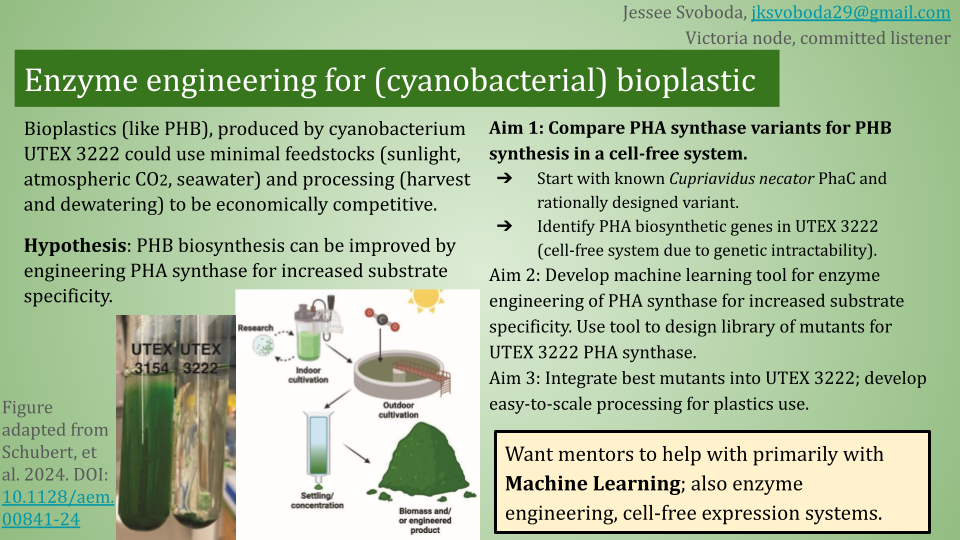
Final Project - idea selection