Week 7 HW: Genetic Circuits Part II: Neuromorphic Circuits
Part 1: Intracellular Artificial Neural Networks (IANNs)
- What advantages do IANNs have over traditional genetic circuits, whose input/output behaviors are Boolean functions?
Increased complexity in what it can process. Genetic circuits are capable of digital logic, but neural networks can fine tune connections and weights to represent a nuanced system with a set of many inputs and outputs. This is in particular in a cell’s ability to contain a “weighted summation” dependent on the situation it gets trained on.
- Describe a useful application for an IANN; include a detailed description of input/output behavior, as well as any limitations an IANN might face to achieve your goal.
IANNs can be used to represent complex systems in biology. An example would be cancer, as cancer cells rapidly mutate and provide continuous data. Input would be DNA, while the output would be a tag like GFP or any other form of fluorescence. IANN is good at making predictions for these systems, but has limitations like increased processing time (as with all neural networks).
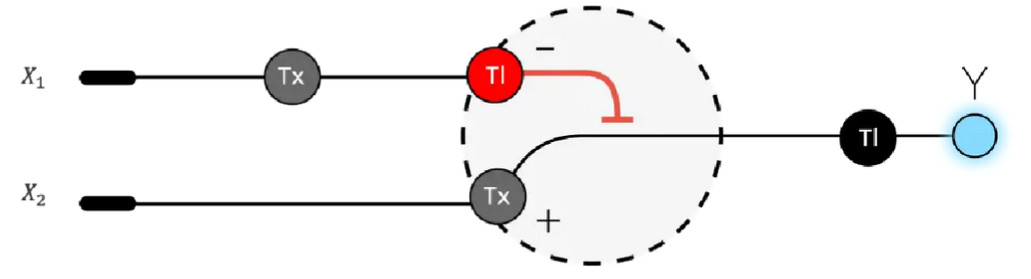
- Below is a diagram depicting an intracellular single-layer perceptron where the X1 input is DNA encoding for the Csy4 endoribonuclease and the X2 input is DNA encoding for a fluorescent protein output whose mRNA is regulated by Csy4. Tx: transcription; Tl: translation.
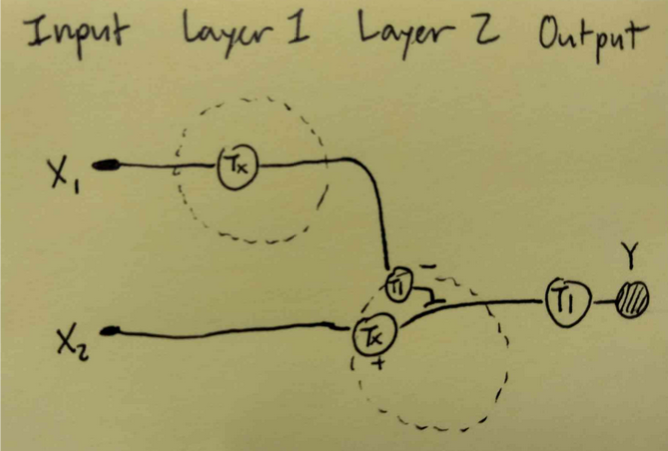
 Draw a diagram for an intracellular multilayer perceptron where layer 1 outputs an endoribonuclease that regulates a fluorescent protein output in layer 2.
This diagram is neither entirely correct nor represents the multilayer perception, will be updated.
Draw a diagram for an intracellular multilayer perceptron where layer 1 outputs an endoribonuclease that regulates a fluorescent protein output in layer 2.
This diagram is neither entirely correct nor represents the multilayer perception, will be updated.
Part 2: Fungal Materials
- What are some examples of existing fungal materials and what are they used for? What are their advantages and disadvantages over traditional counterparts?
Mycelium is an example that has structural integrity. You see it in architecture concepts as a naturally grown building material. Fungi can bring a biodegradable quality to traditional materials while keeping performance.
- What might you want to genetically engineer fungi to do and why? What are the advantages of doing synthetic biology in fungi as opposed to bacteria?
Fungi already have natural properties that can be further optimized with genetic engineering. E.g. mycelium is fire retardant and insulatory after it’s dried, but can be engineered to be as strong as the currently used materials. You can also introduce a new aspect like color. Bacteria-produced material is currently more fragile than fungi-produced. Stuff like mycelium has inherent structure and rigidity, which occupies a different niche in material applications.
Part 3: First DNA Twist Order
- Review Part 3: DNA Design Challenge of the week 2 homework. Design at least 1 insert sequence and place it into the Benchling/Kernel/Other folder you shared in the Google Form above. Document the backbone vector it will be synthesized in on your website.