Week 11 HW: Bioproduction & Cloud Labs
Part A: The 1,536 Pixel Artwork Canvas | Collective Artwork
- Contribute at least one pixel to this global artwork experiment before the editing ends on Sunday 4/19 at 11:59 PM EST.
- A personalized URL was sent to the email address associated with your Discourse account, and you can discuss the artwork on the Discourse.
- If you did not have a chance to contribute, it’s okay, just make sure you become a TA this fall! 😉
- Make a note on your HTGAA webpages including:
- what you contributed to the community bioart project (e.g., “I made part of the DNA on the bottom right plate”)
- what you liked about the project, and
- what about this collaborative art experiment could be made better for next year.
Unfortunately, I did not get to contribute this year, but I did discuss the project with friends in the class. I really like the concept of a collaborative (and also competitive, occasionally) project with an end result that is artistic (while also leading to the lesson next week). I think the process was very lovely, with people’s ideas growing and shifting until it reaches a fully developed design. I’m not too sure if this would lose the spirit of the assignment, but coordinating within nodes or between people might better guide us towards a final design. I feel like the end result, with the four different designs on each well, was a little lucky.
Part B: Cell-Free Protein Synthesis | Cell-Free Reagents
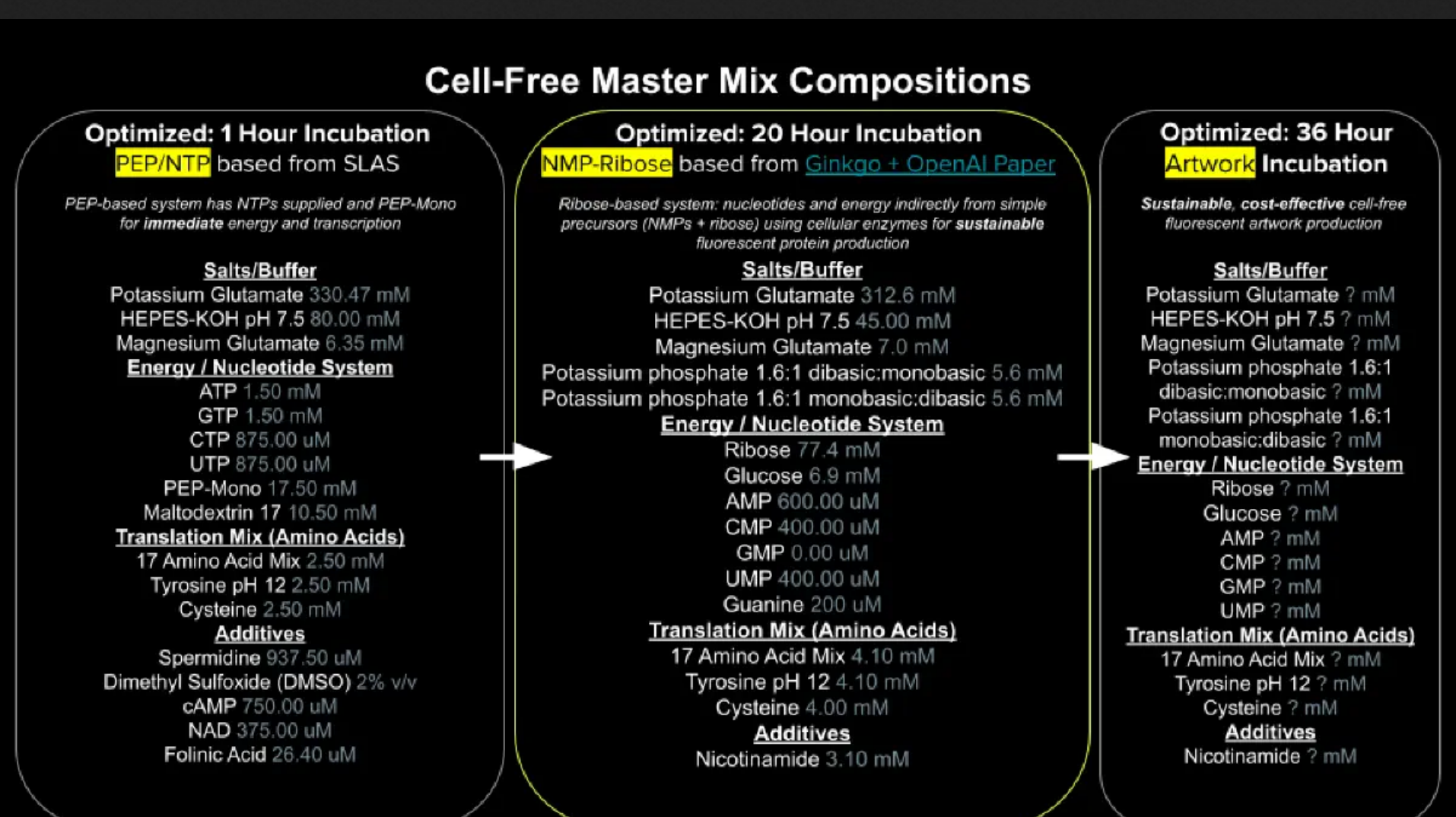
- Referencing the cell-free protein synthesis reaction composition (the middle box outlined in yellow on the image above, also listed below), provide a 1-2 sentence description of what each component’s role is in the cell-free reaction.
- E. coli Lysate
- BL21 (DE3) Star Lysate (includes T7 RNA Polymerase) – Lysate contains cell internals that are necessary in cell-free systems, notable RNA, ribosomes, and other small molecules. In this case, it provides the T7 RNA polymerase needed for transcription.
- Salts/Buffer
- Potassium Glutamate – This provides an ideal condition for the reaction by providing salts to create a buffer, which can maintain pH.
- HEPES-KOH pH 7.5 – This is a buffer that maintains pH within the system (around 7.5).
- Magnesium Glutamate – This provides the Mg2+ ions necessary for maintaining pH and ion concentration.
- Potassium phosphate monobasic – The process of turning a _MP → _TP (monophosphate to triphosphate) requires additional phosphates, which this component provides.
- Potassium phosphate dibasic – Same as above, but monobasic is acidic while dibasic is…basic. They tackle two ranges of pH in the reaction.
- Energy / Nucleotide System
- Ribose – Ribose is part of the process of turning NMPs to NTPs.
- Glucose – Glucose provides energy used in the system.
- AMP – AMP turns into ATP, which is the nucleotide for adenine necessary for RNA synthesis. ATP is also used as an energy source.
- CMP – CMP turns into CTP, which is the nucleotide for cytosine necessary for RNA synthesis.
- GMP – GMP turns into GTP, which is the nucleotide for guanine necessary for RNA synthesis. GTP is also used as an energy source.
- UMP – UMP turns into UTP, which is the nucleotide for uracil necessary for RNA synthesis.
- Guanine – Guanine turns into GMP, which turns into GTP. It’s a more “raw” material and would require more time/complexity to assemble for better efficiency.
- Translation Mix (Amino Acids)
- 17 Amino Acid Mix – These amino acids are the building blocks of our target proteins, and will be used in translation after the RNA has been made.
- Tyrosine – Same as above, but with tyrosine only. Perhaps it is implemented at a higher rate than other amino acids.
- Cysteine – Same as above, but with cysteine only. Perhaps it is implemented at a higher rate than other amino acids.
- Additives
- Nicotinamide – This additive turns into NAD, which is an important cofactor responsible for cellular metabolism.
- Backfill
- Nuclease Free Water – The water is needed to suspend all these components in a solution, allowing them to mix together.
- Describe the main differences between the 1-hour optimized PEP-NTP master mix and the 20-hour NMP-Ribose-Glucose master mix shown in the Google Slide above. (2-3 sentences)
The difference lies in nucleotides. PEP-NTP has nearly ready-to-use ATP, GTP, CTP, UTP, which is the “final form” before translation. However, the process is inefficient and peters out quickly. Ribose uses AMP, GMP, CMP, UMP, which requires an additional process to convert to ATP, GTP, CTP, UTP, but the process is more sustainable and generates more energy/less byproducts for long term reacting.
- Bonus question: How can transcription occur if GMP is not included but Guanine is?
Guanine is just a tertiary layer removed from GTP. Guanine would have to undergo a process to turn into GMP, and then another process to turn into GTP. Transcription would only occur after those two steps.
Part C: Planning the Global Experiment | Cell-Free Master Mix Design
- Given the 6 fluorescent proteins we used for our collaborative painting, identify and explain at least one biophysical or functional property of each protein that affects expression or readout in cell-free systems. (Hint: options include maturation time, acid sensitivity, folding, oxygen dependence, etc) (1-2 sentences each)
- sfGFP – This protein takes the structure of a β-barrel, indicating a hydrophilic outside with a hydrophobic inside. It’d likely be readily receptive to water and a good solution for “just-add-water” cell-free systems.
- mRFP1 – This protein has high brightness, so would not need as many proteins expressed for detection. This could help the cell-free system optimize volume.
- mKO2 – This protein has a pKA of 5.5, which means it’s pretty sensitive to acidity and would drop in fluorescence intensity when exposed to liquid of that pH or lower.
- mTurquoise2 – This protein is known to be rapidly maturing. That means it’ll be very responsive in cell-free systems that are time-sensitive (e.g. an on-the-spot diagnosis).
- mScarlet_I – This protein has moderate acid sensitivity, so is also pretty sentitive to acidity similar to mKO2.
- Electra2 – This protein has high brightness similar to mRFP1, so would behave similarly.
The amino acid sequences are shown in the HTGAA Cell-Free Benchling folder.
- Create a hypothesis for how adjusting one or more reagents in the cell-free mastermix could improve a specific biophysical or functional property you identified above, in order to maximize fluorescence over a 36-hour incubation. Clearly state the protein, the reagent(s), and the expected effect.
Most of these fluorescent proteins are less effective in acidic conditions, so we want to shift the pH in the other direction. We can adjust the concentration of salts/buffer that maintain that pH, as well as increase the concentration of potassium phosphate dibasic, which operates at a higher pH than monobasic.
So from the initial concentrations, we can adjust for mKO2, which has a pKa of 5.5. We can increase the volume of HEPES-KOH and potassium phosphate dibasic (or potentially both dibasic and monobasic if they need to be at the same volume).
- The second phase of this lab will be to define the precise reagent concentrations for your cell-free experiment. You will be assigned artwork wells with specific fluorescent proteins and receive an email with instructions this week (by April 24). You can begin composing master mix compositions here.
Was unable to complete the lab.
The final phase of this lab will be analyzing the fluorescence data we collect to determine whether we can draw any conclusions about favorable reagent compositions for our fluorescent proteins. This will be due a week after the data is returned (date TBD!). The reaction composition for each well will be as follows:
 6 μL of Lysate
 10 μL of 2X Optimized Master Mix from above
 2 μL of assigned fluorescent protein DNA template
 2 μL of your custom reagent supplements
Total: 20 μL reaction
Part D: Build-A-Cloud-Lab | (optional) Bonus Assignment
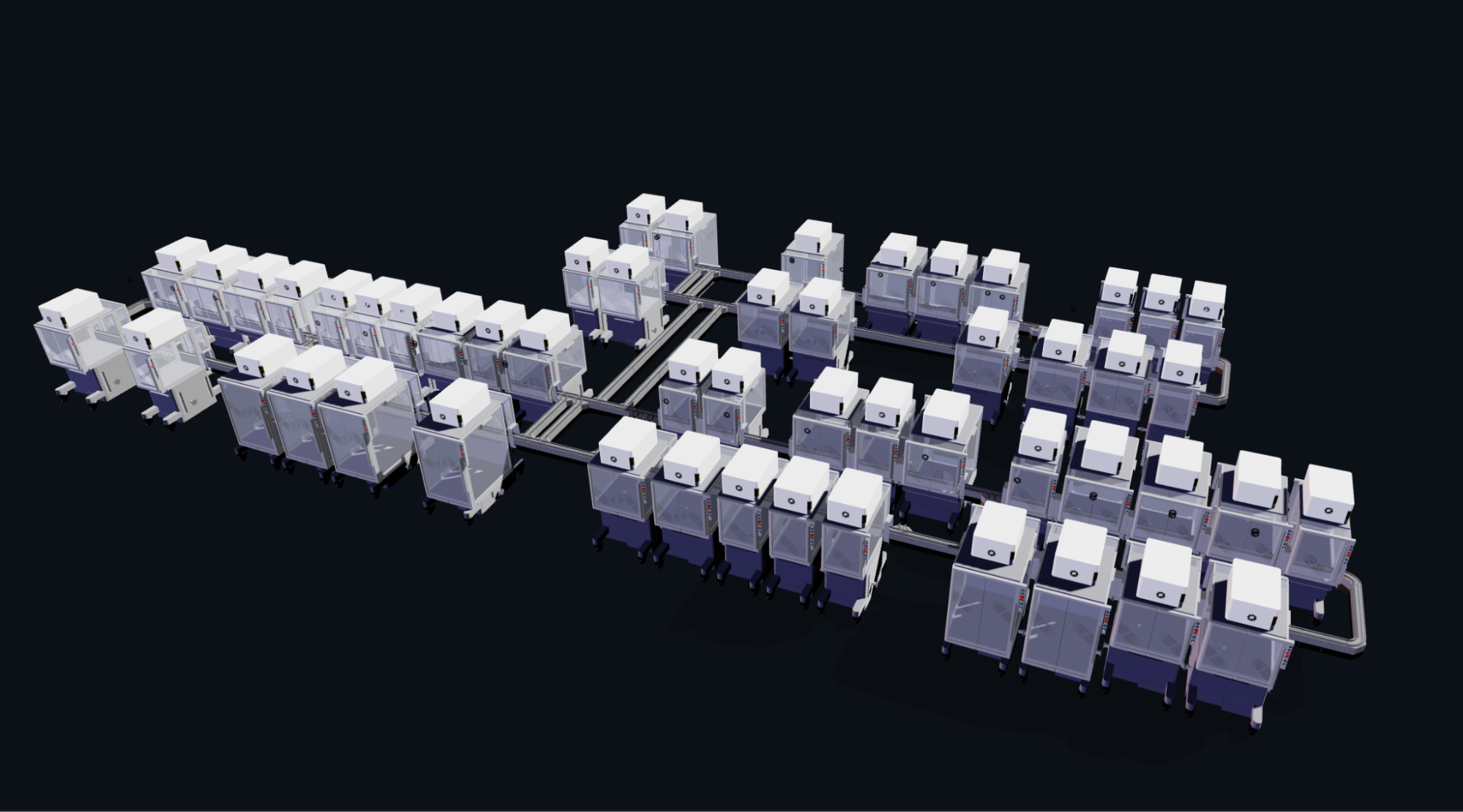
- Use this simulation tool to create an interesting looking cloud lab out of the Ginkgo Reconfigurable Automation Carts. This is just a minimal implementation so far, but I would love to see some fun designs!