Week 11 HW: Bioproduction and Cloud Labs
Part A: The 1,536 Pixel Artwork Canvas | Collective Artwork
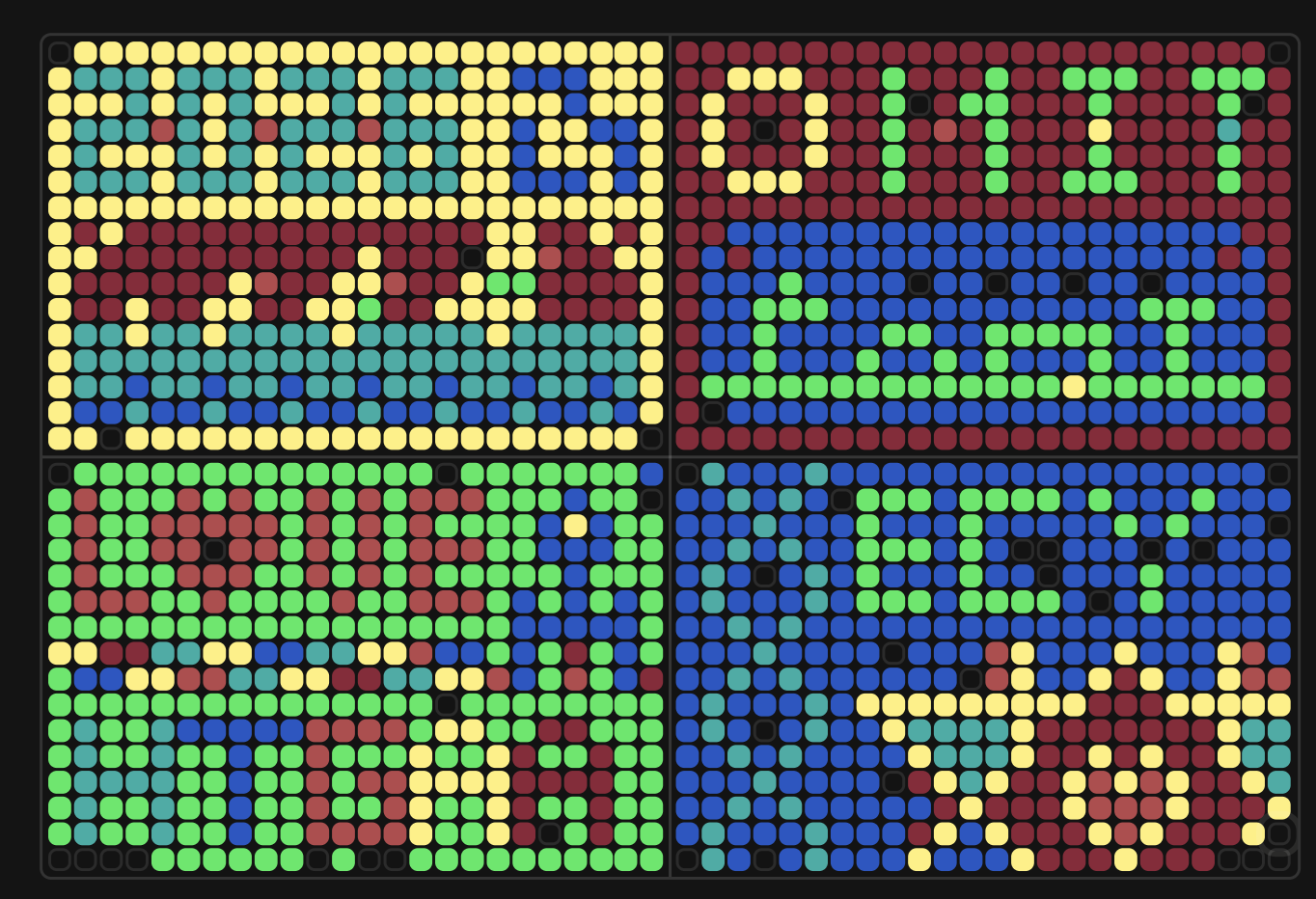
This is a lovely piece of art created by HTGAA community, I love the bio elements and the niche reference to DNA yay.
I received the link but forgot to contribute. But that wasn’t intentional because maybe someday I will return as a TA for this course.
Although with my pathetic knowledge in bio I will probably get fired on the spot.
What I really liked about the project is the creative use of color palette and the layout of words, and also the fact that I was able to see the quantitative recollection of people’s contribution.
Part B: Cell-Free Protein Synthesis | Cell-Free Reagents
- Referencing the cell-free protein synthesis reaction composition (the middle box outlined in yellow on the image above, also listed below), provide a 1-2 sentence description of what each component’s role is in the cell-free reaction.
E. coli Lysate
| Component | Role |
|---|---|
| BL21(DE3) Star Lysate (with T7 RNA Polymerase) | Provides the complete transcription and translation machinery — ribosomes, tRNAs, aminoacyl-tRNA synthetases, initiation/elongation factors, and chaperones. The DE3 genomic insertion encodes T7 RNA Polymerase, enabling high-efficiency transcription from T7 promoter-driven DNA templates. |
Salts and Buffer
| Component | Role |
|---|---|
| Potassium Glutamate | Primary K⁺ source for ribosome function and osmotic balance; glutamate is a preferred counterion over Cl⁻, which is inhibitory to translation |
| HEPES-KOH pH 7.5 | Maintains physiological pH to stabilize enzymatic activity throughout the reaction |
| Magnesium Glutamate | Supplies Mg²⁺, essential for ribosome assembly, RNA structural integrity, and phosphotransfer reactions |
| Potassium phosphate (monobasic/dibasic) | Provides a phosphate buffer reserve and inorganic phosphate for nucleotide phosphorylation reactions |
Energy and Nucleotide System
| Component | Role |
|---|---|
| Glucose | Primary carbon and energy source; feeds glycolysis to drive ATP regeneration and downstream metabolism |
| Ribose | Enters the pentose phosphate pathway (PPP) to generate PRPP for nucleotide salvage and NADPH for redox balance |
| AMP, CMP, GMP, UMP | Nucleoside monophosphates (NMPs) serve as transcription precursors, phosphorylated in situ to NTPs by endogenous kinases |
| Guanine | Free nucleobase salvaged via HGPRT to produce GMP, supplementing the GTP pool for transcription (see Bonus) |
Translation Mix (Amino Acids)
| Component | Role |
|---|---|
| 17 Amino Acid Mix | Provides the bulk substrates required for ribosomal translation and polypeptide elongation |
| Tyrosine | Added separately due to its poor aqueous solubility at neutral pH; typically prepared as a pH 12 suspension |
| Cysteine | Added separately due to oxidation sensitivity and reactivity; prone to disulfide formation in mixed stock solutions |
Additives
| Component | Role |
|---|---|
| Nicotinamide | NAD⁺ precursor (vitamin B3) that sustains the redox cofactor pool required for glycolysis and energy metabolism; also inhibits NAD⁺-consuming enzymes (e.g., sirtuins, PARPs) that would otherwise deplete the pool |
Backfill
| Component | Role |
|---|---|
| Nuclease-Free Water | Brings the reaction to final volume without introducing RNases that would degrade mRNA templates or tRNAs |
- Describe the main differences between the 1-hour optimized PEP-NTP master mix and the 20-hour NMP-Ribose-Glucose master mix. (2-3 sentences)
The 1-hour PEP-NTP system supplies NTPs directly (ATP 1.5 mM, GTP 1.5 mM, CTP/UTP 875 µM each) alongside phosphoenolpyruvate (PEP-Mono, 17.5 mM) and Maltodextrin as fast-acting energy donors — this provides immediate substrates for transcription and translation but is short-lived because PEP is rapidly exhausted and accumulating inorganic phosphate (Pᵢ) inhibits the reaction.
The 20-hour NMP-Ribose-Glucose system instead supplies nucleoside monophosphates (AMP, CMP, UMP) and substitutes GMP entirely with free Guanine (200 µM), relying on endogenous cellular enzymes to phosphorylate NMPs to NTPs using metabolic energy regenerated from Ribose (77.4 mM) and Glucose (6.9 mM), avoiding rapid Pᵢ accumulation and sustains productive synthesis far longer. The PEP-NTP formulation also includes a richer additive cocktail (Spermidine, DMSO, cAMP, NAD, Folinic Acid) to maximize short-burst translation efficiency, whereas the NMP-Ribose system is simplified to Nicotinamide alone and compensates with higher amino acid concentrations (~4.1 mM vs. 2.5 mM) to support extended protein production.
- Bonus question: How can transcription occur if GMP is not included but Guanine is?
Guanine is converted to GMP via the purine salvage pathway:
PRPP (5-phosphoribosyl-1-pyrophosphate) is generated from ribose-5-phosphate, a product of the pentose phosphate pathway fed by ribose. The GMP produced is then sequentially phosphorylated by endogenous kinases:
GTP is the actual substrate incorporated by T7 RNAP during transcription. Using free Guanine rather than GMP is both cost-effective and avoids the chemical instability of pre-formed GTP in the reaction mix — the lysate’s endogenous HGPRT activity handles the conversion efficiently.